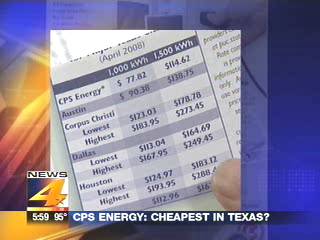
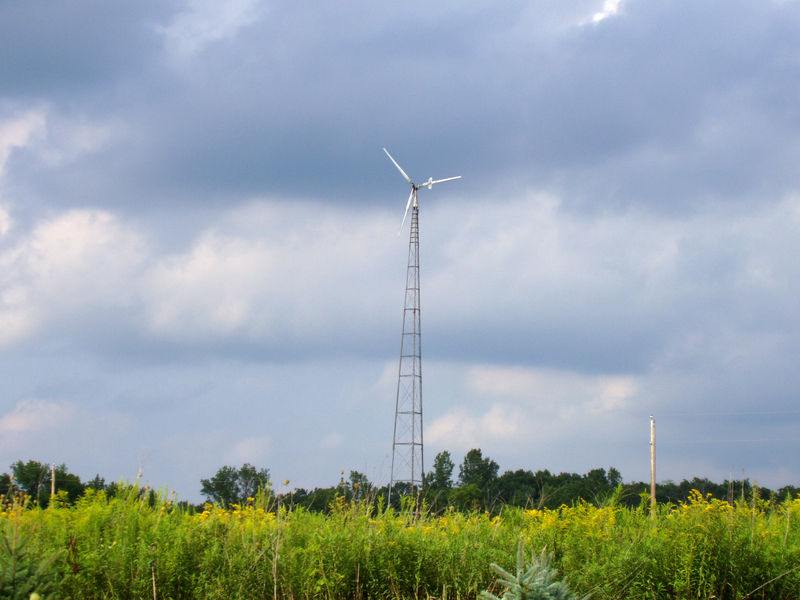
CPS Energy stakes its energy planning credibility on the fact that it has the lowest energy bills in Texas – even lower than those Austin people who get energy from hugging bunnies.
But WOAI crunched the numbers and last month, Austin Energy beat ‘em. Check out the write-up and video here.
In July, Netroots Nation, a network of online progressive voices, hosted a panel including scholarly authors, film directors, and lawyers with the topic:
“How Corporations and the Politicians they Fund are Fighting to Take Away our Legal Rights … and Convincing Us it’s for the Best.”
The speakers highlighted how corporations and conservative think tanks have framed personal injury law suits.Many people in America believe we are a nation of frivolous lawsuits – both in quantity and quality. Yet in reality, the number of lawsuits has been declining over the last 50 years.And if you would like to debate the quality of these suits, you better take it up with the system we have in place. Our elected system gives power to judges and juries who decides who gets what.So why all the complaining?
Propaganda produced by “you know who” has produced the image of lawyers as money-hungry sharks and injured people as whiners who are living irresponsibly.The campaign against lawsuits has been largely successful, yet now our tendency to buy into this propaganda may cost us our rights.
The Bush Administration wants to leave it up to the US Food and Drug Administration to approve our drugs and medical devices and forfeit give up our right to seek compensation through the courts if we are hurt. While some may argue that the FDA has rigorous tests that its products must pass before being put on the market, many companies slide through (some knowing the harm their product may cause, and others not).
If we take away the company’s fear of “getting sued,” what will be their motive to ensure that their product is completely safe? Not to say that everyone in these companies are evil, profit-seeking jerks; there are good people working there too who have a code of ethics and who believe safety comes first. These are the good people who use the possibility of a law suit as the hovering consequence of failing to take safety more seriously.Why would we, as consumers, want to take this argument away from them?
We ought to think about the rights we are relinquishing by doing away with our access to the courts, as well as our safety, which we are leaving up to drug companies and the imperfect FDA to decide.
Dennis Quaid testifies before Congress earlier this year
Take a look at Dennis Quaid, who says he has always thought of himself as a Republican. Even he is combating the process of preemption by giving testimony in Washington DC after a near-fatal overdose of heparin because of faulty labeling and medical devices that involved his newly-born twins. If Dennis Quaid is this concerned about what is going on with our legal system, we definitely should be!
Those were the words of Tom Mullikin (lawyer and nationally known speaker) at a talk he gave sponsored by the Kansas Chamber of Commerce to a “crowded hall full of business and political leaders from across the state,” as printed in the Wichita Eagle. Mr. Mullikin went on to talk about how local efforts to curb the effects of coal plants on the environment are useless, listing “facts” about how man-made emissions only comprise 5.5 percent of greenhouse gases in the atmosphere and that “Kansas homes, factories, cars, livestock and power plants… contribute just 0.013 percent of all greenhouse gases floating in the world’s atmosphere.”
This is not the first time I’ve heard these statements about percentages, and they are irrelevant. It is not the overall percentage of greenhouse gases represented by human activity that matters – what matters is how much the overall amount of greenhouse gases in the atmosphere increases, and 5.5% is a significant amount. Just think of blood alcohol levels, or a glass of water filled to the brim – one more drop will make it overflow.
The other glaring piece of misinformation provided by Mullikin is the idea that changes and efforts on a local scale to reduce greenhouse gas emissions is futile. This notion is not only totally incorrect, it is irresponsible, and Mr. Mullikin should be ashamed for touting such nonsense.
On Monday, various people including representatives from City Public Services, various county commissioners including Tommy Adkisson, commissioner candidate Chip Haass, Laurence Doxsey of HUD , Bill Sinkin of Solar San Antonio, and representatives from the Mayor Phil Hardberger’s office gathered to discussenergy efficiency with the Citizen’s Energy Coalition, SEED Coalition and the Alamo Group of the Sierra Club.
Arjun Makhijani, head of the Institute for Energy and Environmental Research, presented his preliminary findingson energy efficiency potential for San Antonio. I enjoyed the dialogue that came out of his speech. From most people I heard that Dr. Makhijani’s speech hit the right note of pushing CPS to do more while simultaneously congratulating them for their current energy efficiency and renewable goals.
General Electric's ESBWR: Not ready for prime time
Turnout was high at the NRC’s public meeting in Victoria on Thursday about the future of nuclear power in the area. Tara Bozick of the Victoria Advocate estimated 400 people showed up. There was so much going on it might warrant a second post.
The NRC attempted to quell concerns about the fact that Exelon plans to build the Economic Simplified Boiling Water Reactor (ESBWR), despite the fact that they have not yet certified it. In fact, the application for design certification was filed in 2005. Who knows when or if it will be certified, but Exelon’s application to build two of them in Victoria County puts added pressure on the NRC to approve the design.
It was publicly stated by the NRC last night that the ESBWR has never been built before. Why they would consider a combined operating license (COL) at the same time as they are reviewing revisions to the reactor design application is perplexing to say the least. So much for a streamlined process.
I’ll be heading back to Austin soon where we hope to regroup and move on to the next steps in our efforts to stop coal plants. All in all I consider this Arkansas trip to be a large success. We had 77 people come out for the screening in Fayetteville and had over 150 in Little Rock. Many Arkansans are eager to unite and stop these coal plants in order to promote and move towards renewable energy generation.
Here in Hope, however, my spirits were a bit lower. We distributed thousands of fliers at the Watermelon Festival in
the “hope” of drawing people out to the screening and getting folks involved in the fight. We were unsuccessful, however, and the only folks who showed up to the screening were the local hunting club guys who had been fighting this plant since the beginning. We were unable to get any new local interest in opposing the plant.
It is in these local towns, closest to the plants, where the hardest fight lies. Many, if not most, of the locals see the plant as an economic boon, since the few of them who get jobs with the company are usually getting the best job they’ve ever had. Concerns about public health, environmental degradation, and long-term economical impacts are ignored or justified in the light of some industry, any industry, willing to invest in the local community.
As Upton Sinclair said, “It is difficult to get a man to understand something when his salary depends upon him not understanding it.” This was true a hundred years ago, and it is still true today – both for men and women. And as long as the majority of people in this country are kept beneath a yoke of low wages and corporate consumerism, the will of the people to acknowledge, much less fight, the ills of our age will be greatly weakened.
This is not just an American dilemma, consider this Chinese coal plant situation:
The companies who build these plants know this. This is why they choose economically challenged or depressed sites and communities for their projects. It is also why it is so important to find those few locals who are willing and eager to speak against the crowd and stand up for their health, the environment, and a stable and sound energy future.
With that thought in mind we are networking the few dedicated souls in Hope with the rest of the great volunteers throughout Arkansas in our efforts to stop these coal plants. With the momentum we’ve gathered I think we have a great chance of achieving the change we seek.
As with Pandora, all it takes is a faint glimmer of Hope.
This Tuesday I spoke at the PUC’s public hearing on Project 34890, which is charged with deciding on a net metering and interconnection policy for the deregulated markets in Texas. If that description sounds arcane and confusing to you, that’s because it is. In fact, in calling around to several investor-owned utilities last week, most of the people I spoke to had not a clue what I was talking about when I asked if they allowed net metering.
But the gist of it is this: if the rule proposed by the PUC passes, guaranteed incentives for individuals to invest in small renewable energy (putting solar panels on their roof, for example) will disappear.
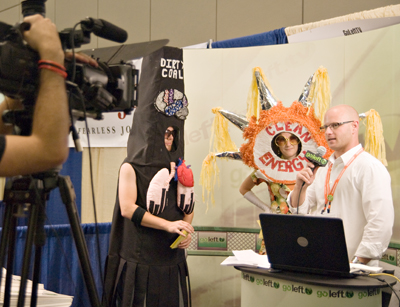
This was by far the most flamboyant activity I have done this summer while interning at Public Citizen. I went to Netroots to promote a talk hosted by the Sierra Club, Lightbulbs to Leadership. I got a little too into character at times. I might have even jigged a bit. The most interesting moments for me were talking with Go Left TV, various bloggers and a radio station. One tried to play “stump the environmentalist” by asking me about nuclear. Which was more than fine by me since I just spent the last couple months researching and organizing around the topic. One of the misconceptions that I got to clear up was the fact that producing nuclear energy does produce green house gases, at least three times more than renewables such as wind.
It was a riduculous and effective way of getting out our message: energy efficiency and renewables can meet our energy needs.
Gas prices are abominably high. The good news? It’s time to kick the oil habit. When i lived in New York City and the price of cigarettes went up to $10, my smoker friends took the hint and kicked the butt.
We face the same problem with gas prices, and with the overwhelming sentiment to “Drill here! Drill now!” overtaking our debate on national energy policy, I’m reminded again of my smoker friends. What if they had simply decided that it was time to start buying their cigarettes in bulk from New Jersey or Connecticut? They would have missed the added health benefits of quitting smoking.
STOP SMOKING NOW!
Global Warming is coming to a crisis point, and we are already seeing the effects: flooding along the Mississippi, record-breaking heat and drought across Texas, and increasing food prices due to lower crop yields are only the leading edge of a climate disaster if we do nothing. Unfortunately, offshore drilling is worse than doing nothing. The saying goes that when you find you are digging yourself into a hole, STOP DIGGING! By increasing production of oil we can only guarantee that we will put more pollution into the atmosphere and hasten the arrival of catastrophic climate change.
But proponents say we have to bring down the price of gas. True– my family is hurt by having to spend $50-$60 every time we fill up our car. But according to the Bush Administration’s Department of Energy, offshore drilling will not affect gas prices at all. It will be 8-10 years before we see any real production out of these wells. Further, the amount they would produce would not help make us more energy independent, as the relatively small supplies would be gobbled up by international demand. Their quote is “Because oil prices are determined on the international market, however, any impact on average wellhead prices is expected to be insignificant.”
Since our oil problem is essentially one of increased demand driving up prices, the best answer to decrease oil prices is to demand less by using less. So, offshore drilling means more global warming, and no easing of the pain at the pump. Efficiency means less global warming, lower prices, and we’re using less gas to begin with. That way, if we did manage to tackle climate change and wanted to drill decades from now when oil is $300 / barrel, we will have left that resource to our children and grandchildren instead of simply greedily drinking that milkshake now.
Sounds like a no-brainer: the type of solution no one in Washington DC would ever consider.
Researchers at MIT have developed a fuel cell which could revolutionize not only how we get energy but how we think about it. The old model has always been to hook up your home to a power grid and an electric utility which buys electricity from coal and gas-burning power plants (and to a lesser degree nuclear and in the last few years some wind).
With this breakthrough, we can conceivably turn our homes into “power plants… and gas stations” according to MIT’s Daniel Nocera.
How the solar fuel cell storage would work - from MIT
With Daniel Nocera’s and Matthew Kanan’s new catalyst, homeowners could use their solar panels during the day to power their home, while also using the energy to split water into hydrogen and oxygen for storage. At night, the stored hydrogen and oxygen could be recombined using a fuel cell to generate power while the solar panels are inactive.
This is an important breakthrough that will lead to lower energy prices for us, but we have to act quickly. We need to deploy smart meters in our cities and start getting ready for plug-in hybrids or fully electric vehicles. Bring it up with your Congressman, Senator, State Legislator, City Councilmember, or electric Co-op board member and get ready for the next generation in energy.