It has been accepted for a while now that the Arctic and the Antarctic Peninsula have been warming, at least partly due to anthropogenic warming. However, recent scientific studies have concluded that the entire continent of Antarctica is warming and is clearly linked to the worldwide warming trend. Based on recent studies and recent events, scientists are extremely concerned that the melting in the Arctic and Antarctic are warming much faster than was previously expected.
One of the most alarming events occurred when an ice bridge that was previously anchoring the Wilkins Ice Shelf to the rest of the Antarctic Peninsula shattered. To use the words of British Antarctic Survey glaciologist Professor David Vaugha, “the ice sheet has almost exploded into a large number, hundreds of small icebergs.”It is also important to note that this ice sheet was formerly thought to be relatively stable, at least for the foreseeable future. This ice bridge was thought to be a critical barrier keeping the rest of the ice sheet in place. Now that it has collapsed, there is nothing to prevent this enormous ice sheet from disintegrating.
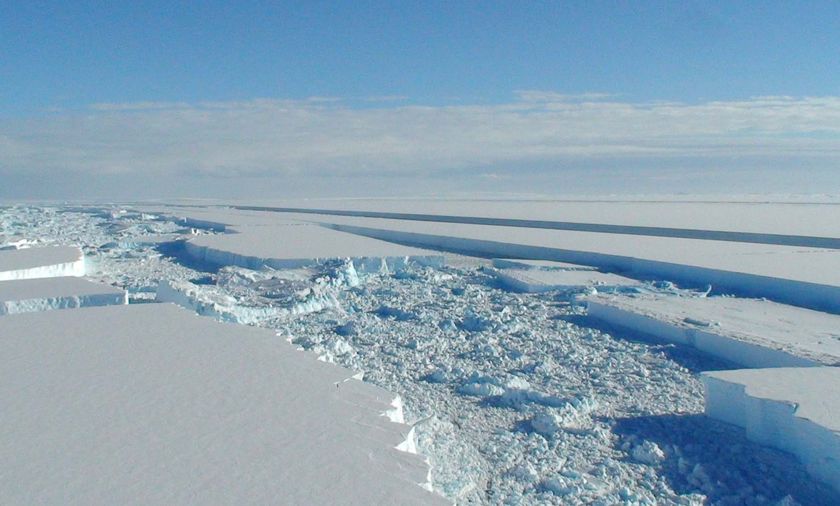
Parts of the ice shelf are now beginning to resemble shattered glass.
But this type of phenomena is not a singular occurrence. In fact, the U.S. Geological Survey recently released a report concluding that the “Wordie Ice Shelf, which has been retreating in the past 40 years, is completely gone.” The same study also stated that the Northern part of the Larsen Ice Shelf has also disintegrated. However, it is important to acknowledge that these and other sea based ice shelves will not contribute to any substantial rise in seas level. Instead, the melting of these sheets opens the door for further melting which will very likely affect sea levels in the future.
But scientists now have evidence that this warming trend is not solely represented in the Antarctic Peninsula. In fact, a new scientific report has concluded that, on average, the entire continent of Antarctica has been warming over the past half century. This report disproves the former belief that the Eastern Part of Antarctica has actually been cooling over the past century. The dispute on the warming in this region of the Arctic was largely due to the lack of weather stations in the interior of the continent. However, with the help of satellite images over the past 25 years and several unmanned weather stations in the interior, scientists were able to conclude that the eastern part of the Antarctic is, in fact, warming. The scientists concluded in the study that anthropogenic green house gas emissions is almost certainly a primary cause of this warming trend.
But as well all know, Antarctica is not the only place in the world experiencing the effects of global climate change. On the other side of the world, scientists are predicting that the Arctic ocean may be nearly ice-free in only 30 years. This figure was reached after averaging six of the most specific models dealing with sea-ice released by the United Nations Intergovernmental Panel on Climate Change. The average of these six models was around 32 years, with one of the models estimating an ice-free arctic summer being only an mere 11 years away.
Based on these events and recent scientific studies, it is evident that global climate change is affecting both poles. The effects of global warming are being felt worldwide, on all 7 continents. The time for debate on this issue has passed, the time for action is now.
– Andrew Townsend, Global Warming Intern
 This week citizens submitted two separate filings to the Nuclear Regulatory Commission (NRC) opposing Luminant (formerly TXU)’s proposed Comanche Peak nuclear reactors. Petitioners include state Rep. Lon Burnam, the


