Feeds:
Posts
Comments

Archive for July 20th, 2011

According to a Lower Colorado River Authority (LCRA) press release, there will be a public meeting in Bay City on July 28th at 6:30 pm regarding the White Stallion water contract.

The Lower Colorado River Authority will hold a public information meeting in Bay City on Thursday, July 28, on a proposed water contract with White Stallion Energy Center. The meeting will begin at 6:30 p.m. at the Bay City Civic Center, 201 Seventh Street.

“LCRA recognizes how important this proposed water contract is to the public and we want to give everyone the opportunity to fully understand the proposed contract before the Board of Directors makes its final decision,” LCRA General Manager Becky Motal said.

The meeting will be structured to offer visitors multiple opportunities to ask LCRA staff about the proposed contract with White Stallion and related issues. The meeting will begin with a short video and presentation on the proposed contract. The public will then have an opportunity to visit with LCRA staff at stations set up for the following issues:

  • Water supply,
  • Proposed White Stallion contract,
  • Water quality and bay health, and
  • Lower basin reservoir.

During the meeting, visitors will be encouraged to submit written questions for a panel question and answer session. The panel will feature LCRA Water Operations Manager Kyle Jensen, LCRA Manager of Water Resources Management Karen Bondy and LCRA Water Supply Strategist James Kowis.

White Stallion has requested 25,400 acre-feet of water a year from LCRA for a power plant in Matagorda County. As a legislatively created regional water supplier, if LCRA has water available to meet a request for supply and an applicant complies with LCRA’s rules, LCRA must make that water available and cannot unreasonably discriminate. LCRA has the water available for White Stallion’s request, even in the current drought conditions.

Because of the size of the request, LCRA has developed a proposal designed to benefit the water supply system of the entire lower Colorado River basin. Under the terms of the proposed contract, White Stallion must pay LCRA $55 million within one year of the contract date. That money must be used for water supply enhancements. LCRA intends to use this payment for:

  • Pumping plant improvements at LCRA’s Bay City pumping plant;
  • A 5,000 acre-foot off-channel reservoir in the lower basin that can serve White Stallion and other customers; and
  • A study to determine the best configuration of water supply projects and enhancements and where they will be located. This could include options like lining canals to save water.

In addition to routine raw water use and reservation rates, White Stallion would also pay $250,000 per year from the date the plant is completed through the end of the contract. These additional funds would be used for future water supply projects. White Stallion also plans to have additional water storage on its plant site capable of storing a week’s worth of the plant’s water use.

Under these terms, once the new reservoir is constructed, LCRA should be able to supply White Stallion without impacting the Highland Lakes or water for agriculture. The new reservoir and future water projects made possible by this contract would also benefit other customers throughout the basin.

“The job of LCRA’s staff was to develop the best water contract it could, and we believe we accomplished that,” Motal said. “This proposed contract is intended to offset the impact of White Stallion to the Highland Lakes and the downstream farmers and also benefits the water supply system of the entire basin.”

A copy of the proposed contract is available at LCRA.org. The LCRA Board will consider the proposed contract August 10.
Read Full Post »

Parts of 32 states are under heat advisories, warnings or watches today as the deadly heat wave that has blasted the Midwest expanded eastward.

Actual temperatures in Washington, D.C., Philadelphia and New York were expected to hit 100 degrees in the coming days with heat indexes — measured as a combination of temperature and humidity — reaching 110 degrees in those cities.

The Weather Service also issued a list of heat index highs topped by 4 Iowa towns: Knoxville, 131 degrees; Newton, 129; Atlantic, 126; and Council Bluffs, 126. Freeport, Ill., and Madison, Minn., followed at 124.

In Austin, where we have already had 35 days of triple digit temperatures and are expected to have more in the remaining months of summer, we have had a slight break with the highs dipping to 99 degrees as the dome of high pressure hovers north of us and expands eastward, but can expect to move back into our routine of 100 plus degree highs soon.

The heat wave has been blamed for at least 13 deaths since last week, the National Weather Service reported.

High temperatures were also responsible for an alarming spike in deaths of illegal immigrants trying to cross into the United States, according to the U.S. Border Patrol. It did not say, however, exactly how many had died due to weather, but they deployed search and rescue units in the south Texas brush country.

The heat also set new peak records for electricity usage.

Xcel Energy, which serves 1.64 million customers in North Dakota, South Dakota, Wisconsin and Minnesota, broke a demand record on Monday with 9,504 megawatts of power used following the old record set in August 2010 of 9,100 megawatts.

In Nebraska, flood control work along the overflowing Missouri River was halted due to the heat, as officials worried that filling sandbags was too strenuous.

In Illinois, the second-largest corn and soybean producing state, the heat and humidity were not yet damaging crops, but a lack of rain is cause for concern.  Texas farmers and ranchers know all too well the impact a long period of heat and no rain can have on herds and crops.

Heat is the number one weather-related killer in the United States.

The National Weather Service statistical data shows that heat causes more fatalities per year than floods, lightning, tornadoes and hurricanes combined.

Based on the 10-year average from 2000 to 2009, excessive heat claims an average of 162 lives a year. By contrast, hurricanes killed 117; floods 65; tornadoes, 62; and lightning, 48.

So everyone should learn the hazards of heat and the symptoms of heat related illnesses.  The following is from http://www.weather.gov

Sunburn

  • Symptoms: Redness and pain. In severe cases swelling of skin, blisters, fever, headaches.
  • First Aid: Ointments for mild cases if blisters appear and do not break. If breaking occurs, apply dry sterile dressing. Serious, extensive cases should be seen by physician.

Heat Cramps

  • Symptoms: Painful spasms usually in muscles of legs and abdomen possible. Heavy sweating.
  • First Aid: Firm pressure on cramping muscles, or gentle massage to relieve spasm. Give sips of water. If nausea occurs, discontinue use.

Heat Exhaustion

  • Symptoms: Heavy sweating, weakness, skin cold, pale and clammy. Pulse thready. Normal temperature possible. Fainting and vomiting.
  • First Aid: Get victim out of sun. Lay down and loosen clothing. Apply cool, wet cloths. Fan or move victim to air conditioned room. Sips of water. If nausea occurs, discontinue use. If vomiting continues, seek immediate medical attention.

Heat Stroke

  • Symptoms: High body temperature (106° F or higher). Hot dry skin. Rapid and strong pulse. Possible unconsciousness.
  • First Aid: Heat stroke is a severe medical emergency. Summon emergency medical assistance or get the victim to a hospital immediately. Delay can be fatal.

Safety Tips

  • Slow down. Strenuous activities should be reduced, eliminated, or rescheduled to the coolest time of the day. Individuals at risk should stay in the coolest available place, not necessarily indoors.
  • Dress for summer. Lightweight light-colored clothing reflects heat and sunlight, and helps your body maintain normal temperatures.
  • Put less fuel on your inner fires. Foods that increase metabolic heat production also increase water loss.
  • Drink plenty of water or other non-alcohol fluids. Your body needs water to keep cool. Drink plenty of fluids even if you don’t feel thirsty. Persons who (1) have epilepsy or heart, kidney, or liver disease, (2) are on fluid restrictive diets or (3) have a problem with fluid retention should consult a physician before increasing their consumption of fluids. Do not drink alcoholic beverages.
  • Spend more time in air-conditioned places. Air conditioning in homes and other buildings markedly reduces danger from the heat. If you cannot afford an air conditioner, spending some time each day (during hot weather) in an air conditioned environment affords some protection.
  • Don’t get too much sun. Sunburn makes the job of heat dissipation that much more difficult.

So until the heat breaks, probably mid to late September for those of us in Central Texas, stay safe and hydrated.

Read Full Post »

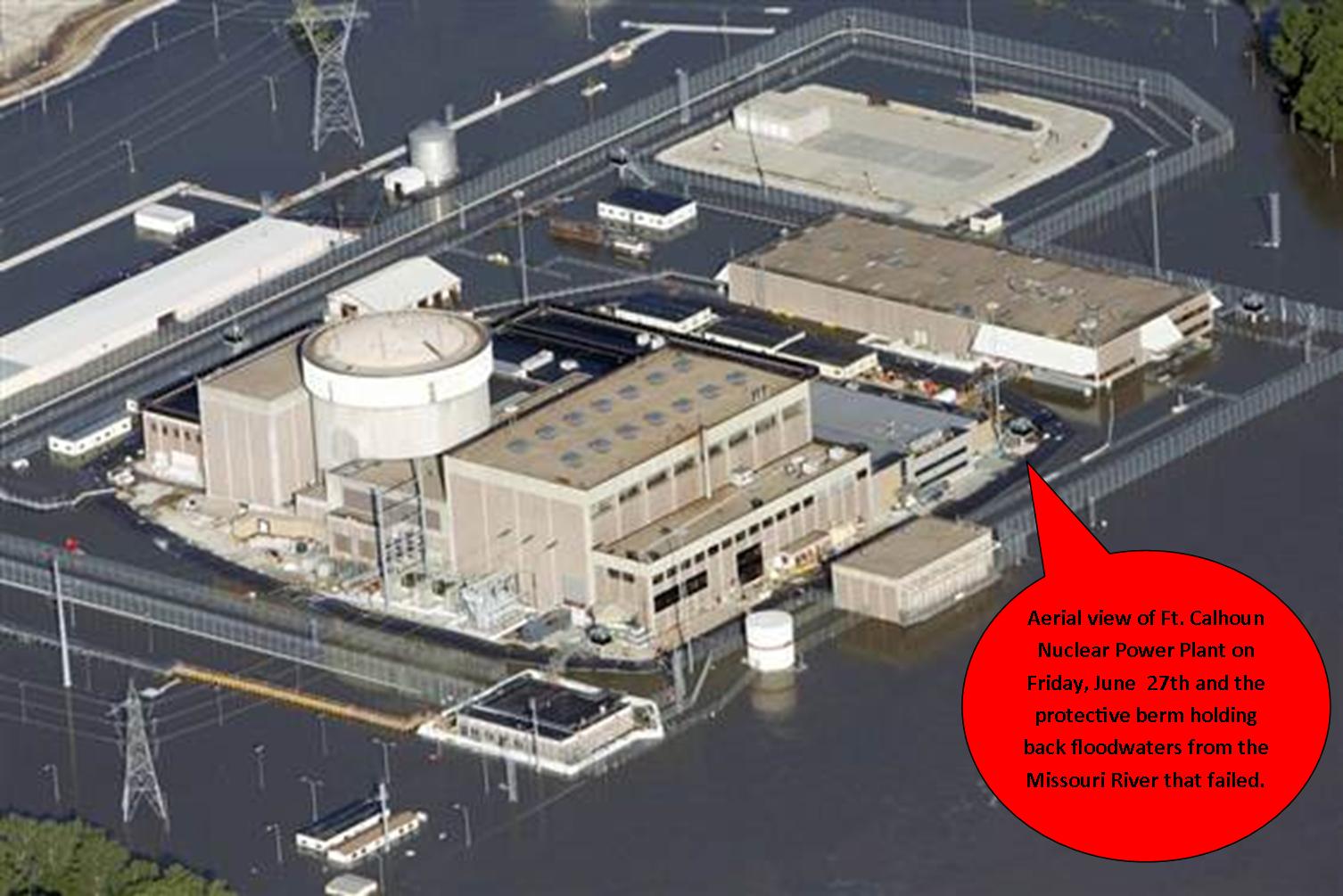
Although flood concerns at Nebraska’s two nuclear power plants have subsided for the time being, the Nuclear Regulatory Commission (NRC) has announced short and long term plans that will examine and possibly affect flood safety at both reactors.  The NRC is schedule to be in Omaha starting July 27th examining flood control at the Fort Calhoun Station.

Fort Calhoun Nuclear Plant during the height of the flood after a 2000 foot long water filled barrier berm failed

In the meantime, the NRC issued a memo yesterday announcing that the Fort Calhoun nuclear power plant will be receiving additional oversight from the Nuclear Regulatory Commission because of problems associated with the reactor protection system at the plant that was uncovered during a scheduled test on June 14, 2010.  At that time, one of four electrical contacts failed in a system used to “trip” or automatically shut down the reactor. The condition appears to have existed for 63 days before it was discovered.  This means the condition was in place before flooding was a concern at the plant,  Fort Calhoun has been shut down since April 7th for a refueling outage, and remained shutdown after June 6 when concerns about flooding along the Missouri River began.  The emergency status abated with the river cresting June 23rd .

While the NRC says the failure did not pose a danger to public health or safety, because other means existed to perform that safety function if necessary and the operator of the plant has replaced the defective electrical component, it does appear that had the plant been operating when the flooding occurred, emergency shutdown might have been compromised.

The NRC preliminarily determined that the violation was “yellow,” meaning it has substantial safety significance (NRC evaluates performance at nuclear power plants with a color coded process which classifies regulatory findings as either green, white, yellow or red, in order of increasing safety significance) and has since downgraded it to white.

Read Full Post »

Follow

Get every new post delivered to your Inbox.

Join 3,136 other followers
