Feeds:
Posts
Comments

Archive for January, 2013

Nuclear Electric Insurance Ltd. (NEIL), the company that insures all 104 U.S. nuclear power plants has just around $3.6 billion on hand to pay for claims from broken nuclear plants in California (San Onofre nuclear power station), Texas (South Texas Nuclear Project), Michigan (Cook nuclear power station) and Florida (Crystal River).  Crystal River alone represents such a financial threat that the insurance company may have to demand that its member utilities shell out more money.

As a mutual insurance company, NEIL’s members agree to cover each other in the event of a catastrophe. NEIL was formed in 1980 in response to the Three Mile Island disaster and is allowed to raise as much as $2 billion from its members in a 20 day period drawing from the owners of all 104 nuclear plants in the United States.

NEIL’s policies allows for a payment up to $2.25 billion for damage to a plant, plus up to an extra $490 million for replacement power while the plant is idled.
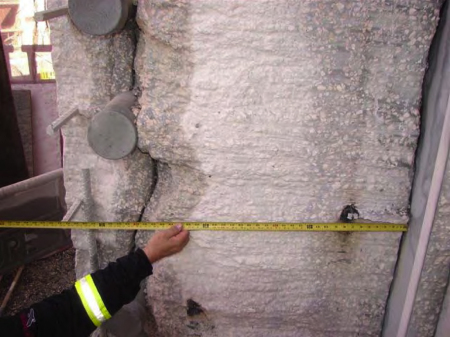
Damage to Crystal River nuclear plant's containment wall

Damage to Crystal River nuclear plant’s containment wall

Repairing the Crystal River plant could cost as much as $3.5 billion for construction work and $300 million a year for related costs such as purchasing alternative electricity while the plant remains off line. That could push the total cost above $5 billion, but there are questions about whether the damage was an accident or whether the 2009 replacement of old steam generators inside the nuclear plant’s 42-inch thick concrete containment wall was mishandled when the managing company chose a do-it-yourself approach in order to save about $15 million by using one of the two companies that handled all similar projects in the nation. An attempt to repair the resulting crack in the containment wall and bring the plant back online resulted in more cracks.

Most of the 104 reactors in the United States were built in the 1970s and early 1980s. A few date back to the 1960s and they are starting to show their age, putting additional pressure on the insurer as is evident in the additional claims in the works.

Turbine loss at the Cook nuclear power station in Bridgman, MI. resulted in a claim for which NEIL had already paid out $400 million by the end of 2011.

The insurer also faces “the meaningful” claim for the South Texas Nuclear Project, which suffered damage to a turbine generator in its number two unit and is not expected to be back online until as late as July this year. It is unclear how much that will cost the insurance company.

And now NEIL must ready itself for the troubles at California’s San Onofre nuclear power station, where two generators have been offline since January 2012.  The replacement power alone for San Onofre’s out-of-service units reached $221 million through September of this year and it is unclear what the repair costs would add to that bill.

In the past, NEIL has paid out annual distributions to all its members after the insurer reaches a comfortable reserve — generally about $3.5 billion. The money is distributed to the members based on the premiums they pay each year. Between the loss of the annual distributions and charges to these power companies to cover shortfalls from these claims, nuclear plants around the country could be looking some unexpected financial hits in the coming year or two.

Read Full Post »

Chasing Ice  is an environmental documentary film, listed in the top 15 best documentaries for the Oscars, coming to Austin TX on Feb 8-10 at Regal Arbor.

Chasing Ice follows acclaimed photographer James Balog on an epic journey as he deploys time-lapse cameras at glaciers around the world.

“You’ve never seen images like this: it deserves to be seen and felt on the big screen.” – Robert Redford

Generous support of a grant from the Kendeda Fund is allowing people to see the film for free to support education and outreach. This program features a limited number of complimentary tickets, on an invitational basis, to openings in select cities – including Austin TX!

To claim your complimentary tickets, please click on the below link and use the group code provided below.

Chasing Ice Ticket Request Form

Group Code: PCITIZEN

Read Full Post »

According to a report yesterday by Terrance Henry of NPR’s StateImpact Texas (click here to read the article), the Las Brisas coal power plant proposed for Corpus Christi has not only been suspended, but Chase Power’s parent company, which was financing the project, has gone out of business.
wicked witch of the westLas Brisas was one of the last remaining coal plants still proposed for Texas. Now only one major coal plant is still being considered.  The White Stallion coal project in Matagorda County is also experiencing problems getting permitted and funding could be the final blow for this proposed plant too.  So we say to White Stallion, to quote the wicked witch of the West, “Just try and stay out of my way. Just try! I’ll get you, my pretty, and your little dog, too!”

Read Full Post »

The South-central Partnership for Energy Efficiency as a Resource (SPEER) enters its second year with an exciting Summit, designed to explore, further develop, and prioritize policies and strategies needed to push energy efficiency forward in new buildings, existing buildings, and electric markets in Texas and Oklahoma.

Ed Mazria, founder and CEO of Architecture 2030, will deliver the keynote address to kick off the Summit in Austin on February 25. Mr. Mazria is an international leader on efforts to make buildings dramatically more energy and water efficient, leading the movement to establish 2030 districts in cities with goals to reach carbon neutrality by 2030. These districts have been established so far in Los Angeles, Seattle, Cleveland, and Pittsburgh.

Public Citizen members can receive a $50 discount off the registration. On the registration page, select “Early Registration- Supporting Organization” and then select “Public Citizen” from the drop down menu.

Sponsors of the SPEER Summit include Dow Chemical, CCRD Partners, Mitsubishi, Environments for Living, TexEnergy Solutions, BASF, the Texas Home Energy Raters Organization, and the CleanTX Foundation.

To learn more about the Energy Efficiency Summit, please visit: www.eepartnership.org/summit


Read Full Post »

Today, Energy and Commerce Committee Ranking Member Henry A. Waxman issued the following statement on new research from the Pembina Institute and Oil Change International, indicating that the Keystone XL pipeline will accelerate the reckless expansion of the tar sands industry and the climate impact of tar sands and the pipeline will be significantly worse than anticipated:

“The new reports show that TransCanada’s Keystone XL pipeline is the key that will unlock the tar sands.  If the pipeline is approved, the world will face millions more tons of carbon pollution each year for decades to come.  After Hurricane Sandy, devastating drought, unprecedented wildfires, and the warmest year on record in the United States, we know that climate change is happening now, we have to fight it now, and we must say no to this pollution pipeline now.”

To access the report released at the event, please visit:
Petroleum Coke: The Coal Hiding in the Tar Sands – Oil Change International
The climate implications of the proposed Keystone XL pipeline – The Pembina Institute

Read Full Post »

Tuesday, a fire erupted in the Unit 2 main transformer that feeds power from the reactor to the public power grid of the South Texas Project Electric Generating Station near Bay City and about 85 miles southwest of Houston.  The unit 2 was automatically taken offline and STP officials say unit 1 is still operational, but STP officials say they don’t know when unit 2 will be restarted.

The fire broke out at 4:42 p.m. was extinguished within 15 minutes, but the plant had to declare that an “unusual event” had taken place and notified county, state and federal officials. Managers declared the event over at 7:47 p.m.  No injuries were reported and STP is claiming that the incident poses no hazard to the public or to plant workers.

The two 1,350-megawatt generators, owned by NRG Energy, CPS Energy and Austin Energy, serve 2 million users. each reactor at the plant produces 1,280 megawatts of electricity. One megawatt is enough to power 500 homes during mild winter conditions, but if your remember the Texas rolling blackouts during a severe winter event in February of 2011 you might also remember that the electricity shortage during that unusual high demand time was due to unexpected plant outages.  Let’s hope we don’t have one of those before unit 2 comes back online.

Interestingly enough, this incident happened just before the Nuclear Regulatory Commission begins seeking public comment on a draft supplemental environmental impact statement for the proposed renewal of the South Texas Project nuclear power plant’s operating licenses for an additional 20 years.

NRC staff will hold two public meetings in Bay City, Texas, on Jan. 15, 2013 to present the findings of the draft report and accept public comments. The meetings will be held at the Bay City Civic Center, 201 Seventh St., from 2-5 p.m. and 7-10 p.m. NRC staff members will be available for one hour prior to each session to meet informally with members of the public.

The South Texas Project nuclear plant has two pressurized-water reactors. The plant operator, STP Nuclear Operating Co., submitted its license renewal application on Oct. 25, 2010. The current operating licenses expire Aug. 20, 2027, for Unit 1 and Dec. 15, 2028, for Unit 2.  The original license was issued based on the expected life of the plant.  Most of our aging nuclear power fleet is nearing the end of their life expectancy and since most energy companies have not been successful in securing funding for building new plants, the strategy is to just extend the life of the current facilities by renewing their licenses.

The draft supplemental environmental impact statement contains the NRC staff’s analysis of potential impacts specific to the South Texas Project site. In preparing the report, the staff held a public meeting in Bay City on March 2, 2011, as part of the public “scoping” process for the report. The staff also conducted site audits at the plant in May and July 2011 and consulted with other agencies while analyzing the applicant’s environmental report submitted with the application.

The draft NRC report does not discuss potential environmental impacts of extended storage of spent nuclear fuel after the plant eventually ceases operation. That issue will be addressed in the NRC’s waste confidence environmental impact statement and rule, expected by September 2014. In August 2012, the Commission decided that the agency will not issue final licensing decisions for reactors, including license renewal, until the waste confidence rule is completed. If at that time, site-specific issues relating to spent fuel storage at South Texas Project remain unresolved, they will be addressed separately.

Public comments on the draft environmental impact statement for the South Texas Project license renewal will be accepted through Feb. 22, 2013. They may be submitted online via the federal government’s rulemaking website at www.regulations.gov using Docket ID NRC-2010-0375. They may also be mailed to Cindy Bladey, Chief, Rules, Announcements and Directives Branch (RADB), Division of Administrative Services, Office of Administration, Mail Stop: TWB-05-B01M, U.S. Nuclear Regulatory Commission, Washington, D.C., 20555-0001. Comments may also be faxed to 301-492-3446.

The South Texas Project draft supplemental environmental impact statement is available for public inspection in the NRC Public Document Room at NRC headquarters, 11555 Rockville Pike, Rockville, Md. Copies will also be available at the Bay City Public Library, 1100 7th St., Bay City, Texas.

Read Full Post »

Well, it’s official.  According to scientists with The National Oceanic and Atmospheric Administration, 2012 was the warmest year on record in the contiguous United States with an average temperature of 55.3 degrees Farenheit.  That’s 3.2 degrees above normal and a full degree higher than the previous warmest year recorded — 1998.  All 48 states in the contiguous U.S. had above-average annual temperatures last year, including 19 that broke annual records, from Connecticut through Utah.

2012 was also a historic year for “extreme” weather, according to NOAA. With 11 disasters that surpassed $1 billion in losses, including Superstorm Sandy, Hurricane Isaac, and tornadoes across the Great Plains, Texas, and the Southeast and Ohio Valley, 2012 was second only to 1998 in the agency’s “extreme” weather index.  2012 was also the driest year on record for the U.S., with 26.57 inches of average precipitation — 2.57 inches below average. Those dry conditions created an ideal environment for wildfires in the West, which charred 9.2 million acres — the third highest amount ever recorded.  At this writing, more than 60% of the country is still in drought, and while down from over 95% at the height of the 2011 drought, nearly 12% of Texas still remains in “exceptional” drought, the highest drought category on the US Drought Monitor scale.

Each year since 2001 has been among the warmest on record worldwide, with 2012 likely to be no exception despite the cooling influence of La Niña early in the year.  If this warming trend continues, extreme weather events and major impacts on agriculture will probably continue to have an effect on the U.S. economy.

Read Full Post »

Follow

Get every new post delivered to your Inbox.

Join 3,179 other followers
