Feeds:
Posts
Comments

Archive for February, 2013

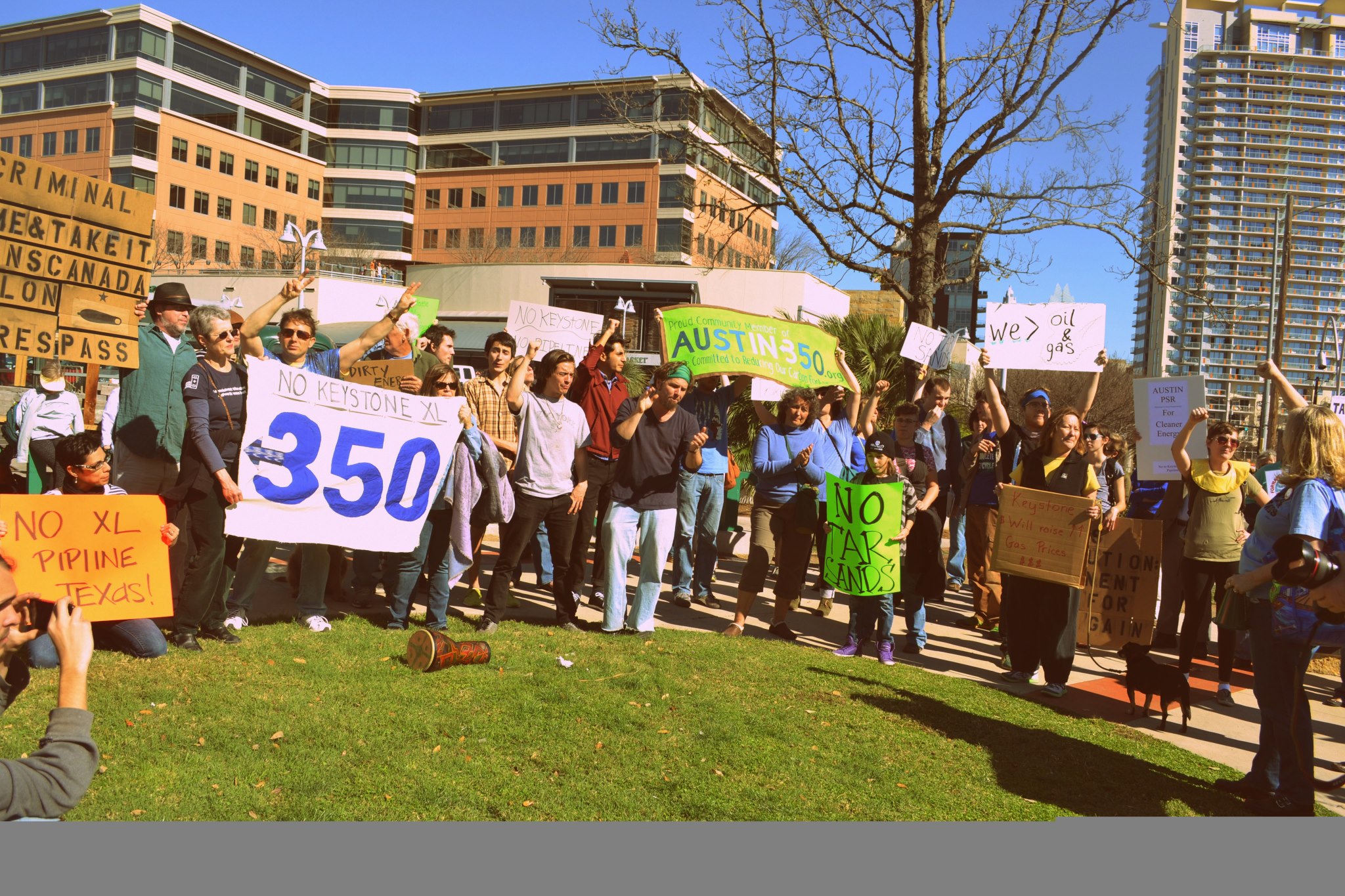
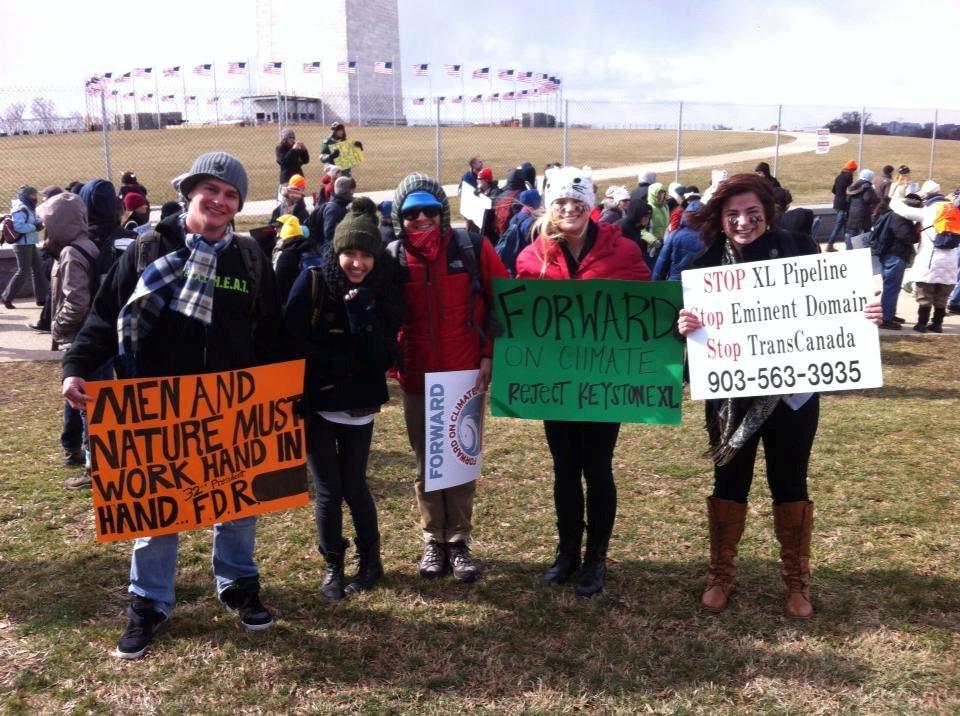
On February 17th, environmental activists gathered in front of the Whole Foods headquarters in Austin, TX to show their support for the Tar Sands Blockade and to raise climate change awareness, adding their voices to the over 40,000 that gathered on the Mall in Washington, DC that same day.

The Keystone XL Pipeline would carry oil from Canada to the Texas Gulf Coast. Around 200 people in attendance at the Austin rally, from many organizations, said the pipeline is environmentally toxic. The protestors chose Whole Foods as the best location for their action because CEO John Mackey recently said “Climate change is not that big a deal.” Chris Wilson with S.T.O.P. (Stop Tar Sands Oil Pipelines) said the oil that will come out from the pipeline will be exported overseas and none will stay in the United States.

Click here to watch the local CBS news affiliate’s coverage.

2013-02-17 Forward on Climate Rally on the National Mall

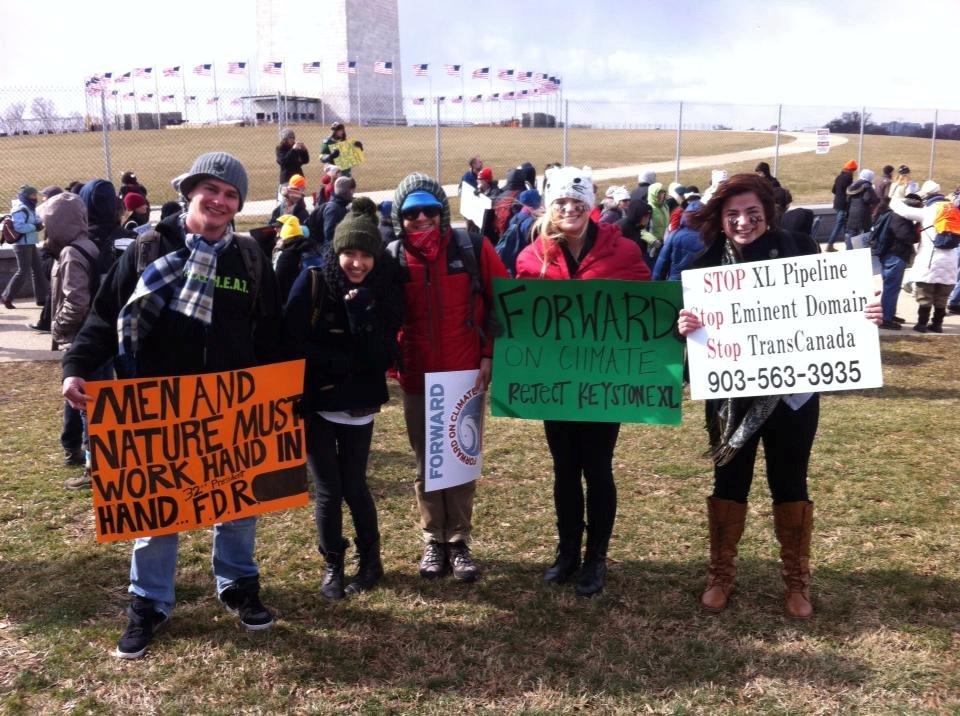
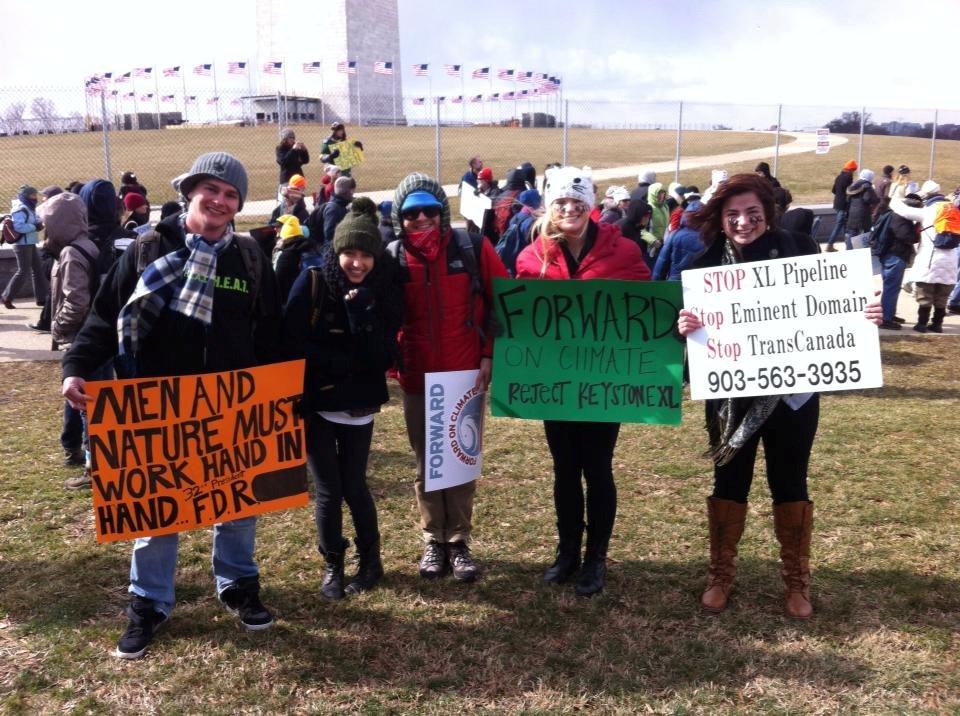
Texans who rode on a bus for 36 hours to Washington, DC to participate in the Climate Forward rally in 30 degree weather with 6 degree wind chill.

Austin Rally - Sasha Violette

Rally in Austin for those unable to make the trip to DC. – Photo by Sasha Violette

Read Full Post »

2013-02-17 Forward on Climate Rally on the National MallI have been a Public Citizen intern since January of this year.  As a Political Science graduate student, in both Undergraduate and Graduate studies I have been immersed in the political process and the theories behind the ideas that have formed our nation.  When I was a bit younger, I dabbled in political activism, with issues like civil rights and equal rights, which are still very near and dear to my heart.  But, I never took the plunge into becoming a full on activist.

Thursday, February 14th, I had the opportunity, through Public Citizen and The Sierra Club, to get on a bus with 48 other Texans and make the long trek to Washington D.C. for the Forward on Climate Rally.  I had been to D.C. several times before, but never for a cause.  Our bus departed from Austin, Texas and made stops in Dallas and Tyler.  At each stop, new people joined us.  Each person on the bus had their own reasons for engaging in this somewhat grueling 30 plus hour bus ride.  Each person was motivated enough to take time out of their schedule and commit to a less than comfortable ride on a bus to our nation’s capital.

In the early part of our journey, many people did not know each other.  Many of us were coming from different places geographically and in life.  As the hours wound on, conversation and ideas began to flow on the bus.  People began to relax and conversations began to percolate throughout the bus.  After the formalities, discussions began on why we were on this trip.  There were people directly affected by the Keystone Pipeline.  Others were concerned with climate.  Some were just champions of the Earth.  For quite a few of my fellow bus riders, activism was old hat.  Others, such as one older, retired gentleman, still were hesitant to call themselves activists.  Some were believers in the cause, but just there for the exchange of ideas and to observe.  But, within the varying reasons for attending the trip, a common thread was clear.  Something needs to be done about climate change.  That was something everyone could agree upon, regardless of what school of thought they were coming from.

As for me, when I got on the bus, I did not really know which one of these types I was.  Climate change has always been a concern to me.  I try to live a “green” life.  I knew the Keystone Pipeline was bad news from things I had read and heard, but I suppose that I was never mad enough to do anything about it.  For me, civil rights and related social issues had always been the most important…

As the trip wore on, we all began to become friends.  We shared experiences and ideas.  By the time we arrived in D.C., we were no longer a bus full of strangers.  There was a feeling that we were a team, and some of us had become quick friends.  Our group spanned many different generations and encompassed many different levels of involvement in the cause. 

Friday night and Saturday, through some downtime and tourism, the group continued to solidify.  Our bonding was increased through a night on the town and sightseeing, but the main event was yet to come.

Sunday, February 17th began by loading on the bus and heading to the Public Citizen D.C. office for breakfast and some interviews with a reporter.  Outside, the cold was biting, with a wind chill of 6 degrees.   As we prepared to depart for the National Mall, the excitement level was high despite a lack of sleep and the cold weather. 

2013-02-17 Forward on Climte Rally March on the White HouseWe arrived near the Washington monument to a sea of busses.  Hundreds of busses.  We arrived about an hour early, and there were people as far as the eye could see ready to participate in democracy.  The estimates of number of people at the Forward on Climate rally ranged from 35,000 to 50,000.  As the rally began, speakers began to deliver messages from many different points of view.  Some were directly affected by the pipeline, other were speaking of climate change and activism.  The excitement level of the crowd increased with every speaker.  The climax of the rally was the 10’s of thousands of us marching to the White House.  The street was packed from curb to curb all the way around the White House.  We now know that President Obama was playing golf with Tiger Woods and oil executives, so he did not see the awe –inspiring site of that many people united for our climate.  Everywhere you looked there were signs.  When you stopped to listen, you could hear chants that would begin with one person and end with a united crowd chanting in solidarity.  While marching around the White House, you almost forgot how cold it was. (It was really cold)  When we returned to the National Mall, I had a sense of accomplishment.  You could not help but feel that we had done something important, united together as a group as varied as any ever assembled.  People of different ages, races, economic backgrounds, and geographic locations; all united in for the planet.  It was then that something I should have realized all along dawned on me.  Climate change and human/civil rights are intertwined.  They are so deeply related, that it is almost hard to see the preverbal forest for the trees.  Without one, there cannot be the other.  It also dawned on me that this is the fight of our generation.  This is the legacy that we should pass on to our children and their children. Our Earth and our climate is intrinsically a human right.  If we do not take action, there may not be an inhabitable planet for future generations, which would be the greatest violation of human rights in our history.  Through the interactions on the bus, the speakers, the sights and the sounds, something that should have been painfully obvious to me was finally made clear.

We cannot be passive observers in this fight against climate change.  We cannot be passive observers in things like the Keystone XL, even if we think they do not directly affect us.  (It does)  The time to remain silent is gone.  It is time to call on everyone who knows these things are terrible to use their voice, their right to free speech, and the democratic process to put an end to this insanity.  The Earth cannot wait while we sit idly by and do nothing while corporations destroy her under the guise of “progress” and “economics.”  We need to stand up and let them know that we will not stand for irresponsible practices and violations of our planet.  We must activate to preserve our climate and Earth for future generations.  We must let President Obama know that we won’t stand for the Keystone XL. 

For me, it is now no longer an option to passively oppose what is going on.  Activism is now a necessity.   I would urge everyone to use their voice, stand up and be heard.    


Read Full Post »
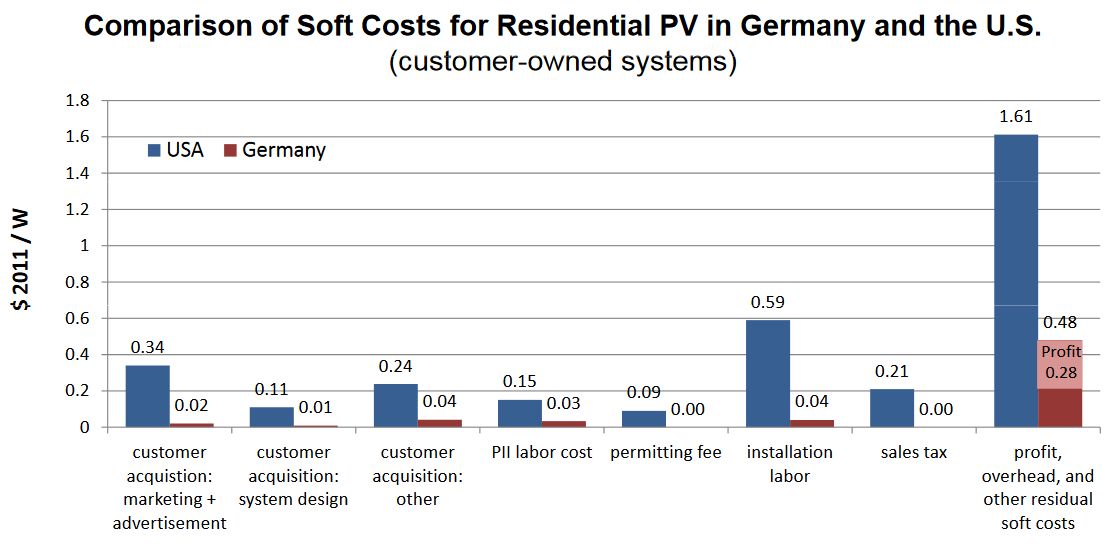
The reason that the U.S. is lagging behind in solar energy isn’t because of the cost solar photovoltaic (PV) panels. Solar PV is becoming increasingly more affordable as technologies advance to increase efficiency and manufacturing costs continue to decline. However, the cost associated with getting a solar system actually installed up on your roof rather has not declined as quickly. “Soft costs” make up more than 50% of the entire cost of solar PV systems in the U.S.  This isn’t the case everywhere though.  The graph below demonstrates the difference between solar installation costs in the U.S. and Germany (currently leading the world in solar generated power).  Soft costs in for solar installations are just a fraction of what they are in the U.S.

US and Germany soft cost of solar graphThis is why the U.S. Department of Energy is enticing communities around the nation to focus their efforts on burning through the red tape that drives project costs up. $10 million in cash awards go to the teams that install the most PV systems in American homes. How these teams will do it is completely up to them. If they are clever enough, maybe they will get through to city and state officials where environmental organizations could not.

There is a maze of rules and regulations to get through, but $10 million is a good incentive to find a way through it.

Graph from Grist (http://grist.org/climate-energy/why-is-rooftop-solar-cheaper-in-germany-than-in-the-u-s/).

Read Full Post »

While the proposed resolution to give Austin Energy governance responsibilities to an appointed board has been taken off the “consent agenda”, it’s still alive and kicking.

City Council will take up the issue at 6 p.m. this evening (Thurs, 2/14) and I hope you can take a bit of time before dinner to stand up for your rights. 

Austin Energy is a owned by us, the citizens of Austin.  Currently, we can influence the direction the utility takes by showing up at City Council meetings (just as I’m hoping you will tonight) and voicing your opinions.  The people of Austin have spoken passionately and convincingly on a variety of issues including development of strong solar energy programs,  assistance for the poor and keeping rates affordable for everyone.  City Council has often changed it’s course as a result of public outcry.  They do so because they know that they can be held accountable at the ballot box (or the electronic voting machine, as the case may be).

An appointed board could dramatically limit the ability that each of us has to ensure that Austin Energy is governed in a way that aligns with our values.

Some have argued that a board could focus more on the important issues at Austin Energy, but an appointed board is not the only option.  With City Council soon to be enlarged – when we move to the 10-1 system with geographic representation – there could easily be a subcommittee that focuses on the governance and oversight of Austin Energy.  If some members of City Council don’t wish to be burdened with the responsibility of governing our most (monetarily) valuable asset, then they could decline to serve on such a subcommittee.

Some Austin Energy customers who live outside Austin have complained that they have no representation in the governing body of Austin Energy (which is Austin City Council).  That’s a fair point and could easily be remedied by reserving one seat (or whatever is proportional based on population) on the subcommittee for an elected representative of those customers residing outside city limits.  What doesn’t make sense it to disenfranchise everyone just because some people aren’t currently represented.

Yes, the system could be more perfect and we at Public Citizen are always working toward making it so, but with all the awards and national recognition that Austin Energy has received, we must be doing something right.

So, please, make your voice heard at City Hall tonight.  The proposed resolution is “Item #46″ and will be taken up at 6 p.m.  You can register to speak or register your opposition at the kiosks in the City Hall lobby.  You can donate your speaking time to someone else, but you must be present at the meeting to do so. If you drive, you can park in the garage underneath City Hall and get your parking validated in the lobby.

If you can’t make it to the meeting tonight, send City Council a letter letting them know you oppose the formation of an appointed board to govern Austin Energy.

For more information, please visit www.cleanenergyforaustin.org.

Read Full Post »

Costs Would Increase; Existing Power Plants Would Get Windfall

The state’s electricity shortfall won’t be solved by paying utilities based on how much power they can generate, rather than how much they actually generate, a new Public Citizen report finds.

The report comes as debate rages among regulators and state lawmakers over how to keep the lights on in Texas. Demand for electricity is increasing while new power plant construction is slowing down.

Some want a “capacity market” – one in which power plant owners are paid for being ready to generate electricity. Others prefer to create incentives for reducing electricity consumption. A new study released today by Public Citizen found that the state’s electricity shortfall won’t be solved by a capacity market. Instead, a capacity market would just reward the owners of existing power plants with substantial windfall profits.

“Our study has found that a capacity market takes too long, costs too much and won’t be enough to keep the lights on,” said Tom “Smitty” Smith, director of Public Citizen’s Texas Office. “We’d be better off developing a new market structure that creates incentives for people to use less electricity.”

The debate about whether to pay electric companies for the energy they produce or the capacity to produce energy has occurred in many parts of the country over the past 10 years. The state’s Public Utility Commission (PUC) has been discussing this issue for more than a year and will consider it again on Thursday. It could vote on whether or not to create a capacity market.

To answer the question of whether a capacity market would benefit Texas, energy experts hired by Public Citizen analyzed a capacity market run by PJM, a regional transmission organization that coordinates electricity movement in 13 states and the District of Columbia, which is the market model most similar to the approach the PUC is discussing. Researchers found that replicating the PJM-run capacity market would take until 2015 and would cost between $1.2 billion and $2.3 billion a year.

In addition, such a market would divert resources from new, more efficient power sources. In the PJM market, $54 billion went to existing power plants while just $4.2 billion went to new resources such as gas, wind and solar.

“Creating a capacity market would take way too long and would cost way too much,” said Anna Sommer, president of Sommer Energy and the report’s principle author. “In addition, it would prop up dirty and inefficient energy plants. A capacity market clearly is not the solution.”

Added David Schissel, president of Schlissel Technical Consulting and a report co-author, “We looked at the other grid operators and their capacity markets and found that in those markets, existing fossil fuel and nuclear plants were the big winners.”

David Power, deputy director for Public Citizen’s Texas office said, “We have been debating this issue for several years. It’s time to act. Even consultants who are recommending a capacity market have concluded that the cheapest, fastest way to keep the lights on is to develop new ways to reduce the demand or the amount of energy we use at peak times when customer demand is highest. The commission can and should develop a one hour ahead demand reduction market.”

This is the first of two studies to be released this week by Public Citizen. The second study will focus on whether a shift to a capacity market would be enough to keep Energy Futures Holdings from slipping into bankruptcy.

The report is available here.

Read Full Post »

Couldn’t make it to the rally in Washington D.C. to protest the Keystone XL pipeline? It’s okay, neither could we! So instead we’re going to have a rally of our own to show our support and to raise climate change awareness here in Austin. Please join us at 5th and Lamar (in front of Whole Foods) on Sunday, February 17th at 2 P.M. Wear a blue shirt (or a No K XL shirt if you have one) and bring an anti Keystone XL/climate change awareness sign. Let’s make a statement that we won’t tolerate dirty energy any longer.

Read Full Post »

Texas Capitol - north viewTwo bills have now been filed in the Texas House that would expand the state’s goals for renewable energy.  Representative Rafael Anchia‘s bill, HB 723, would establish goals for growing renewable energy installations other than large-scale wind through 2022.  Similarly, Representative Eddie Rodriquez‘s bill, HB 303, would establish a goal for solar installations and increase the existing goal (which was met 15 years ahead of schedule) for all renewable energy for 2020.

We applaud these efforts and the leadership that Rep. Anchia and Rep. Rodriquez are showing by filing these bills.  These proposals recognize that success is a good thing and something we want more of.  You wouldn’t think that would need saying, but when a state agency recommends tossing out a successful policy, I start to wonder.  Texas’s renewable energy goals have been extraordinarily successful.  Not only have the goals been met ahead of time, but they have spurred development of the wind industry in Texas, bringing economic benefits to rural parts of West Texas, as well as to manufacturing centers.  On top of that, wind energy is helping to keep electric bills lower.

A carpenter doesn’t throw away her hammer just because she finished building her first book shelf and Texas shouldn’t repeal it’s renewable energy policies, just because we’ve met some of our goals (remember, the non-wind goal was never enforced).  Wind energy does now makes a substantial contribution to meeting the state’s electrical needs – it contributed a record 26% this past Christmas day, but solar energy is still very underutilized (accounting for less than 1% of energy on the ERCOT grid, which serves 85% of the Texas population) and the geothermal energy industry is still getting off it’s feet.  As Rep. Anchia and Rep. Rodriquez’s bills show, this successful policy tool can be adjusted to keep moving Texas forward.

Read Full Post »

Follow

Get every new post delivered to your Inbox.

Join 3,146 other followers