Feeds:
Posts
Comments

Archive for March, 2013

It wouldn’t be a Texas legislative session without some truly backwards bills.  Today we have House Bill 2026 by freshman Representative Sanford of Collin county that would eliminate our state renewable energy goals.

BeachWindIn 1999, the state of Texas made a commitment to renewable energy in the form of the renewable portfolio standard (RPS).  That decision played a major role in spurring the development of the wind industry in Texas.

We have now exceeded the renewable energy goals established in the 2005 update to the RPS and Texas has more wind energy capacity than any other state.[1]  On the surface that may seem to indicate that the RPS has been 100% successful and is no longer needed, but that isn’t the case.

One of the major reasons for establishing the RPS was to encourage diversification of our energy sources, which ultimately makes us more resilient to physical and economic forces that can impact the availability and price of energy sources.  While wind energy has increased from zero percent when the RPS was first established to around ten percent today, other renewable energy sources are still largely absent from our energy portfolio.

With more solar energy potential than any other state, Texas should be the center point of the solar industry as well.[2]  Instead we are lagging behind states with far less solar resources, such as New Jersey and Pennsylvania,[3] and are paying the price in missed opportunities for job growth and new generation capacity that can produce during peak demand.

Solar companies invest in California and other states, because smart policies created attractive markets in those places.  California has 1,505 solar companies compared to Texas’ 260. Even New Jersey has more, with 382.[4] Texas should be doing more, not less to attract solar businesses to our state.

SolarInstallProjections showing that we won’t have enough electricity to meet demand by 2020.[5]  The maximum wholesale price of electricity has been set to triple by 2015, without even determining what the cost to consumers will be.  There have been workshops and meetings to consider the prospect of implementing a capacity market in Texas, which would raise costs even more.  But little time has been spent considering simpler, cheaper solutions such as expanding efficiency and demand response (where customers get paid to reduce there energy usage for short periods of time when demand is high) and getting more solar capacity built in Texas.  Solar is most productive when we need it the most – on hot, sunny afternoons.

The RPS should be retooled to focus on solar and other renewable energy resources that are most capable of producing during peak demand.  Millions of dollars could be saved in the wholesale electric market if we had more solar panels installed.[6]

Solar, like wind, also has the benefit of needing very little water to operate.  Solar photovoltaic (PV) installations need an occasional cleaning to keep performance high, but the amount of water need is minimal in comparison to fossil fuel options.  Coal-fired generators need billions of gallons of water to operate each year[7] and while natural gas-fired generations consume less water than coal-fired generators, they still use more than solar, even without accounting for the millions of gallons of water used to extract the gas with hydraulic fracturing.[8]  Including more renewable energy in our portfolio will make our electric grid less vulnerable to drought[9] and will free up water supplies that are desperately needed for human consumption and agriculture.

Abandoning the RPS now would send a terrible signal to renewable energy companies that are deciding where to establish their businesses.  Our state made a commitment that isn’t set to expire until 2025 at the earliest.  There is no good reason to abandon the policy now.  We should be moving in the opposite direction of what is proposed in HB 2026.  Instead of giving up on a policy that has been successful, we should be looking at ways to build on that success and benefit our state.


[1] AWEA. “Wind Energy Facts: Texas.” Oct 2012. http://www.awea.org/learnabout/publications/factsheets/upload/3Q-12-Texas.pdf.

[2] NREL. “U.S. Renewable Energy Technical Potentials: A GIS Based Analysis.” July, 2012. Pg. 10-13. http://www.nrel.gov/docs/fy12osti/51946.pdf.

[3] SEIA. Solar Industry Data. http://www.seia.org/research-resources/solar-industry-data#state_rankings.

[4] SEIA. State Solar Policy. http://www.seia.org/policy/state-solar-policy.

[5] “Report on the Capacity, Demand, and Reserves in the ERCOT Region.” Dec 2012. Pg 8. http://www.ercot.com/content/news/presentations/2012/CapacityDemandandReservesReport_Winter_2012_Final.pdf.

[6] Weiss, Jurgen, Judy Chang and Onur Aydin. “The Potential Impact of Solar PV on Electricity Markets in Texas.” The Brattle Group.  June 19, 2012. http://www.seia.org/sites/default/files/brattlegrouptexasstudy6-19-12-120619081828-phpapp01.pdf.

[7] “Environmental impacts of coal power: water use” Union of Concerned Scientists http://www.ucsusa.org/clean_energy/coalvswind/c02b.html

[8] http://www.ucsusa.org/clean_energy/our-energy-choices/energy-and-water-use/water-energy-electricity-natural-gas.html

[9] Wu, M. and M. J. Peng.  “Developing a Tool to Estimate Water Use in Electric Power Generation in the United States.” Argonne National Laboratory – U.S. Department of Energy. http://greet.es.anl.gov/publication-watertool.


Read Full Post »

The House Energy Resources Committee is scheduled to hear Representative Dennis Bonnen’s bill, HB 2166, relating to the continuation, functions, and name of the Railroad Commission of Texas; providing for the imposition of fees, the repeal of provisions for the suspension of the collection of fees, and the elimination of a fee.

During the 81st interim session, the Texas Railroad Commission underwent a review by the Texas Sunset Advisory Commission.  During the 82nd Legislative session, the legislature failed to pass a bill reauthorizing the continuation of the Commission and instead added it to the ombudsman bill that extends an agency temporarily when it fails to get sunset legislation passed.  Now that bill is starting to move through the 83rd legislature and the first hearing is scheduled on Wednesday, March 27th starting at 2pm or upon final adjournment or recess of the House in John H. Reagan building on 15th Street between Colorado Street and Congress Avenue in room 120 (JHR 120).

To read the entire bill, click here.

We will keep you posted on this bill as it moves forward.

Read Full Post »

Public Citizen’s positions on the pre-filed amendments to the PUC Sunset bill can be viewed here: http://bit.ly/Guide_to_Amend_PUC_Sunset_bill_HB1600 or in the table below.

Support These Amendments to Improve the PUC Sunset Bill

Bar code # Sponsor Description Comment
830096 Cook clean up cleans up language in bill – no substantial changes
830097 Cook clean up cleans up language in bill – no substantial changes
830077 Davis bans sharing of customer info from advanced meters eliminates the value of smart meter – demand response providers may not be able to operate (NOTE: amendment to the amendment will fix this problem)
830076 Davis requires annual  review of certificate holders
830087 Davis requires written disclosure prior to releasing info from advanced meters protects customer privacy while allowing demand response providers to operate with permission of customer
830088 Davis makes utility liable for damages to advanced meter during installation or removal protects customer from unreasonable charges
830089 Davis bans billing for average use of electricity restricts customer choice (NOTE: amendment to the amendment will fix this problem by allowing customers to choose levelized billing)
830090 Davis reregulates the electric market assures adequate resources to meet the load
830101 King caps transmission congestion costs protects consumers
830104 Phillips prevents Texas generators from exporting electricity from ERCOT during an electricity emergency protects reliability in ERCOT
830084 Phillips bans cost recovery for interstate transmission lines out of state electric generators must finance their own transmission
830086 Rodriguez sets 35%  renewable portfolio standard by 2020 increases generation, local jobs and investment
830082 Strama establishes a peak energy portfolio standard improves reliability and increases local investment and jobs
830106 C Turner requires study by gas utilities on replacing their gas distribution lines improves safety
830072 S Turner requires legislative approval to increase the Universal Service Fund limits costs to consumers
830073 S Turner restricts cease and desist orders for customers to those causing a danger provides reasonable restrictions of PUC power and protects customers
830078 S Turner increases state penalties for market abuses and eliminates double jeopardy restores recommendation of Sunset Advisory Commission staff to increase fines for market abuse
830103 S Turner requires cost-benefit analysis when PUC makes significant market changes helps protect consumers
830102 Vo requires 30 day notice of discretionary changes in electric rates provides some customer protection against unexpected electric rate increases
830098 Walle limits water companies to one rate increase each 3 years and limits the amount of any increase protects consumers

Oppose These Bad Amendments to the PUC Sunset Bill

Bar code # Sponsor Description Comment
830095 Cook changes qualifications for PUC commissioners allows utilities to have too much control over commission
830100 Gonzalez gives PUC citing authority over a new plant in the El Paso area shouldn’t apply to just one company
830085 Krause eliminates the PUC’s ability to issue a cease and desist order jeopardizes reliability
830105 Laubenberg eliminates the PUC’s ability to issue a cease and desist order jeopardizes reliability
830091 Phillips interferes with reliability must run plans could jeopardize reliability and create inefficiencies
830092 Phillips requires CREZ lines to be buried in a specific municipality significantly increases electric consumers’ costs
830093 Stanford eliminates cease and desist orders for retail customers prevents the PUC from stopping abusive behavior and protecting reliability of the electric grid
830094 Sheets creates a 5 member Public Utility Commission two commissioners could meet without following open meeting requirements
830079 Simpson eliminates the PUC’s ability to issue a cease and desist order jeopardizes reliability
830080 Simpson eliminates cease and desist orders for retail customers prevents the PUC from preventing abusive behavior and protecting reliability of the electric grid
830081 Simpson shifts cost of opting out of advanced metering to other customers puts unfair cost burden on customers
830074 S Turner changes to single elected commissioner opens door to even more industry influence over regulators through campaign contributions

Read Full Post »

Whooping Cranes - Wikipedia Photo

Whooping Cranes – Wikipedia Photo

A federal judge has ruled that the Texas Commission on Environmental Quality was responsible for the deaths of 23 rare whooping cranes in the winter of 2008-2009.

Senior U.S. District Judge Janis Graham Jack in Corpus Christi found that TCEQ’s management of rivers feeding San Antonio and Aransas bays caused their salt levels to rise and says the state must develop a conservation plan to protect the last naturally migrating flock of the endangered birds.

Her order also bars the state from issuing any new water permits on the rivers.

Read Full Post »

2007 ACT coordinated over 1000 Texans to rally against a Texas Coal Rush

2007 ACT coordinated over 1000 Texans to rally against a Texas Coal Rush

Whether you’re concerned about eminent domain and oil & gas regulations, climate change and the effects of drought on our water supplies, or you’re ready to see Texas move toward a 21st century clean energy economy, the 83rd legislative session presents a critical opportunity to speak up for the environmental issues you care most about.

One of the biggest lessons we’ve learned over many legislative sessions is that no matter what the issue, legislators pay most attention when their constituents take time to write, call, and show up in person to discuss the issues that are important to them. As a member of the Alliance for a Clean Texas (ACT), we are working hard to achieve big gains for our environment, but if we’re going to win on issues like water conservation or state park funding, your voice MUST be heard.

Get started by registering for ACT Lobby Day today. Even if you can’t make all the way to Austin to meet face to face with your legislator or his/her staff, you can still have an impact by lobbying right at home in your district.

Because of your voices and hard work, last legislative session we saw significant gains on issues like energy efficiency and recycling. But with 67 freshman and sophomore members of the Texas House of Representatives this year – yes, 67 – we’ll need your help more than ever to educate and mobilize a broad grassroots response to the important environmental issues facing our state today.

Sign up for ACT Lobby Day and someone from our team will get in touch with you about making sure your state representative and senator know that clean air, clean water, and a healthy environment are key to growing the Texas economy.

Over a hundred Texans have already signed up to be there.  We hope to see you in Austin too.

Read Full Post »

algae-open-pondChlorella sp. is a species of algae that has a significant proportion of fatty acids to its body mass. For humans, this can be a problem. But, in a world needing more clean energy, fatty biomass is considered a promising option by many scientists and engineers.

Why algae? Algae can grow in a body of water almost anywhere. We don’t need to use any of our precious farmland to grow it. Water conservationists may initially be concerned, but a group of scientists found that Chlorella sp. thrives in our waste water. Not only that, it cleans up the water, removing ammonia and a host of toxic metals. According to their report, the algae could be used to help clean up waste water at municipal water treatment plants then harvested for biofuels.

graph_algaeI had a chance to speak with Dr. Martin Poenie, Associate Professor in Molecular Cell & Developmental Biology, at The University of Texas at Austin. The Poenie Lab is helping to develop a technique for harvesting the oils from algae that could greatly reduce cost. Dr. Poenie also told me algae can be a significant source of phosphates, which we use in fertilizers. One of the most significant things about algae biofuels, is their small carbon footprint and high energy content. CO2 is sequestered during the growth phase of the algae and it is not released until the fuel is burned. On the whole, biofuels from algae look promising, and the variety of products that can be derived from it will make algae farming even more profitable.

Texas could do more to capture the energy and job benefits from this home grown energy source. Texas Legislature should act to strengthen renewable energy goals. HB 303, SB 1239, and HB  723 would all be good steps in the right direction.

Read Full Post »

Would you decide who manages your retirement account by closing your eyes and pointing?  Probably not.

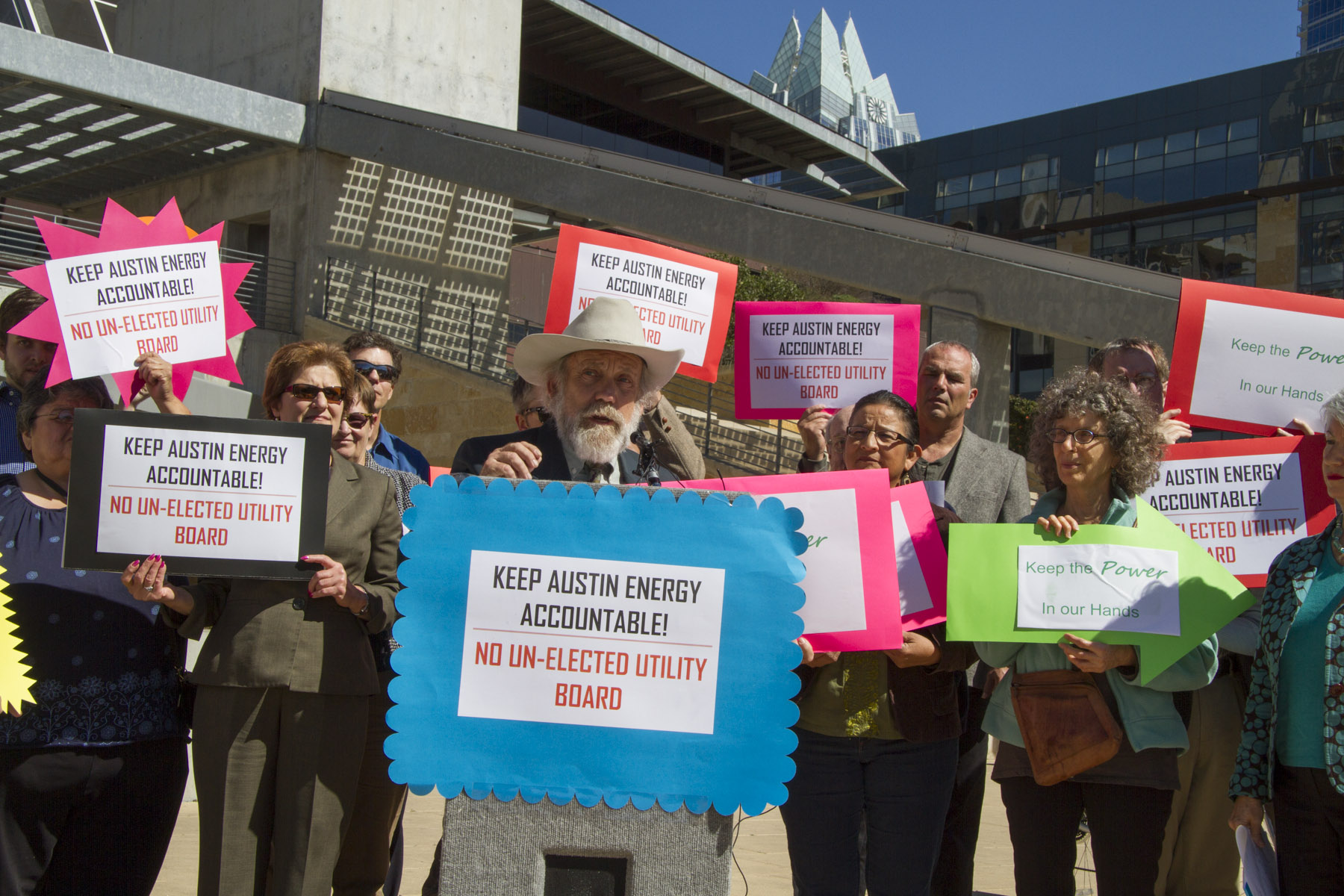
Press Conference RE: Austin Energy Governance 2-13-13Yet, Austin City Council is moving forward with a rash plan to hand over the bulk of its power to govern and oversee Austin Energy to an appointed board.  A well thought-out Austin American-Statesman editorial reveals the fool-hardness of making such a substantial governance change without even studying if it is needed or if the proposed change would yield better results than the current system of governance by the City Council.

This is one of those times when we need to remember that “the only thing we have to fear is fear itself.”  City Council (and a couple of our state legislators) have been reacting out of fear that Austin Energy, or parts of it, could be deregulated.  But, in light of the recent settlement reached with the out-of-town ratepayers, that is unlikely to happen.  We need City Council to stare their fear in the face and make a rational, fact-based decision.  Panicking now could cost our utility and our city for years to come.

Our city’s most valuable asset should be accountable to us, the citizens of Austin and the customers it serves.  Elections don’t always turn out the way I wish and some appointees do their jobs well, but I’m a populist, so at the end of the day, I want the power in the hands of the people.  With elections, we give power to individuals to do jobs an with elections we can take that power away.  An appointed board wouldn’t have to be responsive to citizen concerns and could make the vast majority of decisions about how Austin Energy is run and what to prioritize.

If, after studying the pros and cons of governance by City Council vs. governance by a board, City Council still believes that they are not the best people to oversee Austin Energy, an elected board would be a better option than an appointed board.

Let’s keep the power in our hands.

Tell Austin City Council not to approve an appointed board.


Read Full Post »

San Antonio Kick-Off is scheduled for Wednesday, March 13, 2013 at the Whole Foods Market Meeting Room, 255 E. Basse Rd. #130, San Antonio, TX, 78209

RSVP here!

This past year, Texas experienced one of its worst droughts: Reservoirs dipped to record lows, and as many as 500 million trees across Texas died.  In San Antonio, it seems everyone knows the level of the Edwards Aquifer, and recent storms have not brought adequate relief or repaired this damage.

The good news is that we can save millions of gallons through common-sense, cheap solutions like fixing leaky pipes and recycling water that we have already collected. But we need YOUR help. The best way to learn more and get involved is to join San Antonio’s Save Texas Rivers Kick-Off Wednesday, March 13 at 6:30PM.

Environment Texas will discuss Texas water policy, the importance of conservation, and ways to ensure a sustainable water future. RSVP here and bring a friend!

Read Full Post »

beforenafter1[1]The Keystone XL pipeline is embroiled in controversy from coast to coast. Environmentalists are rallied by its giant carbon footprint, the damage caused by spills, and the destruction of Canada’s boreal forests. Meanwhile, landowners are being forced to give up their property rights and cope with unacceptable safety issues.

More than thirty Texas waterways will be threatened by Keystone XL pipeline spills.  Tar sand is very difficult to clean up, especially in water.  And, Keystone XL is not required to pay the standard eight cents per barrel tax into the Oil Spill Liability Trust Fund, which means the cost to clean up any spills along the pipeline could become the tax burden of U.S. Citizens.  When tar sand comes into contact with water it begins to separate, leaving the heaviest, thickest product on the bottom.  Meanwhile, benzene and other airborne toxins are lifted to the surface of the water and evaporate into the atmosphere, directly threatening human life.

Burst pipelineLandowners in Texas have been confronted with having a tar sand pipeline cross their farms and ranches.  Ranchers and farmers have no choice where the pipeline lays down on their property.  The easement around the pipe is fifty feet wide, and there will be a kill zone around and under the pipe due to its temperature, which may exceed 158 degrees F. A running pressure of 1,600 pounds per square inch introduces the possibility of a stream with enough force to cut a person in two should a small rupture in the pipe occur.  But, problems with the pipeline do not stop at inherent danger.  The land owners are given a choice of payment for the easement, which requires them to pay taxes on the land under the pipe or, they can have the easement condemned, which leaves them without the right to use that property.  In truth, the land owners have no option when companies such as Keystone XL decide that a pipeline should cross their property, except to deal with the risks, or leave.

To make matters worse, the tar sands that would flow through the Keystone XL pipeline won’t even be used in the U.S. – they are destined for export to foreign countries.  So, we will incur the risks to our land and water and will suffer the consequences of climate change, but we won’t have any more energy security than we do now.  That’s a bad deal.  The risks associated with the Keystone XL pipeline are unacceptable. Most importantly, these risks are avoidable.  Let President Obama know that you want him reject the Keystone XL pipeline because the risks don’t outweigh the benefits.  The recently released draft Supplemental Environmental Impact Statement (SEIS) from the U.S. Department of State acknowledged that construction of the Keystone XL pipeline would create “numerous” and “substantial” impacts on the environment, but it claims the project is better than the alternatives.  If you disagree, as I do,  send comments on the draft SEIS via email to: keystonecomments@state.gov.

Read Full Post »

Today, the the Department of State released a Draft Supplemental Environmental Impact Statement (SEIS) for the new Presidential Permit application for the proposed Keystone XL pipeline.

The SEIS acknowledges that the construction of the controversial Keystone XL pipeline would create “numerous” and “substantial” impacts on the environment, but they are claiming that the project is a better than any of the alternatives, essentially clearing the project to go ahead.

The report concluded that the tarsands diluted bitumen (dilbit) that the pipeline will transport into and across the U.S. produces 17 percent more greenhouse gases than heavy crude oil refined on the Texas Gulf Coast. In addition, it said the construction phase of the project would result in carbon dioxide emissions equivalent to about 626,000 passenger vehicles operating for a full year.

The Draft Supplemental Environmental Impact Statement, once published by the EPA, starts the clock on the public comment period.  At this time, we expect the SEIS to be published sometime next week.  Our best guess is Wednesday.  From that point, the public will have 45 days to comment on the document, so let’s dust off our legal pads and pens and start drafting our comments.  Having spent three days on a bus and marching around the mall in Washington DC in freezing weather with many of you, I know you have a lot to say.

Comments can be addressed to the following mailbox: keystonecomments@state.gov.

Read Full Post »

We Texans and Public Citizen  Support Crawford Family as Legal Action Continues Against Keystone XL Southern Segment – #NoKXL

Yesterday, Landowner Julia Trigg Crawford and her attorney Wendi Hammond announced that they have filed their appeal against TransCanada with the 6th Judicial Court in Texarkana.  The brief disputes TransCanada’s attempt at taking Crawford’s property on the basis that TransCanada has yet to prove the company is a common carrier, but is instead a private foreign company utilizing its pipeline for private gain.

“Our appellate brief is now in front the Sixth Circuit Court of Appeals and we are confident this panel of experienced judges will give all the issues the thoughtful consideration and thorough review they deserve,” noted landowner Julia Trigg Crawford.  “Since the lower court’s ruling against us in August we’ve worked diligently to elevate the dialogue around property rights and eminent domain abuse.”

“Since before 1920, the Texas legislature wisely limited the enormous power of eminent domain authority to a common carrier subject to the Texas Railroad Commission’s (RRC) jurisdiction and other legal requirements. In the Crawford family’s case, the RRC admitted it does not have jurisdiction over TransCanada’s pipeline, but the trial court allowed TransCanada to take the Crawford’s private land anyway,” commented Hammond, Crawford family farm attorney. “This decision highlights a serious problem, not just for the Crawfords, but for many families across Texas.  Now this important matter will be decided by a higher court.”

Groups including We Texans and Public Citizen are supporting Crawford and her family in their continuing resolve to pursue this landowner’s case to a higher court.  The groups view this precedent setting case as a private company attempting to take land for private use and foreign profit.

Debra Medina, executive director of We Texans, applauded the Crawford family’s courage in continuing their opposition to the taking of their property.  “We agree with the Crawford family in believing that there has been an erroneous ruling against them and hope that the appellate court will right that wrong.  In doing so, the court can protect not only the Crawford Family farm, but also set a precedent that will ensure the law is followed and all private property in Texas is duly protected.”

“What’s at stake here is whether the state should allow a public agency to allow condemnation for private gain. The Crawford case is emblematic of the failure of the Texas Railroad Commission to effectively ensure that companies doing business in Texas are indeed a common carrier,” commented Tom Smitty Smith of Public Citizen.  “The State has laid this burden of proving up common carrier upon landowners such as the Crawfords, while the proof should be incumbent upon those who want to business here in Texas. The entire process needs to be overhauled.”

“The Railroad Commission allowed TransCanada to have the status of a common carrier, yet the agency has stated that it doesn’t not have the authority to give eminent domain powers to TransCanada,” added Smith.  “TransCanada has yet to prove to the court that they are transporting the product for the public good or for the public for hire as required by law.”

“Currently, there is a loophole in Texas law that allows a company to simply check a box on a one page form at the Railroad Commission that allows companies to declare themselves a common carrier without any checks and balances,” noted Rita Beving, North Texas Public Citizen organizer.  “Last summer we started a dialogue with the Texas Land & Resource Management Committee regarding this problem.  We are hoping the matter of common carrier and eminent domain gets rectified during this year’s legislative session.”

“I’ve testified to legislative subcommittees at our state Capitol, shared my story with the Sunset Commission in their review of the embattled Texas Railroad Commission, and traveled to Washington, D.C. twice to speak to governmental agency representatives and support groups,” Crawford added.  “At the heart of this issue is the fact the Texas Railroad Commission has seemingly abandoned Texas landowners.  By their own admission, they are aware that companies use the T-4 form to demonstrate to the public that the company is operating as a common carrier pipeline with eminent domain authority when, in fact, the RRC operating permit provides no evidence of that fact at all.”

“What was once just the voice of Texas landowners is now a national issue, with all eyes upon Texas and how our Legislature will step up to repair this grossly flawed land condemnation process,” Crawford concluded. “I stand at the ready to continue shining a light on what’s really happening on the ground to Texas landowners as we protect our land, and we look forward to a positive outcome in our appeal.”

TransCanada has initiated construction of the southern segment of the Keystone XL pipeline along its 485-mile trek from Cushing to the Texas coast. TransCanada will pump Canadian tar sands crude or Dilbit to refineries on the Gulf coast.  The northern segment of the Keystone XL awaits approval by the State Department for its presidential permit.

In the meantime Enbridge, TransCanada’s Canadian competitor, has begun surveying for an additional twin line to the existing Seaway pipeline near the DFW area.  Both Enbridge’s 36-year old repurposed Seaway pipeline and the new twin line will carry tar sands from Cushing to the coast.  The dual Enbridge lines are expected to exceed Keystone’s capacity with 850,000 barrels per day of tar sands crude.

Enbridge is currently responsible for the largest and most expensive onshore spill in history.  The Michigan spill occurred in July 2010 carrying tar sands crude through a 43-year old repurposed line.  Two years and more than $850 million later, the spill is still being cleaned up on the Kalamazoo River.

“Landowner fights such as that of the Crawford family with TransCanada have sparked a new battle on a whole new front with another Canadian company,” Beving concluded.  “Many of us are now getting calls from landowners now worried about Enbridge, which also plans to carry dangerous Dilbit crude through its pipelines from Cushing to the coast.”

Click here to read a copy of the brief.

Read Full Post »