Feeds:
Posts
Comments

Archive for the ‘Campaign Finance’ Category

Our partners at Progress Texas are hosting a special screening of the documentary Koch Brothers Exposed at the Alamo Drafthouse on South Lamar on Monday, December 3rd at 6:30 PM.  They have already sold out more than half the theater – be sure to reserve your seats now before they sell out!

From director Robert Greenwald (Outfoxed, WalMart: the High Cost of Low Price), comes a terrific documentary film on Charles and David Koch—two billionaire brothers who have bankrolled a vast network of organizations that work to undermine middle class interests on issues ranging from Social Security to the environment to civil rights. This film uncovers the Kochs’ corruption—and points the way to how Americans can reclaim their democracy.

After the screening, Progress Texas will host a 30-minute discussion and Q/A with invited speakers Texas State Representative Garnet Coleman, Austin Chronicle Political Reporter Richard Whittaker, and others.

Purchase Ticket

The price per ticket for a non-sustaining donor is $20. This includes entry for the movie AND a $10 credit towards the purchase of any food or drinks.

As always, Progress Texas sustaining donors get in free, but space is limited. To make sure you have a seat you will need to reserve your ticket for $10. That $10 will be put directly to a food and drink credit. If you are a current sustaining donor and interested in attending this event or have questions, please contact mark@progresstexas.org for more information.

Check out the trailer below and make sure to get your reserved seat ticket today!

Koch Brothers Exposed

Read Full Post »

The controversial 2010 Supreme Court decision Citizens United – that gave corporations untold influence in our electoral system and said “money” is “speech” – has created an environment in which millions of dollars in corporate cash is drowning out the voices of Texans.

It is time for Texans to demand the end of unlimited money in our elections and take action on a local level.

We are proud to support a homegrown Texas grassroots movement called Texans United to Amend in their efforts demanding local governments across the state of Texas pass resolutions supporting a constitutional amendment to reverse Citizens United and declare that only human beings are entitled to rights under our constitution.

We are joining Texas United to Amend to ask for you to make a difference in your community and sign this petition urging your local government to pass a resolution that seeks an amendment of the U.S. Constitution that firmly establishes that money is not speech, and that only human beings, not corporations are entitled to constitutional rights.

Sign the petition today and call on your local government to pass a resolution.

You might be asking – why local governments? Isn’t this a federal issue?

Social change has always come from grassroots groups, with speeches and marches in the street. This has been true of both the direct election of Senators (17th Amendment) and Women’s Suffrage (19th Amendment). The movement for a constitutional amendment to remedy Citizens United is, at its core, a grassroots one. It is driven by real concerns about the health of our democracy that reverberate in each and every community in Texas.

Passing local resolutions at the local level in Texas is the necessary first step toward restoring free and fair elections to the American people, both locally and nationally. Your work, along with coalitions like Texas United to Amend, can make a difference.

Click here and join Texans United to Amend in calling on your local government to pass a resolution that seeks an amendment of the U.S. Constitution that firmly establishes that money is not speech, and that only human beings, not corporations are entitled to constitutional rights.

Across the country, ordinary citizens like you are making their voices heard.  Nine states have already passed resolutions calling for a constitutional amendment to overturn Citizens United, and many more states are considering the same. If you want to do more, let us help you set up an organizing meeting the week of October 8.  This will be an exciting way to begin planning for the third anniversary of the Citizens United v. Federal Election Commission ruling and to prepare to gather petition signatures on election day when millions of potentially interested voters go to the polls.  Click here to get more information and sign up.

Read Full Post »

By Michael Tahmoressi, St. Edwards student and Public Citizen intern

Texas can be characterized as a pay to play environment.  Politicians bend to their districts business interests and gubernatorial appointees seem to be selected based on the amounts they contribute to the governor.

Contributions Equal Access and Appointments

Rick Perry has taken this to a new extreme with the deal he appears to have struck with Harold Simmons, a billionaire chemical industry mogul whose latest project is a radioactive waste repository in Andrews county Texas. Simmons single handedly pushed his project forward, boasting about it in a rare interview in 2006.  Click here to read D Magazine’s article “Harold Simmons is Dallas’ Most Evil Genius.

State engineers and geologists strongly objected to licensing the dump, expressing concern that radioactive material could contaminate groundwater in the region.  Three staff scientists at the Texas Commission on Environmental Quality resigned rather than sign off on the licenses. Nevertheless, Rick Perry spearheaded the approval of the waste dump, operated by Waste Control Specialists (WCS) and the TCEQ executive director, Glenn Shankle, approved the application, just a few months before he went to work as a lobbyist for WCS.  Click here to read Public Citizen’s report The Repository and the Risk.

The next step of the plan was to open the facility up to allow other states to dump their waste in the site.  That decision lay in the hands of the Texas Low-Level Radioactive Waste Disposal Compact Commission (TLLRWDCC), comprised of six Texas commissioners appointed by Perry.  Two additional commissioners appointed by Vermont fill out the Compact Commission.  In 2010, eleven days after Governor Perry was re-elected, the Compact Commission voted 5-2 to approve rules that would make Texas the radioactive waste disposal site for the country.

The Texas Sunset Advisory Commission flagged this potentially huge liability problem in its report on the Texas Commission on Environmental Quality:

“Texas, and not the Compact Commission nor the disposal facility licensee, holds liability for compact waste brought into the state. Low-level radioactive waste can be radioactive for a long time, and potential future contamination could not only have a severe impact to the environment and human health, but to the State, which bears the ultimate financial responsibility for compact waste disposal facility site.”

A Texas observer article goes on to explain that the state would not only be forced to take care of any potential contamination problems but also the closure of the waste dump. This is clearly illustrates the biggest problem in our state the power does not lie in the hands of the people but in the business sector. Click here to read the article from the Texas Observer.

Double Dipping: An Acceptable Practice?

The case of State Represenative Joe Driver, (R-Garland) is another example.  Driver, who was convicted of felony abuse of official power, admitted in an interview in 2006 that he pocketed taxpayer money for travel expenses that his campaign had already paid. Click here to read the Texas Tribune article.  For years he had been double dipping, submitting the same receipts to his campaign and the state for airline tickets, meals, incidentals; collecting thousands of dollars in state mileage reimbursements for travel in vehicles for which his campaign had already spent more than $100,000 since 2000. This resulted in his campaign covering these travel costs, while he pocketed the profit by reimbursing himself with taxpayer money.

The Attorney general has not done enough to stop criminals like Driver.  Abbott’s ethics probes have been terribly inadequate.  Of the 57 probes he has started since his term in office began in 2002 only half of those resulted in convictions and a majority of those were for only minor infractions.

Abbott is a power broker with a political war-chest of over 8 million dollars.  Ninety nine percent of that can be traced back to business interests, more than $1 million from the business sector with the top contributors Houston homebuilder Bob Perry who gave the attorney general $470,265 in addition to Houston’s John Nau, Kenny Troutt, who made a fortune from his Excel phone company and energy and water investor T. Boone Pickens following close behind.

Texans need a justice agency they can trust to stop this hijacking of our democracy politicians that are either being rented by big business lobbies or are trying to get a cut of the action.

It Was A Gift, Not a Contribution

Legislative power broking has become normal practice in Texas.  Lobbyists’ daily activities in the capital involve massaging the backs of legislative members and their staff with gifts of food and activities, and functional bribes, in the form of monetary campaign promises or the problem State Representative Kino Flores (D-Palmview) in the valley encountered.

Flores had been receiving money from local businesses for years and not properly filing required reports on them. He was indicted for accepting gifts and failure to report them to the state. Overall, he failed to disclose $115,000 to $185,000 of income each year from 2004 to 2009.

Blatant corruption taints our democracy, how can citizens believe in their governments officials to manage the state, when the balance of power has gradually shifted to the moneyed elite. The general population is so removed from policy implementation they usually only show interest in issues that directly affect them; making it appear that they are okay with a level corruption when the reality is that they are unaware of the corruption or feel powerless to do anything about it. This is inherent to our economic system that demands efficiency and results at the expense of ethics.

Politicians for Sale or Rent, Rooms to Let – 50 Cents

Politicians aren’t for sale in Texas, they are for rent.  There was a study done by Larry Bartels professor at the Woodrow Wilson School of Government about economic inequality and congressional response. Bartels found that senators are more likely to respond to concerns brought forward by members of the top ⅓ of their district’s total constituency. Bartels also found that senators never voted or responded to the concerns of the lower economic ⅓.  Click here to read the report.

If the game is rigged towards the top ⅓ of our population because money buys influence, what are the rest of us supposed to do to get our voices heard? 

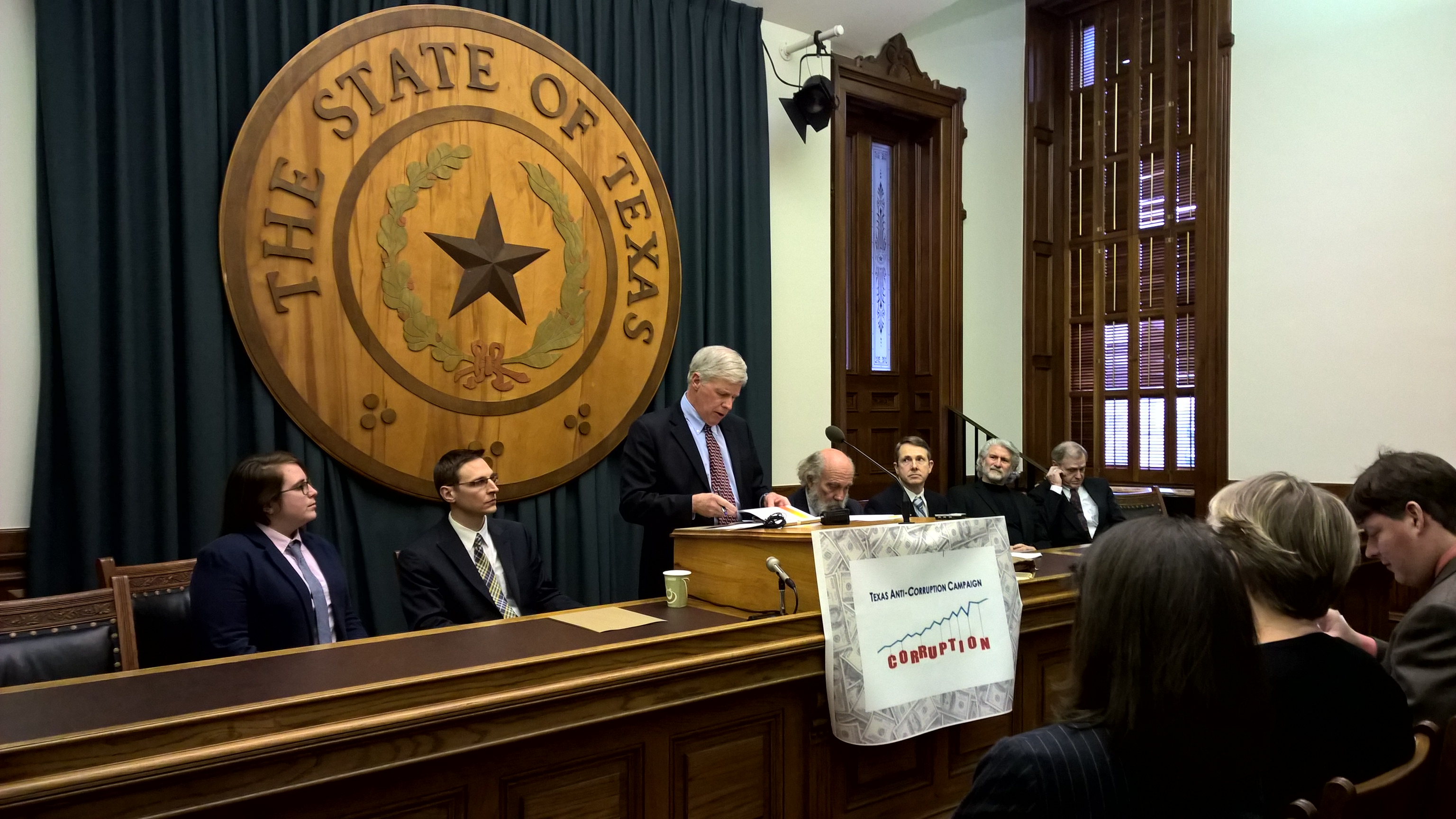
Tom “Smitty” Smith of Public Citizen and 15 other advocates from legislative watchdog groups had an answer. On April 10th, testifying in front of the Texas Sunset Advisory Committee they urged the committee to make the Texas Ethics Commission (TEC) an enforcement agency and to expand their authority to investigate beyond minor infractions.  In addition, they recommended that a TEC enforcement director be given greater authority to subpoena records, that the legislature expands what is disclosed by candidates each election cycle and that they create a limit on the amount that individuals can contribute.

Public watchdogs speaking out against corruption at the TEC Sunset hearing is tantamount to sustaining what is left of our democracy in Texas. It’s impossible to place personal responsibility on the people for not participating in rooting out corruption because the power is not in their hands and the very folks responsible for representing them are being bought by big business groups.

Public Citizen and other watchdog groups are the vanguard of citizens who are committed to accountability.  We hold those in the government, who believe their positions put them above the law, accountable and demand that there be a reverse in the flow of power back to the people.  Public hearings like the one on April 10th allow us the ability to present our grievances.

The system may be sluggish and cumbersome, but Public Citizen is committed to maintaining and expanding a network of allies who are committed to holding Texas government officials accountable for the misuse and abuses of power.

Read Full Post »

Statement by Tom “Smitty” Smith, Director of the Texas office of Public Citizen

It’s time to unshackle Texas’ ethics watchdog and give it some teeth.

A recent study by the  Center for Public Integrity, Public Radio International and Global Integrity found that when it comes to government openness and accountability, Texas ranks in the lower half of all states.

While the language of the laws received a B- grade in the study, when it came to implementing the laws (or disclosing and enforcing them), Texas got a D+

Among the faults found in the study, four stand out as most egregious: The Lone Star State’s poor financial disclosure laws make it almost impossible to tell when an officeholder has a conflict of interest; lobbyists can make unlimited contributions to legislators to influence policy; contributors or their employees can be appointed to regulatory agencies – and adopt policies to benefits their business interests; and the revolving door is kept spinning by loopholes that allow government officials to go to work for the businesses they regulated or had legislative control.

While Texas should be performing better, the ethics commission isn’t to blame. It has been handcuffed since it started. Instead of policing the politicians, the watchdog is protecting them.

It is time for Texas to get tough on political crimes, stop protecting the politicians and treat the ethics commission as if it were just another professional regulatory agency. The commission should have the authority to take enforcement actions and hear complaints without needing to check in with a board of political appointees.

The Ethics Commission will undergo Sunset review this year. In advance of discussions about necessary reforms for the commission, which are slated for April 10, ethics watchdog groups will make public a comprehensive reform package. It’s time to give Texas the ability to rein in out-of-control, unethical behaviors.

Check out the excellent coverage of this issue by the Texas Tribune

Texas Gets a D+ in Public Integrity Study

Texas: The story behind the score

Read Full Post »

According to the Texas Energy Report, state environmental regulators appointed by Gov. Rick Perry issued a permit in January for a Houston-area industrial waste injection well to a company whose top investors include some of Perry’s close friends and campaign contributors.

The Texas Commission on Environmental Quality (TCEQ) approved the permit over the objections of the Texas Railroad Commission (whose commissioners are elected) and every state and local official representing Montgomery County, and in spite of an administrative law judge’s recommendation to deny the permit because the well might pollute groundwater.

Perry’s presidential campaign opponents have criticized him for “crony capitalism,” the appearance of a pay-to-play culture that gets favorable state government treatment for his campaign donors. Perry also has been criticized for state environmental regulation that appears to put business ahead of environmental quality and safety.

All those issues are raised in the environmental commission’s actions on the permit sought by TexCom  Inc. of Houston and its investors with close ties to Perry.

Major investors in the injection well include Texas A&M University System Regent Phil Adams and Barry Switzer, a former football coach for the University of Oklahoma and the Dallas Cowboys.

Adams is a friend of Perry’s from their days as students at A&M. He has donated almost $300,000 to Perry’s state campaign fund, and at one time or another he has employed both of Perry’s children in his Bryan insurance agency. Another Adams investment became controversial in Perry’s gubernatorial re-election campaign last year when it was revealed that the company received a $2.75 million grant from the state’s Emerging Technology Fund.

Switzer raised more than $57,000 for Perry’s 2010 re-election and attended Perry’s primary election victory party. This August, Switzer hosted a fundraiser for Perry’s presidential campaign that took in $273,500.

Adams and Switzer are investors in a subsidiary of TexCom Inc. The company fought for five years to obtain the permit for a Montgomery County site for an injection well for industrial waste, mostly generated by the oil and gas industry. TexCom has reported that the site has the potential to generate $20 million a year in revenue.

Switzer became involved with TexCom in 2006 when he led investors to put $6 million into the company. Then in 2007, Switzer and two other Oklahoma investors founded Foxborough Energy Co. LLC and Montgomery County Environmental Solutions, which together bought at least a 60 percent share of the TexCom subsidiary that was seeking the Montgomery County well permit.

Adams’ state financial disclosure reports have shown him as an investor in the two Oklahoma companies since 2008.

Texas Ethics Commission undergoing Sunset Process

The Texas Ethics Commission (TEC) has responsibility for civilly enforcing our state’s campaign finance laws. In the agency’s Self-Evaluation, they reported that in in 2009 they received 274 complaints from the public and there were zero initiated by the agency.  In 2010, they received 374 complaints from the public and again, zero initiated by the agency.  If the TEC is to be an effective enforcement agency, it must be restructured so that it operates like all other civil state law enforcement agencies.

Those concerned about the appearance of pay-to-play politics should ask the Sunset Commission to recommend the legislature make changes to the Texas Ethics Commission that:

  • Prohibit any contributor of more than $100 from being appointed to any board commission or office or contracting with the state  for 2 years after the contribution is made
  • Prohibit state agencies from contracting or giving grants to contributors of the Governor, Lt Governor or Speaker of the House.

Any community could fall victim to “crony capitalism” and Texans have an opportunity to ask their representatives to make it stop!

Read Full Post »

Bastrop Texas wildfires

Wildfires rage over Labor Day near Bastrop, TX, southeast of Austin


Our hearts, prayers and thoughts go out to the people currently evacuated and who have lost their homes this holiday weekend. I, myself, having gone through losing a home to fire I send my best to all of you affected, and have already contacting folks via our church to find out how we can help. I’ll post links as soon as I can get them to give directly to disaster relief. UPDATE: KVUE has a great list they are updating with where to donate. Please give what you can.

This puts into focus several things that have been ruminating in my head all weekend, and it all comes back to this one question– Why does Rice play Texas?  This weekend, two of our nation’s best universities met on the football field. And while both Rice and University of Texas can duke it out on relatively equal footing on the basis of academics, Rice is. . . shall we say, not the athletic powerhouse that Texas is. So, why does Rice always begin its football season with a drubbing of 34-9 (hey, tip of the hat for getting 9 points on the scoreboard– I guarantee there will be teas that do less this year), with the Owls now having lost 41 games out of the last 42 meetings to the Longhorns? And here the answer lies with the other goings-on of this long weekend.

It started with a bang and whimper as our Caver-in-Chief, President Obama, announced he would overrule both the Supreme Court in Whitman v American Trucking Associations and the EPA in pulling back on the agency’s interstate smog rule that has been in the works since the Bush Administration. As Prof of Law Lisa Heinzerling points out in an excellent post over at Grist called Ozone Madness, this decision is wrong based on the law, the science, the economics, and the transparency.

While the President is trying to, I’d assume, take what he sees as the high ground and compromise with those people who claim that these regulations kill jobs, the opposite is, in fact, true. These National Ambient Air Quality Standards, or NAAQS, are set by the Clean Air Act and, defined by the Supreme Court, are to be based on the best available science about what levels of pollutants are healthy for human beings (people like you and me) to breathe. Tea partiers and some of their corporate paymasters in the fossil fuel industry have been caterwauling that these rules will be “too expensive” to implement, and therefore shut down a lot of old, dirty power plants.

coal smokestacks polluteUmmmm.. . . yes, please? Couldn’t we, nay, shouldn’t we shut them down? Our best available science tells us these pollution sources are making us sick. We need these life-saving regulations to help all of the sick children, the elderly, and just the plain folks who  suffer from asthma and other respiratory disease. Count up the missed school days, the missed work days, the premature deaths– count how they hobble our economy. How can children compete in a global economy if they are missing days from school sick because they can’t breathe? How much work is done not on time? How much lost productivity have we hamstrung our economic engine with to cater to people who don’t know how to compete in a modern energy economy against cleaner forms of production? Because the new EPA rules won’t shut down all power plants, only those who can’t compete, who can’t run cleanly. And since there is also good evidence to show that these sorts of life-enhancing regulations actually help, not hurt,  the economy. It also rebuts the White House’s own stated position that they posted just one. day. earlier. that clean air helps the economy, preventing in this year alone:

  • 160,000 premature deaths;
  • More than 80,000 emergency room visits;
  • Millions of cases of respiratory problems;
  • Millions of lost workdays, increasing productivity;
  • Millions of lost school days due to respiratory illness and other diseases caused or exacerbated by air pollution.

So aside from the doublespeak and the just plain bad policy, it looked like the Obama Administration is also taking early steps to signal that they will approve the Keystone XL pipeline to bring the world’s dirtiest and most carbon-intensive source of oil on the planet to Texas Gulf Coast refineries, despite weeks of protests involving thousands of people and hundreds of arrests.

The impact on the climate if this is approved? Well, according to Jim Hanson, one of our top climate scientists, he called it “essentially game over.” Or, as Bill Paxton in Aliens put it:  (WARNING: NSFW for swearsies, including the dreaded f-dash-dash-dash word)

Ok, well, all kidding aside because this is deathly serious, as in the fate of the planet’s climate, THIS is what Jim Hanson told climate protesters outside the White House just before he was arrested for his part in the protest.

Bill McKibben, environmental activist and one of the ringleaders of the several weeks long protest event, said this on Friday about how this is not the end of the protests, it’s only the beginning:

These are serious stakes. “Game Over” stakes. What does that mean? Well, for climate, if you’ve liked the record-breaking heat this year in Texas, you’re in luck, as this could easily become the new normal with climate change. And with the heat, we’ve got the huge economic impacts of the drought. For farmers and ranchers, the Dallas Morning News is reporting a 5 billion dollar loss. Thats Billion with a B, folks.

So next time someone starts talking about how it’s “too expensive” to deal with climate change, do what the Violent Femmes say to do and “Add it Up.” (warning:song lyrics also NSFW because of those darn swearsies)  Loss from hurricanes like Irene, loss from this summer’s floods and tornadoes in Joplin, loss from drought, loss from wildfires, loss to the economy from dirty air (since hotter temperatures mean worse smog), and tell me that just continuing to do nothing and just putting more carbon into the atmosphere is potentially the most expensive thing we can do.

JFK speaking at Rice University

So, what does this have to do with Rice vs Texas? Well, what we have here is political expediency and taking the easy path instead of fighting for what is right. Regulations, regardless of their impact on a multinational corporation’s bottom line, save lives, and improve lives. This is what Ralph Nader fought for when he wrote Unsafe at Any Speed. Corporate whining and their record-breaking profits are not more important than people, and people’s’ rights to breathe clean air, or live in a stable climate. I, for one, am not willing to give up on Central Texas, and let this become the new normal for climate. When I first came to Austin, my literal first impression of the area was “I now understand why people were willing to die at The Alamo to protect this land.”


Decades ago, another President came to Texas to challenge a nation to go to the moon before the end of the decade, and asked an assembled crowd at Rice University the magic question.

“Many years ago the great British explorer George Mallory, who was to die on Mount Everest, was asked why did he want to climb it. He said, “Because it is there.” … But why, some say, the moon? Why choose this as our goal? And they may well ask why climb the highest mountain? Why, 35 years ago, fly the Atlantic? Why does Rice play Texas?

President Kennedy answered his own question:

“We choose to go to the moon in this decade and do the other things, not because they are easy, but because they are hard, because that goal will serve to organize and measure the best of our energies and skills, because that challenge is one that we are willing to accept, one we are unwilling to postpone, and one which we intend to win.”

Climate change is the same challenge, which I previously hit on in another blog post where I also used this quote. It is certainly one we must be willing to accept, unwilling to postpone, and which we intend to win.

But, most importantly, he notes that “But this city of Houston, this state of Texas, this country of the United States was not built by those who waited and rested and wished to look behind them. This country was conquered by those who moved forward.”

Let me take liberty with JFK’s speech where he talks about the need to build a space industry and replace it with a clean energy economy. “If this capsule history of our progress teaches us anything, it is that man, in his quest for knowledge and progress, is determined and cannot be deterred. The [creation of a clean energy economy] will go ahead, whether we join in it or not, and it is one of the great adventures of all time, and no nation which expects to be the leader of other nations can expect to stay behind in this race for [clean energy].  Those who came before us made certain that this country rode the first waves of the industrial revolution, the first waves of modern invention, and the first wave of nuclear power, and this generation does not intend to founder in the backwash of the coming age of [energy]. We mean to be a part of it—we mean to lead it.

Our economic torpor, our environmental problems, and yes, our hurricanes and droughts and wildfires, are ALL things we can solve if we are willing to take this same leadership role. Surely there will be pollution in the future, there will be recessions, there will be storms and droughts and fires– but they will NOT be supercharged by an ever-increasing blanket of carbon making our planet warmer and warmer. We must stop doing the same things over and over, relying on fossil fuels, and expecting different results. We must put our courage to the sticking place, and say that we will not allow the voices of a few, economically powerful and well-connected industries to wreak untold havoc on us and our neighborhoods.

You’ll notice, in JFK’s speech, he talks about the costs that a trip to the moon will require. He advocates not spending money recklessly, but in spending a large amount of money to win this challenge.

To be sure, all this costs us all a good deal of money. This year’s space budget is three times what it was in January 1961, and it is greater than the space budget of the previous eight years combined. That budget now stands at 5 billion 400 million dollars a year—a staggering sum, though somewhat less than we pay for cigarettes and cigars every year. Space expenditures will soon rise some more, from 40 cents per person per week to more than 50 cents a week for every man, woman and child in the United States, for we have given this program a high national priority—even though I realize that this is in some measure an act of faith and vision, for we do not now know what benefits await us. But if I were to say, my fellow citizens, that we shall send to the moon, 240 thousand miles away from the control station in Houston, a giant rocket more than 300 feet tall, the length of this football field, made of new metal alloys, some of which have not yet been invented, capable of standing heat and stresses several times more than have ever been experienced, fitted together with a precision better than the finest watch, carrying all the equipment needed for propulsion, guidance, control, communications, food and survival, on an untried mission, to an unknown celestial body, and then return it safely to earth, re-entering the atmosphere at speeds of over 25 thousand miles per hour, causing heat about half that of the temperature of the sun—almost as hot as it is here today—and do all this, and do it right, and do it first before this decade is out—then we must be bold

However, I think we’re going to do it, and I think that we must pay what needs to be paid. I don’t think we ought to waste any money, but I think we ought to do the job.”

President Obama will be giving a speech on jobs later this week. In it, I’d love to hear even a smidgen of the boldness and realism of Kennedy. I’d love for him to recant his statement on the EPA smog rule, and say that he will stop the Keystone XL pipeline, as it will only increase our dependence on oil when we need to be quitting it. But I doubt it.

But, it could be worse. We could be realistically thinking about electing as President of the United States someone who believes climate change is a hoax, that climate scientists are in it for the money, and the best way to run a state is to slash the budget of the Forest Service, the agency responsible for fighting fires in Texas, by $34 million– almost one-third of its budget– on the eve of one of the most destructive fire seasons ever. It is worth noting that during the sunset hearings on the Texas Forest Service I testified as to the need of the Forest Service to engage in extra forecasting as to what a climate-change-fueled fire season would look like and be prepared to fight it, so this is a little bit of a personal issue for me.

Apologies for the political birdwalk and the sniping at the two likely major-party candidates for the Presidency. What is clear is what JFK was talking about: we must do things like fight climate change not because they are easy, but because they are hard, and because they are a challenge we are willing to accept and unwilling to postpone. It is a fight we must win, it is a fight for our very existence as we know it here in Texas.

This Saturday my alma mater will be coming to Austin to play Texas, and as my BYU Cougars sit as 4.5 point underdogs against the Longhorns, they and we must remember that this is why Rice plays Texas. This is why BYU plays Texas. To challenge ourselves, and organize our best efforts to make us better. That is why Rice plays Texas. And that is ultimately why we must get our head in the game on clean energy and quit our addictions to fossil fuels and their campaign contributions.

###

For updates on where exactly wildfires are raging in Texas, please visit http://ticc.tamu.edu/Response/FireActivity/

Read Full Post »

Leave it to Texans for Public Justice to bring us another strange but true tale from the world of Texas lobbyists.

A well known Texas lobbyist was recently caught writing himself unauthorized checks out of a client’s political committee.  That in and of itself is not strange, wrong, but not strange.  The strange part is that a sane lobbyist would have chiseled every other client before targeting a trade association for loan sharks! Click here to read TPJ’s Lobby Watch with this story.

Read Full Post »

It is looking like the 2012 election will be dominated by the Super PAC.  If you thought your voice counted for little before, check out this MSNBC story on the new powerhouse super PAC called “Make Us Great Again” which, while claiming it is independent, just launched a website filled with photos of Rick Perry and campaign bullet points about the governor’s record creating jobs and lowering taxes in Texas.  No mention about slashing public education funding or what types of jobs were created in the state.


Read Full Post »

According to a new report by Texans for Public Justice (TPJ), a record 1,302 active Texas political action committees (PACs) spent $133 million in the two-year 2010 election cycle, a 12 percent increase from the 2008 cycle.  Over the past decade Texas PACs increased their spending nearly three-fold and the number of active PACs grew by 50%.

Check out TPJ’s latest in-depth analysis of PAC activity – Texas PACs: 2010 Cycle Spending – available at TPJ.ORG.

Read Full Post »

Review Highlights of a Decade of Texans for Public Justice’s Perry-related Research

NOW

THEN (as TAMU Yell Leader)

Texas Governor Rick Perry is unknown to much of America.  Texans for Public Justice (TPJ) has followed this politician since he became governor in late 2000, publishing numerous reports on Perry’s politics and policies.  With talk of a Perry presidential campaign escalating, “The Rick Perry Primer” summarizes the highlights of a decade of TPJ’s Perry-related research.

“The Rick Perry Primer” is available at TPJ.ORG.

Read Full Post »

Stephen Colbert and the FEC squared off today in Washington over the fake news anchor’s SuperPAC request. Colbert testified today in an FEC hearing in which he sought a media exemption so he can form his own Super political action committee. The Comedy Central host has been making fun of campaign finance laws for months and today was the moment of truth for the comedian. Colbert has brought attention to the controversial campaign finance laws and has been largely seen as showing how absurd the laws surrounding a SuperPAC can be.

Public Citizen’s Congress Watch (our colleagues in DC) sent a letter to the FEC urging them to deny Stephen Colbert’s request for a media exemption. Public Citizen’s own Craig Holman said that “This would carve out a gaping loophole in campaign finance laws, allowing any company involved in media to foot, in secret and without limit, the electioneering expenses of political committees. If the press exemption were to be so dangerously expanded by the FEC, the next request will be for media companies to directly finance unlimited candidate campaigns under the press exemption – an abuse that is already being advocated in some quarters.”  What does that mean?  Well, it means if Viacom resources can be used to produce ads for ColbertPAC, then Fox could possibly produce ads for their contributors, such as Karl Rove and his SuperPAC, CrossroadsGPS. It would be a terrible slippery slope and stretch our campaign finance laws to the breaking point.

The members of the FEC appeared to take notice of Public Citizen’s request, voting in favor of allowing Stephen Colbert to have a SuperPAC, but with the narrow media exemption we advocated. In a vote of 5-1, the FEC approved a modified version of the Colbert Advisory Opinion request that is fairly narrow and consistent with the current press exemption.

The FEC today has made a good decision in the minds of advocates for campaign finance reform. They have drawn a line in the sand between media companies and political action committees. They have also not been hypocritical in their decisions, and thus have allowed for a comedian to create a SuperPAC (much like the ones Karl Rove and Sarah Palin have created), who may as well be comedians because their campaign finance activities make us laugh because without laughing we’d cry. With the Supreme Court’s recent controversial ruling on public financing of elections, it’s nice to have some comic relief in the twisted world that is campaign finance.

Thanks to our friends at CREW who posted this video on their blog:

Colbert makes some good points here, but also does what we think is really necessary: by “kidding on the square“, he’s using humor to point out exactly how ridiculous our campaign finance laws are. Because when he starts running his ads, people will notice. And hopefully they’ll realize the real jokes are not Colbert, but the other superPACs out there.

Colbert put it best: “Some of you have cynically asked “Is this some kind of joke?” I, for one, don’t think participating in democracy is a joke… that wanting to know what the rules are is a joke. But I do have one federal election law joke.

Knock Knock

(who’s there)

Unlimited union and corporate campaign contributions.

(Unlimited union and corporate campaign contributions who?)

That’s the thing, I don’t think I should have to tell you.”

The joke is serious. Colbert is right. The Supreme Court with Citizens United have created the most absurd unintended consequences ever. We need real campaign finance reform, but we hope Colbert’s laughs will bring others to the cause.


Read Full Post »

Tim Pawlenty

Mit Romney

With the 2012 presidential race heating up, candidates have begun to boast about their high-profile donors. In particular, Texas millionaire Bob Perry has been a significant contributor to both Tim Pawlenty and Mitt Romney’s campaigns.  It is not uncommon for big donors to give to multiple campaigns, explains Alexander Burns in his Politico article, but Burns goes on to say “the real test of loyalty here will be who –if any– Perry actually bundles contributions for.”  Bundling is when a large group of fundraisers get together to form their own PAC allowing individuals to funnel more money into an election.

Perry also gave to multiple candidates in the 2008 presidential election. He gave the maximum amount of $2,300 to both Romney and McCain in the Republican primary.  However, Perry is hardly alone in hedging his bets.

Michael Beckel’s OpenSecrets blog shows many donors give to multiple campaigns.  The most interesting discovery from Beckel’s report is that many people cross party lines even when they give a substantial amount to each candidate (talk about hedging your bets).  Perhaps the most surprising of the cross-overs are that two donors gave the maximum amount to Rep. Ron Paul and now Secretary of State Hillary Clinton.

Beckel offers a quote from an anonymous Democratic campaign operative to explain the multiple donations. The operative said “donations like these are about access. At that level of contribution, you probably get to meet the candidate and have a conversation with them.”

Perry seems to be all about access and creating chances to be in the “winner’s circle” as Larry Sabato describes.  Perry has been a influential person not only in Texas politics but also national politics. He has donated millions of dollars to 527 groups or PACs,  such as Karl Rove’s PAC American Crossroads, Tom Delay’s TRMPAC and ARMPAC (both instrumental in Tom Delay’s criminal conviction) and the highly controversial group Swift Boat Veterans for Truth.  It appears the 2012 election cycle will be no different for Perry who will continue to use his large amounts of money for access and influence.

Read Full Post »

Although the taxi cab industry in Austin is not often considered a power player in politics, individuals, top executives and owners have spent thousands of dollars in this city council election cycle. In particular, the election for the Austin City Council Place 3 seat has seen substantial amounts of money flow into it from the taxi cab companies. The race is between incumbent Randi Shade and newcomer Kathie Tovo. With well over $210,000 raised by the candidates, the taxi companies have accounted for nearly $18,000 of that money.

The influx of money can be attributed to disagreements within the industry by management and cab drivers as described in the Austin American Statesman article by Ben Wear. In the article, General Manager of Austin Yellow Cab Edward Kargbo is quoted as saying that they donated to “council members who we have found to be open to sitting down and hearing both sides.” The main debate is over whether legacy permits should be issued by the city council. The permits would allow drivers with at least 5 years of experience to bypass the three major taxi companies in Austin. The taxi companies are worried that this would lead to a loss of control in the marketplace. In the Place 3 election, Tovo has stated she is in favor of legacy permits whereas Shade has said she is opposed to it.

The large proportion of money that the taxi industry has devoted to this campaign has some people worried like Electric Cab owner Chris Nielsen who has said that City Council members were influenced by donations by cab executives. From The Statesman:

Yellow Cab and Austin Cab were granted five-year franchises in May 2010 by the council. Both votes were unanimous, although Morrison and Riley were not present when the Austin Cab vote occurred. The taxi drivers association at the time argued that given its concerns over the taxi fees and other issues, the term of the franchises should have been much shorter than five years.

The council’s response to the drivers’ concerns was to pass a resolution ordering the city’s staff to develop recommendations on a variety of issues involving taxis. In September, city staffers gave the council a briefing that included some immediate recommendations and items for further study.

Those recommendations included putting into the city code regulations for “low-speed electric vehicles,” a suggestion that has complicated the taxi dynamic this election season.

That proposed ordinance, which was to come before the council on April 21 , would allow the sole Austin company running those golf cart-like vehicles to potentially compete directly with taxis for short trips downtown. The company, Electric Cab of Austin, currently operates only as a shuttle contractor for hotels, rather than as a taxi service.

Two days before it was to come up, however, Shade raised concerns at a council work session about authorizing a new business while study of the overall taxi industry was ongoing. The council decided to table that matter for three to six months.

Electric Cab owner Chris Nielsen , who had flirted earlier in the year with running against Shade, claimed that she and other council members were influenced by the donations they had received from the cab executives. No, Shade said.

“It’s not the city’s job to create a special niche for one guy’s business,” she said.

Nielsen, still angry about the delay, said last week that on the May 14 election day he talked to Yellow Cab employees passing out Shade campaign fliers near the O. Henry Middle School polling place.

He said they told him they were from Houston and were paid by their company to travel to Austin and do the electioneering.

Not so, Shade said, after checking with Kargbo with Yellow Cab. Kargbo said that the Yellow Cab contingent did include employees from Houston, none of them drivers, and some nonemployees.

They were campaigning exclusively for Shade, he said.

Regarding Nielsen’s claim about the workers being on the Yellow Cab payroll during their Austin stay, Kargbo said: “That is 100 percent inaccurate. No one was paid to come up and do anything for Shade.”

With the election coming to a climax later this week, it is likely we are going to see even more money flow into the two campaigns. However, almost 12% of the money raised so far came from the taxi cab industry. It appears that of all the issues facing the city of Austin, the taxi cab debate is one of the most influential yet least talked about issues in the race. Yet the least talked about issue could be the one that decides the City Council Election for the Place 3 seat.

Read Full Post »

Texas State Senator Mike Jackson added an amendment to the ethics bill (HB 1616) only 48 hours before the regular session ended and seems to be regretting that decision.  Now he wants Gov. Rick Perry to veto his own legislation. 

The amendment was written so that candidates would have been able to expunge from their record any complaint if the candidate could prove it was a mistake in good faith.  According to the bill, candidates would have 14 business days after a complaint was filed to “fix” their reports without penalty so long as there was no “intent to mislead or to misrepresent the information contained in the report.”

However, there was no limitation on how large of a donation could be dismissed and the bill would have the unintended consequence of allowing a candidate to hide a pattern of misreporting potentially embarrassing donations by claiming they were an accounting or typographical error or misunderstanding of reporting requirements.  The bill would also remove the incentives to accurately report campaign contributions and expenditures as well as reduce the Texas Ethics Commission’s revenue from fines.

If Jackson does not get a veto from Perry, he has placed an amendment on to the special session’s Fiscal Matters Senate bill (SB 1) to repeal his earlier amendment.  Although SB 1 is controversial in many respects, the new amendment is a bright spot for proponents of campaign finance reform. The amendment would have been destructive to the campaign process and allowed candidates a loophole in which to exploit. Campaign finance laws need to be reformed but not in this way. Sen. Jackson did well to fix his mistake with his amendment in the special session and should be recognized for owning up to it.

Read Full Post »

In a shareholder meeting yesterday, Target executives addressed growing concerns over political actions of the company as well as performance. Shareholders were upset over the $150,000 donation to Minnesota Forward, which is a political group that backed Tom Emmer as a gubernatorial candidate in Minnesota in 2010. Emmer is an opponent of same-sex marriage and the relationship between Target and the candidate sparked a flurry of protests at the time including a flashmob inside one Target store. The singing group even referenced the controversial Supreme Court Ruling in Citizens United v. FEC.


The donation also caused the Pop Star Lady Gaga to end her relationship with Target and urged them to donate to pro-gay rights charities.


Chairman, President and CEO Gregg Steinhafel said in the shareholder meeting that Target “learned a lot last year” and that they “welcome everybody”.  Target Corp. has changed their policy and process on political donations, but some argue that the process has not helped the situation but rather made it less transparent.

Target has been trading at 52 week lows, but the causes are up for debate. The executives of Target point towards their inability to convince consumers to spend on items other than food and other staples. Steinhafel said that shoppers are “still very thoughtful about spending” during these difficult economic times. Although Steinhafel stated in the shareholders meeting that Target is going to remain “neutral” on gay rights as well as “other social issues that have polarizing points of view”, the damage has been done and might continue. The best way to avoid a controversy like this is, as Mike Dean executive director of Common Cause in Minneapolis stated in a newspaper article, to “refrain from political spending”. Citizens United opened the door for unlimited amounts of campaign spending by corporations which can be detrimental to a democratic system. Perhaps the best defense at this point is to boycott those businesses that participate in the process.

Read Full Post »

Older Posts »

Follow

Get every new post delivered to your Inbox.

Join 3,176 other followers