Feeds:
Posts
Comments

Archive for the ‘Coal’ Category

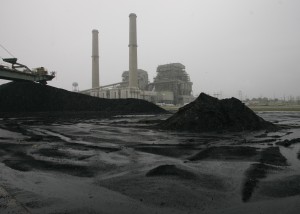
Plant in Point Comfort

Plant in Point Comfort

The Calhoun County Port is located an hour southeast of Victoria, Texas, and across the bay from Port Lavaca, in Point Comfort. In March, I took a trip to this port city and was astonished by some of the issues I found there.

The port has submitted documents to TCEQ for operating a bulk material handling dock.  Our coalition was told it will be used for coal imports, most likely for the plants there.  The permit application allows for the handling of coal and petcoke.  The main facilities there are Alcoa and Formosa plants for plastics.

I first noticed the lack of wildlife near the site.  On the Port Lavaca side of the bridge over the bay there are seagulls flying around, but in Point Comfort I did not see any wildlife.  No birds, insects, or even squirrels.  There was a deathly silence surrounding the area, broken only by the whirring of port-related trucks.  No one was fishing on the Point Comfort side of the bridge, while the Port Lavaca side was bustling with people fishing on piers.

On Texas 35 I saw a large elevated area that I first assumed would be used for a landfill.  There were Caterpillar bulldozers pushing around dirt up a 15 foot tall, mile-wide manmade hill.  However, it may also be a site of the coal import facility since it is right next to a ship dock.

I drove further and saw many TCEQ air quality permit signs, including for the Formosa plastics plant.  Some of the plants with TCEQ air quality permit signs were emitting some kind of steam.  At the end of the road was a large chute with huge piles of bauxite, the ore from which aluminum is made.

The residential areas were empty and had very few cars in front of them.  I wasn’t sure if that was because few people in the area had cars, but later on I was told that a lot of the residents died of cancer or the houses were condemned.  There were playgrounds right next to the plastics plant, but it is doubtful that Point Comfort was an area with a lot of children.

At the gas station as I was leaving I picked up a copy of the local newspaper, the Port Lavaca Wave.  On the front page was a news story about how Point Comfort was getting one more police officer in addition to the sheriff because the plant workers were driving too fast.  On a hunch I decided to look into the crime rate in the area and found something shocking.  There is a correlation between lead exposure and violent crime.  The violent crime rate in Port Lavaca is extremely high for a municipality of its size (11,405).  The violent crime rates are comparable to mid-sized cities like El Paso that are many times larger than Port Lavaca.

What I saw there was straight out of a nightmare, the result of when too little regulation and overpowering industry meet residential areas.  However, workers aren’t safe either, as there was a recent fire that resulted in injuries at the Formosa plant there.  These horrific industrial areas are not limited to isolated areas where people move out.  This is a common theme across the Gulf Coast in more populated areas like Plaquemines Parish near New Orleans, LA and Houston, TX.  In the face of disasters like the one in West, TX issues like these need to be raised to policymakers and community leaders to prevent the deaths of both persons and communities.

Read Full Post »

Gina_McCarthy_--_EPAWhile EPA nominee, Gina McCarthy is likely to be confirmed, the confirmation hearing on Thursday was dominated by a debate on the future of coal as a source of electric power in the U.S. according to a report by NBC News.

Click here to read NBC’s story on this confirmation hearing.

Read Full Post »

It wouldn’t be a Texas legislative session without some truly backwards bills.  Today we have House Bill 2026 by freshman Representative Sanford of Collin county that would eliminate our state renewable energy goals.

BeachWindIn 1999, the state of Texas made a commitment to renewable energy in the form of the renewable portfolio standard (RPS).  That decision played a major role in spurring the development of the wind industry in Texas.

We have now exceeded the renewable energy goals established in the 2005 update to the RPS and Texas has more wind energy capacity than any other state.[1]  On the surface that may seem to indicate that the RPS has been 100% successful and is no longer needed, but that isn’t the case.

One of the major reasons for establishing the RPS was to encourage diversification of our energy sources, which ultimately makes us more resilient to physical and economic forces that can impact the availability and price of energy sources.  While wind energy has increased from zero percent when the RPS was first established to around ten percent today, other renewable energy sources are still largely absent from our energy portfolio.

With more solar energy potential than any other state, Texas should be the center point of the solar industry as well.[2]  Instead we are lagging behind states with far less solar resources, such as New Jersey and Pennsylvania,[3] and are paying the price in missed opportunities for job growth and new generation capacity that can produce during peak demand.

Solar companies invest in California and other states, because smart policies created attractive markets in those places.  California has 1,505 solar companies compared to Texas’ 260. Even New Jersey has more, with 382.[4] Texas should be doing more, not less to attract solar businesses to our state.

SolarInstallProjections showing that we won’t have enough electricity to meet demand by 2020.[5]  The maximum wholesale price of electricity has been set to triple by 2015, without even determining what the cost to consumers will be.  There have been workshops and meetings to consider the prospect of implementing a capacity market in Texas, which would raise costs even more.  But little time has been spent considering simpler, cheaper solutions such as expanding efficiency and demand response (where customers get paid to reduce there energy usage for short periods of time when demand is high) and getting more solar capacity built in Texas.  Solar is most productive when we need it the most – on hot, sunny afternoons.

The RPS should be retooled to focus on solar and other renewable energy resources that are most capable of producing during peak demand.  Millions of dollars could be saved in the wholesale electric market if we had more solar panels installed.[6]

Solar, like wind, also has the benefit of needing very little water to operate.  Solar photovoltaic (PV) installations need an occasional cleaning to keep performance high, but the amount of water need is minimal in comparison to fossil fuel options.  Coal-fired generators need billions of gallons of water to operate each year[7] and while natural gas-fired generations consume less water than coal-fired generators, they still use more than solar, even without accounting for the millions of gallons of water used to extract the gas with hydraulic fracturing.[8]  Including more renewable energy in our portfolio will make our electric grid less vulnerable to drought[9] and will free up water supplies that are desperately needed for human consumption and agriculture.

Abandoning the RPS now would send a terrible signal to renewable energy companies that are deciding where to establish their businesses.  Our state made a commitment that isn’t set to expire until 2025 at the earliest.  There is no good reason to abandon the policy now.  We should be moving in the opposite direction of what is proposed in HB 2026.  Instead of giving up on a policy that has been successful, we should be looking at ways to build on that success and benefit our state.


[1] AWEA. “Wind Energy Facts: Texas.” Oct 2012. http://www.awea.org/learnabout/publications/factsheets/upload/3Q-12-Texas.pdf.

[2] NREL. “U.S. Renewable Energy Technical Potentials: A GIS Based Analysis.” July, 2012. Pg. 10-13. http://www.nrel.gov/docs/fy12osti/51946.pdf.

[3] SEIA. Solar Industry Data. http://www.seia.org/research-resources/solar-industry-data#state_rankings.

[4] SEIA. State Solar Policy. http://www.seia.org/policy/state-solar-policy.

[5] “Report on the Capacity, Demand, and Reserves in the ERCOT Region.” Dec 2012. Pg 8. http://www.ercot.com/content/news/presentations/2012/CapacityDemandandReservesReport_Winter_2012_Final.pdf.

[6] Weiss, Jurgen, Judy Chang and Onur Aydin. “The Potential Impact of Solar PV on Electricity Markets in Texas.” The Brattle Group.  June 19, 2012. http://www.seia.org/sites/default/files/brattlegrouptexasstudy6-19-12-120619081828-phpapp01.pdf.

[7] “Environmental impacts of coal power: water use” Union of Concerned Scientists http://www.ucsusa.org/clean_energy/coalvswind/c02b.html

[8] http://www.ucsusa.org/clean_energy/our-energy-choices/energy-and-water-use/water-energy-electricity-natural-gas.html

[9] Wu, M. and M. J. Peng.  “Developing a Tool to Estimate Water Use in Electric Power Generation in the United States.” Argonne National Laboratory – U.S. Department of Energy. http://greet.es.anl.gov/publication-watertool.

Read Full Post »

According to a report yesterday by Terrance Henry of NPR’s StateImpact Texas (click here to read the article), the Las Brisas coal power plant proposed for Corpus Christi has not only been suspended, but Chase Power’s parent company, which was financing the project, has gone out of business.
wicked witch of the westLas Brisas was one of the last remaining coal plants still proposed for Texas. Now only one major coal plant is still being considered.  The White Stallion coal project in Matagorda County is also experiencing problems getting permitted and funding could be the final blow for this proposed plant too.  So we say to White Stallion, to quote the wicked witch of the West, “Just try and stay out of my way. Just try! I’ll get you, my pretty, and your little dog, too!”

Read Full Post »

Back in March, the Dallas Observer reported about the chance that Energy Future Holdings (EFH – formerly TXU) the state’s largest power generator, was verging on bankruptcy,  Our question then was – are Texas ratepayers going to have to pay for EHF’s bad bet?

Before and since then, there has been a lot of talk about how the EPA is threatening our ability to keep the lights on in Texas.  It was just last fall that Dallas based Luminant claimed that it would be taking 2 coal-fired generating units at the Monticello plant offline due to the cost of complying with newly proposed EPA regulations.

Now, with EPA’s Cross-State Air Pollution Rule off the table, Luminant is going to take the Monticello plant offline for the winter season anyway.  The reality of the energy market in Texas and across the U.S. is that coal isn’t the cheapest option anymore.

Now comes the Dallas Observer with a new article questioning EHF’s Luminant generation division’s claim that EPA regulations are going to be the cause of plant closures.

Brantley Hargrove writes:

Does Texas’ biggest electricity generator, Dallas-based Luminant, just have one hell of a poker face, or should we not read too much into Friday’s announcement that it will idle two units at its Monticello plant for six months? If you’ll recall, the company threatened to idle the units last summer, a time when record demand almost forced rolling blackouts. It claimed that an EPA rule designed to reduce the amount of harmful air pollution wafting across state lines was going to force the company to remove 1,200 megawatts from the grid, enough to power more than a million homes.

Texas politicos were quick to pile onto the agency’s “job-killing” regulations, which they said threatened the very integrity of the grid. “As expected, the only results of this rule will be putting Texans out of work and creating hardships for them and their families, while putting the reliability of Texas’ grid in jeopardy,” Gov. Rick Perry scolded from the presidential campaign trail.

“The rule will impose great costs on coal-fired power plants, causing some to shut down or curtail operations, threatening the state’s electrical capacity reserve margins needed to avoid power disruptions during times of peak demand,” Texas Commission on Environmental Quality director Bryan Shaw warned. “Such a scenario could lead to blackouts, which create serious health risks for Texans dependent on reliable energy.”

To hear them tell it, Texas was given a brief reprieve when a federal appeals court stayed the rule pending oral arguments. And when it tossed the Cross-State Air Pollution Rule altogether last month, the court’s decision was heralded as a decisive coup for Luminant and Texas electric reliability.

“EPA’s illegal micro-managing of state air-quality plans was so specific that immediately after the rule-making it was clear that coal-powered energy production at Texas-based plants operated by Luminant, a big utility, would have to be cut,” a Wall Street Journaleditorial opined. “Tuesday’s ruling means Luminant will be able to keep 1,300 megawatts of power online in Texas, which needs more electricity because unlike other parts of the U.S. in the Obama era it is growing.”

But no sooner had Texas Attorney General Greg Abbott crowed over his “defeat” of the “EPA overlords” than Luminant announced it would idle those two Monticello units anyway. Awkward. For between six or seven months, starting in December, they will sit dormant. Luminant spokesperson Allan Koenig blames low power prices. Monticello has been running below capacity as it is, he says. They’ll be back online in time for next summer’s heat wave. In the meantime, somehow, Luminant won’t lay anybody off.

What Koenig says about the power market is true: The price of electricity fell along with the price of natural gas back in 2008. Ever since then, their bottom line has gotten pinched, along with everyone else’s.

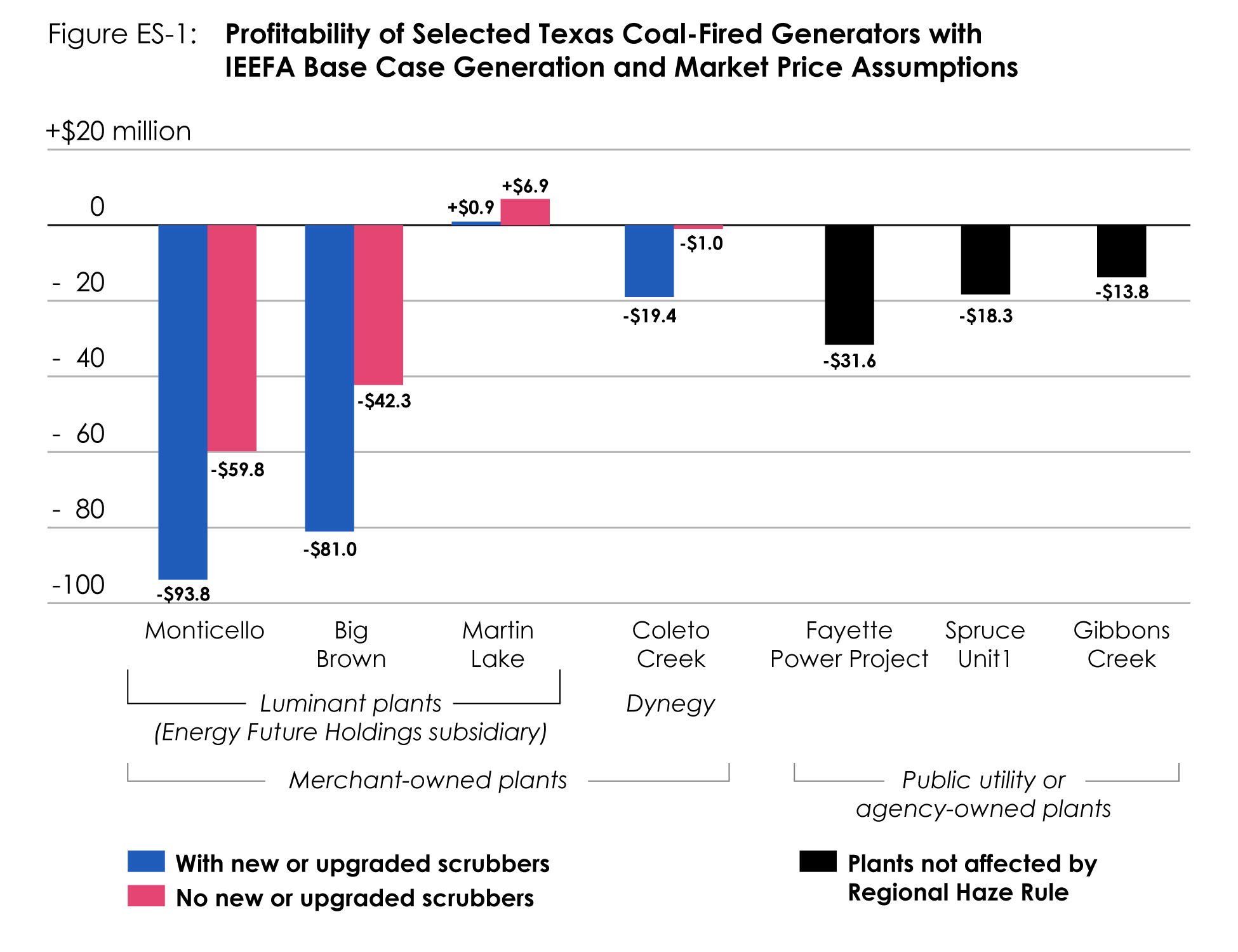
But Luminant is a special case, troubled by a unique predicament, causing some to wonder whether we can lay everything at the feet of the cruel market. The real problem came (as we examined in a March cover story, “Blackout Blues”) when private equity firm Kohlberg Kravis Roberts saddled the former TXU with tens of billions of dollars in debt. The bull electricity market KKR was betting on went bearish, and the newly reconstituted Energy Future Holdings’ already daunting mountain of debt became insurmountable. Analysts think the company’s preparing for an impending bankruptcy.

So, the coal-fired plants KKR expected Luminant to ride into profitability are now cheaper to shut down, particularly when seasonal electricity demand is low. That makes sense. It made sense, too, that as the generator navigated treacherous financial straits, costly pollution controls on aging, depreciating coal-fired units wouldn’t be the wisest investment. It’s one big expense they can’t currently afford. Nor can it afford to lose money by running a coal-fired plant.

It all causes one to wonder, though: Now that the threat of regulation has, albeit momentarily, passed, and the units it threatened to shut down because of clean air rules have gone dark anyway, what was the point of all that brinksmanship? Was Luminant playing a high-stakes game of chicken to ward off regulations by threatening to idle a plant it was going to idle regardless of the outcome? Luminant’s Koenig says the shut down is “in no way related” to last year’s regulatory standoff. “Federal regulation is very, very different from low power prices,” Koenig says. “We can’t control either, but we can respond to regulation and low power prices. The argument to me, it’s absolutely apples and oranges.”

Yet others in the industry say it’s all about the market. Always has been.

“These regulations will not kill coal,” John Rowe, until recently the leader of one of the country’s largest generators, told an audience at an American Enterprise Institute conference. “In fact, modeling done on the impacts of these rules shows that up to 50 percent of retirements are due to the current economics of the plant due to natural gas and coal prices.”

If fingers need to get pointed anywhere, point them in that direction, and at LBO architects that left the company all but incapable of navigating these choppy Texas waters.

We are wondering the same and believe market factors are impacting the coal industry more than the EPA and the current administration.

Read Full Post »

Finally a positive ruling for those adversely affected by coal power plants.  Today a federal judge ruled that the Tennessee Valley Authority is liable for a huge spill of toxin-laden sludge in 2008 in Tennessee when containment dike at TVA’s Kingston Fossil Plant burst. About 5 million cubic yards of ash spilled out of a storage pond, into a river and spoiled hundreds of acres in a riverside community 35 miles west of Knoxville.

U.S. District Court Judge Thomas Varlan found TVA was negligent in its conduct and will be liable for damages to be determined later. Ratepayers have had to pay for the spill in the form of higher power costs as the $1.2 billion cleanup of the spill, the Environmental Protection Agency described as one of the worst environmental disasters of its kind, continues.  After damages are awarded it is likely that TVA will pass those costs along to their customers.

And rest assured, the nearly $11 million TVA paid for outside legal help plus the work done by in-house lawyers, for which TVA is saying they can’t provide a total, will also be passed along to ratepayers.

Lesson learned here, if your energy generator messes up, you get to pay for it.

Read Full Post »

Today, the US Appeals Court in Washington, DC struck down an important pollution rule that would have protected up to 240 million Americans who live downwind from power plants that dump life-threatening pollution into our air like dangerous smog and soot.

The divided ruling to block the Cross State Air Pollution Standard is a setback for EPA’s efforts to protect the public health by implementing clean air standards.

EPA should appeal this decision. The Clean Air Act clearly provides the EPA authority to address this dangerous pollution. A higher court would likely overturn this dangerous decision that puts lives at risk.

EPA estimates that the Cross State Air Pollution Standard would have saved thousands of lives, improved air quality for more than 75 percent of Americans in 2014 alone, and provided vital clean air protections for millions of Americans across the Eastern United States, including:

  • Preventing states from allowing dangerous pollutants which are linked to heart and respiratory illnesses, to enter downwind states.
  • Saving up to 34,000 lives each year
  • Preventing 15,000 heart attacks each year
  • Preventing 400,000 asthma attacks each year
  • Providing $120 billion to $280 billion in health benefits for the nation each year

“Pollution from power plants is killing Texans and our climate,” said Tom “Smitty” Smith, the director of the Texas office of Public Citizen.  “This decision doesn’t mean that we don’t need to reduce power plant pollution and take action promptly.  In the end, failure to act will mean higher medical costs and continued reliance on out of state coal.”

The Cross State Air Pollution Rule (CSAPR) was designed to address smog pollution.  The federal court sent the rule back to the agency for revision and in the interim, told the EPA to administer its existing Clean Air Interstate Rule.  Oddly enough, the 2005 Clean Air Interstate Rule was ruled unlawful in 2008 by the same court that just overturned the new rule.

“Today’s decision only delays for a year at most a new transport rule. Smart utilities will use the temporary delay to develop plans to transition to renewables,” Smith continued. “The days of dirty coal are numbered and today’s ruling does nothing to change that fact.”

More about the Cross State Air Pollution Standard

The Cross-State Air Pollution Standard reduces the sulfur dioxide and oxides of nitrogen pollution emitted from coal-fired power plants across 28 eastern states. That pollution drifts across the borders of those states, contributing to dangerous — and sometimes lethal — levels of particulate (soot) and smog pollution in downwind states.

EPA issued the standard under the “Good Neighbor” protections of the Clean Air Act, which ensure that the emissions from one state’s power plants do not cause harmful pollution levels in neighboring states. While no one is immune to these impacts, children and the elderly are especially vulnerable. The Cross-State Air Pollution Standard would have provided healthier air for 240 million Americans in downwind states.

Nine states (Connecticut, Delaware, Illinois, Massachusetts, Maryland, New York, North Carolina, Rhode Island, Vermont), five major cities (District of Columbia, Baltimore, Bridgeport, Chicago, New York and Philadelphia), the American Lung Association, the Clean Air Council, Environmental Defense Fund (EDF), NRDC, Sierra Club, and major power companies (Calpine, Exelon and Public Service Enterprise Group) have all intervened in support of these vital clean air protections.

The litigation was brought by power companies, including AEP, Southern, DTE, GenOn, and Luminant. The state of Texas, the National Mining Association and the International Brotherhood of Electrical Workers supported their effort in parallel cases.

Read Full Post »

If you think that bonuses are supposed to reward success, you’re not alone, but the reality is more bizarre.  While Energy Future Holdings, formerly TXU, of Dallas continues its downward spiral toward bankruptcy, it’s handing out millions in bonuses to its executives.

The bonuses are called retention bonuses and are supposed to keep executive from fleeing the company as its prospects worsen.  At first glance, that makes some sense.  Recruiting replacements might be difficult.  After all, who is going to want to take charge of a failing company?  But then, who would want to hire an executive whose last job was running a company that failed so spectacularly?  And if bonuses increase as the company does worse, what incentive is there to improve performance?  Against the basic principle of capitalism, this system actually provides an incentive to fail.

Meanwhile, Energy Future Holdings is still making huge payments to the private equity holders that are responsible for over leveraging the company in the first place.  Henry Roberts Kravis, CEO of KKR received $30 million and his cousin and co-CEO, George Roberts received $29.9 million in compensation for 2011.  Clearly, the survival of Energy Future Holdings is not the main concern of either these private equity barons or the executives at the company, or else they wouldn’t be squeezing personal profit out of it when it’s floundering.

While employees at Energy Future Holdings and its subsidiaries may be worrying about what the future holds, those at the top are cashing in big.  No government payments or loans to the company or altering of the energy market will change that dynamic.

Don’t let your money be used to line the pockets of failing executives and private equity CEOs.

If you live in Texas, please sign our petition urging all Texas Legislators to oppose any public or ratepayer-funded bailout of Energy Future Holdings

Read Full Post »

No Bailout for Energy Future HoldingsEnergy Future Holdings, formerly TXU, of Dallas might be looking for a handout – from you.

Back in January, Moody’s changed Energy Future Holdings Corp’s rating outlook to negative and made it impossible to ignore what anyone who had been paying attention to the company’s quarterly reports already knew: Energy Future Holdings is on a path heading towards bankruptcy.  Now there are rumors floating around that the company may ask the Texas Legislature to approve a public or ratepayer-funded bailout.

Neither option would benefit majority of Texas citizens and we urge everyone to sign our petition in opposition to any bailout proposal for Energy Future Holdings

You might wonder how the profitable TXU end up as the failing Energy Future Holdings.  The answer is twofold.

First, in Texas, electricity prices are set based on the price of natural gas.  When natural gas prices were high, this meant that coal-fired power plants could reap additional profit.  This made TXU an attractive acquisition because the company owned many coal-fired power plants.  But now, natural gas prices have plummeted and those same coal-fired power plants, especially the oldest and most inefficient, are dragging Energy Future Holdings down.  The private equity investors made a big bet on the wrong energy source.

The second problem is that Energy Future Holdings was acquired in a leveraged buyout.  What that means is that instead of the investors paying the full amount to buy TXU, they financed the deal partially through loans to the company.  While the company has done a good job of staving off the day of reckoning by refinancing many of those loans, many are approaching maturity and additional refinancing options are limited by the negative prospects for the company.

So, while TXU was a profitable company with relatively low debt, Energy Future Holdings is an unprofitable company (because of low natural gas prices) with massive debt (because of the leveraged buyout) that is approaching maturity.  This isn’t a good combination and some people are going to lose money on the deal (many already have).  However, those losses shouldn’t be placed on Texas taxpayers or ratepayers.

Tell your state representatives and senators that you oppose bailing out failed corporations.

Most of us have to live with the consequences of our bad decisions.  Help us make sure that Wall Street and private equity firms must do the same.

Read Full Post »

Get tough on environmental crimes

Texas law requires that the our state environmental agency, the Texas Commission on Environmental Quality (TCEQ), consider a facility’s past compliance when making decisions regarding permits or inspections.  In fact, a facility’s Compliance History score affects every bit of its business with the TCEQ.

New rules currently proposed by the TCEQ to the Compliance History program would possibly bump up thousands of previously categorized “poor” performers to an “average” classification without having removed an ounce of pollution from our air and water.  The TCEQ has introduced even more limitations which will only further serve to keep every facility average.  These changes include increasing the score by which a performer falls into the poor category, separating repeat violations by media (i.e. administrative violations vs specific emissions violations), giving the TCEQ Executive Director extraordinary authority to change a facility’s classification, and handing out bonus points for ill-defined and unregulated voluntary measures that a facility can implement.

If the Compliance History program reforms go forward as currently written, we will be missing out on two major opportunities by continuing to pretend that all facilities in this state are average.

  • First, we miss a chance to implement the type of regulation that a lot of people in our state prefer.
  • Second, and most importantly, we miss a huge opportunity to try to clean up the air and water around our state in a business friendly manner.

At a time when the challenge of grappling with an increasing array of environmental and health threats to our state and its population gets harder every day, we cannot afford to let such opportunities pass us by.  We urge the TCEQ to reconsider its Compliance History rules, and deliver a program that works to the people of the state of Texas.

The public has a chance to weigh in on these rules and we ask you to consider coming to the public hearing on March 6th or sending comments to the TCEQ by March 12th.  Tell them:

  • Don’t pardon the polluters by increasing the threshold for being declared a poor performer
  • Don’t give the executive director the right to pardon polluters
  • Don’t give polluters a get out of jail free card for signing up for “defensive polluting” classes

As we know from our criminal justice system, swift sure and certain punishment deters crime.  We should apply these lessons to environmental crime too

Public Hearing : TCEQ will hold a public hearing on this proposal in Austin on March 6, 2012 at 10:00 a.m. in Building E, Room 201S, at the commission’s central office located at 12100 Park 35 Circle.

Comments can be submitted  by March 12, 2012.

Tips on Commenting Effectively

You will be providing comments for the rulemaking – 2011-032-060-CE: HB 2694 (4.01 and Article 4): Compliance History

  • Identify who you are and why the regulation affects you;
  • Explain why you agree or disagree with the proposed rulemaking;
  • Be direct in your comment; and
  • Offer alternatives, compromise solutions, and specific language for your suggested changes.

Read Full Post »

The U.S. Senate is set to take a vote to stop the Environmental Protection Agency’s (EPA) rules affecting downwind communities.  This single vote – tomorrow at noon – will be an up or down vote in the U.S. Senate and will dramatically affect the EPA’s work on clean air issues from stationary sources like coal plants.

S.J. Res. 27, sponsored by Sen. Rand Paul (R-KY), would block the EPA from moving forward with the regulation called the Cross State Air Pollution Rule (CSAPR).  Your call or email can make a difference in the air quality of your community.

Need contact information for your U.S. Senator?  Click here to find out who represents you, call or email your Senators and ask them to vote against Sen. Rand Paul’s S.J. Res. 27.

Read Full Post »

StateImpact is a collaboration among NPR and local public radio stations in eight pilot states to examine issues of local importance. The project seeks to inform and engage communities with broadcast and online news about how state government decisions affect people’s lives.

In Texas, a collaboration between local public radio stations KUT Austin, KUHF Houston and NPR with reporters Mose Buchele, Terrence Henry and Dave Fehling traveling the state, the focus will be on reporting on how energy and environmental issues affect you.  Click here to read their reports or listen to them on NPR member stations.  Below are links to just a few of the stories StateImpact – Texas has reported on recently.

Read Full Post »

Public Citizen, Sierra Club and SEED Coalition are calling on Luminant to come clean and retire, rather than idle, the old dirty coal plant, Monticello 1 and 2.

After receiving notice that Luminant Generation Company, LLC, has filed a Notification of Suspension of Operations for Monticello Units 1 and 2 with the Electric Reliability Council of Texas (ERCOT), these environmental groups called on Luminant to retire the units rather than idle them and be more forthcoming with long-term plans that will affect workers.  While Luminant and Texas have been in the headlines repeatedly for their opposition to the Cross State Air Pollution Rule, the rule would effectively help Dallas/Fort Worth meet the minimum public health air quality standards for the first time in years. Yet, if Luminant only idles the plants, then chooses to run them at full capacity next summer, the implications for Dallas/Ft Worth’s air quality remain unclear.

“Luminant has been frightening Texans with claims that power will become scarce if the company is not allowed to continue polluting unabated.  But other Texas utilities are cleaning up their act without difficulty, and this summer’s successful growth of coastal wind demonstrates there are multiple ways to meet Texas’ electricity needs.” said Jen Powis, representative of Sierra Club’s Beyond Coal Campaign.   “Indeed, the Public Utilities Commission and ERCOT both have multiple tools in their arsenal that can be used to ensure grid reliability as Texas moves beyond coal.”

Luminant states that the rule unfairly targets their existing generation, yet a review of the 2009 self-reported emissions inventory maintained by the Texas Commission on Environmental Quality demonstrates that the three Luminant coal plants (Big Brown, Monticello, and Martin Lake) are the top 3 industrial polluters in Texas among nearly 2,000 industrial plants. They are exceptionally dirty plants:

  • Combined they emit 25.5% of state industrial air pollution
  • Combined they emit 33.8% of state industrial SO2 air pollution
  • Combined they emit 11.4% of state industrial PM10 air pollution
  • Combined they emit 10% of state industrial NOx air pollution
  • Combined they emit 37.6% of state industrial CO air pollution

Comparing Luminant’s three coal plants only to other coal plants, however, shows an even more problematic tale.  Luminant’s Big Brown, Monticello, and Martin Lake are:

  •  46.8% of all Texas coal plant emissions (19 existing coal plants)
  • 41.5% of all Texas coal plant SO2 emissions
  • 36.0% of all Texas coal plant PM10 emissions
  • 30.6% of all Texas coal plant NOx emissions
  • 71.7% of all Texas coal plant CO emissions

“We call on Luminant to move beyond posturing and sit down at the negotiating table with EPA in good faith to discuss responsible retirement plans for these plants, like CPS Energy in San Antonio is doing. This approach would be good for consumers, our health and the environment,” said Tom “Smitty” Smith of Public Citizen’s Texas office.

“In order to protect the health of Texans, Luminant must plan now to retire these old coal plants. Monticello has often been the worst emitter of toxic mercury pollution in the nation,” said Karen Hadden, Executive Director of the Sustainable Energy and Economic Development (SEED) Coalition. “We don’t believe Luminant’s plans to retrofit these plants are economically feasible given the company’s poor financial health. Their plans rely on multiple expensive changes, any of which could simply fail to materialize. Luminant should commit to retire Monticello Units 1 and 2, and work with ERCOT, EPA, and public interest groups to prioritize clean energy generation.”

Public Citizen, Sierra Club and SEED Coalition call on Luminant to cease the use of scare tactics, and commit to a plan to retire its Monticello Units 1 and 2, paving the way for clean energy in North Texas. All three groups also call on ERCOT and the PUC to move forward by implementing new rules for energy storage, distributed renewable energy like onsite solar, energy efficiency, demand response, and a restructuring of the Emergency Interruptible Load System to assure there are maximum options available next summer.

“The Legislature has already granted broad authority to ERCOT and PUC to expand our use of these tools,” noted Cyrus Reed, with Sierra Club. “Now it’s time for them to step up to the plate, begin implementing these measures, and using their time to create solutions rather than fight clean air protections.”

Read Full Post »

The States Attorney general is leaping into the environmental fray once again with a filing with the federal appeals court to review the new EPA regulations while the Texas house state affairs hold hearings today, but Governors Perry’s attorney and chief is taking it one step farther filing against  four different rules according to the AGs web site:

“Specifically, Texas petitioned the U.S. Court of Appeals for the D.C. Circuit to stay the EPA’s greenhouse gas Endangerment Finding, the Light-Duty Vehicle Rule, the Prevention of Significant Deterioration (PSD) Interpretive Rule, and the Tailoring Rule.”

After a record-breaking heat wave it seems that its turning out to be better to litigate than try to find a solution (problem what problem), with all the state agencies now following lock step on message. It was back in Pres Bush’s administration that some of the rules were proposed and many of Texas’s and the rest of the countries industries have been gearing up and cleaning up to meet the new rules. After the White House caved on the ozone rules one can guess that they are expecting to get away with anything they want.

Reported shortages of different inhalers for the treatment of breathing difficulties by pharmacies,along with studies showing that Texas can meet the new cross state pollution rule and clean up the air don’t seem to carry any weight with this administration. Recent press releases on the loss of 500 jobs by Luminant (take a look at their stock market filings if you think this is just about federal intervention) and our previous post ,after the state just got done axing over 6000 jobs with its heavy-handed budget process, are making headlines. “Jobs for coal, but not for kids” might be a more appropriate  tag-line.

Its time to turn on the scrubbers, have the PUC come out with a strong energy efficiency rule to cut the load (a proven and cost-effective method) get a move on with the 500Mw non-wind renewable rule  that keeps getting tabled (and not paying companies to try to un-mothball old generation units). Just maybe we can get a little more fresh air and some non polluting peaking energy when we need it.

Leadership not lawyership is more of what we need.

###

By promoting cleaner energy, cleaner government, and cleaner air for all Texans, we hope to provide for a healthy place to live and prosper. We are Public Citizen Texas.

Read Full Post »

http://www.greenpeace.org/usa/en/news-and-blogs/campaign-blog/is-the-epa-trying-to-destroy-rick-perrys-texa/blog/36841/

Earlier this month Rick Perry denied the reality of climate change at a presidential debate. This week Governor “Good-Hair” has continued his crusade of fact fabrication and blamed the loss of 500 Texas jobs on the EPA and its new regulations (called the Cross-State Air Pollution Rule or CSAPR). This accusation came just after TXU/Luminant, the largest power generating company in Texas, announced it would be shutting down two of its coal units. While Luminant is taking a step in the right direction, this unethical tactic of blaming impending EPA regulations for job losses has become old hat for politicians like Perry and large fossil-fuel corporations like Luminant.

Accusations like this are nothing new. The fossil-fuel industry shrilly shouted the same kind of job-killing rhetoric over forty years ago when the Clean Air Act was passed. Instead of killing jobs, however, the Clean Air Act created them. Many studies have shown that the economic benefits, including job creation, of making polluters clean up their act far outweigh any negative impacts (such as layoffs at plants).

Unfortunately, it looks like President Obama has been drinking the same Industry-financed kool-aid as his main opponent. The President has announced that these crucial smog-reducing rules will be pushed back to 2013 (at the earliest). President Obama should be ashamed of his decision to delay these rules. He has, in effect, sacrificed human lives and the lungs of children because big-energy lobbyists have whined about it. The excessive pollution from Luminant’s three dirtiest coal plants is estimated to cause one premature death every three days. Whether Obama or Perry (as the likely candidate) wins the next presidential election, it looks like neither will stand up to corporate polluters for the sake of American lives. Visit Greenpeace online to sign a petition asking Obama to reverse this decision.

The EPA’s purpose is not to coddle fossil-fuel industries, nor to ensure their profit margins stay at ideal levels – it exists to protect human and environmental health. If companies in Texas like Luminant cannot conduct their business responsibly and acknowledge the pollution and harm they cause, then they must be held accountable by the public and our leaders.

Texans are paying the price for the cowardice of our politicians and the irresponsibility of these large energy corporations. These Luminant plants are some of the dirtiest coal plants in the country. Why should we have to pay higher medical bills and environmental clean up costs so that companies like Luminant can maximize profits?

This report from TR Rose Associates shows in detail how Luminant’s shuttering of these coal plants is most likely due to poor financial management. Considering that these plants are practically worthless for Luminant it makes sense for them to shut them down. This retirement has everything to do with the energy market and Luminant’s mismanagement of their resources and very little to do with any new EPA regulations.

Luminant should follow the example of the TVA, who announced back in April the closure of 18 coal plants. TVA further committed to retraining their workers for jobs in energy efficiency and renewable energy – both fields which are likely to employ more people than traditional fossil-fuels. Luminant could easily end this boondoggle and shut down all three of their large, old, dirty plants: Monticello, Martin Lake, and Big Brown. Texas has some of the best solar, wind and geothermal potential in the country. There is no reason, or excuse, for TXU to lay off any workers from any of these old plants, when the company could easily retrain them and invest in geothermal plants throughout that region. If these workers are abandoned it will be Luminant’s fault, not EPA’s.

These regulations should be seen as an opportunity for Texas to embrace renewable energy generation and to transition our power generation (and the relative jobs) to new facilities and programs that use this century’s technology, not last century’s. Luminant and Governor Perry should stop scapegoating the EPA and take responsibility for the health of the public and the future of energy generation in Texas. We Texans should do all we can to encourage and promote that kind of action.

Read Full Post »

Older Posts »

Follow

Get every new post delivered to your Inbox.

Join 3,172 other followers