Feeds:
Posts
Comments

Archive for the ‘Radioactive Waste’ Category

Update:  The U.S. Nuclear Regulatory Commission said an alert at the Oyster Creek plant in Forked River, N.J., ended early Wednesday, October 31.

According to an NRC press release, three reactors (Nine Mile Point 1 in Scriba, N.Y., Indian Point 3 in Buchanan, N.Y.; and Salem Unit 1 in Hancocks Bridge, N.J.) experienced shutdowns as Hurricane Sandy pounded the East Coast.  Another plant, Oyster Creek in New Jersey, remains in an “Alert” due to high water levels in its water intake structure.

NRC says, “Nine Mile Point 1 underwent an automatic shutdown at about 9 p.m. Monday when an electrical fault occurred on power lines used to send power to the grid. It is likely a storm-related event, but the plant’s operators are still evaluating the cause. All plant safety systems responded as designed and the shutdown was safely carried out. Meanwhile, Nine Mile Point 2 experienced a loss of one of two incoming off-site power lines as a result of the fault. One of the plant’s emergency diesel generators started in response to generate power usually provided by the line. Nine Mile Point 2 remained at full power.”

NRC continued, “Indian Point 3 automatically shut down at about 10:40 p.m. Monday in response to electrical grid disturbances caused by the storm. . . the unit was placed in a safe shutdown condition.” And, “Salem Unit 1 was manually shut down by plant operators at about 1:10 a.m. Tuesday as a result of circulating-water pumps being affected by high river level and debris in the waterway.”

Finally, but perhaps of most concern, Oyster Creek had an declared an “Alert” at approximately 8:45 p.m. on October 29th  preceded by an “Unusual Event” at about 7 p.m. when the water level first reached a minimum high water level criteria. The water level rose due to a combination of a rising tide, wind direction and storm surge. While the water level has dropped since peaking earlier today, the Alert remains in place until the level is below the specific criteria for the intake structure, which is where water from an intake canal is pumped into the plant for cooling purposes.

The alert came after water levels at the plant rose more than 6.5 feet above normal, potentially affecting the “water intake structure” that pumps cooling water through the plant.

Those pumps are not essential to keep the reactor cool since the plant has been shut for planned refueling since October 22. Exelon however was concerned that if the water rose over 7 feet it could submerge the service water pump motor that is used to cool the water in the spent fuel pool, potentially forcing it to use emergency water supplies from the in-house fire suppression system to keep the rods from overheating.

Exelon also moved a portable pump to the intake structure as a precaution in case it was needed to pump cooling water.  The water levels reached a peak of 7.4 feet — apparently above the threshold — but the pump motors did not flood.  As of 11 a.m. EDT Tuesday the water level was down to 5.8 feet, but they will need the water level to stay below 6 feet for a while before the alert status is taken off.  When the water level falls below 4.5 feet, the plant could then be taken off the unusual event status.

Fortunately for everyone, Oyster Creek, the oldest nuclear plant in the nation, was shut down for a refueling and maintenance outage prior to the storm and the reactor remains out of service.

Read Full Post »

The agency responsible for approving the construction of nuclear reactors may no longer be able to rely on its old “build reactors now and worry about radioactive waste later” approach.

Learn more about new challenges to nuclear waste policy.

For decades, nuclear reactors have been built under two assumptions:

  • One day there would be a place to permanently store the lethal waste generated from nuclear power.
  • While the final burial place was being determined, the nuclear waste could be safely stored on-site.

But when it comes to waste that remains dangerous for hundreds of thousands of years, assumptions can be a reckless gamble.

A federal court agrees.

In June, the U.S. Court of Appeals in Washington ruled that these assumptions are no longer good enough, prompting the Nuclear Regulatory Commission to address the shortcomings of the two rules which translate these assumptions into policy — the waste confidence decision and the storage rule.

In response, 24 groups, including Public Citizen, challenging both new reactor licenses and license renewals for existing reactors filed a petition urging the NRC to respond to the court ruling by freezing final licensing decisions.

On July 8, the NRC voted to suspend a final decision on all new reactor licenses. No doubt this is a short-term win for us.

But the intermediate and long-term implications for nuclear energy and the policies that govern radioactive waste are still unclear.

As these implications unfold, we will continue to keep you updated and when possible provide opportunities to take action toward improving the safety of our country’s mounting stockpile of nuclear waste.

To get more information on the court’s decision, check out the blog post by Allison Fisher of Public Citizen’s Climate and Energy Program, Will nuclear power continue to hobble along despite its radioactive Achilles’ heel?

Read Full Post »

Late yesterday, in a stunning rebuke of TCEQ’s decision to deny citizens the right to show how dangerous radioactive disposal would be in West Texas, State District Court Judge Lora Livingston ordered TCEQ to reverse their decision denying the Sierra Club the right to a contested case hearing over the license granted to Waste Control Specialists to operate a radioactive waste dump in Andrews County, just east of the New Mexico border. In her order, Judge Livingston remanded the case back to the TCEQ for a contested case hearing on whether this radioactive waste can be safely disposed of in West Texas.

The Sierra Club’s won a battle in its long fight against a radioactive waste dump in West Texas when the Travis CountyJudge reversed a decision made by the TCEQ three years ago that denied Sierra Club its right to a contested case hearing on the license given to Waste Control Specialists (WCS) for the dump. Sierra Club subsequently filed a lawsuit in District Court to win that hearing, but the court date had been delayed for years.  Yesterday was the first opportunity for opponents to argue before an impartial judge about the TCEQ’s conscious decision to ignore key information about potential problems with the site. The Judge agreed that TCEQ should have granted the Sierra Club the right to oppose the license for the waste dump in a contested case hearing before state administrative law judges and now the TCEQ license has been remanded to the agency to grant the contested case hearing.

Low level radioactive waste is so dangerous that it has to be disposed of in specially designed remote and isolated sites to prevent contamination of water and air.  When Waste Control Specialists applied for a license, the staff at TCEQ reviewed the application and recommended its rejection because of their concerns about the possibility of water intrusion and contamination.  The TCEQ’s executive director overruled the recommendation of the staff and recommended issuing the license.

In light of the staff’s concerns, the Sierra Club requested a hearing on the application. That request was denied and the license was issued by two of the three TCEQ commissioners appointed by Governor Perry. Six months later TCEQ’s executive director went to work for WCS.

New information has recently come to light about the WCS site  pertaining to the potential for water to come into contact with radioactive materials. According to data provided by TCEQ., water has been detected in monitoring wells at the facility for the last several months. An expert report authored by geologist George Rice and entitled, Occurrence of Groundwater at the Compact Waste Facility Waste Control Specialists Facility Andrews County, Texas, points out that infiltration of rainwater and movement of groundwater was already occurring within the buffer zone of the “Compact Waste Site” as recently as this March.

Just last week, the TCEQ granted WCS the right to receive radioactive waste at the site and begin operations despite the Sierra Club’s appeal to State District Court.

Cyrus Reed, Conservation Director of the Lone Star Chapter of Sierra Club said, “This ruling confirms what we have been saying all along. The Sierra Club and its members in West Texas and Eastern New Mexico deserve the opportunity to show that radioactive waste dumped at the WCS site could impact people in the area through airborne radioactive particles and potential groundwater contamination. TCEQ should immediately stop operations at the WCS site and follow the judge’s order and grant the Sierra Club’s request for an expeditious but fair contested case hearing on the license for the dump site.”

Rose Gardner lives within four miles of the WCS radioactive waste facility and was represented in this case by Sierra Club. “I’m very glad about the judge’s decision, since we’ll now have a hearing where we can fully examine radioactive risks to our land and water. We now have more livestock than ever before and having the WCS radioactive waste dump nearby threatens our health and safety. TCEQ blocked this hearing before and needs to be more open with information and opportunities for citizens to participate,” said Gardner.

“This case is of national significance because the dump’s biggest investor is Harold Simmons, one of the largest contributors to Republican political campaigns and attack ads. He helped to fund the “Swift  Boat Veterans for Truth”  and  the “Obama is a Muslim”  attack ads. The Wall Street Journal has reported that Simmons has spent $18 million so far this election cycle and plans to spend a total of $36 million before the end of this cycle. Why would he spend that kind of money?  The amount and types of waste could be vastly expanded by a Republican President or Congress thus increasing the amount of money Simmons can make off of the dump and  increasing the funds he has available to donate to future political campaigns. And if anyone doubts that his political spending will pay off in favorable treatment, all they have to do is look at how successful he’s been in Texas”  said Tom “Smitty”  Smith of Public Citizen’s Texas Office.

“This is a big victory for the citizens of Texas and New Mexico. The TCEQ knew this case was likely to be decided this week, but rushed to sign off on the dump site late last month, allowing radioactive waste to start coming into Texas, showing just how much political pressure Harold Simmons, the chief financial investor of WCS, can exert on Texas politics and agencies. The first shipments of radioactive waste arrived just 10 days ago.  We call on TCEQ to act responsibly and reverse their decision granting that permit,” said Karen Hadden of  the Sustainable Energy and Economic Development (SEED) Coalition.

The SEED Coalition and Public Citizen have been actively involved in opposing the recently adopted rule to open up the WCS facility to accepting waste from the rest of the nation and continue to monitor the transparency and accountability around this rule change.

Read Full Post »

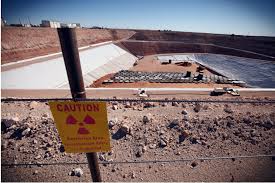
Harold Simmons built a West Texas dump for radioactive waste that is bigger than 1,000 football fields, paid out hundreds of thousands of dollars in campaign contributions and got a permit for it in Texas, and is now working to fill it.

To turn it into a profitable enterprise, the Texas billionaire has now hired lobbyists to urge the Obama administration to expand the types of nuclear waste, including depleted uranium, the dump can accept and award his company disposal contracts.

Click here to read the Bloomberg story on the influence of money on this regulatory issue.

Click here  and here and here and here, to read earlier blog posts about Harold Simmons, his Texas political contributions and the WCS radioactive waste dump.

Read Full Post »

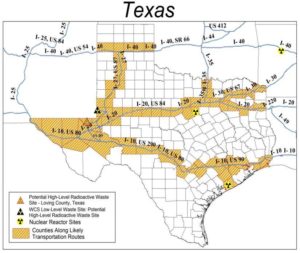
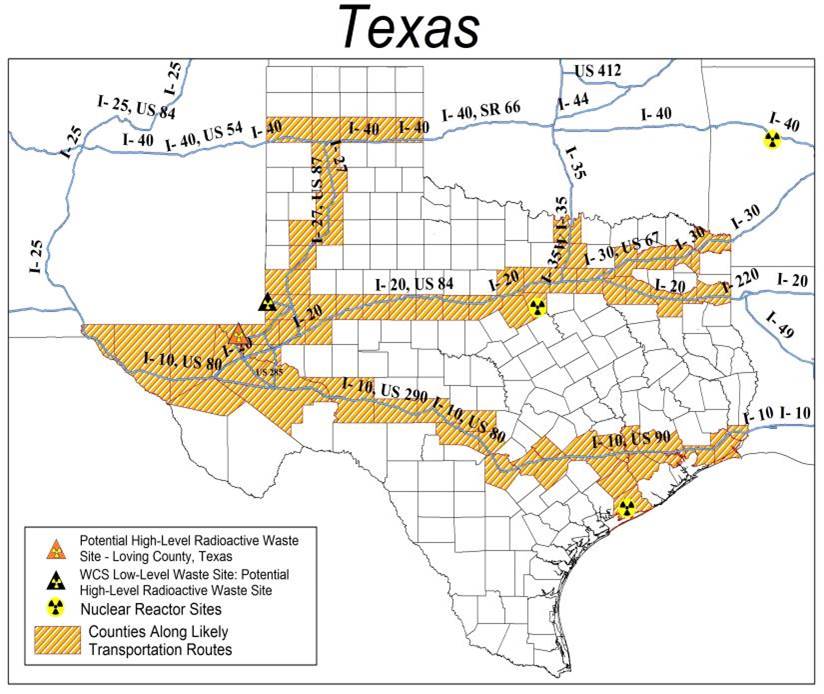
Trucks carrying low-level radioactive waste from 38 states could start rolling down Texas highways bound forburial at a dump in Andrews County on the Texas / New Mexico border as early as April,.

The state’s commission (Texas Low Level Radioactive Waste Disposal Compact Commission) overseeing disposal of low-level waste in Texas may approve the final rule changes needed this Friday, March 23rd. State lawmakers cleared the way with a new law passed late in the 82nd legislative session and state regulators still need to sign off on the burial site’s construction, but it seems inevitable that Texas is going to become the nation’s radioactive dumping ground.

The Compact Commisson meeting is scheduled to begin at 9am on Friday, March 23rd in the Texas Capitol Extension at  1400 North Congress, Austin, Texas in Hearing Rm. E1.024,  We’ve provided the meeting agenda below and encourage any who are interested to attend the hearing.

Agenda

1. Call to Order

2. Roll Call and Determination of Quorum

3. Introduction of

a. Commissioners

b. Elected Officials

c. Press

4. Public Comment (Note: Pursuant to Article IV, Section Two (c) of the Commission¿s Bylaws, the Commission [subject to such time constraints as may be established by the Chair] also will provide an opportunity for members of the public to directly address the Commission on each item on the agenda during the Commission¿s discussion or consideration of the item.

5. Discussion and possible action with regard to the final adoption of amendments to Rule 675.23 (Importation of Waste from a Non-Compact Generator for Disposal) (31 TAC 675.23) with changes from the proposed amendments to the rule as published in the Texas Register on January 20, 2012 (37 Tex. Reg. 184).

A) Receive and discuss the report of the Rules Committee (Mr. Lee [Chair], Mr. Salsman, Mr. Saudek, and Mr. Wilson) with respect to its deliberations after the publication of the proposed amendments to Rule 675.23 (31 TAC 675.23) as published in the Texas Register on January 20, 2012 (37 Tex. Reg.184).

B) Receive and act on the recommendations of the Rules Committee with respect to

(i) the final adoption (with changes) of proposed amendments to Rule 675.23 (31 TAC 675.23) as published in the Texas Register on January 20, 2012 (37 Tex. Reg. 184); and

(ii) the filing and publication of Rule 675.23 (31 TAC 675.23) as finally adopted in the Texas Register.

 6. Discussion and possible action on the following petitions for export: A) South Texas Project B) Vermont Yankee C) Luminant

7. Discussion among Commission members about methods of processing and evaluating applications for Agreements for importation of waste for disposal in accord with Compact Commission Rules and with Texas requirements expressed in Chapter 401 of the Texas Health and Safety Code, including quantities and revenue expectations and including possible action to appoint one or more Committees in connection with the processing of applications for Agreements for importation.

8. Discussion on and possible action on Bionomics Request for Import Agreement.

9. Presentation of Site status report and outlook from Waste Control Specialists Inc.

10. Presentation from Advocates for Responsible Disposal in Texas concerning Compact site use plans and issues.

11. Site status report from the Texas Commission on Environmental Quality including discussion of plans for actions on commingling rule change effort and actions on site licensing and disposal site rate case actions.

12. Receive a report from and possibly take action in response on any recommendations from the Committee on the Commingling Rule (Ms. Morris [Chair], Mr. Saudek and Mr.Wilson)

13. Chairman¿s report on Compact Commission activities including reporting on fiscal matters and on status of filling needs for staffing.

14. Discussion and possible action regarding the provisions of existing Compact Commission Rule 675.21(l) (31 TAC 675.21(l)).

15. Determination of date and location of next meeting.

16 Adjourn.

Read Full Post »

Among the recommendations for managing the current stockpile of spent nuclear fuel — approximately 65,000 tons of waste stored at about 75 operating and shut-down reactor sites around the country — is a plan to move the waste to temporary storage sites.

Public Citizen rejects this plan. In the absence of a permanent and viable solution, we and more than 200 other organizations advocate safeguarding the waste where it is generated.

Tell your representative in Congress to reject efforts to move radioactive waste to temporary dump sites.

The temporary dump plan is flawed for several reasons:

  • It would put tons of lethal radioactive waste on our highways, rails and waterways. An accident in transit could put whole communities at risk.
  • It would condemn a few targeted communities to being radioactive waste dumps for the whole country. Past attempts to place temporary dumps targeted Indian reservations and poor communities of color by offering substantial financial incentives.
  • The temporary dumps could become permanent if no suitable geological repository site is found.
  • It does not address an existing critical vulnerability of nuclear waste storage: almost all reactor fuel pools are filled to capacity. Fuel that is cool enough to move is stored in outdoor casks. Both types of storage are vulnerable to accidents, attack and natural disasters, as shown so clearly by the Fukushima nuclear disaster.

To better safeguard this waste, we advocate hardened on-site storage — a plan that calls for emptying the waste storage pools and placing the irradiated rods in high-quality outdoor casks fortified by thick bunkers and berms.

Ideally, we should stop generating nuclear waste, but while it continues to accumulate, we must implement smart safeguards to protect people and the environment from the immediate risks associated with high-level radioactive waste.

Tell your representative to increase nuclear waste safety at reactor sites.

Read Full Post »

Waste Control Specialists LLC (WCS) is seeking several amendments to its Radioactive Material License # R04100 from the Texas Commission on Environmental Quality (TCEQ).  Five of the amendments request design changes to the Compact Waste Disposal Facility (CWF) and the Federal Waste Facility (FWF) for commercial and federal low-level radiactive waste disposal. The other two amendment applications set forth new Waste Acceptance Criteria that includes rates and contract considerations and new pavement design considerations.

Just as important, TCEQ is considering revising language and definition for waste of international origin, acceptance criteria, reporting of inventory and liability coverage as well as the issued TCEQ waste water permit.

TCEQ is accepting public comments and requests for a public meeting.  These can be submitted by mail to:

the Office of the Chief Clerk
MC 105
TCEQ
P. O. Box 13087

or electronically at www.tceq.state.tx.us/about/comments.html by December 17th.

If you need more information about the license application or the licensing process, please call the TCEQ Office of Public Assistance at 1-800-687-4040.

We will post the link to the amendment applications as soon as we are able to find them.  TCEQ recently migrated its database and the links no longer work.  Makes finding materials to base written comments on a bit more complicated.

Read Full Post »

Gov. Rick Perry has replaced all six of the Texas commissioners who sit on the Texas Low-Level Radioactive Waste Disposal Compact Commission reappointing only two previously serving commissioner.  The TLLRWDCC commissioner terms were modified by Senate Bill 1605 as part of the 82nd Legislature giving Perry the ability to replace commissioners whose positions he didn’t like with new commissioners.

The appointees were:

  •  Eric J. Doyal of Houston, a senior associate at Capital Point Partners. He is appointed for a term to expire Sept. 1, 2013.
  • Andrews County Judge Richard H. Dolgener, Dolgener was first appointed in 2008 and is appointed for a term to expire Sept. 1, 2015.
  • Milton B. Lee II of San Antonio, a registered professional engineer and retired CEO of CPS Energy who left amid the shakeup following the municipally owned utility’s failure to disclose a dramatic price increase in the estimated cost of two new nuclear reactors to the City Council before a major bond vote.  He is appointed for a term to expire Sept. 1, 2013.
  • Linda Morris of Waco, a licensed medical health physicist and the Department Chair of the  Environmental Health & Safety Technology Department at Texas State Technical College. She is appointed for a term to expire Sept. 1, 2017.
  • John Matthew Salsman of College Station, a certified health physicist and the director of Environmental Health and Safety at Texas A&M University. He is appointed for a term to expire Sept. 1, 2017.
  • Robert Wilson of Lockhart, an attorney and partner at Jackson, Sjoberg, McCarthy and Wilson. He is re-appointed for a term to expire Sept. 1, 2017, and will serve as chair of the commission for a term to expire at the pleasure of the governor.

Read Full Post »

According to the Fox news station in Salt Lake City, UT, controversy has arisen about EnergySolutions’ plans to dispose of what they call blended radioactive waste at its Clive Facility in the west desert of Utah.

There are three classifications of waste: A, B and C, all radioactive. Only the lowest level, type A, is allowed in Utah, but Energy Solutions says it’s found a way to blend and store the waste safely by mixing higher-level class C waste with low-level waste and labeling it class A – are you buying this, cause I’m pretty skeptical and it just sounds like fiction to me.  This magic would take place at a facility in Tennessee according to EnergySolutions.

EnergySolutions may have found a legal loophole that would allow them to store higher level radioactive waste at the Clive facility, but ultimately, the Utah Division of Radiation Control will decide whether the blended waste can be disposed in Utah.

In the meantime, William Dornsife, executive vice president of WCS, the Texas company building a radioactive waste disposal facility in Andrews County, Texas is telling Utah to bring it on. He wants the waste to go to Texas, not Utah.

Texas is licensed to take class A, B and C waste without the blending alchemy that EnergySolutions is proposing, and there is a lot of money at stake — potentially hundreds of millions of dollars.  WCS and billionaire Harold Simmons are salivating at the opportunity to spend what they probably see as the political capital with which they walked away from the 82nd Texas legislative session earlier this year to rake in the profits at the expense and liability of the Texas taxpayer.

Face it Texas, we are now the radioactive waste capital of the country.

Read Full Post »

The Texas Low-Level Radioactive Waste Disposal Compact Commission will meet Saturday, August 20, 2011, at 10:30 AM in the James Roberts Center, 855 Hwy 176 East, Andrews, TX 79714.  Don’t know yet what they will have on their agenda, but they say it will be posted in the Texas Register and on the Commission website when available.

Click here to read more about legislation that passed this session, opening the state wide to accept radioactive waste from around the country and giving Waste Control Specialists, the operator of the Texas waste site, carte blanche for much of the regulation of this site.

Have Questions?  Contact the Texas Low Level Radioactive Waste Disposal Compact Commission

http://www.tllrwdcc.org
Telephone: 512-820-2930
Mailing Address:
TLLRWDCC
3616 Far West Blvd., Ste. 117, # 294
Austin, Texas  78731
NOTE:  This is a mailing address only and not the physical location of the Commission.

Read Full Post »

In their ongoing effort to accomplish a cold shutdown by January, Tokyo Electric Power Co (Tepco), the beleaguered operator of the crippled Fukushima Daiichi nuclear-power plant said it had resumed the use of recycled water to cool the reactor cores this weekend, a week after its first attempt was suspended due to leaks that developed within minutes of starting up the recycled water system.

Tepco has installed a tank to store 1,000 metric tons of decontaminated water to complete the recycling system, stabilizing the water source for cooling the Nos. 1-3 reactors, eliminating the need to use fresh water from an outside source to cool the reactors, and creating even more irradiated water, which then requires storage or disposal.

Establishment of a closed cooling system is essential to stabilizing the Daiichi reactors and getting the reactors to cold shutdown, which is defined as lowering the temperature of the fuel rods to below 100 degrees Celsius—water’s boiling point—and keeping it there.

If Tepco’s current efforts are successful, they hope to increase the flow of water and bring down the reactor-core temperatures, which currently hovers between 100 and 160 degrees Celsius.

Even if the recycling system works smoothly, Japan is still left with the problem of how to dispose of the radioactive sludge being created during the filtering process.  Japan, like Texas, has a disposal site for low-level radioactive waste, but there are no guidelines for disposing of the type of sludge now being created, which is expected to total 706 metric tons.

In the meantime, work at the complex is being hampered by the unseasonably hot weather.  There have been 17 reported cases of heatstroke at the plant in recent weeks.

And if that wasn’t enough

Tepco also faces other issues as senior members of Japan’s government developed secret plans to break up the nuclear plant operator, according to reports uncovered by Reuters.

The plan would bring nuclear operations of Tepco under government control, and force Tepco to sell its power distribution business.  Only the power-generation operations that use thermal and hydraulic power plants would remain as the company’s business cutting Tepco’s size to one third of its current operations.

I guess a really, really big mistake costs industry really, really big.

Read Full Post »

Facilities that process large quantities of radioactive material have the potential for significant environmental contamination due to the scale of their operations. Over time, leaks from these facilities can lead to significant radioactive contamination of the subsurface soil and groundwater.  In addition, the high costs of disposing of radioactive material off-site may lead these facilities to store more waste on site, increasing the potential for subsurface radioactive contamination and significantly higher decommissioning costs.

Currently these facilities are required to perform surveys to verify that radioactive releases are below regulatory requirements and do not pose public health hazards.  However, the NRC believes that existing regulations were not clear enough concerning subsurface contamination.

A new Nuclear Regulatory Commission (NRC) rule would now require these facilities to minimize the introduction of residual radioactivity at their sites during operations. It also requires reporting of additional details about a facilities cost estimates for decommissioning and tightens NRC control over certain financial instruments set aside to cover eventual decommissioning costs.

These new regulations, which will take effect December 17, 2012, were designed to prevent future “legacy sites” with insufficient funds for decommissioning. A legacy site is a facility with an owner who cannot complete complex decommissioning work for technical or financial reasons, causing those costs to fall to the taxpayer.

An unintended consequence will be that there is that much more low-level radioactive that will need to be disposed of in sites such as the Andrews County site that the Texas legislature just passed legislation on opening it up to accept waste from outside the original two state compact (Texas and Vermont).  Click here to read more about radioactive waste disposal in the US.

Read Full Post »

Critiques of nuclear generation have generally revolved around safety risks and high construction fees, but relatively little attention has been paid to what happens when a nuclear plant powers down for good.

Costs Can Reach Over $1 Billion

Nuclear plants must be decommissioned at the end of their useful life, and operating licenses are generally for 40-60 years. The costly, labor-intensive process involves two major actions: nuclear waste disposal and decontamination to reduce residual radioactivity.

There are currently 104 commercial nuclear power plants operating in the US, most of which were built in the 1970s and are slated for decommissioning during the next three decades.

At least one nuclear plant now running will be shut for good in the next several years, namely Exelon Corp’s Oyster Creek plant in 2019. Before then, we could see Entergy Corp’s Vermont Yankee plant shutter as early as next year, should the state’s veto of a license already granted by the NRC hold up in court.  And New York State politicians continue to wield whatever pressure they can to keep Indian Point from winning a license extension in ongoing proceedings.

South Texas Nuclear Project (STP) in Matagorda County licenses expire in 2027 and 2028, they recently applied for a license renewal which would extend the life of the plants 20 years, and they would expire in 2047 and 2048 respectively.  The license renewal application is being contested and you can click here to find out how you can listen in to the 1st Atomic Safety and Licensing Board (ASLB) hearing on this license renewal application.  However, even if the license renewal is approved, there is a possibility that at some point before the license expiration dates, the costs of repairs could exceeded the value of the plant, and dismantling it could offer a better financial option.

As of April 2011, there were 23 nuclear units in various stages of decommissioning. Only ten out of the 23 have been completely cleaned up.

Decommissioning costs typically run at $500 million per reactor unit. But actual costs vary based on size and design, and some have reached over $1 billion — that is between 10 percent and 25 percent of the estimated cost of constructing a nuclear reactor today.

About 30 percent of the cost of decommissioning goes towards waste disposal.

A decommissioned plant creates several different streams of waste

  • Spent nuclear fuel rods are kept in dry storage or in spent fuel ponds at the reactor sites. An average nuclear plant generates 20 metric tons (44,092 lbs) of used nuclear fuel annually, or 1,200 metric tons over a plant’s 60-year lifespan. Every 3 to 5 years, one-third of the fuel assembly rods in the reactor are removed and stored in storage pools for about 10 to 20 years. During this period, the fuel loses much of its radioactivity and heat.  After that period, the fuel can be stored in large sealed metal casks that can be cooled by air. Typically a 1000 MWe reactor will discharge about 2 metric tons of high level waste each refueling. A PWR will discharge 40 to 70 fuel rods; a BWR will discharge 120 to 200 fuel rods.
  • Anything contaminated with lower levels of radiation — pipes, tools, workers’ clothing, reactor housings, really, pretty much everything but the spent fuel rods — are sent to special low-level nuclear waste facilities around the country. The remaining non-radiated waste can be disposed of in regular landfills.

Three pathways to decommissioning

The Nuclear Regulatory Commission offers utilities three options for decommissioning plants.

  • The first option is immediate cleanup after the plant shuts down.
  • In the second option, called SAFSTOR, the plant is closed and awaits cleanup at a later time, offering plants extra time to increase their decommissioning funds.While there is a requirement for operators to set aside funds for decommissioning, some plants have had to shut down before they had sufficient decommissioning funds and once they shut down, the revenue stream dries up.  This means they must wait until their funds accrue sufficient interest to begin decommissioning.The NRC gives utilities up to 60 years to complete decommissioning.This waiting period adds flexibility for plant owners with multiple reactors that shut down at different times. Once all the reactors cease operation they will be decommissioned together to save money and resources.

Of the 13 reactors currently being decommissioned, six chose immediate decontamination and seven remain in SAFSTOR conditions.

  • No U.S. plant has ever chosen the third decommissioning option, called ENTOMB.Workers would begin by moving the fuel rods into dry storage casks removing 99.9 percent of the plant’s radiation, but which currently must be stored on site.  Next, they use solvents and filters to clean up other contaminated surfaces.The other radioactive material onsite is sent to low-level waste facilities, and the plant is left to sit for decades.With ENTOMB there is no requirement to build extra containment buildings because the NRC postulates that most of the radiation will already be gone, though plant operators would continue to monitor the site for security.After 80 to 100 years, the plant would be safe enough to enter while wearing street clothes, and workers could dismantle the plant with just “a plasma torch and dust mask”.Still utilities don’t like the ENTOMB option because they don’t want to deal with the long-term liability.

Radioactivity for Volume

Low-level radiation waste comes in three varieties: Class A, B and C. Class A waste contains the lowest levels of radiation.

There are three low-level nuclear waste facilities in the United States — in Clive, Utah; Barnwell, South Carolina and Hanford, Washington. Clive only accepts Class A waste; the other two sites accept Class B and C waste but only from select northwestern and eastern states.

The new low-level waste facility under construction in Andrews County, Texas will accept Class A, B and C waste, and originally limited its intake to nuclear waste from Texas and Vermont, but the Texas legislature just opened the site up to take waste from outside the original compact, meaning it could take waste from anywhere in the United States.  However, a study by the Texas Commission on Environmental Quality indicates the site only has the capacity to take the low-level radioactive waste from the six Texas and Vermont reactors.

When Barnwell and Hanford started restricting their operations, nuclear plants adjusted their practices. Operators began changing filters more often to selectively create Class A waste that could be sent to Clive.  As a result, Class B and C now make up less than 15 percent of low-level nuclear waste.

So after nearly 60 years, with 104 nuclear reactors approaching the end of their useful life, it remains unclear how this country is going to deal with the decommissioning waste.  How foolish would a nuclear renaissance be in the face of this unsurmounted problem?  The industry continues to insist, over-optimistically, that we will find a long-term solution, yet ,pessimistically, doesn’t think we can find a replacement renewable energy source in the same time frame.  The industry dost protest too much, methinks.

Read Full Post »

In honor of SB 1605, a Simmons‘ led bill on the Texas Low-Level Radioactive Waste Disposal Compact Commission, we decided to post a music video speaking of more sensible, viable options for clean energy. Hope you enjoy it!

And the lyrics after the jump if you want them: (more…)

Read Full Post »

All rights reserved by Public Citizen Texas

Infamously dubbed by Dallas Magazine “Dallas’ Most Evil Genius”, socialite and energy tycoon Harold Simmons is no stranger to Texas lobbying.  As this blog previously reported in January, Simmons has contributed $1.12 million from 2001 to September 2010 to Rick Perry significantly increasing his contributions between 6/25/2009 and 9/30/2010 totaling $600,000 in a 15 month period or more than doubling his previous contributions. Now why did Simmons increase his campaign contributions? Perhaps it’s been used to grease the wheels on his  recently passed radioactive waste bill SB 1504 allowing Simmons’ company Waste Control Specialists a monopoly on Texas low-level radiation waste disposal.

Simmons’ money didn’t stop at Perry. According to the Texans for Public Justice, Simmons paid $182, 350 in the 2010 election cycle to 92 members of the House, 94% Republicans and 6%  Democrats. Obviously, all of this is significant because of the recent vote in the House on bill SB 1504. 76% of the members who received Simmons contributions or $138,350 voted with the money, yea, while only 13% or $24, 500 voted nay and 11% or $19,500 abstained from voting. Contrary to a damning report by Public Citizen addressing the dangers of nuclear waste disposal , 84% of the House members who took Simmons’ money voted following the company line while only 16% or 15 members abstained from voting or voted nay.

Simmons granted a rare interview to the Dallas Business Journal in 2006 offering an eerie outlook on his lobbying efforts “It took us six years to get legislation on this passed in Austin, but now we’ve got it all passed. We first had to change the law to where a private company can own a license [to handle radioactive waste], and we did that. Then we got another law passed that said they can only issue one license. Of course, we were the only ones that applied.

Most House Members Who Took Simmons’ Money Voted To Grant Him A Monopoly to Import Nuclear Waste

Simmons BillVote in House No. of Members Percent of Members Total Amount From Simmons Average Amount from Simmons
Yea 108 72% $138,350 $1,281
Nay 36 24% $24,500 $681
Not Voting 6 4% $19,500 $3,250
Totals 150 100% $182,350 $1,216

House Members Taking Simmons’ Money but Bravely Went Against Their Benefactor

House Member Dist. Party Simmons Amount in 2010 Cycle 2nd Reading Vote 5/17 3rd Reading Vote 5/18
Anderson, Charles 56 R $2,000 Absent Absent
Carter, Stefani 102 R $2,000 Nay Nay
Coleman, Garnet 147 D $15,000 Yea Nay
Davis, Sarah 134 R $500 Yea Nay
Dukes, Dawnna 46 D $1,000 Nay Nay
Farrar, Jessica 148 D $500 Absent Nay
Gallego, Pete 74 D $15,000 Nay Nay
Giddings, Helen 109 D $1,000 Nay Nay
*Howard,  Donna 48 D $500 Nay Nay
Hunter, Todd 32 R $2,000 Absent Absent
Issac, Jason A. 45 R $1,000 Nay Nay
Kolkhorst, Lois 13 R $1,000 Nay Nay
*Martinez Fischer, Trey 116 D $1,000 Nay Nay
Reynolds, Ron 27 D $500 Nay Nay
Straus, Joe 121 R $15,000 Not Voting Not Voting
Villarreal, Mike 123 D $1,000 Nay Absent

*Member of House Natural Resources Committee that first approved bill.

Note: If you are interested to see  if your representative voted with the money or even received 2010 campaign contributions from Simmons please visit this link provided by TPJ, Bankroll Call: Correlating Simmons Contributions To Texas House Votes.

Read Full Post »

Older Posts »

Follow

Get every new post delivered to your Inbox.

Join 3,196 other followers