Feeds:
Posts
Comments

Posts Tagged ‘austin city council’

Today, Thursday (April 11th) at 4 PM Austin City Council will vote on ordinance that would hand control of the city’s municipal utility, Austin Energy, to an unelected board chosen by corporate headhunters.  This change could open the door to industry insiders and special interests controlling Austin Energy, the city’s largest asset, valued at $3.9 billion.  It’s OUR utility and we should elect those who manage it.

There will be a first vote on this ordinance comes tomorrow despite great public outcry about the rushed nature of this plan, the failure to hold a real public hearing and the failure to acknowledge the millions of dollars wasted at other utilities, such as CPS Energy, at the hands of unelected boards.

A percentage of the profits of Austin Energy currently goes to fund programs for the city, but that funding could be at risk with an unelected board in charge.  Reduced funding could seriously jeopardize our parks, roads, libraries, clinics and public safety department.  There is also some concern that the move to make our public utility more of a corporate model could mean that our green energy and low-income programs are at risk.

This is your utility and we encourage you to come to City Hall this afternoon.  Speak if you can, or, if you prefer, donate your time to a friend.  While the “time certain” has been set for 4 pm, please don’t let that deter you.  Come even if you can’t arrive by 4 pm. City Council has been known to be hours late in getting started on an item. We’ll have food on hand.

The backup material (attachment 3 on item #11) includes the draft ordinance, the new report (which is an interesting compilation of data, but doesn’t support the concept of changing Austin Energy’s governance), and a list of 15 ways that the ordinance conflicts with the City Charter.

Even if you can’t attend, but can come by City Hall at some point in the day, please go by and register against agenda items #11 and #45 at the kiosks inside.

You can also call or email council members, specifically Mayor Lee Leffingwell and Council Members Sheryl Cole, Bill Spelman, Chris Riley and Mike Martinez, and ask them to halt this fast-tracked, undemocratic ordinance. Remind them that the utility is ours – not theirs to give away.

City Clerk 974-2210
E-mail all City Council Members at once: http://www.austintexas.gov/mail/all-council-members
Lee Leffingwell 974-2250 Lee.Leffingwell@austintexas.gov
Sheryl Cole 974-2266 Sheryl.Cole@austintexas.gov
Chris Riley 974-2260 Chris.Riley@austintexas.gov
Mike Martinez 974-2264 Mike.Martinez@austintexas.gov
Kathie Tovo 974-2255 Kathie.Tovo@austintexas.gov
Laura Morrison 974-2258 Laura.Morrison@austintexas.gov
Bill Spelman 974-2256 Bill.Spelman@austintexas.gov

More info is online at www.CleanEnergyforAustin.org.

Read Full Post »

Would you decide who manages your retirement account by closing your eyes and pointing?  Probably not.

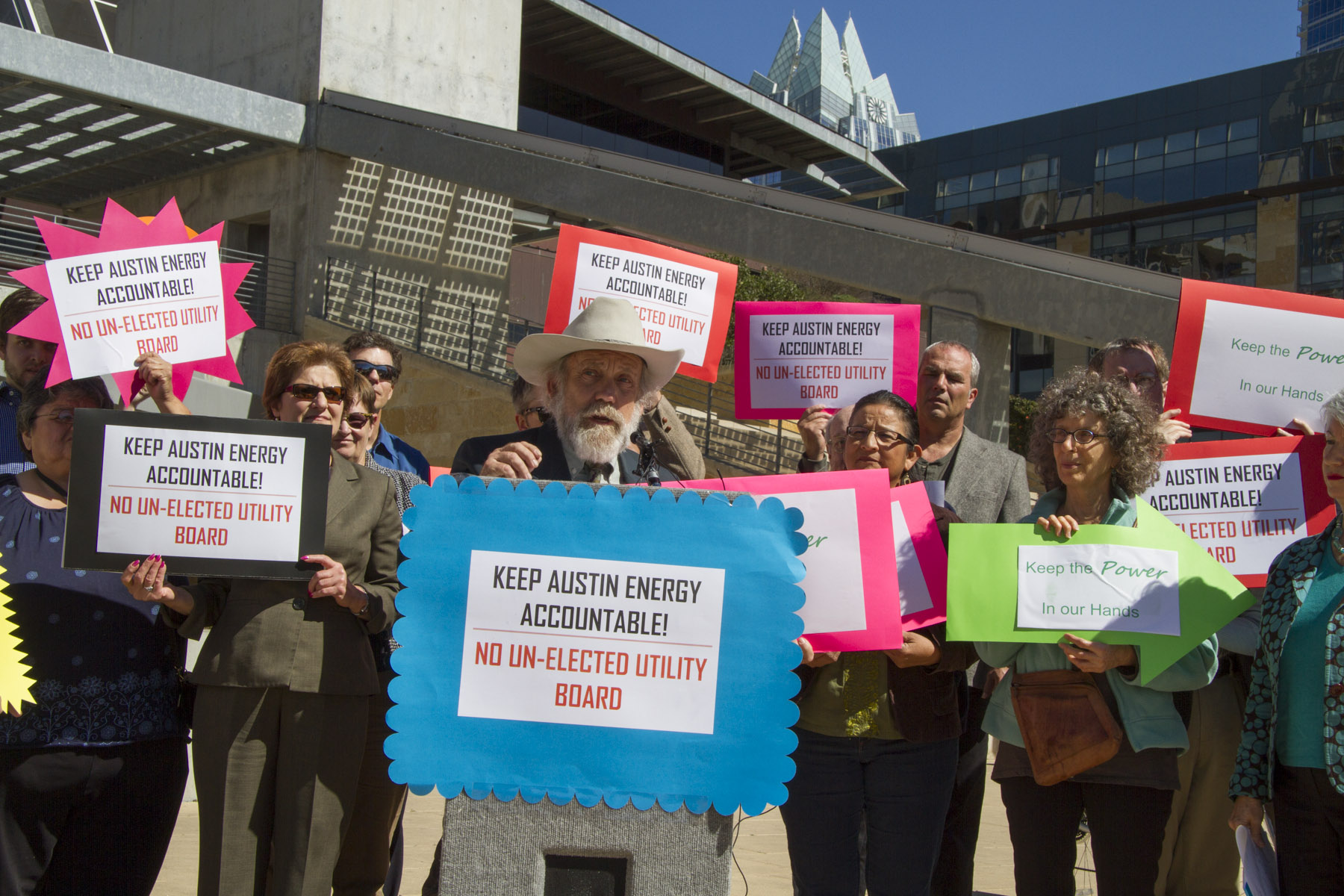
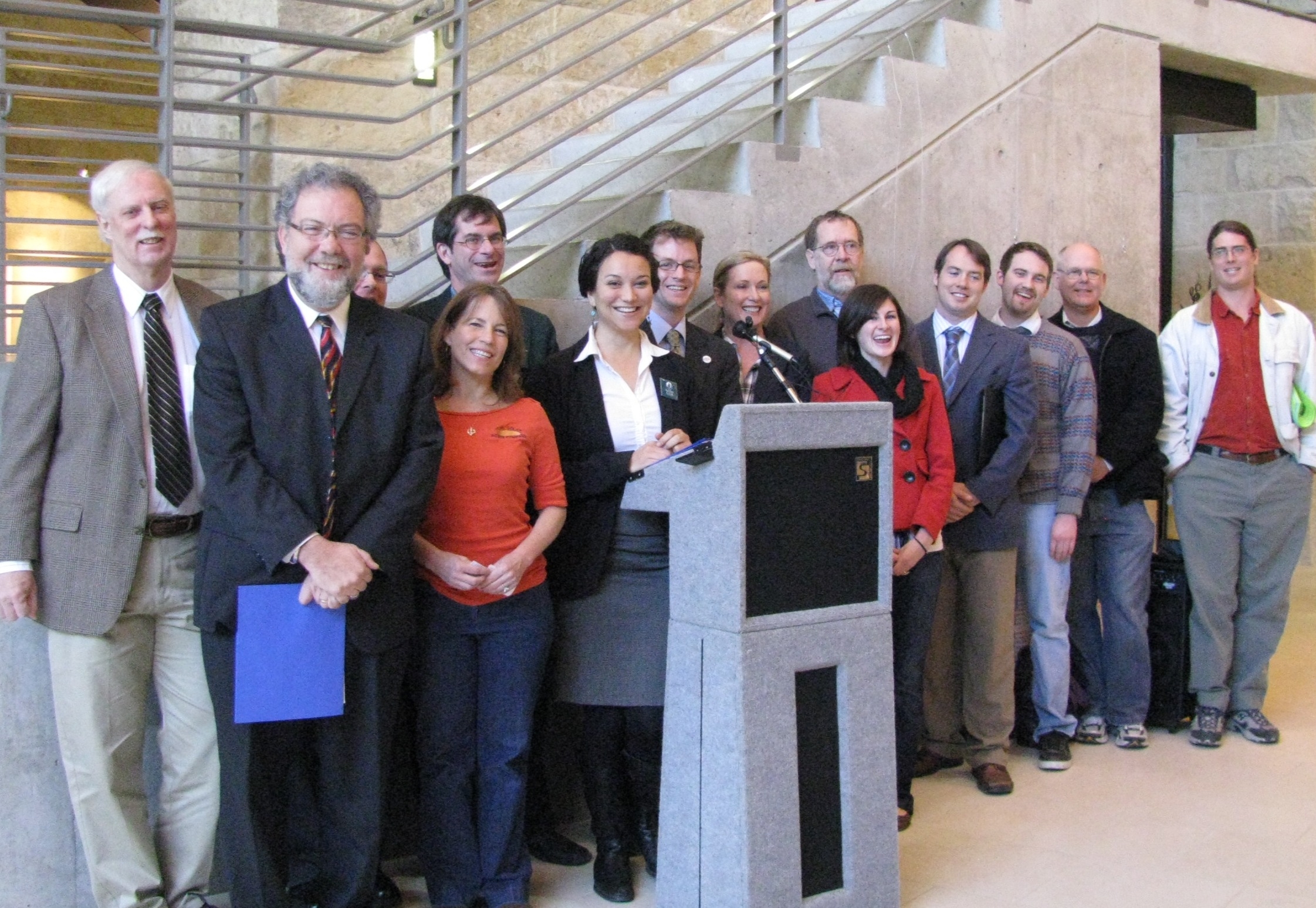
Press Conference RE: Austin Energy Governance 2-13-13Yet, Austin City Council is moving forward with a rash plan to hand over the bulk of its power to govern and oversee Austin Energy to an appointed board.  A well thought-out Austin American-Statesman editorial reveals the fool-hardness of making such a substantial governance change without even studying if it is needed or if the proposed change would yield better results than the current system of governance by the City Council.

This is one of those times when we need to remember that “the only thing we have to fear is fear itself.”  City Council (and a couple of our state legislators) have been reacting out of fear that Austin Energy, or parts of it, could be deregulated.  But, in light of the recent settlement reached with the out-of-town ratepayers, that is unlikely to happen.  We need City Council to stare their fear in the face and make a rational, fact-based decision.  Panicking now could cost our utility and our city for years to come.

Our city’s most valuable asset should be accountable to us, the citizens of Austin and the customers it serves.  Elections don’t always turn out the way I wish and some appointees do their jobs well, but I’m a populist, so at the end of the day, I want the power in the hands of the people.  With elections, we give power to individuals to do jobs an with elections we can take that power away.  An appointed board wouldn’t have to be responsive to citizen concerns and could make the vast majority of decisions about how Austin Energy is run and what to prioritize.

If, after studying the pros and cons of governance by City Council vs. governance by a board, City Council still believes that they are not the best people to oversee Austin Energy, an elected board would be a better option than an appointed board.

Let’s keep the power in our hands.

Tell Austin City Council not to approve an appointed board.


Read Full Post »

Although the taxi cab industry in Austin is not often considered a power player in politics, individuals, top executives and owners have spent thousands of dollars in this city council election cycle. In particular, the election for the Austin City Council Place 3 seat has seen substantial amounts of money flow into it from the taxi cab companies. The race is between incumbent Randi Shade and newcomer Kathie Tovo. With well over $210,000 raised by the candidates, the taxi companies have accounted for nearly $18,000 of that money.

The influx of money can be attributed to disagreements within the industry by management and cab drivers as described in the Austin American Statesman article by Ben Wear. In the article, General Manager of Austin Yellow Cab Edward Kargbo is quoted as saying that they donated to “council members who we have found to be open to sitting down and hearing both sides.” The main debate is over whether legacy permits should be issued by the city council. The permits would allow drivers with at least 5 years of experience to bypass the three major taxi companies in Austin. The taxi companies are worried that this would lead to a loss of control in the marketplace. In the Place 3 election, Tovo has stated she is in favor of legacy permits whereas Shade has said she is opposed to it.

The large proportion of money that the taxi industry has devoted to this campaign has some people worried like Electric Cab owner Chris Nielsen who has said that City Council members were influenced by donations by cab executives. From The Statesman:

Yellow Cab and Austin Cab were granted five-year franchises in May 2010 by the council. Both votes were unanimous, although Morrison and Riley were not present when the Austin Cab vote occurred. The taxi drivers association at the time argued that given its concerns over the taxi fees and other issues, the term of the franchises should have been much shorter than five years.

The council’s response to the drivers’ concerns was to pass a resolution ordering the city’s staff to develop recommendations on a variety of issues involving taxis. In September, city staffers gave the council a briefing that included some immediate recommendations and items for further study.

Those recommendations included putting into the city code regulations for “low-speed electric vehicles,” a suggestion that has complicated the taxi dynamic this election season.

That proposed ordinance, which was to come before the council on April 21 , would allow the sole Austin company running those golf cart-like vehicles to potentially compete directly with taxis for short trips downtown. The company, Electric Cab of Austin, currently operates only as a shuttle contractor for hotels, rather than as a taxi service.

Two days before it was to come up, however, Shade raised concerns at a council work session about authorizing a new business while study of the overall taxi industry was ongoing. The council decided to table that matter for three to six months.

Electric Cab owner Chris Nielsen , who had flirted earlier in the year with running against Shade, claimed that she and other council members were influenced by the donations they had received from the cab executives. No, Shade said.

“It’s not the city’s job to create a special niche for one guy’s business,” she said.

Nielsen, still angry about the delay, said last week that on the May 14 election day he talked to Yellow Cab employees passing out Shade campaign fliers near the O. Henry Middle School polling place.

He said they told him they were from Houston and were paid by their company to travel to Austin and do the electioneering.

Not so, Shade said, after checking with Kargbo with Yellow Cab. Kargbo said that the Yellow Cab contingent did include employees from Houston, none of them drivers, and some nonemployees.

They were campaigning exclusively for Shade, he said.

Regarding Nielsen’s claim about the workers being on the Yellow Cab payroll during their Austin stay, Kargbo said: “That is 100 percent inaccurate. No one was paid to come up and do anything for Shade.”

With the election coming to a climax later this week, it is likely we are going to see even more money flow into the two campaigns. However, almost 12% of the money raised so far came from the taxi cab industry. It appears that of all the issues facing the city of Austin, the taxi cab debate is one of the most influential yet least talked about issues in the race. Yet the least talked about issue could be the one that decides the City Council Election for the Place 3 seat.

Read Full Post »

For those in Austin who don’t know, the EGRSO (the Economic Growth and Redevelopment Services Office… I had to look it up too) gets a substantial portion of its funding from the municipally-owned utility Austin Energy. What does this office do? From its city website:

[The EGRSO] implements the City of Austin Economic Development Policy as directed by the Austin City Council.

Essentially, the office provides grants and loans of city funds or services in order to promote economic development. Among its awardees are Facebook, LegalZoom, Heliovolt, Friday Night Lights, and the Home Depot Austin Technology Center.

Recently, the Electric Utility Commission voted unanimously to cut AE’s funding of the EGRSO, citing the fact that AE faces tough budget choices inside its own walls. Commissioner Shudde Fath wrote in the Business Journal that AE can no longer be the city’s cash cow.

EUC Chairman Phillip Schmandt released a statement on the matter yesterday:

I applaud EGRSO and its programs.  There are many great ideas in EGROS’ $10 Million budget.

But not every great idea should be funded with government money.

And more to the point, not every great idea should be funded from utility bills paid by our hard working customers who are struggling to make ends meet every month. (more…)

Read Full Post »

YeeeeeeeeeeeeeeHaaaaaaaaaaaaaaa!

Today is a great day. Not only is this the 40th anniversary of Earth Day, but Austin City Council just gave every Texan  a reason to celebrate: Mayor Lee Leffingwell and City Council passed the Austin Energy Generation Plan!

After two years of hard work, enormous inclusive cooperation and citizen participation, the council unanimously approved the proposed Austin Energy Resource, Generation, and Climate Protection Plan.

City hall attendants saw rigorous public approval–and some misguided contention–of the plan’s affordability and the process’ public participation during the public discussion. Council broke for citizen communications and an executive session before returning to approve the proposal.

Mayor Leffingwell spoke strongly in favor of the bill for both its environmental and economic responsibility, saying that global climate change will be the defining challenge of our era. Although it is a global problem, he said, Austin has a responsibility to do its part because “the sum of local policy is global policy.”

I caught up with Public Citizen’s David Power, Ryan Rittenhouse and Matt Johnson outside along with Sierra Club’s Cyrus Reed celebrating the fruition of their tireless efforts.

Matt would like to thank all the members and supporters of the Clean Energy for Austin coalition for their hard work and dedication.

Congratulations! Go and celebrate Earth Day with jubilation!

###

By promoting cleaner energy, cleaner government, and cleaner air for all Texans, we hope to provide for a healthy place to live and prosper. We are Public Citizen Texas.

Read Full Post »

Photo Courtesy of Donna Hoffman at the Lone Star Chapter of the Sierra Club. Thanks Donna!

Dozens of businesses and nonprofit organizations as well as more than 200 citizens have formed Clean Energy for Austin, a coalition whose purpose is to push Austin City Council to adopt a clean energy plan. Specifically, the coalition supports the passage of Austin Energy’s Resource and Climate Protection Plan and recommendations of a city task force created to examine the plan. Coalition members support the plan because of its emphasis on renewable energy and efficiency, green jobs creation and careful consideration of Austin’s low-income residents.

To date, more than 70 businesses, 18 non-profit organizations and more than 200 individuals have signed on in support of the energy plan through www.cleanenergyforaustin.org.

The energy plan is a road map for how Austin Energy, the city-owned electric utility, will meet the city’s energy needs over the next 10 years. It includes a substantial investment in energy efficiency and a variety of renewable energy resources like wind and solar, as well as new more efficient natural gas plants. In addition to diversifying its generation portfolio, Austin Energy wants to create a self-sustaining market for renewable technologies like solar rooftops and parking lots by 2020.

“A good business practice is to keep your options open when selecting suppliers,” said Steve Taylor of Applied Materials, a semiconductor manufacturer employing more than a thousand Austinites. “This plan allows for a diversity of different energy options, so it protects businesses – and residents – from long-term price spikes for any single power source because other energy supply options will be available and abundant. This plan also enhances Austin’s efforts to create green businesses and green jobs for years to come.”

The plan is the culmination of a nearly two-year public process of gathering input from multiple stakeholder groups, including businesses, environmental organizations, and groups serving low-income communities. Four representatives from the mayor’s Generation and Resource Planning Task Force, which analyzed more than a dozen scenarios of where Austin could get its power by 2020, are members of the coalition: Phillip Schmandt, chairman of Electric Utility Commission, Cary Ferchill, chair of Solar Austin, as well as non-profit members Public Citizen and Sierra Club.

“The great thing about the plan is its flexibility,” said Matthew Johnson, clean energy advocate with Public Citizen. “If costs for any resource type rise or fall dramatically over the next 10 years, Austin Energy would have the ability to change the plan, and do so with the help of community stakeholders. That’s the beauty of a diverse portfolio of resources. If Austin were locked into building a new coal or nuclear plant, our fate would be sealed.”

Energy efficiency, generally recognized as the cheapest energy resource, would be the main component of the plan. Austin Energy would take a more proactive and coordinated approach to reach low-income households with free weatherization to help lower their electric bills.

“Low-income communities need the most help with paying utility bills,” said Sunshine Mathon, design and development director of Foundation Communities, an Austin-based nonprofit affordable housing organization. “Austin has a long track record of having the lowest bills in Texas because of its commitment to conservation programs that help people lower their bills. My hope is that with the passage of this plan, those programs will not only expand but coordinate with other programs like bill assistance, neighborhood housing and community development.”

Coalition representatives also said that the plan reduces financial risk associated with overreliance on fossil fuels. The plan would enable Austin Energy to ramp down the Fayette coal plant more often, protecting the utility from pending carbon regulation.

“Whether or not you support greenhouse gas regulation, reducing the amount of carbon emissions that Austin is responsible for makes economic sense,” Johnson said. “That’s in addition to the improvements in air quality Austin and the surrounding region would experience. It’s a win-win.”

Austin’s City Council could vote on the plan in March, according to Austin Mayor Lee Leffingwell. He has scheduled a Feb. 22 town hall meeting on Austin Energy’s Resource and Climate Protection Plan. Coalition members urge the public to visit www.cleanenergyforaustin.org and sign on as well as attend the town hall meeting to show their support.

###

By promoting cleaner energy, cleaner government, and cleaner air for all Texans, we hope to provide for a healthy place to live and prosper. We are Public Citizen Texas.

Read Full Post »

Last Thursday Austin Energy General Manager Roger Duncan briefed Austin City Council on the utility’s Resource and Climate Protection Plan.  This plan is the culmination of 18 months of input from the public, the creation of a generation resource task force of various stakeholders to review various energy plans and make recommendations, and support and input from both the Electric Utility Commission and the Resource Management Com­mis­sion — but it still isn’t the end of the line for the plan.  The generation plan will also be the subject of a city-wide town hall meeting February 22nd, and city council is expected to vote on some version of it in March.

The energy plan that Duncan (who will be retiring soon and we wish him the very best) presented  sets Austin on a path to reduce our carbon emissions 20% below 2005 levels by 2020 and get a total of 35% of our energy from renewable resources. It will meet council’s renewable energy goals, move Austin Energy towards becoming the leading utility in the nation in terms of clean energy and global warming solutions, and re-affirm the city’s commitment to the Climate Protection Plan, which has the laudable goal to establish a cap and reduction plan for the utility’s carbon dioxide emissions.  It is a flexible, living document that will allow council to evolve and adapt as conditions change. AND it will reduce the capacity factor of our Fayette Coal Plant to 60% and gets the ball rolling on figuring out the best way to shut it down(which you know makes me happy). Sounds like a pretty sweet deal, doesn’t it?

As we’ve come to expect over the years from our award winning utility, Austin Energy is taking an especially responsible and forward-thinking role with this new plan.  I’ve formed this opinion for a few reasons:

  1. They’re adopting aggressive renewable energy and efficiency goals as part of a larger, smart business plan.  Austin doesn’t need a new generation plan because we’re going to be strapped for energy by 2020; Austin Energy could rest on their laurels and do nothing for the next ten years and we’d be fine buying up excess energy on the open market as its power purchase agreements expire and gas plants age.  But if they did that, by the time 2020 rolled around Austin would be way behind the technological curve and very likely be stuck with higher rates as a result.  Austin Energy has picked up on the national trend that the traditional fuels we rely upon, such as coal, are quickly becoming financial liabilities even as solar and wind are becoming more and more cost effective.  This plan will allow the utility to reposition itself  for 2020 going forward so that in ten years we will have made the preparations necessary to take full advantage of the coming clean tech boom rather than be left scrambling and dependent on outdated energy sources.
  2. Austin Energy and the task force that helped formulate this plan were very careful to balance considerations of reliability, affordability, and clean (in terms of the environment and human health).  The city has the responsibility to make sure that everyone who lives here can afford their utility bills.  It doesn’t do any good to make the switch to a new clean economy if we do so on the backs of those that can least afford it.  But that couldn’t be farther from the case with this plan; this isn’t green for some, this is green for all.  Compared to other options, this plan will minimize the impact for those least able to pay their electricity bill, supports in-house economic development and the hiring of local contractors, and ensures that everyone will have a chance to play a role in moving our city and economy forward.  There’s been a lot of focus and attention on the utility’s estimate that the plan will raise rates in 2020 by approximately 22% or $21 a month, but what’s missing from that discussion is that even if Austin Energy doesn’t do anything between now and 2020 rates will go up by 15% or about $14 a month.  So do the math — for an extra $7 a month in ten years, we can build up a clean local economy that minimizes impacts on low-income consumers and creates avenues to new employment opportunities, improves public health, AND puts Austin in a prime position to start lowering rates by taking advantage of cheap renewable energy. OR we can save families $7 a month compared to today on their utility bills but lose out on new jobs and leave every citizen in the city of Austin at the mercy of high fossil fuel costs and coming federal regulations on greenhouse gas emissions.  Austin Energy is not only looking at what is most affordable now, but what is most affordable in the long term. Coal may be cheap and reliable energy now, but depending on it in the long term will get us into trouble in terms of cheap and affordable in 2020.
  3. Austin Energy is not only reaching for the low fruit of emissions reductions and energy efficiency, they’re building high-tech ladders to get at the really juicy stuff at the top of the tree. Let me explain. There are a number of ways Austin Energy could go about reducing emissions.  The easiest of these would be to buy renewable energy credits, or RECs. RECs and offsets are in essence a mechanism for utilities, businesses, and governmental bodies to pay someone else to clean up and still get the credit for it.  They’re a good and have a positive influence on society at large because they do encourage clean energy investment and development, but not necessarily in a nearby community (in fact almost certainly not).  It might be easier in the short run to pay someone else to be clean up, but then we miss out on all the delicious creamy gravy that comes along with renewable energy development.  If you buy RECs you don’t get new jobs and businesses in your community.  If you buy RECs your own people are still breathing the same amount of pollution.  But Austin Energy is taking the initiative to really get at the heart of the problem by cutting the amount of pollution coming out of the smokestacks we own.  For that, they should be applauded.

This is just my own personal take-away from listening to various people discuss the recommendation plan and hearing Roger Duncan’s presentation to council. You can learn a lot more about the process and final recommended plan by visiting AustinSmartEnergy.com or CleanEnergyforAustin.org. Join us after the jump for some fast facts on the various components of the plan, but for the real nitty gritty check out Duncan’s own powerpoint presentation.

(more…)

Read Full Post »

*Update: Greg Harman at the San Antonio Current just published a fantastic and very thorough recap of the twisted nuclear saga. Check it out!

Here’s part 2 in this year’s first annual Year in Review: Top Texas Vox Stories of 2009 series. Part 1 is just a hop, skip and scroll down.

3. San Antonio Nuclear Debacle/Amores Nucleares Telenovela

This year has been a doozy for nuclear power, with the highlight of course being the San Antonio situation.  Over the last 12 months San Antonio has ridden a wild wave of cost estimates, community meetings, protests, scandals, and misinformation.  But I’m getting ahead of myself. Remember when…

Last January, CPS Energy committed to spend $60 million more on the proposed expansion of the South Texas Nuclear Project, a decision which at that point brings the city utility’s total expenditures on units 3 & 4 to $267 million. Not long after that, Austin City Council took a look at participating in the expansion project but said “No way, that’s much too risky of an investment for us.” San Antonio decided that something magical (but mysterious) was different for them, despite our prediction in late April that the proposed reactors could actually cost as much as $22 Billion.  Mum was CPS’ word on a cost estimate at that time, but by June they announced that $13 Billion was a good, round number. We worried at this point that CPS was being overly optimistic, ignoring the history of the South Texas Project and other nukes around the nation and independent reports, but those concerns largely fell on deaf ears.

Then over the summer, CPS Energy launched a massive public outreach campaign, with meetings in every district — but kind of botched it.  Despite activists’ protests that CPS’ cost numbers were innacurate, the utiltiy refused to release their information or back up numbers, and many San Antonio citizens left the community meetings feeling disenchanted with the process and suspicious of CPS.

As a rising tide of activists and concerned citizens grew, eventually they formed the coalition group Energía Mía and worked together to halt CPS’ spending for more nuclear reactors. The group launched a string of protests and press conferences highlighting the many flaws of nuclear power and the San Antonio deal in particular.  Everyone was all geared up for a big showdown the last week in October, but then the cowpie really hit the rotating bladed device (let’s call it a windmill). For the next part, I’m going to pull from a previous post where I likened the whole situation to a geeky, policy version of a telenovela.

Previously, on Amores Nucleares:

With just days before San Antonio City Council was to vote to approve $400 million in bonds for new nuclear reactors, it was leaked that the project could actually cost $4 Billion more than CPS had been saying all summer (according to Toshiba, who would actually be building the plant). The vote was postponed, there was an impromptu press conference, and it came out that CPS staff had actually known about the cost increase for more than a week — Oops! Oh, and the “leak” wasn’t that CPS came out with the truth, an aide from the mayor’s office only found out after confronting CPS about a rumor he’d heard. But how did the mayor’s office find out? NRG, CPS’ partner in the project was the “Deepthroat”, because they were going to announce Toshiba’s $17 Billion cost estimate at a shareholder’s meeting soon after the city council vote and thought, geez, that could look really bad for CPS! Meanwhile, CPS reps flew to Japan in a hurry to figure things out. Steve Bartley, interim GM for CPS, resigned. Furious that CPS had hidden the ugly truth from City Council, the mayor demanded the resignation of two key CPS board members, and got City Council to vote unanimously that they get the boot. Chairwoman Aurora Geis agreed to go, but Steve Hennigan said “No Way, Jose.” THEN CPS completed an internal audit of the whole shebang to figure out what-the-hell-happened, which found that Steve Bartley was to blame, and everyone else was only guilty of failure in their “responsibility of prompt disclosure”. Then it came out the project could be even more way way expensive than anyone thought (except of course Energia Mia, Public Citizen, SEED Coalition, the Center for American Progress, Nuclear Information and Resource Service, and analysts Arjun Makhijani, Clarence Johnson, Craig Severance, and Mark Cooper to name a few). And then those crazy cats all started suing each other.

So in the end, they told folks all summer long that the plant would cost $13 Billion, even though insiders knew since late June that it could very well be $4 Billion more. Latest update is that the plant could really cost $18.2 Billion! On December 31st, Toshiba provided CPS with another new estimate, which the utility will use to come up with their own new cost estimate mid-January. City council is slated to vote sometime after that, once and for all, on $400 million in bonds to continue the project.

But clearly, enough is enough. So if you live in San Antonio, tell City Council to stop throwing good money after bad, and to cut their losses before its too late. Tell them to vote “no” to nuclear bonds and start the year off fresh and free from the “ghost of nuclear projects past.”

###

By promoting cleaner energy, cleaner government, cleaner cars, and cleaner air for all Texans, we hope to provide for a healthy place to live and prosper. We are Public Citizen Texas.

Read Full Post »

AUSTIN – Public Citizen Texas will be honoring the recipients of this year’s Texas Outstanding Public Service (TOPS) Awards at the organization’s 25th anniversary dinner today. The awardees are local visionaries, recognized experts and celebrated advocates who have aided in the effort to help Texas realize a more environmentally conscious and sustainable energy future.

Those receiving the TOPS Awards were chosen by Tom “Smitty” Smith, director of Public Citizen Texas, and his staff based on their accomplishments and contributions to the overall health, safety and democracy of all Texans. This year’s lineup of winners includes two journalists, three legislators, two activists, a whistleblower, a legislative aid and a man whose lifetime of achievement merits the finest award of all.

Winners of this year’s awards include Roger Duncan, general manager of Austin Energy, Austin American-Statesman reporter Claudia Grisales, San Antonio Current reporter Greg Harman, state Reps. Dave Swinford and Rafael Anchia, citizen activists Gerry Sansing and Dr. Wes Stafford, state Sen. Wendy Davis, whistleblower Glenn Lewis and state legislative staffer Doug Lewin.

Duncan will receive this year’s Lifetime Achievement Award. Duncan is a true visionary who has not only blueprinted the greening of the Austin City Council but also of the city’s public utility. He successfully transformed Austin Energy and set standards for the rest of the nation. He has been a major player in the fight for green issues for more than three decades – starting with his journey as a student activist in the 1970s, serving two terms as a member of the Austin City Council in the 1980s and eventually leading the city’s environmental department for nine years as the assistant director. Duncan is considered the architect of several of Austin’s nationally acclaimed energy efficiency and renewable energy programs, including GreenChoice and the Green Building Program. Furthermore, under Duncan’s leadership, Austin Energy adopted ambitious goals to bring more solar energy to Austin, committing to the development of major solar generating capacity. Duncan was also one of a few people to realize early on that the city of Austin had the potential to reduce urban air pollution by using plug-in hybrids. He assembled a coalition of potential buyers of plug-ins in the country and implemented a program at Austin Energy that offered an incentive package for such hybrids. Although he has announced his planned retirement for next year, it will not be surprising to see him in some sort of leadership role in the city in the near future.

In a quote from Duncan published in the Austin Chronicle last month, he said, “Today, it is time for me to return to my original role as an involved citizen of Austin.” Public Citizen Texas welcomes him as such (more…)

Read Full Post »

Environmental Groups Applaud EPA Choice

New Regional Administrator could signal change in direction for polluted state

DALLAS – Environmental advocates across several states are applauding the Obama Administration’s choice of Dr. Al Armendariz to lead Region 6 of the Environmental Protection Agency, which includes Texas, Louisiana, New Mexico, Oklahoma and Arkansas. Armendariz, an engineering professor at Southern Methodist University, has worked with diverse constituencies ranging from corporations to citizens groups and has published dozens of studies on myriad environmental issues throughout his career. His appointment garnered high praise from the environmental community.

“Our region has typically provided a haven for some of the worst polluters in the country, and has paid a steep price,” said Tom “Smitty” Smith, Texas Director for Public Citizen. “I believe the appointment of Dr. Al Armendariz signifies a new direction for Region 6.”

In an effort to make sure EPA Administrator Lisa Jackson and the White House chose a strong environmental leader for Region 6, about twenty prominent advocates signed on to a list of principles that they hoped would guide the appointment. Dr. Armendariz was one of two candidates the groups endorsed for the position. Their list of qualities for an ideal administrator included a commitment to environmental justice and science-based policy, minimal ties to industries regulated by EPA and a strict adherence to the President’s Executive Order on Ethics, which was intended to prevent conflicts of interest between lobbyists and government agencies.

“Al Armendariz demonstrates the kind of vision, integrity and grassroots approach to enforcing environmental law this region needs if we’re truly going to clean up our act,” said Jeffrey Jacoby, Program Director at the Texas Campaign for the Environment (TCE). “He embodies the ‘Principles for Environmental Leadership and Real Change’ we believed should guide this appointment.”

Indeed, many within the environmental community see appointment of Armendariz as indicative of a new approach for the regional EPA.

“We are thrilled with Dr. Armendariz’s appointment,” said Luke Metzger, Director of Environment Texas. “After eight years of the Bush EPA, it’s a new day for Texas’ environment. Move over polluter lobbyists, science and human health are in charge now.”

In addition to environmentalists, some within the business community were also pleased with Obama’s choice. Former Austin City Councilmember Brigid Shea, now principal and co-founder of an environmental consulting firm, stated, “As a businessperson who’s concerned about the environment, it’s time this region got someone who understands that we can have both a healthy environment and a strong economy, that the two are not at odds.”

Dr. Armendariz will take over for Acting Region 6 Administrator Larry Starfield. During his tenure, he will face a number of pressing environmental challenges, including potentially overseeing the implementation of federal climate change legislation, bringing metropolitan areas in Texas into compliance with the Clean Air Act and working to clean up toxic “hot spots” along the Gulf Coast.

“Texas needs a tough air enforcement chief at EPA 6 Dallas like Dr. Armendariz who’s willing to tackle head on the state’s serious air quality challenges with large urban areas like Dallas and Houston failing to meet new ozone standards, and who is willing to require Texas to clean up its large dirty coal plants and refineries,” stated Dr. Neil Carman of the Sierra Club’s Lone Star Chapter.

Environmental justice activists from communities across the state are also hopeful that the appointment of Dr. Armendariz will benefit Texans living directly adjacent to polluting facilities

“The Executive Order 12898 on Environmental Justice is a document that looks good on paper, but in the real world EPA’s office of Environmental Justice has at times sided with industry over our communities; and pollution problems in poor communities have gotten worse, not better,” said Suzie Canales, Executive Director of Corpus Christi-based Citizens for Environmental Justice. “Now under Armendariz, we have real hope that environmental justice issues will be a serious priority to the agency.”

Many environmental justice groups endorsed Armendariz from the beginning of the Regional Administrator selection process, citing his commitment to science, his understanding of the issues and his dedication to enforcing the spirit of environmental laws such as the Clean Air and Clean Water Acts.

“Dr. Armendariz is exactly the kind of person you’d want to have this job, but seemingly never gets it,” said Jim Schermbeck, long-time Field Organizer with Downwinders at Risk. “Because of what’s at stake and the fact that Texas is the belly of the polluter beast, this may be one of the most important, far-reaching appointments the Obama Administration makes. Downwinders at Risk is proud to have been the group that first utilized Dr. Armendariz’s expertise for our cause of cleaning up the Midlothian cement kilns back in 2005. That work lead directly to his becoming the premier ‘citizen’s scientist’ in Texas on air pollution, and paved the way for his much larger influence on the state scene. Congratulations to both Dr. Armendariz and the EPA.”

As enthusiastic as environmentalists are about the appointment, they also promised to hold Dr. Armendariz accountable to the people affected by pollution issues in the five-state region. “As outstanding as Dr. Armendariz has been on paper and in interviews, we’ll be watching to make sure he walks the walk,” says Jacoby, who works in TCE’s Dallas office, “Remember, Al, my office is right down the street.”

# # # #

By promoting cleaner energy, cleaner government, cleaner cars, and cleaner air for all Texans, we hope to provide for a healthy place to live and prosper. We are Public Citizen Texas.

Read Full Post »

Many thanks to everyone that made it to the Austin City Council meeting yesterday for an anti-coal demonstration! Twenty five to thirty concerned citizens stood up in City Council chambers, dressed in black to represent the yearly moralities from our Fayette Coal Plant, as Ryan Rittenhouse addressed the Council. Check out the video below for more, and join the facebook group Austin has a Dirty Secret to stay in the loop on future coal actions and demonstrations:

Read Full Post »

It has been less than 24 hours since I received a copy of Austin Energy’s Generation Plan recommendation and there’s a lot here to like.  Before I get to the highlights, let me just say that those of you who spoke up, filled out the survey, played the sim game and demanded more renewable energy, energy efficiency, less dependence on coal, your voice was heard!

Here are the highlights:

Energy Efficiency: Goal increases from 700 megawatts to 800 megawatts by 2020, a new study on energy efficiency potential will be conducted and AE will target “baseload” efficiency more (previously they had really gone after peak reduction with an emphasis on load-shifting).

Renewable Energy: Goal increases from 30% to 35%. Doesn’t seem like a lot but it is. By 2020 Austin Energy will have 1001 megawatts of wind, 200 megawatts of solar (double what the previous goal was) and 162 megawatts of biomass.  They had originally thought to seek an additional 100 MW of biomass on top of what AE already has coming from Nagocdoches in 2012, but decided to scale that back to 50 MW. Not a bad idea considering the limited resource in Texas.

Gas: An additional 200 MW of combined cycle at Sand Hill. The expansion of the plant will provide balancing services to variable renewable resources.

Nuclear: Keep STP 1 & 2. Still saying no to 3 & 4 (woo-hoo!). If someone makes them an offer to contract for the power (we hope it never gets built), they’ll evaluate it.

Coal: The increase in energy efficiency and renewable energy should enable AE to reduce the capacity factor of their share of Fayette coal plant to around 60%, “setting the stage for eventual sale or other disposition of Austin’s share of the plant” (from the AE recommendation). At last night’s Electric Utility Commission meeting, Duncan said currently it’s at about 85-90%.

CO2 plan: Emissions would be 20% below 2005 levels by 2020 (Waxman, Markey, you got that?).

Water use: Water use intensity of the utility’s generation sources reduces by 20% from 724 gallons/kWh to 574 gallons/kWh. Most of that would come from running Fayette smaller.

Other notes: AE will heavily go after solar resources within the city. Duncan estimated that there is roughly 3,000-4,000 MW of solar potential in the city (both for electricity and solar water heating). AE also would work to develop energy storage like compressed air energy storage-aka CAES (case).

We have tons of questions and we’re still analyzing the plan. But our first impression is: this is a pretty good plan but it can be improved.  Roger Duncan and his staff deserve recognition. At a time when other utilities in Texas are actually still building new coal plants (CPS Energy, LCRA), Austin Energy recognizes the need to get out of coal. To hear this acknowledged by the utility publicly is very positive, but City Council needs to make this a commitment. The goal should be to see Fayette closed… sooner rather than later.

Obviously, this plan comes with a price tag. Once we get the chance to ask more questions and analyze the plan and possible variations of it we’ll do a more in depth post.

We look forward to a healthy debate on this plan over the next few months. To all you Austinites who want a clean and more sustainable utility, keep urging city council to go beyond coal!

-Matt

Read Full Post »

You are invited to learn about and provide input to the Austin Pecan Street Project tomorrow, June 23 from 4 p.m. to 7:30 p.m. at the Capital Area Workforce Board, 6505 Airport Blvd., Suite 101-E (please enter from the Highland Mall side of the building).

The Pecan Street Project is an initiative charged with exploring the challenges Austin faces in building a modern energy system, including a smart grid.  On September 25, 2008, the Austin City Council adopted a resolution directing the city to work with Environmental Defense Fund and other community stakeholders, to conduct an analysis of system improvements, technology advances, and business models that would enable Austin Energy to more fully develop its capacity for the distributed generation of clean energy.

Attendees will be provided information about the project, followed by an invitation to participate in breakout sessions encouraging discussion and soliciting feedback about the project’s technology, system design, financial and economic development aspects.

The project is a partnership among the City of Austin, Austin Energy, University of Texas, the Greater Austin Chamber of Commerce and Environmental Defense Fund. The project has already garnered 11 corporate partnerships, including Dell Inc., IBM Corporation, Intel, Cisco Systems and others.

For a primer on just what a “smart grid” is, check out the following video.  Hope to see you at the meeting tomorrow!

For more information on the Pecan Street Project, check out their YouTube channel and watch a couple of their videos.

Read Full Post »

The House Technology, Economic Development and Workforce Committee met today to discuss HB 516, a bill to establish and fund a green job skills training program under the Texas Workforce Commission.  Representative Mark Strama (D-Austin) authored the bill, which specifies green jobs as being “jobs in the field of renewable energy or energy efficiency.” These include jobs in energy efficient building, construction, and retrofitting, renewable electric power, biofuels, deconstruction and reuse of materials, energy efficiency assessments, manufacturing of sustainable products, and manufacturing using sustainable processes and materials. Considering the fact that Texas unemployment rate has hit a 19-year high and is home to an increasingly environmentally-conscious public, creating green jobs simply makes sense.  Austin City Council’s recent approval and the public’s support of the Webberville solar plant shows that there is local a push for a greener economy. The fact that $43 billion of the recently passed stimulus package is slated towards energy, especially green energy, speaks volumes about what direction the country would like to go towards its use of energy. If the bill does pass, federal funding will be the principal source of money. (more…)

Read Full Post »

2_18_09partyThis afternoon the Austin City Council moved unanimously to approve Item 16 on the agenda, the purchasing power agreement with Gemini Solar Development Company to build a 30 MW solar plant at the Webberville tract.  That means that by the end of 2011, Austin should be the proud home of the nation’s largest utility scale photovoltaic installation.  This is a tremendous milestone for both the City and Austin Energy that will set us up as a leader in solar energy, create jobs, attract industry, and protect our citizens from volatile future energy prices while curbing our global warming emissions.

Lee Leffingwell made the motion to approve item 16 with three additional recommendations.  The first direction was to include a provision that any federal stimulus funds, rebates, or incentives recovered would be passed on to Austin, rather than kept by Gemini.  The second was to create a new task force to review future energy projects.  The task force, he promised, would consist of diverse stakeholders and not be weighted in terms of energy usage.  This is an important point, as several representatives from the city’s large scale industrial users such as Spansion and the Building Owners and Managers Association (BOMA) specifically requested that future stakeholder meetings be based upon the size of user consumption– meaning that in future energy projects, city council dialogue would be dominated even more than ever by large industrials.  As David Power, Public Citizen’s Deputy Director, testified, that sounds a little too much like, “for every dollar I spend, I get a vote.”  Cheers to Lee Leffingwell for insisting on a more inclusive process.

The third and final additional direction was, as expected, to roll the power purchase agreement into Green Choice, so that citizens would be able to voluntarily opt into a program to buy solar power at a locked-in price. Councilman Mike Martinez stated that he would be more than happy to be the first person to sign up for such a program, except that Leffingwell already called “shotgun” on that distinction.

Council members Sheryl Cole, Laura Morrison, and Randi Shade all made additional comments in support of the plant, stating that this was a tough decision to make in hard economic times but that this solar plant, far from a luxury item, was an important element of Austin’s long term energy goals.

The Austin City Council has earned Public Citizen’s most heartfelt appreciation for proving itself, once again, a renewable energy leader.  We especially respect the time and effort that the Council and its staff put into this contentious process, and look forward to working with them on future projects.

We also encourage Austinites to express their thanks to the Mayor and City Council for approving this historic first step towards our renewable energy future.

Read Full Post »

Older Posts »

Follow

Get every new post delivered to your Inbox.

Join 3,136 other followers