Feeds:
Posts
Comments

Posts Tagged ‘Austin Energy’

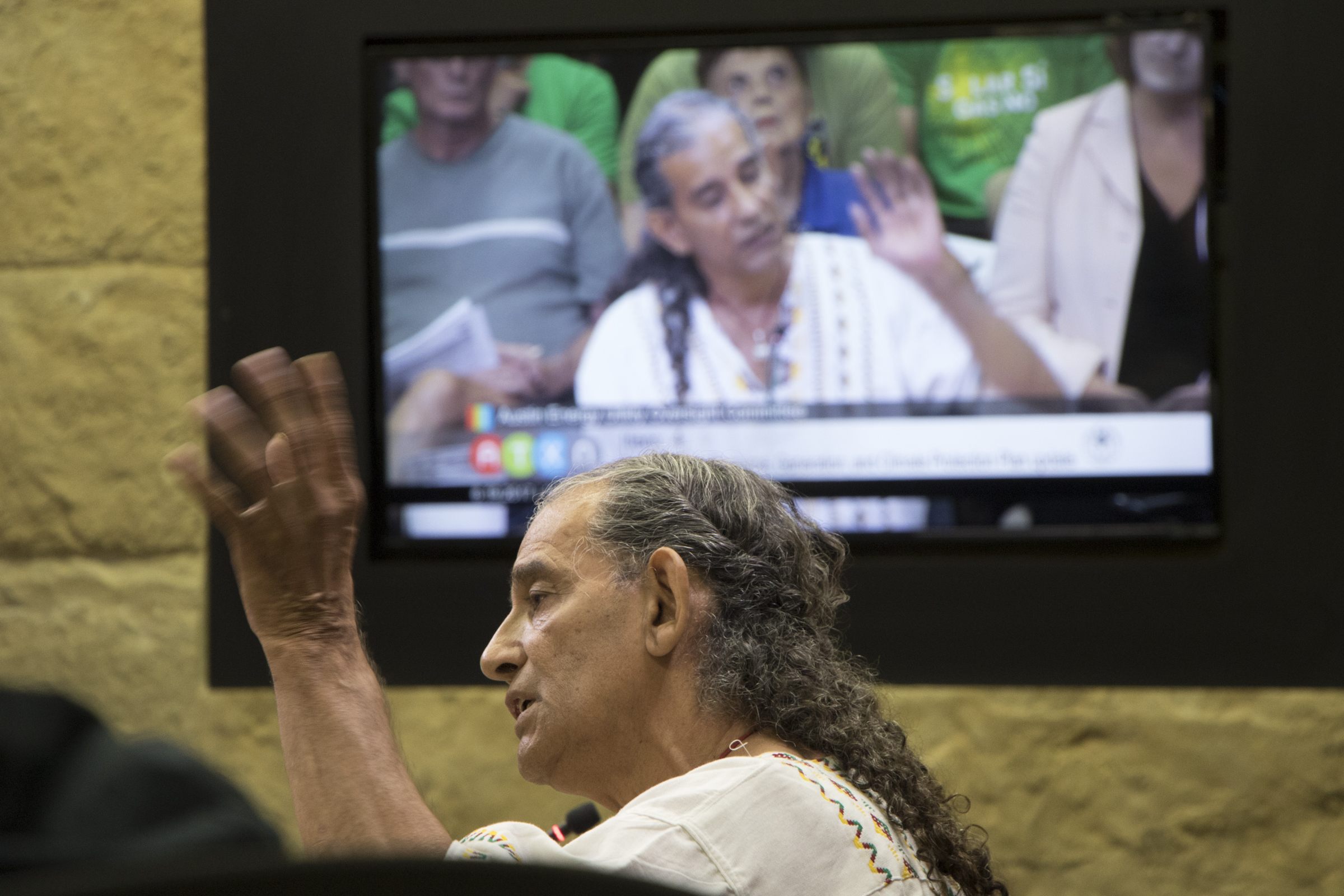
Press Conference RE: Austin Energy Governance 2-13-13Our basic premise that governance by an elected body is more accountable is proving true.  Over the past couple months, many Austinites have expressed their concerns to City Council about a proposed ordinance that would establish an un-elected board to govern Austin Energy.

Before citizens got involved in the process, this ordinance seemed destined to pass and we all would have found ourselves with less power over an important piece of our local government.

As citizen’s began to voice their concerns the majority of city council members heard their constituents and the ordinance was substantially changed. Councilmembers deserve a lot of credit for the work that they have done to improve this ordinance.  However, it would still establish an un-elected board, which is a dangerous road to go down because such a board could be granted more powers in subsequent ordinances.

Discussion of the ordinance that would establish an un-elected board to govern Austin Energy has been set for 7 pm this Thursday (5/23).  It is item #29 on the agenda. (click here and select item 29 to watch the portion of today’s work session concerning this ordinance)

If you wish to sign up to speak on it or just to register your opinion, you can do so at the kiosks inside City Hall.

Because of the changes made to the ordinance in response to citizen participation in the process, the primary supporters of the ordinance, including Mayor Leffingwell, now no longer support it.  Thus, the ordinance may be withdrawn on Thursday morning, so look at the agenda before heading to City Hall Thursday evening.

Read Full Post »

Austin Mayor Lee Leffingwell just postponed a major agenda item (#15), regarding an un-elected board taking over Austin Energy. Numerous citizens were planning to attend the council meeting tonight to express  concerns, and had gone out of their way to arrange their schedules to be there. The mayor completely removed the issue from discussion, not just from a council vote.

The disregard for citizens’ input and time is appalling. Perhaps the mayor’s move is simply a response to citizens having organized more effectively than special interest groups, such as CCARE, who haven’t been able to mobilize support for changing the governance of Austin Energy.

The ordinance may not have been ready for a vote tonight, but the mayor should have left the item open for discussion for the large number of citizens who have set time aside to be present tonight.

We hope that all the engaged citizens that planned on attending the city council meeting tonight will come to the meeting on May 23 and show the Mayor that the public won’t be silenced.

Please contact us with any questions on this issue:

Kaiba White, Public Citizen, kwhite@citizen.org, 607-339-9854 
Karen Hadden, SEED Coalition, karen@seedcoalition.org, 512-797-8481 

Read Full Post »

While Austin City Council continues to move forward with an ordinance to transfer governing authority of Austin Energy from our elected City Council to an unelected board, Austin democracy is being attacked at in the state legislature as well.  Senate bill 410, sponsored by Senator Kirk Watson and Representative Paul Workman, would allow the city to establish an unelected board without a charter election, as our city charter calls for.

The issue of who should govern Austin Energy is important, but it’s also local in nature.  There is no need for state to amend Austin’s charter.  That is a right reserved for the citizens of Austin.  If the changes proposed by City Council are truly in the best interest of our city, that case should be made to the voters and decided upon at the ballot box. 

To have a state representative who doesn’t even live in Austin carrying a bill to change our charter is unacceptable.

The Austin City Charter was adopted by the people of Austin and the people of Austin approved a governance structure for Austin Energy that is accountable to the people through elections.

An unelected board won’t be directly accountable to the ratepayers and wouldn’t necessarily represent our values.  As we debate this issue in Austin the unelected board at San Antonio’s CPS Energy is slashing the rate customers with solar installations will receive for their energy in half without first consulting the public or the solar industry.  Austin Energy customers could be facing similar changes if we don’t act now to protect our rights.

SB 410 has passed the Senate and will be heard by the House Committee on State Affairs tomorrow.

Please consider attending the hearing and speaking against SB 410.

What: Hearing on SB 410 to change Austin’s charter to move Austin Energy governance to an undemocratic board without a vote by the citizens of Austin, as our charter requires.

When: 1:00pm on Wednesday, May 1

Where: John H. Reagan (JHR) building, room 140 – 105 W. 15th St., Austin, TX, 78701

Why: Because Austin Energy’s governance structure will impact decisions going forward, including on renewable energy and energy efficiency programs and rates.  This is the decision that will determine how other decisions are made.

You can register against the bill at the kiosks outside of room 140.  Even if you don’t wish to speak, registering against the bill would be helpful.  We hope you’ll consider saying a few words about the value of local democracy though.  Speakers will be limited to 3 minutes each.

SB 410 is anti-democratic and is one more example of the state government trying to interfere with Austin’s internal policies and governance.

We need your help to stop this bill.

Public opposition to SB 410 at Wednesday’s hearing may be the only thing that can ensure that our Austin representatives don’t let this bad bill move forward.

Please email Kaiba White at kwhite (at) citizen.org if you can attend the hearing at 1:00pm on Wednesday.

Read Full Post »

I was part of and witnessed an inspiring evening at Austin City Hall yesterday.  Engaged citizens came together to speak passionately about the importance of maintaining democratic leadership for Austin Energy, our city’s electric utility.

Many people talked about wanting the right to vote on a change in governance, about the importance of accountable leaders and about the need for multiple public hearings to discuss this important issue.  Others spoke about our utility continuing to invest in renewable energy and energy efficiency and maintaining our commitment to assisting low income families with their electric bills.  The voices were many and varied and the process took hours.

And we made a difference.

Several important amendments were added to the ordinance that, if they remain, limit the powers granted to the unelected board and increase oversight by our elected City Council.  Councilwoman Laura Morrison continued to be our champion on the Council, but Councilmen Chris Riley and Mike Martinez also emerged as allies on numerous amendments to lessen the negative impact of establishing an unelected board.  I commend them on their willingness to listen to the public and make changes to address some of our concerns.  (It should be noted that Councilwoman Tovo was in China for City business, but has also stood by the people throughout this debate.)

There is still a lot of work to be done to eliminate the threat of an unelected board, but it’s clear that public participation does make a difference.  And that’s our fundamental point.  We, the people, wish to retain our direct access to and influence on those who govern Austin Energy.  An unelected board wouldn’t be accountable to the ratepayers.

Please visit CleanEnergyForAustin.org to stay informed over the next week.  Email me at kwhite(at)citizen.org to receive email updates.  This isn’t over yet.

I remember the feeling of community brewing

Of democracy happening

~Ani Difranco

Read Full Post »

Today, Thursday (April 11th) at 4 PM Austin City Council will vote on ordinance that would hand control of the city’s municipal utility, Austin Energy, to an unelected board chosen by corporate headhunters.  This change could open the door to industry insiders and special interests controlling Austin Energy, the city’s largest asset, valued at $3.9 billion.  It’s OUR utility and we should elect those who manage it.

There will be a first vote on this ordinance comes tomorrow despite great public outcry about the rushed nature of this plan, the failure to hold a real public hearing and the failure to acknowledge the millions of dollars wasted at other utilities, such as CPS Energy, at the hands of unelected boards.

A percentage of the profits of Austin Energy currently goes to fund programs for the city, but that funding could be at risk with an unelected board in charge.  Reduced funding could seriously jeopardize our parks, roads, libraries, clinics and public safety department.  There is also some concern that the move to make our public utility more of a corporate model could mean that our green energy and low-income programs are at risk.

This is your utility and we encourage you to come to City Hall this afternoon.  Speak if you can, or, if you prefer, donate your time to a friend.  While the “time certain” has been set for 4 pm, please don’t let that deter you.  Come even if you can’t arrive by 4 pm. City Council has been known to be hours late in getting started on an item. We’ll have food on hand.

The backup material (attachment 3 on item #11) includes the draft ordinance, the new report (which is an interesting compilation of data, but doesn’t support the concept of changing Austin Energy’s governance), and a list of 15 ways that the ordinance conflicts with the City Charter.

Even if you can’t attend, but can come by City Hall at some point in the day, please go by and register against agenda items #11 and #45 at the kiosks inside.

You can also call or email council members, specifically Mayor Lee Leffingwell and Council Members Sheryl Cole, Bill Spelman, Chris Riley and Mike Martinez, and ask them to halt this fast-tracked, undemocratic ordinance. Remind them that the utility is ours – not theirs to give away.

City Clerk 974-2210
E-mail all City Council Members at once: http://www.austintexas.gov/mail/all-council-members
Lee Leffingwell 974-2250 Lee.Leffingwell@austintexas.gov
Sheryl Cole 974-2266 Sheryl.Cole@austintexas.gov
Chris Riley 974-2260 Chris.Riley@austintexas.gov
Mike Martinez 974-2264 Mike.Martinez@austintexas.gov
Kathie Tovo 974-2255 Kathie.Tovo@austintexas.gov
Laura Morrison 974-2258 Laura.Morrison@austintexas.gov
Bill Spelman 974-2256 Bill.Spelman@austintexas.gov

More info is online at www.CleanEnergyforAustin.org.

Read Full Post »

Would you decide who manages your retirement account by closing your eyes and pointing?  Probably not.

Press Conference RE: Austin Energy Governance 2-13-13Yet, Austin City Council is moving forward with a rash plan to hand over the bulk of its power to govern and oversee Austin Energy to an appointed board.  A well thought-out Austin American-Statesman editorial reveals the fool-hardness of making such a substantial governance change without even studying if it is needed or if the proposed change would yield better results than the current system of governance by the City Council.

This is one of those times when we need to remember that “the only thing we have to fear is fear itself.”  City Council (and a couple of our state legislators) have been reacting out of fear that Austin Energy, or parts of it, could be deregulated.  But, in light of the recent settlement reached with the out-of-town ratepayers, that is unlikely to happen.  We need City Council to stare their fear in the face and make a rational, fact-based decision.  Panicking now could cost our utility and our city for years to come.

Our city’s most valuable asset should be accountable to us, the citizens of Austin and the customers it serves.  Elections don’t always turn out the way I wish and some appointees do their jobs well, but I’m a populist, so at the end of the day, I want the power in the hands of the people.  With elections, we give power to individuals to do jobs an with elections we can take that power away.  An appointed board wouldn’t have to be responsive to citizen concerns and could make the vast majority of decisions about how Austin Energy is run and what to prioritize.

If, after studying the pros and cons of governance by City Council vs. governance by a board, City Council still believes that they are not the best people to oversee Austin Energy, an elected board would be a better option than an appointed board.

Let’s keep the power in our hands.

Tell Austin City Council not to approve an appointed board.


Read Full Post »

While the proposed resolution to give Austin Energy governance responsibilities to an appointed board has been taken off the “consent agenda”, it’s still alive and kicking.

City Council will take up the issue at 6 p.m. this evening (Thurs, 2/14) and I hope you can take a bit of time before dinner to stand up for your rights. 

Austin Energy is a owned by us, the citizens of Austin.  Currently, we can influence the direction the utility takes by showing up at City Council meetings (just as I’m hoping you will tonight) and voicing your opinions.  The people of Austin have spoken passionately and convincingly on a variety of issues including development of strong solar energy programs,  assistance for the poor and keeping rates affordable for everyone.  City Council has often changed it’s course as a result of public outcry.  They do so because they know that they can be held accountable at the ballot box (or the electronic voting machine, as the case may be).

An appointed board could dramatically limit the ability that each of us has to ensure that Austin Energy is governed in a way that aligns with our values.

Some have argued that a board could focus more on the important issues at Austin Energy, but an appointed board is not the only option.  With City Council soon to be enlarged – when we move to the 10-1 system with geographic representation – there could easily be a subcommittee that focuses on the governance and oversight of Austin Energy.  If some members of City Council don’t wish to be burdened with the responsibility of governing our most (monetarily) valuable asset, then they could decline to serve on such a subcommittee.

Some Austin Energy customers who live outside Austin have complained that they have no representation in the governing body of Austin Energy (which is Austin City Council).  That’s a fair point and could easily be remedied by reserving one seat (or whatever is proportional based on population) on the subcommittee for an elected representative of those customers residing outside city limits.  What doesn’t make sense it to disenfranchise everyone just because some people aren’t currently represented.

Yes, the system could be more perfect and we at Public Citizen are always working toward making it so, but with all the awards and national recognition that Austin Energy has received, we must be doing something right.

So, please, make your voice heard at City Hall tonight.  The proposed resolution is “Item #46″ and will be taken up at 6 p.m.  You can register to speak or register your opposition at the kiosks in the City Hall lobby.  You can donate your speaking time to someone else, but you must be present at the meeting to do so. If you drive, you can park in the garage underneath City Hall and get your parking validated in the lobby.

If you can’t make it to the meeting tonight, send City Council a letter letting them know you oppose the formation of an appointed board to govern Austin Energy.

For more information, please visit www.cleanenergyforaustin.org.

Read Full Post »

On a blustery and brilliantly sunny Texas winter day a couple hundred Central Texas citizens, that included officials and solar enthusiasts, gathered on what had been an empty 380 acre field only three years ago to usher in a new era of “drought-proof” energy for the City of Austin.

Former Austin Mayor Will Wynn, PUC Commissioner Rolando Pablos, Austin Councilmember Bill Spelman, Travis County Commissioner Ron Davis, Webberville Mayor Hector Gonzales, Austin Energy General Manager Larry Weis, Austin Councilmember Chris Riley, Austin Mayor Lee Leffingwell and Mark Mendenhall of SunEdison.

On Friday, January 6, 2012, Austin Energy held a grand opening ceremony for their new Webberville Solar Project, the largest facility in Texas and among the largest in the nation with 127,728 ground mounted solar panels that rotate with the sun and will generate 30 megawatts (MW) of electricity – enough to power 5,000 homes annually.

A number of years ago, the City of Austin purchased this land planning to install a new coal-fired power plant.  When those plans fell through, a landfill was proposed for the site that now boasts 280 acres of solar panels with a view of downtown Austin along its horizon.

Public Citizen says kudos to the City of Austin and Austin Energy for their vision and efforts in completing this project.  Given that the State Climatologist is warning us that Texas can expect up to 5 more years of the current drought cycle, this project came just in time to help provide our community with drought–proof electricity during the peak use times – that will come in handy next summer.

Read Full Post »

Consumer, low income and environmental groups say the low-income and low energy use customers will bear a disproportionate share of the proposed Austin Energy rate increase and are calling on Austin Energy customers to attend the second of four hearings of the Electric Utility Commission (EUC) on Monday night, September 19th at the Austin Energy Headquarters located at 721 Barton Springs Road, Austin, TX at 6PM.

At that hearing, the commission will be hearing customers’ thoughts on $113 million dollar rate increase proposal for Austin Energy (AE).

“Getting the rates right is critical to assuring that people can afford to live in this city and will continue to move here, said Tom “Smitty” Smith, the director of the Texas office of Public Citizen.  “We see five flaws to the current proposal:

  • they haven’t proven they need this much of a rate increase;
  • the proposed rates overcharge residential consumers almost 20% more than previous methods of allocating costs;
  • the proposed rates continue to be a corporate welfare program that subsidizes large industrial consumers and places the burden on average customers;
  • the proposed rates are unfair to low income users; and
  • the proposed rates discourage conservation and renewable energy use.”

The EUC will be hosting a series of hearings on the proposed rate increase. Monday’s hearing is the second of four and will focus on these issues.  Several consumer groups and low-income advocates will present their alternative proposals.

Josh Houston with Texas IMPACT said, “As an essential element of the city’s social safety net, the issue of electric rates intimately links the faith community and disadvantaged ratepayers.  Austin Energy’s proposed rate design adversely impacts both.  However, it is a false dichotomy that there has to be a choice between clean energy and affordable rates for disadvantaged ratepayers.  Austin Energy has always been an innovative leader and we are confident there’s a solution beneficial to both God’s creation and ‘the least of these’.”

There are numerous elements to the Austin Energy proposal that contributed to some residential customers paying more than their fair share of a rate increase.

“This is a case about subsidization:  Residential ratepayers subsidizing industrial ratepayers; and residential small (low energy) users subsidizing residential large (high energy – over 5,000 Wh per month) users,” said Lanetta Cooper, an attorney with Texas Legal Services Center.

Ms. Cooper elaborated saying, “Austin Energy used assumptions that unfairly shifted costs away from the large commercial and industrial customers onto residential customers and has admitted many of its large commercial and industrial customers are paying $20 million below AE’s cost of service.  If AE had followed the methodology that was consistent with City of Austin council’s precedent, residential customers would have had 20 million dollars in costs less allocated to them.  Unfairly, AE is seeking to raise residential rates twice as much as the increase it needs for the whole utility.”

Much of the huge disparity in rate increases for residential users is due to an increase in fixed customer charges that include economic development costs that benefit commercial customers and have nothing to do with the provision of electric service to residential customers and the addition of a new wires charge from $6 to $25. This results in raising residential small user rates 42%.

Cyrus Reed, the Conservation Director of the Lone Star Chapter of Sierra Club said of this, “Austin Energy’ s recommended rate increase puts too much of a burden on low energy users working families and the residential sector in general with these proposed new high fixed costs  Instead AE should adopt new rates that are a fairer balance between industrial and residential, support it’s generation plan to encourage energy efficiency and conservation solar and moving away from continuing to rely on burning coal at its Fayette power plant.”

Austin Energy customers are encouraged to attend and participate in the meetings in any of three ways:

  • speak during citizen communications (3 minute limit) at any meeting
  • submit written questions or comments at any time via the rate review website
  • request an opportunity to provide formal comments or a presentation during EUC rate review meetings.

Comments or questions on the rate proposals or a request to make formal comments at an EUC meeting may be submitted directly via email to ratereview@austinenergy.com.

Read Full Post »

At the height of the energy crisis last week, Public Citizen’s Texas director, Tom “Smitty” Smith, told the Austin Chronicle, “Austin Energy was one of the first cities in the United States to really aggressively try to do this kind of load management, and days like this show how effective it is in preventing blackouts,” Smith continued. “It’s working, and it’s demonstrably cheaper than burning coal or gas to make electricity.”

To read the story discussing weather crisis and energy in the Texas deregulated market, click here to go to the Austin Chronicle’s story.

Read Full Post »

Citizens spoke at Austin City Hall to let city leaders know that purchasing more nuclear power is unacceptable.  NRG, the energy company that is the major owner of South Texas (Nuclear) Project,  is scrambling for investors in its proposed expansion of the plant, especially since a messy court battle with partner CPS Energy last year that ended with San Antonio reducing their 50% share down to just over 7%.  Reactor development had been costing San Antonio $30 million a month. After spending $370 million, CPS Energy sued NRG for $32 billion, accused NRG of fraud and conspiracy and spent $6.1 million on litigation to determine how get out of the partnership

NRG now wants Austin to buy into nuclear power through a power purchase agreement instead of direct investment.  (Click here to read our earlier post on the letter sent by NRG to Austin Energy.)  “Considering this messy history and the fact that reactor costs have tripled, why should Austin Energy even be talking about a nuclear deal with NRG?” asked Karen Hadden, Director of the SEED Coalition.  Watch the press conference video to see how other concerned citizens are responding to this new NRG tact.

Solar Si, Nuclear No! Press Conference
Speakers, in order of appearance:
Karen Hadden, SEED Coalition
Frank Cooksey, Former Mayor of Austin
Susan Dancer, South Texas Association for Responsible Energy
Susana Almanza, PODER
Roy Waley, Vice Chair, Austin Regional Group of the Sierra Club”

The power purchase agreement would raise electric bills 20% or more and would cost $13 – $20 billion over the life of the reactors. These billions of dollars could do so much more if used for safe, clean renewable energy and efficiency projects..

Frank Cooksey, who was the Mayor of Austin from 1985-1988 when Austin was hemoraging money during the construction of the first two units at STP as cost overruns and construction delays caused the existing reactors to balloon to six times the original budget estimate and come online eight years late, said “I was serving during the time when those costs were placed into our electric utility rate base, resulting in large increases in the utility bills of our citizens. The angriest and most difficult public hearing that I ever presided over was the one that addressed the increases in electric rates generated by the high costs of construction of the STNP (South Texas Nuclear Project).”

Austin Energy has been a leader on energy efficiency and in developing solar projects, and other clean energy efforts that benefit our local economy.  The recently approved Austin Generation Plan, developed by a citizen task force with input from Austin Energy and approved by the City Council, builds on that legacy and did not include a power purchase agreement  with a nuclear project that Austin already decided was too risky to buy into as a partner.

Nuclear reactors would consume vast quantities of Colorado River water at a time when regional drought is expected to increase. No other form of power comes with such high security and terrorism risks and creating more radioactive waste adds to a problem that has not been solved.

Austin should steer clear of more nuclear power and pursue a safe and clean energy path.

Read Full Post »

STP ZombieOn January 25th, Juan Garza, President of Advanced Technology with NRG Energy, Inc. sent a letter to Austin Energy general manager, Larry Weis.  The contents of that letter are outlined below.

Two months ago, I informally delivered a proposal to you for Austin Energy and NRG Energy to explore a purchase power agreement from the South Texas Project Expansion. Today I am pleased to formally deliver to you a proposal for an internal framework for moving forward to explore the addition of more nuclear energy to Austin Energy’s baseload. The attached document outlines a series of transactions that NRG Energy believes could have significant value to Austin Energy. The components outlined in this proposal, while only a starting point to negotiations, showcase the potential for a nuclear power purchase agreement.

NRG recognizes that this is a particularly busy time for Austin Energy with a rate case, a power generation plan, an affordability matrix and a new business model all in play. We understand the responsibilities of the utility and believe that we can structure an offer that will help with each of the issues and aid in the fulfillment of your overall goals. We will work to ensure that the time demands on you and your staff are minimal as we move forward to evaluate a potential partnership.

We know that you are focused on reducing the city’s carbon footprint and keeping rates low and we believe we can develop an effective proposal to accomplish both of your goals. If NRG purchases Austin Energy’s stake in the Fayette Power Plant it would provide a significant influx of capital to the utility that could be used to significantly delay the need for a rate increase. Austin Energy could replace the coal–‐generated baseload provided by Fayette with carbon–‐free baseload from STP 3 and 4 through a power purchase agreement, thereby reducing the utility’s carbon footprint by 70 percent while ensuring affordable rates for a generation.

It is the intention of NRG that the points laid out in the attached document include opportunities to support Austin’s long–‐term goals, such as a partnership to develop solar, wind or offshore wind projects. NRG’s corporate focus is on diversification of energy sources that results in a portfolio that provides many options.

I look forward to engaging in this process on behalf of NRG. I hope that we can begin discussions as soon as possible and I will make myself available at your convenience. It is my hope that we can engage in an open discussion through a non–‐ binding MOU agreement about how NRG can best help Austin Energy reach its energy goals.

NRG Energy, Inc. Proposal to Austin Energy

The components outlined below are starting points for the negotiation of a nuclear power purchase agreement between NRG Energy, Inc. and Austin Energy. Once both parties enter into a non–‐binding MOU agreement along with appropriate Non–‐Disclosure/Confidentiality Agreements, these points can be discussed in further detail and adjusted to meet the needs of Austin Energy:

  1. NRG would acquire from Austin Energy it’s fifty percent (50%) undivided ownership interest in each of Units 1 and 2 at the Fayette Power Project for fair market value.
  2. NRG and Austin Energy would enter into an interim power purchase agreement (600MWs) for the purchase and sale of power generated by Units 1 and 2 at the South Texas Project at a fixed price.
  3. NINA and Austin Energy would enter into one or more long term purchase power agreements (for a total of 800MWs) and, together with the Interim PPA, for the purchase and sale of power generated by Units 3 and 4 at STP at a fixed price.
  4. Target closing date is June 30, 2011.
  5. Delivery point—source busbar.
  6. Partner with Austin Energy on a renewable project such as wind or solar.
  7. This proposal will only establish the framework for further good faith negotiations to be conducted among the parties to reach a definitive agreement without any intent to incur any liability or other obligation thereby. A binding agreement or contract will not be deemed to have been entered into by the parties with respect to this proposal unless and until definitive agreements having mutually satisfactory terms and conditions have been duly executed and delivered by each party.
  8. Each party will be liable for its respective costs, expenses, and fees incurred by it and its representatives in connection with the negotiation of a definitive agreement and any related documents.


Public Citizen believes this is a bad deal. 

The offer made by NRG to swap Austin’s share of the Fayette coal plants for a contract to buy nuclear power is like giving up smoking cigarettes and taking up smoking crack cocaine. Taking this deal will leave us broke, addicted and dependent on a dealer for our next fix of energy.

We’d loose control of the coal plant to NRG, which means Austin will not be able to reduce emissions from this plant when it threatens our air quality nor will we be able to reduce the damage to the climate.  

Austin has developed a long range generating plant that calls for meeting our energy needs with efficiency, renewables, and natural gas. This plant can be easily changed if the markets shift, while a long term deal with NRG can’t.

 There are 10 good reasons NOT to do this deal

  1. We’ll loose control of our energy future and be locked into a long term deal. 
  2. The cost of buying 800 MW of nuclear energy over the 40 year lifetime of this plant would exceed $20 billion.  The last time Austin bought into STNP, it wreaked havoc on the city’s bond rating.
  3. We could invest that money in energy generated in Austin, and create wealth locally. The people who will make money off this deal are from New Jersey and Japan.
  4. The cost of the proposed nuclear plant has tripled in the last three years while the cost of solar and other alternatives are dropping.
  5. The date this plant is expected to come on-line has been delayed 3 years already.
  6. These nuclear plants will built next to two existing nuclear plants – and if one were to have a leak or an explosion, we’d loose more than 1/3 of our power.
  7. The type of nuclear plant hasn’t been built in the US.
  8. If this plant is built the cooling water will reduce water levels Lake Travis and other Highland lakes.
  9. We’ve looked at buying into the plant twice before and rejected the deals twice.
  10. NRG has been sued for fraud by San Antonio because they weren’t honest about the costs of the deal that they had with them.  This has driven NRG to try something never done before in nuclear construction – finding buyers for the electricity before the concrete is even poured.
  11. 

If you are concerned about Austin pursuing such a deal, call the mayor and tell him about your concerns.

Read Full Post »

A couple of weeks ago an outage at South Texas (Nuclear) Project (STP) occurred when unit 2 automatically shutdown due to an ”equipment failure”.  This outage triggered a reliability deployment of LaaRs (Load Acting as a Resource) event at ERCOT.  This shifting of load to cover an unexpected event can be quite expensive and the retail electric providers who purchase their electricity from STP will bear the brunt of that cost.

South Texas Nuclear Plant entrance from NRC.gov

One of these two reactors isn't working. And they call renewable energy unreliable!

South Texas Project has since announced it will extend its Unit 2 outage to repair a seal-housing gasket on a reactor coolant pump, which moves water through the steam generator.   The company has decided that, while the gasket’s condition is within operating criteria, STP will make the needed repairs, while they also continue to run unit 1.

A repair schedule is being finalized and restoration of the unit is projected to be completed sometime in November, but we here wonder if it won’t be even into December before it is repaired.

In the meantime, Austin Energy, which gets 27% of its energy from STP, and San Antonio’s CPS, which gets 38% of its energy from STP will be purchasing energy from other sources to make up for the loss from the STP outage.  Let’s hope we don’t have a major cold front come in before STP unit 2 is back online, or these energy companies could be looking at a lowered earnings projection for their final quarter.

This continues a banner few weeks for the nuke industry, who had to shut down Vermont Yankee because of a radioactive water leak and an unexplained transformer explosion at Indian Point 2, a reactor just 24 miles north of New York City, a known secondary target of terrorists on 9/11.

###

By promoting cleaner energy, cleaner government, and cleaner air for all Texans, we hope to provide for a healthy place to live and prosper. We are Public Citizen Texas.

Read Full Post »

Seal of Travis County, Texas

Image via Wikipedia

Austin Energy hired a consultant to help determine how its rates compare to those of other utilities in preparation for its plan to substantially raise electricity rates in 2012.   The work is ongoing, but an eye-opening statistic has already emerged.  Estimates indicate that the average US household’s energy costs are equal to 7% of household income, but the study shows that on average, the poorest 5 percent of Travis County households spend about 45% of their incomes on electricity.

That is a staggering statistic and points out the need to provide more energy efficiency funding for low-income families.  The short and long term benefits are economic relief and cost-effective home improvements. While assistance relieves pressure on individual households, the benefits also ripple into the community. With less money spent on energy, more money is available for other goods and services. If this money is spent locally, Austin captures this revenue, with further benefits rippling out from there.

Keep in mind, most low-income households are renters.  There should be incentives put in place to encourage landlords to increase the energy efficiency of their properties.  And don’t forget, there are environmental benefits to reducing our energy usage.  This seems like a win win for our city.

Read Full Post »

Meet Audrey and Jim Thornton, two of the landowners who have the threat of a Canadian tarsands pipeline proposed to run through their land. Tarsands crude is many times more concentrated with toxins and carcinogens than typical, Texas, crude oil. Like just about every other land-owner along the pipeline route, the Thorntons have been threatened with eminent domain if they do not sign a deal with TransCanada – the company building the pipeline.

Interview with the Thorntons:

Vimeo

YouTube

Like most people, the Thorntons don’t think it is right that a foreign company can come into the United States (and Texas) and use the threat of eminent domain to force landowners into a contract. And, like many others, the Thorntons have quickly learned the vast extent of the negative impacts such a pipeline would have not only on folks like them, but the world in general.

Check out our previous posts on the Canadian Tar Sands Pipeline including this one.

###

By promoting cleaner energy, cleaner government, cleaner cars, and cleaner air for all Texans, we hope to provide for a healthy place to live and prosper. We are Public Citizen Texas.

Read Full Post »

Older Posts »

Follow

Get every new post delivered to your Inbox.

Join 3,167 other followers