Where: Obama will be speaking at Applied Materials at 9700 US Highway 290 East. We are going to be meeting at Uncle Bob’s Self Storage- 9717 U.S. 290 Austin, Texas at 3:30pm and will try and get as close as possible to the event location.
Applied Materials is a technology company that makes solar panels. Obama will probably be speaking about clean energy and he needs to get the message that he cannot support a clean energy economy and also approve the Keystone XL pipeline, one of the dirtiest energy projects in the world.
President Obama already supported construction of the southern leg of Keystone XL through Texas and Oklahoma, but he has a chance to reverse course and make the right choice on the crucial northern leg of the pipeline. 350 organizers have met him at every one of his public events in the past few weeks — including overseas — help them keep the pressure on when he comes to Austin. We can’t let him talk about clean energy without speaking up about Keystone XL.
This is one of the best ways you can show the President that Keystone XL does not fit into a clean energy future. So, invite your friends and neighbors and co-workers, and take an hour to join tomorrow. Click here to RSVP!
The Keystone XL pipeline is embroiled in controversy from coast to coast. Environmentalists are rallied by its giant carbon footprint, the damage caused by spills, and the destruction of Canada’s boreal forests. Meanwhile, landowners are being forced to give up their property rights and cope with unacceptable safety issues.
More than thirty Texas waterways will be threatened by Keystone XL pipeline spills. Tar sand is very difficult to clean up, especially in water. And, Keystone XL is not required to pay the standard eight cents per barrel tax into the Oil Spill Liability Trust Fund, which means the cost to clean up any spills along the pipeline could become the tax burden of U.S. Citizens. When tar sand comes into contact with water it begins to separate, leaving the heaviest, thickest product on the bottom. Meanwhile, benzene and other airborne toxins are lifted to the surface of the water and evaporate into the atmosphere, directly threatening human life.
Landowners in Texas have been confronted with having a tar sand pipeline cross their farms and ranches. Ranchers and farmers have no choice where the pipeline lays down on their property. The easement around the pipe is fifty feet wide, and there will be a kill zone around and under the pipe due to its temperature, which may exceed 158 degrees F. A running pressure of 1,600 pounds per square inch introduces the possibility of a stream with enough force to cut a person in two should a small rupture in the pipe occur. But, problems with the pipeline do not stop at inherent danger. The land owners are given a choice of payment for the easement, which requires them to pay taxes on the land under the pipe or, they can have the easement condemned, which leaves them without the right to use that property. In truth, the land owners have no option when companies such as Keystone XL decide that a pipeline should cross their property, except to deal with the risks, or leave.
To make matters worse, the tar sands that would flow through the Keystone XL pipeline won’t even be used in the U.S. – they are destined for export to foreign countries. So, we will incur the risks to our land and water and will suffer the consequences of climate change, but we won’t have any more energy security than we do now. That’s a bad deal. The risks associated with the Keystone XL pipeline are unacceptable. Most importantly, these risks are avoidable. Let President Obama know that you want him reject the Keystone XL pipeline because the risks don’t outweigh the benefits. The recently released draft Supplemental Environmental Impact Statement (SEIS) from the U.S. Department of State acknowledged that construction of the Keystone XL pipeline would create “numerous” and “substantial” impacts on the environment, but it claims the project is better than the alternatives. If you disagree, as I do, send comments on the draft SEIS via email to: keystonecomments@state.gov.
Statement of Trevor Lovell, Environmental Program Coordinator, Public Citizen’s Texas Office
It is unfortunate that President Barack Obama has decided to ignore news stories in Business Week, the Wall Street Journal, Bloomberg News and Financial Post, among others, explaining in simple terms how the southern leg of the Keystone XL pipeline will raise gas prices for American consumers.
Public Citizen has long warned about Keystone’s health and safety risks, the environmental devastation associated with tar sands mining and its disproportionate impact on global climate change, and the unconscionable contributions to local air pollution in Port Arthur, Texas. Port Arthur is one of the Environmental Protection Agency’s (EPA) “Environmental Justice Showcase Communities” due to a concentration of environmental health risks that disproportionally burden minority communities.
But Keystone XL also poses another risk – a risk to U.S. consumers and the fragile economic recovery. Analysts and economists agree that building the southern leg of this pipeline will alleviate a glut of oil in Cushing, Okla., and allow more oil products to be exported to other countries, thereby reducing domestic supply and raising gas prices.
The southern leg of this pipeline does not bring oil into the country (a goal our organization does not endorse), but does create a clear path to get oil out to export markets. Since refined oil products are now the largest export commodity in the U.S., it is obvious that pushing more oil to the Gulf Coast will result in more export activity and less supply for Americans.
Today, Public Citizen renews its call for the president and relevant agencies to treat this pipeline as a tar sands pipeline. As construction has not yet begun, it would be imprudent to build the pipeline when we anticipate new findings from a congressionally mandated study on the unique dangers of tar sands pipelines, which may inform new regulations for this industry.
Texas may be an oil and gas state, but the health and safety of our citizens is no less important than it is anywhere else. Our water resources are threatened now more than ever, and this pipeline would cross the Carrizo-Wilcox Aquifer in East Texas, which serves 60 counties and as many as 12 million people. When the presidential permit was denied earlier this year, the inadequate study of threats to Nebraskan water resources was cited as a central concern. Apparently water resources in Texas do not require the same kind of thorough review. Texans deserve protection from our elected and appointed leaders, and today President Obama has shown he is ready to sacrifice that protection for election-year politics.
—————————————————————————————————————————
Below is a statement issued by Independent Texans by Julia Triggs Crawford
Response from Julia Trigg Crawford to President Obama’s support for TransCanada’s Keystone Pipeline Project
Julia Trigg Crawford, a Texas farmer who is challenging TransCanada’s use of eminent domain to take an easement across her property for TransCanada’s Keystone pipeline, issued the following statement in response to President Obama’s Thursday morning press conference in Cushing, OK:
“Today President Obama indicated he’s taking an “All of the Above” strategy to his energy policy, and in doing so will expedite the Cushing to Houston leg of TransCanada’s pipeline. While his decision was not unexpected, it is disappointing that this issue continues to be a political football during this election game.”
“Where I come from you’re only as good as your word, and I am proud to stand by my principles no matter the pressure that’s applied. And there’s no doubt about it, TransCanada’s applying pressure anywhere they can, from Washington D.C. to small towns along the proposed pipeline route, and not everyone can hold up.”
“I stand by my belief that TransCanada illegally asserts that its pipeline is a common carrier and is for the public good. My attorneys tell me we have a strong case and we are eagerly awaiting our day in court. Should we win, and I wouldn’t be in this fight if I didn’t think we would, I hope that our case will give strength to other landowners who are still fighting for their property, and to those being bullied by a company falsely wielding the club of eminent domain.”
“I’m just a farmer caring for a piece of good Texas earth, up against a foreign corporation with the power to bend the will of a President, so I’m under no delusion that this will be easy. I am reaching out to my fellow Americans and anyone who believes in an individual’s right to private property to help me in this fight. You can go to www.standwithjulia.com to take action and to contribute to our legal defense fund so that we can face TransCanada on an even playing field.”
“So here is my “All of the Above“ strategy. Stand by one’s principles, hold onto and protect those property rights afforded to every American by the United States Constitution, and never bow to pressure that runs contrary to the promises you’ve made”.
Native Americans protesting the Keystone XL pipeline will be compelled to stay in enclosure located miles from President’s pro-oil event
Native American’s gathering in Cushing, OK today to protest President Obama’s words of praise for the Keystone XL pipeline were forced by local authorities to hold their event in a cage erected in Memorial Park. The protestors were stunned that their community, so long mistreated, would be insulted in such an open manner instead of being given the same freedom of speech expected by all Americans simply for taking a stance consistent with their values.
“A lot of tribal councils and Indian businesses struggle to find a balance between economic resources and our inherited responsibilities for the earth,” said Indian actor and activist Richard Ray Whitman in a statement. “How will the decisions we make now effect coming generations?”
“President Obama is an adopted member of the Crow Tribe, so his fast-tracking a project that will desecrate known sacred sites and artifacts is a real betrayal and disappointment for his Native relatives everywhere,” said Marty Cobenais of the Indigenous Environmental Network. “Tar sands is devastating First Nations communities in Canada already and now they want to bring that environmental, health, and social devastation to US tribes.”
The President visited Cushing to stand with executives from TransCanada and throw his support behind a plan to build the southern half of the controversial Keystone XL pipeline to move tar sands bitumen and crude oil from Cushing to the Gulf Coast refineries in Texas.
A major concern for Native Americans in Oklahoma, according to spokespeople at the event, is that Keystone XL and the Canadian tar sands mines that would supply it ignore impacts to indigenous communities and their sacred spaces.
“Natives in Canada live downstream from toxic tar sands mines,” said Earl Hatley, “and they are experiencing spikes in colon, liver, blood and rare bile-duct cancers which the Canadian government and oil companies simply ignore. And now they want to pipe these tar sands through the heart of Indian country, bulldozing grave sites and ripping out our heritage.”
The group points to a survey done by the Oklahoma Archeological Survey which found 88 archaeological sites and 34 historic structures that were threatened by Keystone XL. TransCanada was asked to reroute around only a small portion of these, leaving 71 archaeological sites and 22 historic structures at risk. The group says they have asked for a list of these sites and to oversee operations that might threaten sacred burial grounds, but neither request has been honored.
Beyond the threat to their own cultural heritage, the group voiced opposition to the pipeline’s environmental impacts.
“The Ogallala Aquifer is not the only source of water in the plains,” said RoseMary Crawford, Project Manager of the Center for Energy Matters. “Tar sands pipelines have a terrible safety record and leaks are inevitable.”
“We can’t stop global warming with more fossil fuel pipelines,” added Crawford. “The people who voted for this President did so believing he would help us address the global environmental catastrophe that our pollution is creating. He said he would free us from ‘the tyranny of oil.’ Today that campaign promise is being trampled to boost the President’s poll numbers.”
Solyndra was the pie in the face, but Keystone XL is the rake in the yard the White House needs to avoid.
Approval of controversial pipeline is bad for the environment, and bad politics, as it would offend not just environmentalists, but voters of all stripes across America’s heartland who would have the pipeline run through their backyards. It is another ethics landmine that would invite more attack from the WH’s political enemies about pay to play politics– this time because of copious amounts of Big Oil influence-peddling.
We’ve previously talked about Solyndra. It’s not a problem with solar or of federal investment, but of questions about campaign finance and due diligence, problems which also exist in the much larger loan program for nuclear, especially when nuclear energy companies have been such big campaign backers of Obama’s.
But that is a tough legislative mountain to climb– and not one that it seems the White House has the intestinal fortitude for, given their willingness to always “compromise” (read: capitulate) to the Powers That Be. But those Powers That Be don’t Be without the steady stream of money they pour into campaign coffers, so its unlikely that Obama would rush to reform that system that has, so far at least, worked out better for him than his opponents.
So while it is unlikely Obama can avoid the ethical morass and swampland that is money for access and favors, one landmine he can avoid in approving the Keystone XL pipeline that would bring the world’s dirtiest oil from Canada to Texas.
The other question is obviously one of addiction. If we are to take seriously the metaphor of an addiction to oil, then Keystone XL is like a new meth dealer moving in next to our heroin dealer. Climate scientist Jim Hansen has called the approval of the pipeline “game over” for the climate.
But besides a discussion of the merits, there is the question of why is this the rake in the yard Obama needs to avoid? It starts with the voters, specifically those who will be affected by this pipeline.
Today at 1:30 pm Texas time, East Texas landowners who made up the group Stop Tarsands Oil Pipelines, or STOP, held a press conference detailing their opposition to this proposed monstrosity. Among their chief complaints were that the State Department had failed to account for the current devastating Texas drought in their environmental impact study. From STOP:
Strike 3: State Dept’s 3rd Pipeline Assessment Ignores Texas Drought
DOS puts Europe/China’s oil supply ahead of water for 12 million Texans and ag lands as wildfires burn
East Texas cattle rancher Don Williams has trimmed his herd in half, lost calves to drought, and now faces wildfires burning just 20 miles from his ranch. Even before all of this, Williams was concerned about the impact the proposed Keystone XL tar sands pipeline would have on water supplies in the Carrizo Wilcox aquifer, which most East Texans rely on.
When he learned that the State Department, in their review of the proposed pipeline, had not even looked at what drought conditions meant for the pipeline’s safety, he was outraged.
“We need that aquifer, and that they could just ‘overlook’ what’s happened here in the last year shows we can’t trust what they’re telling us,” said Williams who also serves on the City Council in New Summerfield, a town of just over 1,000 people. “Tar sands oil isn’t like regular crude – they’ve got to pack it with heavy metals and chemicals just to thin it down enough to pump it. The first pipeline they built spilled at least a dozen times in just one year of operation.”
A report released today by an East Texas group called Stop Tarsands Oil Pipelines corroborates Williams’s story, demonstrating
Drought? What Drought?
that the historic Texas drought, which has been devastating communities and grabbing headlines all summer long, was overlooked by the US State Department in its third and purportedly final environmental impact statement (FEIS) on the controversial Keystone XL tar sands pipeline.
“Texas is burning, our firefighters have faced 300 consecutive days of wildfire,” said David Daniel, STOP’s Founder and President. “I’ve seen firsthand that a tar sands pipeline spill in Michigan is still contaminating water 14 months later, putting 40 miles of the Kalamazoo River off limits. If we had a similar spill in Texas under conditions like these where could we go for water for our homes, farms, and ranches?”
The report issued by STOP examines the implications for operating the proposed pipeline, which would push the denser and more toxic tar sands oil at higher pressures and temperatures than conventional oil pipelines, during droughts like the one currently scorching Texas. According to STOP, the impacts of a severe drought were ignored by the U.S. State Department in its review of the environmental impacts of the proposal.
STOP also documents that the Texas Commission on Environmental Quality has placed six TransCanada water withdrawal permit applications on hold due to drought.
“If State Department had bothered to talk to any Texans they would have realized that pumping 830,000 barrels a day of tar sands crude through the middle of Texas would be a grave mistake,” said Don Williams, East Texas Cattle rancher and City Councilman, New Summerfield. “We need all the water we have to keep our farms and ranches in business.”
To make matters worse, says David Daniel, the oil being delivered by this pipeline may not be intended for U.S. consumption. He points to a report by oil industry economist Philip K. Verleger, which concludes that the tar sands oil is much more likely to be exported to global markets for consumption in China and Europe.
“They’re selling this pipeline to the public as energy security, but the truth is that U.S. demand for oil has flat-lined whereas China’s demand keeps growing,” says Daniel. “Dr. Verleger is an oil industry economist who just happens to also be honest about what he sees, which is more than I can say for TransCanada after dealing with them the last couple years.”
Beyond that, with lobbyist ties to the White House, this makes approving the decision for the Keystone XL the biggest affirmation that pay-to-play politics and revolving door between industry and government are alive and well in Washington DC. TransCanada, the owner of the proposed pipeline, hired former Clinton campaign staffer Paul Elliot and several other Obama staffers to lobby the State Department and the White House. Is it any wonder why their analysis would overlook something so obvious as the Texas drought when they are being lobbied to get this out the door as quickly as possible?
It’s worth noting this is the third flawed FEIS that the State Department has produced. Three strikes and you’re out? Well, if there was any justice in this world, yes, as it would be obvious this is not due diligence, but pure politics and a Potemkin village of looking at impacts to local residents and their water supplies. It is a boneheaded mistake, and makes it look like the Obama administration is full of a bunch of rookies, making obvious mistakes like forgetting drought.
If Obama wants to avoid having his Presidency resemble The Three Stooges any more, he needs to clean the pie off his face from Solyndra, and don’t even go close to that rake. He can’t afford another similar self-inflicted wound, especially one that is not only so avoidable but also happens to be the right thing to do.
Now where are those three nincompoop chandelier hangers I hired?
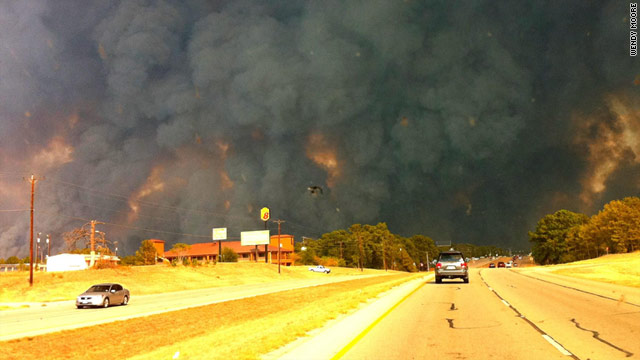
Wildfires rage over Labor Day near Bastrop, TX, southeast of Austin
Our hearts, prayers and thoughts go out to the people currently evacuated and who have lost their homes this holiday weekend. I, myself, having gone through losing a home to fire I send my best to all of you affected, and have already contacting folks via our church to find out how we can help. I’ll post links as soon as I can get them to give directly to disaster relief. UPDATE: KVUE has a great list they are updating with where to donate. Please give what you can.
This puts into focus several things that have been ruminating in my head all weekend, and it all comes back to this one question– Why does Rice play Texas? This weekend, two of our nation’s best universities met on the football field. And while both Rice and University of Texas can duke it out on relatively equal footing on the basis of academics, Rice is. . . shall we say, not the athletic powerhouse that Texas is. So, why does Rice always begin its football season with a drubbing of 34-9 (hey, tip of the hat for getting 9 points on the scoreboard– I guarantee there will be teas that do less this year), with the Owls now having lost 41 games out of the last 42 meetings to the Longhorns? And here the answer lies with the other goings-on of this long weekend.
While the President is trying to, I’d assume, take what he sees as the high ground and compromise with those people who claim that these regulations kill jobs, the opposite is, in fact, true. These National Ambient Air Quality Standards, or NAAQS, are set by the Clean Air Act and, defined by the Supreme Court, are to be based on the best available science about what levels of pollutants are healthy for human beings (people like you and me) to breathe. Tea partiers and some of their corporate paymasters in the fossil fuel industry have been caterwauling that these rules will be “too expensive” to implement, and therefore shut down a lot of old, dirty power plants.
Ummmm.. . . yes, please? Couldn’t we, nay, shouldn’t we shut them down? Our best available science tells us these pollution sources are making us sick. We need these life-saving regulations to help all of the sick children, the elderly, and just the plain folks who suffer from asthma and other respiratory disease. Count up the missed school days, the missed work days, the premature deaths– count how they hobble our economy. How can children compete in a global economy if they are missing days from school sick because they can’t breathe? How much work is done not on time? How much lost productivity have we hamstrung our economic engine with to cater to people who don’t know how to compete in a modern energy economy against cleaner forms of production? Because the new EPA rules won’t shut down all power plants, only those who can’t compete, who can’t run cleanly. And since there is also good evidence to show that these sorts of life-enhancing regulations actually help, not hurt, the economy. It also rebuts the White House’s own stated position that they posted just one. day. earlier. that clean air helps the economy, preventing in this year alone:
160,000premature deaths;
More than 80,000 emergency room visits;
Millions of cases of respiratory problems;
Millions of lost workdays, increasing productivity;
Millions of lost school days due to respiratory illness and other diseases caused or exacerbated by air pollution.
The impact on the climate if this is approved? Well, according to Jim Hanson, one of our top climate scientists, he called it “essentially game over.” Or, as Bill Paxton in Aliens put it: (WARNING: NSFW for swearsies, including the dreaded f-dash-dash-dash word)
Ok, well, all kidding aside because this is deathly serious, as in the fate of the planet’s climate, THIS is what Jim Hanson told climate protesters outside the White House just before he was arrested for his part in the protest.
Bill McKibben, environmental activist and one of the ringleaders of the several weeks long protest event, said this on Friday about how this is not the end of the protests, it’s only the beginning:
These are serious stakes. “Game Over” stakes. What does that mean? Well, for climate, if you’ve liked the record-breaking heat this year in Texas, you’re in luck, as this could easily become the new normal with climate change. And with the heat, we’ve got the huge economic impacts of the drought. For farmers and ranchers, the Dallas Morning News is reporting a 5 billion dollar loss. Thats Billion with a B, folks.
So next time someone starts talking about how it’s “too expensive” to deal with climate change, do what the Violent Femmes say to do and “Add it Up.” (warning:song lyrics also NSFW because of those darn swearsies) Loss from hurricanes like Irene, loss from this summer’s floods and tornadoes in Joplin, loss from drought, loss from wildfires, loss to the economy from dirty air (since hotter temperatures mean worse smog), and tell me that just continuing to do nothing and just putting more carbon into the atmosphere is potentially the most expensive thing we can do.
So, what does this have to do with Rice vs Texas? Well, what we have here is political expediency and taking the easy path instead of fighting for what is right. Regulations, regardless of their impact on a multinational corporation’s bottom line, save lives, and improve lives. This is what Ralph Nader fought for when he wrote Unsafe at Any Speed. Corporate whining and their record-breaking profits are not more important than people, and people’s’ rights to breathe clean air, or live in a stable climate. I, for one, am not willing to give up on Central Texas, and let this become the new normal for climate. When I first came to Austin, my literal first impression of the area was “I now understand why people were willing to die at The Alamo to protect this land.”
Decades ago, another President came to Texas to challenge a nation to go to the moon before the end of the decade, and asked an assembled crowd at Rice University the magic question.
“Many years ago the great British explorer George Mallory, who was to die on Mount Everest, was asked why did he want to climb it. He said, “Because it is there.” … But why, some say, the moon? Why choose this as our goal? And they may well ask why climb the highest mountain? Why, 35 years ago, fly the Atlantic? Why does Rice play Texas?“
President Kennedy answered his own question:
“We choose to go to the moon in this decade and do the other things, not because they are easy, but because they are hard, because that goal will serve to organize and measure the best of our energies and skills, because that challenge is one that we are willing to accept, one we are unwilling to postpone, and one which we intend to win.”
But, most importantly, he notes that “But this city of Houston, this state of Texas, this country of the United States was not built by those who waited and rested and wished to look behind them. This country was conquered by those who moved forward.”
Let me take liberty with JFK’s speech where he talks about the need to build a space industry and replace it with a clean energy economy. “If this capsule history of our progress teaches us anything, it is that man, in his quest for knowledge and progress, is determined and cannot be deterred. The [creation of a clean energy economy] will go ahead, whether we join in it or not, and it is one of the great adventures of all time, and no nation which expects to be the leader of other nations can expect to stay behind in this race for [clean energy]. Those who came before us made certain that this country rode the first waves of the industrial revolution, the first waves of modern invention, and the first wave of nuclear power, and this generation does not intend to founder in the backwash of the coming age of [energy]. We mean to be a part of it—we mean to lead it.“
Our economic torpor, our environmental problems, and yes, our hurricanes and droughts and wildfires, are ALL things we can solve if we are willing to take this same leadership role. Surely there will be pollution in the future, there will be recessions, there will be storms and droughts and fires– but they will NOT be supercharged by an ever-increasing blanket of carbon making our planet warmer and warmer. We must stop doing the same things over and over, relying on fossil fuels, and expecting different results. We must put our courage to the sticking place, and say that we will not allow the voices of a few, economically powerful and well-connected industries to wreak untold havoc on us and our neighborhoods.
You’ll notice, in JFK’s speech, he talks about the costs that a trip to the moon will require. He advocates not spending money recklessly, but in spending a large amount of money to win this challenge.
To be sure, all this costs us all a good deal of money. This year’s space budget is three times what it was in January 1961, and it is greater than the space budget of the previous eight years combined. That budget now stands at 5 billion 400 million dollars a year—a staggering sum, though somewhat less than we pay for cigarettes and cigars every year. Space expenditures will soon rise some more, from 40 cents per person per week to more than 50 cents a week for every man, woman and child in the United States, for we have given this program a high national priority—even though I realize that this is in some measure an act of faith and vision, for we do not now know what benefits await us. But if I were to say, my fellow citizens, that we shall send to the moon, 240 thousand miles away from the control station in Houston, a giant rocket more than 300 feet tall, the length of this football field, made of new metal alloys, some of which have not yet been invented, capable of standing heat and stresses several times more than have ever been experienced, fitted together with a precision better than the finest watch, carrying all the equipment needed for propulsion, guidance, control, communications, food and survival, on an untried mission, to an unknown celestial body, and then return it safely to earth, re-entering the atmosphere at speeds of over 25 thousand miles per hour, causing heat about half that of the temperature of the sun—almost as hot as it is here today—and do all this, and do it right, and do it first before this decade is out—then we must be bold…
However, I think we’re going to do it, and I think that we must pay what needs to be paid. I don’t think we ought to waste any money, but I think we ought to do the job.”
President Obama will be giving a speech on jobs later this week. In it, I’d love to hear even a smidgen of the boldness and realism of Kennedy. I’d love for him to recant his statement on the EPA smog rule, and say that he will stop the Keystone XL pipeline, as it will only increase our dependence on oil when we need to be quitting it. But I doubt it.
Apologies for the political birdwalk and the sniping at the two likely major-party candidates for the Presidency. What is clear is what JFK was talking about: we must do things like fight climate change not because they are easy, but because they are hard, and because they are a challenge we are willing to accept and unwilling to postpone. It is a fight we must win, it is a fight for our very existence as we know it here in Texas.
This Saturday my alma mater will be coming to Austin to play Texas, and as my BYU Cougars sit as 4.5 point underdogs against the Longhorns, they and we must remember that this is why Rice plays Texas. This is why BYU plays Texas. To challenge ourselves, and organize our best efforts to make us better. That is why Rice plays Texas. And that is ultimately why we must get our head in the game on clean energy and quit our addictions to fossil fuels and their campaign contributions.
###
Agency Is Refusing to Adhere to an Order to Release Document That Would Help Determine Safety of New Nuclear Reactors
WASHINGTON, D.C. – The Nuclear Regulatory Commission (NRC) should stop balking and provide a critical document that would reveal how the owners of a Texas nuclear plant expansion project plan to deal with a fire or explosion, three public interest groups told the commission late last week.
Three administrative judges of the Atomic Safety and Licensing Board have ordered the agency to provide at least a redacted version, but NRC staffers have refused. The NRC’s lack of transparency could impact the ability to get adequate safety-related information not only about the South Texas Project (STP) but about other proposed reactors around the country as well.
Late Friday, the groups – the Sustainable Energy and Economic Development (SEED) Coalition, Public Citizen and the South Texas Association for Responsible Energy – filed a brief with the NRC. It noted that the NRC staff’s refusal to provide the information violated President Barack Obama’s new transparency policy. The groups also said the NRC is acting arbitrarily and trying to shut the public out of NRC proceedings.
“After the Sept. 11 attacks, Congress required new fire and safety standards for all new plants and the NRC developed rules to reflect this. Now, the NRC is trying to do its work behind closed doors, and its staffers are literally making up how to handle information as they go along, keeping as much secret as possible,” said Karen Hadden, executive director of the SEED Coalition. “Without disclosure of this information, we can’t tell how well the NRC is doing in protecting the public.” (more…)
Throughout the global warming debate, I have often heard an argument I like to call “the China cop-out.”
It goes somewhere along the lines of, “Developing nations like China and India are growing so quickly, adding so many new coal-fired power plants, and emitting so much carbon dioxide that it isn’t worth it for the US to take action on climate change until they are on board as well.”
To which my response has always been, “Since when does America look to China to lead?”
Recent news shows that if America is willing to rise to the challenge of mitigating climate change impacts and become a leader once again, other nations will follow. To prove my point, this just in: Japan jumps on the green stimulus bandwagon.
Just as President Obama has been shepherding the stimulus package, loaded up with green goodies, through the House and Senate, Prime Minister Taro Aso of Japan has announced his intention to draft a “Green New Deal” to counter both climate change and the global economic downturn.
Grist reports that Aso will “order a stimulus package focusing on slashing greenhouse gases at a meeting of his global warming advisory panel Wednesday.” At this meeting his government will also ” present various plans to cut carbon dioxide emissions by 15 percent from 1990 levels by the year 2020.”
If America commits to lead by example, who knows how many other leaders we may be able to influence?
President-elect Barack Obama’s choice to head the Environmental Protection Agency promised Wednesday that she would deploy federal regulators to check air quality around schools in response to a USA TODAY investigation that identified hundreds of schools that appeared to be in toxic hot spots.
The nominee, Lisa Jackson, told members of the Senate Environment and Public Works Committee that she would “send investigators and samplers out to verify the extent of the problem” and “mobilize” agency efforts within 30 days of her confirmation. Parents, she said, “have a right to know their children are safe when they are in school.”
This is an incredibly important issue, and its good to hear that if chosen, Jackson is committed to protecting the lungs of America’s youth. We’ll know for sure if she’s official some time after the inauguration.
Today’s New York Times reported that life is not all peaches and cream for the Obama campaign after they opted out of the presidential public financing system. (See Article “Straining to Reach Goal, Obama Presses Donors“)
Pushing a fund-raiser later this month, a finance staff member sent a sharply worded note last week to Illinois members of its national finance committee, calling their recent efforts “extremely anemic.”
The signs of concern have become evident in recent weeks as early fund-raising totals have suggested that Mr. Obama’s decision to bypass public financing may not necessarily afford him the commanding financing advantage over Senator John McCain that many had originally predicted.
But the campaign is struggling to meet ambitious fund-raising goals it set for the campaign and the party. It collected in June and July far less from Senator Hillary Rodham Clinton’s donors than originally projected. Moreover, Mr. McCain, unlike Mr. Obama, will have the luxury of concentrating almost entirely on campaigning instead of raising money, as Mr. Obama must do.
It is not yet clear whether the Obama campaign will be able to ratchet up its fund-raising enough in the final two months of the campaign to make up the difference.
Public financing is a boon to any politician who accepts it, as it allows her or him to run free from the strings attached to big-dollar-donations and to focus the campaign’s time on where it should be spent: connecting with voters. This is why when I explained Public Financing to Congressman Nick Lampson, currently running in the most competitive House race in the country, he was exuberant to think of a time when he would no longer have to dial for dollars. Considering the other two competitive House races in Texas, in CD 7 and 10, think of the race it would be if the campaigns were on equal footing moneywise and ideas, not dollars, affected the outcome of the race.
And, if you don’t think that money doesn’t change policy, think again. Every issue, from the War in Iraq to Consumer Protection to Global Warming to Education has powerful monied interests who are willing to pour money into the debate to get what they want.
Kate Kaye, the author of the blog who brought this to our attention, explained it best:
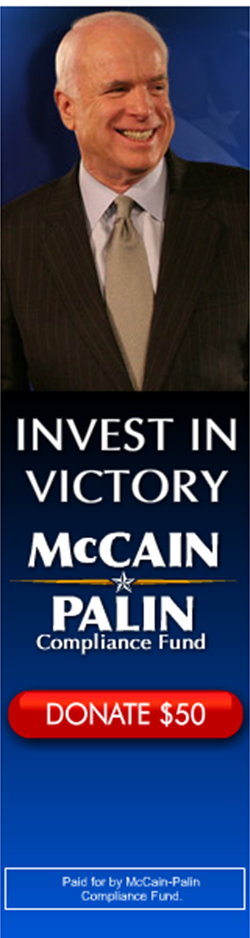
According to a disclaimer on the McCain campaign site, “Because the McCain-Palin Campaign is participating in the presidential public funding system, it may not receive contributions for the any candidate’s election. However, federal law allows the McCain-Palin Campaign’s Compliance Fund to defray legal and accounting compliance costs and preserve the Campaign’s public grant for media, mail, phones, and get-out-the-vote programs. Contributions to McCain-Palin Victory 2008 will go to the Compliance Fund, and to participating party committees for Victory 2008 programs.”
That Victory fund is operated by the compliance fund, the Republican National Committee, and the Michigan, Missouri, Ohio, and Pennsylvania GOPs.
Hmmm…I wonder what states are in the most contention this year….
The lesson is clear: we should support full, airtight public financing NOW and we should make our leaders accept it– a “Great divorce” of Money and Politics.
Obama originally opted out of public financing by citing that the presidential system was “broken” and that he had created a “parallel public financing system” via the netroots. This, along with McCain’s continued fund-raising, is an argument to shore up the presidential system, not scrap it.
We can pass full public financing laws. We can keep elections fair at the local, state, congressional, and federal level. Currently, the Fair Elections Now Act sits idle in Congress with some serious inertial problems. We should change that, and call our leaders and ask them to sign on to Fair Elections. We can make it a priority of the next Congress, insuring that future elections are clean and fair.