Feeds:
Posts
Comments

Posts Tagged ‘emissions’

Background: What the controversy is all about
On May 25, 2010, the US Environmental Protection Agency (EPA) barred the Texas Commission on Environmental Quality (TCEQ) from issuing a permit to a refinery in Corpus Christi. EPA said that the process used to justify that permit violated the Clean Air Act.  EPA’s Region 6 Administrator, Al Armendariz, also stated that the EPA would block future permits and force polluters to comply with EPA standards if the TCEQ did not change its rules. On June 14th, EPA announced it was taking over the process for two additional air-quality permits

At issue are two types of air permits used in Texas – one known as a “flex permit” and one known as a “plant-wide applicability limit.” In both cases, instead of issuing permits that limit pollution from each individual point-source (e.g. a smokestack), TCEQ limits pollution for entire facilities, allowing operators to emit more pollution from one stack if another stack was emitting less. Studies indicate that there would be greater emission reductions if limits were done on a stack-by-stack basis.

These permits make enforcement extremely difficult at vast petrochemical and refining facilities. They also fail to protect people from emission clouds that can occur as a result of letting one stack emit more than would be allowed under the Clean Air Act.

Suppressed reports add fuel to the fire
The flex permit controversy had been brewing for some time as EPA and TCEQ battled behind closed doors, secretly playing a game of chicken with air pollution regulations. Meanwhile, another controversy was broiling beneath the surface in Fort Worth.  Elected officials from the area felt they were getting the run-around from TCEQ when they asked whether natural gas drilling and processing on the Barnett Shale was putting residents’ health at risk.

On June 1st, TCEQ admitted they had failed to divulge (i.e. suppressed) reports showing elevated benzene levels in the area.  In a statement, Mark Vickery said TCEQ “missed an opportunity” to “bolster their confidence in the quality of the air.” In reality, TCEQ knowingly presented inaccurate air-quality information to leaders and decision makers for months. Soon after, TCEQ admitted that 3 additional air-quality reports had not been made public. (more…)

Read Full Post »

Federal environmental regulators set new limits on sulfur dioxide emissions for the first time in 40 years.  A move that could prevent thousands of asthma attacks and premature deaths while reducing health care costs..

The new rules, which take effect under court order, will prohibit short-term spikes of sulfur dioxide (SO2), which is primarily emitted from coal-fired power plants and other industrial facilities.  Texas has 17 coal plants, with another dozen under construction or in the permitting phase across the state.

The EPA estimates nationally the cost of retrofitting power plants to comply with the new rules will be $1.5 billion over the next 10 years.  The savings in health benefits could be as much as $13 billion to $33 billion a year.

The previous standard called for concentrations of no more than 140 parts per billion, averaged over 24 hours. Under the new rules, the allowable level of SO2 would drop to 75 parts per billion in one hour to guard against short-term spikes, and is seen by the EPA as the most efficient and effective way to protect against SO2 pollution in the air we breathe.

Although the final standard is a bit less strict than the American Lung Association had urged, it is well within the range recommended by EPA’s independent science advisers.

At this writing it is anticipated that Jefferson County is the only area in Texas that would fail the tougher standard, but EPA is requiring additional monitors in some areas of the state that are borderline.

###

By promoting cleaner energy, cleaner government, and cleaner air for all Texans, we hope to provide for a healthy place to live and prosper. We are Public Citizen Texas.

Read Full Post »

Here are the weekly highlights from the Texas Progressive Alliance.

CouldBeTrue of South Texas Chisme wants to know why Republicans like Victoria’s DA Steve Tyler, Nueces County’s DA Anna Jimenez and (who could forget) Alberto Gonzales abuse their offices?

The Texas Cloverleaf thinks Rick Perry is eyeing 2012 before 2010 is even over with.

WhosPlayin is watching the situation in Flower Mound, where a group of citizens successfully petitioned to have an oil and gas drilling moratorium put on the ballot, only to get some mostly frivolous ethics charges filed against them by a former Town Councilman.

Continuing his examination of partisan voting trends, Off the Kuff looks at how voting changed in judicial races between 2002 and 2006.

WCNews at Eye On Williamson has an update as the runoff, to see who will challenge Rep. Diana Maldonado, approaches HD-52 GOP Runoff – issues take a back seat.

Bay Area Houston compares Sarah Palin’s intelligence on safe sex and nuclear disarmament.

They’re everywhere! They’re everywhere! Emissions, which are really toxins, are throughout the entire Barnett Shale area. Bluedaze: DRILLING REFORM FOR TEXAS.

McBlogger loves it when Bill Hammond of the Texas Association of Business let’s Teh Stupid flow freely.

FOX News’ 24-hour “War of the Worlds”-styled fearmongering caught the attention of PDiddie at Brains and Eggs.

This week on Left of College Station, Teddy reports on the how the campaign in the Republican primary for Texas Congressional District 17 has turned negative. Also, Teddy takes a first look at the College Station City Council Place 2 candidates and at the Bryan City Council Single Member District 3 candidates. Left of College Station also covers the week in headlines.

Libby Shaw asks a simple question over at TexasKaosSo, How will Rick Perry deliver access to affordable health care to Texas? . She points out that “According to new federal regulations, Rick Perry and the health insurance companies in Texas have 90 days to deliver a plan that will cover uninsured Texans.

Neil at Texas Liberal posted on the history of disco music. Disco Inferno! Learn The Interesting History Of Disco Music Despite the bad historical reviews disco receives, a new book says that the music was an important social indicator in a time of societal gains for women and gays.

###

By promoting cleaner energy, cleaner government, and cleaner air for all Texans, we hope to provide for a healthy place to live and prosper. We are Public Citizen Texas.

Read Full Post »

Yesterday the Texas Attorney General Greg Abbott filed an official injunction against BP Products’s Texas City Refinery for “violating state health, safety and environmental protection laws, including the Texas Clean Air Act, the Texas Water Code, and the Texas Health & Safety Code.”  The refinery was cited for 46 separate emissions of unlawful pollutants, a violation of the Clean Air Act.  Among these was the emisssion responsible for the March 2005 explosion that killed 15 workers and injured 170.

Between 2000 and 2007, the TCEQ filed 15 enforcement orders to get BP to clean up its act.   But it doesn’t look like the authority of the TCEQ was enough to stop the refinery from emitting hundreds of thousands of pounds of unauthorized pollutant emissions, including volatile organic compounds (VOCs), carbon monoxide, hydrogen sulfide, sulfur dioxide and nitrogen oxides.

According to the Attorney General’s press release,

Under Texas law, BP was required to report unlawful emissions to the Texas Commission on Environmental Quality and take corrective action to prevent future emissions. However, BP not only failed to report emissions to environmental regulators within the legally mandated deadlines–but also did not take the necessary measures to prevent additional unlawful emissions in a timely manner.

The injunction requires BP to implement all necessary measures to eliminate future unlawful emissions, which includes installing additional air quality monitors to ensure future compliance. The state is also seeking civil penalties, fines and attorneys’ fees.

It’s really good to see the government stepping in to enforce clean air laws.  Kudos to Abbott for stepping in to keep Texans safe and our air clean.

Read Full Post »

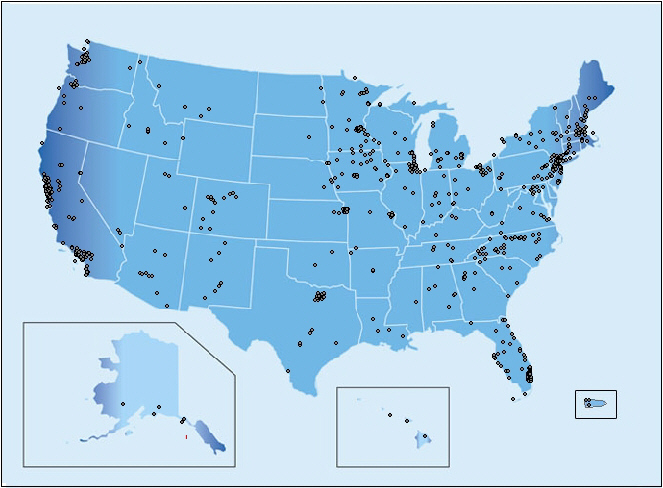
US_mapClimate change is clearly an important issue, and there is a lot that needs to be done about it at all levels of society. Fortunately there have been individuals and localities that have made great efforts to reduce their carbon footprint, and this should be applauded. I want to focus on a particular success in the area of local effort to reduce emissions and improve efficiency: The Mayor’s Climate Protection Agreement. This is an agreement between the mayors of several hundred participating cities, across the U.S to reduce their emissions to 7% below 1990 levels.

The agreement was started on February 16, 2005 by Seattle Mayor Greg Nickels and there are currently 944 participating cities in the United States that have pledged to reduce their emissions below 1990 levels. The agreement was officially endorsed by the Annual U.S Conference of Mayors in 2005, and the conference has actively encouraged Mayors to sign onto the agreement since. Mayors in participating towns and cities use practices such as vegetation restoration, anti-sprawl policies, emissions controls and efficiency improvement activities to improve their climate friendliness. (more…)
Read Full Post »

As expected, the House Energy and Commerce Committee approved climate change legislation last night and sent it along in the legislative process. We strongly urge lawmakers to make major overhauls to this bill or go back to the drawing board.

The problem? Oil, coal and nuclear industries had far too much say in its shaping, and it shows.

Now more than ever, Public Citizen needs you to tell your representatives that climate change legislation should not be weakened by the corrupting influence of big money.

Those who say this bill is the best the legislative process can produce are wrong: The American people demanded strong climate legislation, and polluters are subverting these goals.

Public Citizen supports strong, effective climate legislation, but this bill won’t achieve it. We can talk about hoping to reduce greenhouse gas emissions significantly, but this bill won’t do it.

It creates a legal right to pollute for industries and gives away credits for free to allow companies to meet those targets without having to pay for them. That is not going to spur the kind of investments we need.

We must act fast to influence lawmakers to fix this piece of legislation. Please take action so that our voices can be heard loud and clear over those of the oil, coal and nuclear industries.

For more information about the climate change bill and how it needs to be fixed, visit our Web site and watch Tyson Slocum explain Public Citizen’s position in an interview on Democracy Now!

Take action today, and let your representatives know you want them to put interests of consumers above those of the energy industries.

Read Full Post »

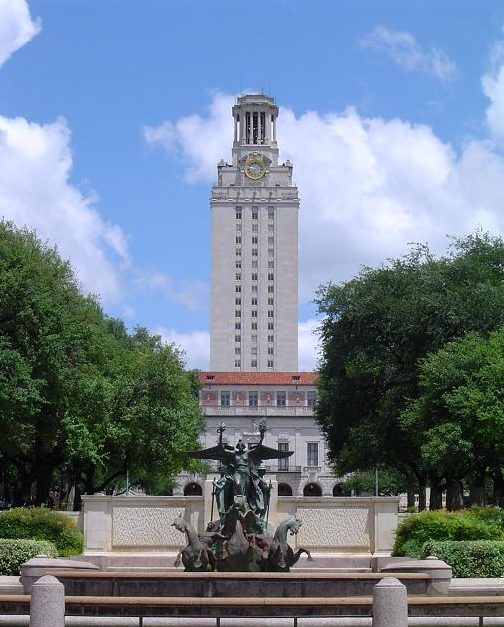
picture-201Over the past several months, researchers at the Good Company have been compiling a report to measure our own University of Texas’ emissions.  Last week the results were announced…. We’ve got big feet.
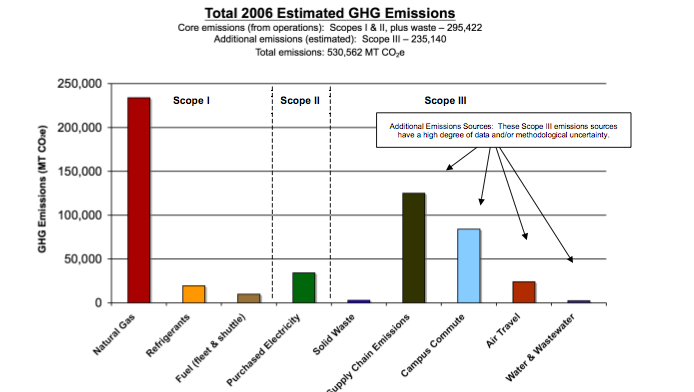
Thereport showed that UT’s total carbon emissions were a 292,434 metric tons of carbon dioxide equivalent in 2006.  Emissions sources not required by the traditional registries are estimated to be an additional 238,237 metric tons.  The vast majority of these emissions were from natural gas consumption, which totaled 233,839 metric tons of CO2.

The release of this information is an important step to be accountable for our greenhouse gas emissions. Says Assistant Director of the Campus Environmental Center and Public Citizen’s own, Druscilla Tigner:

It was exciting!  This was a fantastic opportunity for the University of Texas to really stare its problems in the face, and pinpoint exactly what they need to do to reduce its impact on the environment.  It’s a concrete jumping point for the campus sustainability movement.

picture-151For me, one of the most interesting aspects of the report was a measure of the green house gasses emitted by a typical UT student to determine the per student carbon footprint.  The report offered two general categories of students. (more…)

Read Full Post »

Breaking News!  Remember back in December, when I was having a daily conniption due to various midnight memos and parting shots from the outgoing Bush administration?  Particularly troubling was former EPA administrator Stephen Johnson’s decision to reverse the landmark Bonanza decision.  Well, now Johnson’s reversal has been reversed.

Last November the EPA’s governance board ruled that its regional office had been too hasty in approving  a new coal-fired power plant in Bonanza, Utah because the plant didn’t include carbon dioxide emissions or control techniques in their permit application.  The Sierra Club helped secure this victory by filing a suit against Utah’s Deseret Power Electric Cooperative for not controlling carbon dioxide. Their argument was based upon the landmark Massachusetts v EPA case, which required the agency to regulate CO2 as a pollutant under the Clean Air Act.  But then at the last minute, outgoing Stephen Johnson issued a memo reversing this decision and saying that the EPA should ignore CO2 emissions when permitting new coal fired power plants.

But REJOICE, for this morning the Sierra Club reports:

Washington, DC: President Obama’s Environmental Protection Agency (EPA) today took the first step toward regulating carbon dioxide emissions from coal-fired power plants. EPA, under the new leadership of Administrator Lisa Jackson, granted a petition from the Sierra Club and other groups calling for reconsideration of an unlawful, midnight memo issued by former EPA Administrator Stephen Johnson which sought to prohibit controls on global warming pollution from coal plants. EPA announced in a letter to the Sierra Club that it will publish a proposed rulemaking in the Federal Register and seek public comments on the decision in the near future.

Today’s decision is consistent with a previous ruling by the EPA’s Environmental Appeals Board (EAB) in the Bonanza case, which found that there was no valid reason for the Bush administration’s refusal to limit carbon dioxide emissions from new coal-fired power plants. The so-called Johnson Memo sought to unlawfully overturn that decision.

Sierra Club, the Natural Resources Defense Council, and the Environmental Defense Fund filed suit against the Bush administration to overturn the Johnson Memo. That litigation will now be put on hold as a result of today’s announcement.

Okay, so the EPA hasn’t officially nixed the memo, but they are posting a proposed rulemaking (to nix it) and inviting public comment.  Not too shabby for a Tuesday.

The decision to grant the Sierra Club’s petition says a lot about the EPA’s new direction and leadership under Lisa Jackson.

Said David Bookbinder, Chief Climate Counsel for the Sierra Club in a press release this morning,

Today’s victory is yet another indication that change really has come to Washington, and to EPA in particular. This decision stops the Bush Administration’s final, last-minute effort to saddle President Obama with its do-nothing policy on global warming.

Not only does today’s decision signal a good start for our clean energy future, it also signals a return to policy based on sound science and the rule of law, not deep pocketbooks or politics. Lisa Jackson is making good on her promises to bring science and the rule of law back into the center of the decision making process at EPA.

We live in exciting times.

Read Full Post »

Throughout the global warming debate, I have often heard an argument I like to call “the China cop-out.”

It goes somewhere along the lines of, “Developing nations like China and India are growing so quickly, adding so many new coal-fired power plants, and emitting so much carbon dioxide that it isn’t worth it for the US to take action on climate change until they are on board as well.”

To which my response has always been, “Since when does America look to China to lead?”leadership

Recent news shows that if America is willing to rise to the challenge of mitigating climate change impacts and become a leader once again, other nations will follow. To prove my point, this just in: Japan jumps on the green stimulus bandwagon.

Just as President Obama has been shepherding the stimulus package, loaded up with green goodies, through the House and Senate, Prime Minister Taro Aso of Japan has announced his intention to draft a “Green New Deal” to counter both climate change and the global economic downturn.

Grist reports that Aso will “order a stimulus package focusing on slashing greenhouse gases at a meeting of his global warming advisory panel Wednesday.” At this meeting his government will also ” present various plans to cut carbon dioxide emissions by 15 percent from 1990 levels by the year 2020.”

If America commits to lead by example, who knows how many other leaders we may be able to influence?

Read Full Post »