Feeds:
Posts
Comments

Posts Tagged ‘Energy Efficiency’

While Austin City Council continues to move forward with an ordinance to transfer governing authority of Austin Energy from our elected City Council to an unelected board, Austin democracy is being attacked at in the state legislature as well.  Senate bill 410, sponsored by Senator Kirk Watson and Representative Paul Workman, would allow the city to establish an unelected board without a charter election, as our city charter calls for.

The issue of who should govern Austin Energy is important, but it’s also local in nature.  There is no need for state to amend Austin’s charter.  That is a right reserved for the citizens of Austin.  If the changes proposed by City Council are truly in the best interest of our city, that case should be made to the voters and decided upon at the ballot box. 

To have a state representative who doesn’t even live in Austin carrying a bill to change our charter is unacceptable.

The Austin City Charter was adopted by the people of Austin and the people of Austin approved a governance structure for Austin Energy that is accountable to the people through elections.

An unelected board won’t be directly accountable to the ratepayers and wouldn’t necessarily represent our values.  As we debate this issue in Austin the unelected board at San Antonio’s CPS Energy is slashing the rate customers with solar installations will receive for their energy in half without first consulting the public or the solar industry.  Austin Energy customers could be facing similar changes if we don’t act now to protect our rights.

SB 410 has passed the Senate and will be heard by the House Committee on State Affairs tomorrow.

Please consider attending the hearing and speaking against SB 410.

What: Hearing on SB 410 to change Austin’s charter to move Austin Energy governance to an undemocratic board without a vote by the citizens of Austin, as our charter requires.

When: 1:00pm on Wednesday, May 1

Where: John H. Reagan (JHR) building, room 140 – 105 W. 15th St., Austin, TX, 78701

Why: Because Austin Energy’s governance structure will impact decisions going forward, including on renewable energy and energy efficiency programs and rates.  This is the decision that will determine how other decisions are made.

You can register against the bill at the kiosks outside of room 140.  Even if you don’t wish to speak, registering against the bill would be helpful.  We hope you’ll consider saying a few words about the value of local democracy though.  Speakers will be limited to 3 minutes each.

SB 410 is anti-democratic and is one more example of the state government trying to interfere with Austin’s internal policies and governance.

We need your help to stop this bill.

Public opposition to SB 410 at Wednesday’s hearing may be the only thing that can ensure that our Austin representatives don’t let this bad bill move forward.

Please email Kaiba White at kwhite (at) citizen.org if you can attend the hearing at 1:00pm on Wednesday.

Read Full Post »

You may have never heard of Property Assessed Clean Energy (PACE), but it has the potential to make a huge difference in adoption of distributed renewable energy systems, such as rooftop solar installations. PACE allows businesses to borrow money from local governments to work on energy efficiency and renewable energy projects in the buildings they occupy.

Since PACE is funding is loans, there is no real expense to the taxpayer.  On the other side of the coin, it allows businesses to spread out the costs of becoming more environmentally friendly over time, all while lowering their monthly utility costs.  This strategy is a win-win-win for Texans.  Business save money, the environment benefits, and it cost Texans nothing.

The Texas Legislature is currently considering legislation that would move PACE forward for our state.  Senate bill 385 has already cleared the hurdle of the Texas Senate, and now is pending in our House of Representatives. House bill 1094 is still waiting be voted out of the House Committee on Energy Resources.  The House should move forward to adopt this common sense measure.

As of 2013, 27 states and the District of Columbia have PACE legislation on the books to help combat harmful emissions from electric generation.  States from California to Wyoming have enacted PACE programs.  Generally, in these states, the financing terms are 15-20 years.  It works very much like taking out a home loan, or perhaps a better example would be a home improvement loan, but for commercial properties. Disbursing the payments over a longer period of time makes these efficiency upgrades affordable for a wider variety of business.  It also makes upgrades attainable for smaller businesses.

I urge fellow Texans to get in touch with their State Representative and tell him or her to support the PACE bills (HB 1094 and SB 385).  This is common sense legislation that benefits everyone.

Click here to find out who represents you. 

Read Full Post »

The South-central Partnership for Energy Efficiency as a Resource (SPEER) enters its second year with an exciting Summit, designed to explore, further develop, and prioritize policies and strategies needed to push energy efficiency forward in new buildings, existing buildings, and electric markets in Texas and Oklahoma.

Ed Mazria, founder and CEO of Architecture 2030, will deliver the keynote address to kick off the Summit in Austin on February 25. Mr. Mazria is an international leader on efforts to make buildings dramatically more energy and water efficient, leading the movement to establish 2030 districts in cities with goals to reach carbon neutrality by 2030. These districts have been established so far in Los Angeles, Seattle, Cleveland, and Pittsburgh.

Public Citizen members can receive a $50 discount off the registration. On the registration page, select “Early Registration- Supporting Organization” and then select “Public Citizen” from the drop down menu.

Sponsors of the SPEER Summit include Dow Chemical, CCRD Partners, Mitsubishi, Environments for Living, TexEnergy Solutions, BASF, the Texas Home Energy Raters Organization, and the CleanTX Foundation.

To learn more about the Energy Efficiency Summit, please visit: www.eepartnership.org/summit


Read Full Post »

The worst drought in more than 50 years in Texas is expected to continue as a weak La Nina weather pattern is predicted to strengthen this winter.  Drought has already reduced cooling water needed by coal-fired power plants and may limit electric output from power plants next summer, an official from the Electric Reliability Council of Texas (ERCOT – the grid operator)  reported.

At this time, only one small generating unit is currently curtailed due to a lack of adequate cooling water, however a continuation of the severe drought in Texas could result in as much as 3,000 MW being unavailable next summer, Kent Saathoff, vice president of ERCOT grid operations told the board last week.

The drought has lowered the water level at nearly every reservoir in the state, according to the Texas Water Development Board. A lack of cooling water limits the ability of a power plant to operate at full capacity.

Texas’ hottest summer on record pushed power consumption to record levels, straining the state’s electric resources on many days in August.

Grid officials and lawmakers are worried that the drought will compound existing issues that impact the state’s power supply: looming environmental regulations that will curtail output from coal-fired power plants and a lack of new power-plant investment.

ERCOT predicts about 434 megawatts would be unavailable next summer if Texas gets about half its normal rainfall over the winter and spring months and if there is no significant rainfall, as much as 3,000 MW could be unavailable by May.

Power plant owners are taking steps to increase access to cooling water by increasing pumping capacity, adding pipelines to alternate water sources and securing additional water rights.  Some water authorities have already curtailed new “firm” water contracts, so it may be harder for plants to secure additional water.

Right now, the Public Utility Commission of Texas (PUC) is working to implement new energy efficiency legislation.  If we just used our energy more efficiently, we wouldn’t have come so close to a grid crisis even under the extreme circumstances of this past summer.  Other states have used energy efficiency to keep the lights on for their families and businesses when they were having problems by cutting energy demand by 20% or more on the hottest days of the summer.
Studies have shown that Texas could cut 23% of our peak energy use on the hottest days and it would be cheaper than generating electricity.
To prevent rolling blackouts next summer, the governor and the PUC could improve the energy efficiency and market-based conservation programs that will keep our air conditioning running on hot summer days and keep our local  businesses operating . 

The Texas Public Utility Commission should:

  • Reward utilities that exceed their energy efficiency goals.
  • Use the money from a program set up to provide utility assistance for eligible Texans that is funded by fee Texans pay on their electric bills every month for the weatherization of low-income homes.

And the governor can issue an executive order that requires all state agencies, schools, municipal and county governments to reduce energy use by 5% next summer and report their savings to the state.

You can email the governor and express your opinion by clicking here.

Read Full Post »

Electric Reliability Council of Texas

Image via Wikipedia

Its predicted that the entire state will have record temperatures this weekend. Please take all measures to avoid using unnecessary energy. They might have a hurricane on the east coast but we have a heat wave in Texas and there might not be enough electricity to go around.

Statement from ERCOT CEO Trip Doggett on the need for conservation through the weekend:

Our information indicates this weekend will be one of the hottest on record in some areas of Texas. Electric demand and usage will be extremely high and we need every person to help us conserve electricity between the hours of 3 p.m. and 7 p.m. on Saturday and Sunday.

Please help us keep the power flowing to every Texan in ERCOT by turning up your thermostat a few degrees if you’re able, turning off unnecessary lights and appliances and doing dishes and laundry in the morning or after 7 p.m.

Your efforts do make a difference and are appreciated.

Conservation Tips
Consumers can help by shutting off unnecessary lights and electrical appliances between 3 and 7 p.m., and delaying laundry and other activities requiring electricity-consuming appliances until later in the evening. Other conservation tips from the Public Utility Commission’s “Powerful Advice” include:
Turn off all unnecessary lights, appliances, and electronic equipment.
When at home, close blinds and drapes that get direct sun, set air conditioning thermostats to 78 degrees or higher, and use fans in occupied rooms to feel cooler.
When away from home, set air conditioning thermostats to 85 degrees and turn all fans off before you leave. Block the sun by closing blinds or drapes on windows that will get direct sun.
• Do not use your dishwasher, laundry equipment, hair dryers, coffee makers, or other home appliances during the peak hours of 3 to 7 p.m.
• Avoid opening refrigerators or freezers more than necessary.
• Use microwaves for cooking instead of an electric range or oven.
• Set your pool pump to run in the early morning or evening instead of the afternoon.

Businesses should minimize the use of electric lighting and electricity-consuming equipment as much as possible. Large consumers of electricity should consider shutting down or reducing non-essential production processes.

Media Contact: Theresa Gage
tgage@ercot.com

###

By promoting cleaner energy, cleaner government, and cleaner air for all Texans, we hope to provide for a healthy place to live and prosper. We are Public Citizen Texas.

Read Full Post »

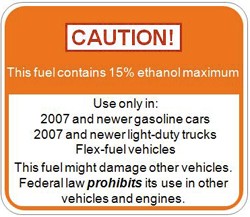
Over the past couple of years, there has been a heated debate involving the potential EPA implementation of allowing a greater percentage of ethanol in gasoline.  The current volume percentage of ethanol allowed is 10% for vehicles made between the years 2001 and 2006. Recently, the EPA has been discussing the approval of what is known as E15 (15 volume percent ethanol blended with gasoline), and in October of 2010, the request was waived for the implementation of E15 to be allowed in vehicles made in 2007 and later.  Taking these two decisions into consideration, this now allows for E15 use in vehicle makes 2001 and newer, lighter-make vehicles into the commerce division.  Studies have shown that E15 is likely to result in somewhat lower evaporative emissions compared to fuel currently sold in much of the country (E10) as a result of the lower volatility of E15 under the partial waiver conditions. There are currently two conditions that must be met.  These conditions take into consideration the concerns of the community.  One condition of the waiver involves the mitigation of the possibility of citizens misfueling E15 in the wrong vehicles.  The other condition addresses the fuel and quality of the ethanol.

Sign indicating ethanol at gas station

On January 21, 2011, the EPA did in fact grant a partial waiver for E15 for use in MY2001-2006 light-duty motor vehicles. These decisions were based on test results provided by the U.S. Department of Energy (DOE) and other information regarding the potential effect of E15 on vehicle emissions. Taken together, the two actions allow, but do not require, E15 to be introduced into commerce for use in MY2001 and newer light-duty motor vehicles if conditions for mitigating misfueling and ensuring fuel quality are met. The EPA is still in the process of completing work on regulations that would provide a more practical means of meeting the conditions.

These new waivers implemented earlier this year by the EPA have cattle ranchers in an uproar as well.  But what could the Texas livestock industry possibly have to do with the newest ethanol implementations? According to the Texas and Southwestern Cattle Raisers Association (TSCRA), the new 50% increase in ethanol-gasoline allowance, is detrimental to the costs of their livestock production.  The TSCRA claim that such a dramatic increase in ethanol permittance will have serious negative repercussions for their cattle ranches.  A statement made by TSCRA president and fellow rancher, Dave Scott, indicated that these high levels of corn based ethanol are one of the most influential factors in driving price increases in corn products, including the feed for cattle.  This is a clear indication of the dangers we create once we begin to place our food and fuel in competition against one another.  In 2008, according to the US Department of Agriculture, feed for livestock reached its record high at $45.2 billion.  This was an increase of more than $7 billion from 2007.  With the cost of feed for livestock and newer, higher levels of ethanol being so intertwined with each other, we will only be seeing an even more dramatic rise in the cost of feed for cattle production…and more unhappy ranchers.

Our nation’s food supply and methods of transportation must find a way to compromise and divert their routes of competition elsewhere because both are at serious risk in the future.

Read Full Post »

Texas Mail-in Rebate Program

If you’ve considered participating… 

Funds are still available for the Texas Appliance Mail-In Rebate Program. Texas has already approved over $12 million in rebates and funds are limited, so act soon!

Funding for the program is available to Texas residential consumers on a first-received, first-issued basis according to the application’s postmark date until funds are depleted. 

  • You can check available rebate funds to see daily updates on the estimated rebate funds remaining. As funds near depletion, we will issue a notice of closure on our website.
  • Review the Rebate Eligibility Program Rules and search eligible appliance models before you purchase and install an appliance.
  • To be eligible for a rebate, program rules require that you remove and properly dispose of your old appliance. In doing so, you have one of two options to choose from: Recycling or Disposal

    NOTE: If you do NOT have an existing appliance to recycle/dispose of, OR if you keep, gift, donate or sell your old appliance, you will NOT be eligible for an appliance or recycling rebate.

  • Completely fill out an Official Rebate Application Form (PDF, 116KB), including the “Disposal/Recycling Information,” and submit according to program rules.
If you’ve already mailed in an application…
  1. It may take up to eight weeks to review and approve your application. You can check your rebate status online or call toll-free (855) 556-1312.
  2. Double check your application form to make sure it was filled out completely and accurately. An incomplete application form is the most common error; you may have overlooked something as simple as selecting the check box for “Option One: Disposal” vs “Option Two: Recycled.” You may resubmit missing information to ensure your application is processed. Please write your Rebate ID number on all resubmitted forms and supporting documentation. Check your rebate status online or contact customer service to retrieve your Rebate ID number.

    NOTE: If you do NOT select an option under the “Disposal/Recycling Information” section, then “Option One: Disposal” will automatically be selected for you and you will NOT qualify for the additional $75 bonus recycling rebate.

For other program questions, please see the Texas Comptroller’s Frequently Asked Questions (FAQs), contact customer service or call toll-free (855) 556-1312.

Read Full Post »

Seal of Travis County, Texas

Image via Wikipedia

Austin Energy hired a consultant to help determine how its rates compare to those of other utilities in preparation for its plan to substantially raise electricity rates in 2012.   The work is ongoing, but an eye-opening statistic has already emerged.  Estimates indicate that the average US household’s energy costs are equal to 7% of household income, but the study shows that on average, the poorest 5 percent of Travis County households spend about 45% of their incomes on electricity.

That is a staggering statistic and points out the need to provide more energy efficiency funding for low-income families.  The short and long term benefits are economic relief and cost-effective home improvements. While assistance relieves pressure on individual households, the benefits also ripple into the community. With less money spent on energy, more money is available for other goods and services. If this money is spent locally, Austin captures this revenue, with further benefits rippling out from there.

Keep in mind, most low-income households are renters.  There should be incentives put in place to encourage landlords to increase the energy efficiency of their properties.  And don’t forget, there are environmental benefits to reducing our energy usage.  This seems like a win win for our city.

Read Full Post »

According to an American Council for an Energy-Efficient Economy (ACEEE) study, Texas now ranks 32nd among U.S. states in energy efficiency, down from 23rd in 2009. The current 10 top-ranked states in energy efficiency are shown below:

1. California
2. Massachusetts
3. Oregon
4. New York
5. Vermont

6. Washington
7. Rhode Island
8. (tie) Connecticut
8. (tie) Minnesota
10. Maine

SOURCE: ACEEE

Even Arizona and New Mexico have recently outstripped Texas, with Arizona adopting new energy-saving targets that moved them from 29th to 18th, and New Mexico climbing from 30th to 22nd with the passage of stringent new building codes, coupled with performance incentives for utilities to become more energy-efficient.

In 2007,  another ACEEE report found that, with ambitious energy-efficiency efforts, Texas could eliminate about 75 percent of the projected growth in electricity demand over the next 15 years. Since then, the Public Utility Commission has raised the utilities’ target for energy efficiency – now at 20 percent – to 25 percent by 2012 and 30 percent by 2013.

Several major Texas cities, notably Austin, Dallas and San Antonio, have adopted forward-looking codes, but even they could step it up a notch. Backing from the Legislature would signal to other Texas cities that improving energy efficiency isn’t a local option but a statewide priority.

###

By promoting cleaner energy, cleaner government, and cleaner air for all Texans, we hope to provide for a healthy place to live and prosper. We are Public Citizen Texas.

Read Full Post »

Some great points from the director of Environmental Defense Fund‘s Texas Regional Office (and Energy Program), Jim Marston.

If you’re concerned about government spending, consolidating existing efficiency programs and oversight into one agency has the potential to reduce overlap and redundancy in government and create more opportunities for consumers and businesses to save money. (more…)

Read Full Post »

Long thought to be the last commodity that can’t be saved for later use, large scale electrical energy storage is finally looking like a technology who’s time might have come.

Recently introduced the “Storage Technology of Renewable and Green Energy Act of 2010″ Act (S. 3617) introduced by U.S. Senators Jeff Bingaman (D-N.M.), Ron Wyden (D-Ore.) and Jeanne Shaheen (D-N.H.) stands to finally get things moving in the energy storage development space.

To go along with that, the Texas Commission on Environmental Quality announced that they are taking applications for a Texas Emissions Reduction Program (TERP) new technology implementation grant (NTIG) on energy storage based on a bill that got passed last session (yes they did pass a few bills last session). Anyone that needs a cool 3 mil to get a project off the ground should consider applying as applications are due by September 17 and, if congress can get their act together, there might be a 20% tax credit to sweeten the pot.

Energy storage has been called the holy grail of renewable’s by members of the Leg and could potentially solve a bunch of technical issues on the Texas electrical grid depending on the technology implemented. Compressed air storage, fast acting flywheels, super conducting magnetic loops and all sort of different batteries each provide a different solution to various problems.

Grid stabilization is one that needs to be looked at in the near future. Using solid state electronics these storage solutions can react in fractions of a second (and less then one of the 60 cycles per second our electrical system runs on) to smooth the flow of electrons from the generator to your home and business and reducing the speed that a gas generator needs to react to an increase or decrease in load on the electrical grid.

Large scale storage will allow wind (which blows mostly at night in Texas) and solar to be stored and used when the energy is most needed (all though solar produces most of its energy at peak load already). Batteries, suitably placed like the one EET built in Presidio can reduce the need to build new transmission lines and substations. Lets hope our Legislators (both in Texas and at the federal level) can do something to move this new technology along. It can support the increasing amount of renewable’s we need to build, stabilize our electrical system and reduce emissions by making renewable energy available when we need it, and providing fast acting response when the grid needs a little extra juice, rather than firing up another gas turbine, or help us, a coal plant.

###

By promoting cleaner energy, cleaner government, and cleaner air for all Texans, we hope to provide for a healthy place to live and prosper. We are Public Citizen Texas.

Read Full Post »

Come close together, cats and kitties, and gather ’round, while the Powerman gets his story-telling hat- the one with the fine white brim- slips it on and talks about what’s going down with a happening riff:, with a tip o’ the hat to Lord Buckley for those yet to be hip to the flip, we are not talking bout sound. 60.000 cycles per second 60 hertz or one sixtieth of a second, precisely, exactly, over and over, up and down, positive to negative and back again, round and around. You- over in the corner, the group that seems in tune, go ahead and hit an Ohm- I know that you want to. Now don’t that sound mighty fine, but take it down real low, just a hum, the cats might have to carry this tune ’cause it’s down kinda a low, around 60 cycles or so. Now there’s a Ohm that’s fine to hear and hum that travels, it’s nice and it’s clear, and kitties don’t worry if the tone hunts around, that’s fine, it’s how it works, now I’ll tell you what’s going down.

Back in the day, not so long ago, there were wizards walked the earth mighty and proud. They worked with lightning, electricity we say, with sparks and bolts that could knock you down, pick you up and smack you around and kill a cat if you didn’t know the rules, it wasn’t nothing to play round with now, can you dig it? I knew that you could. (more…)

Read Full Post »

Today, Public Citizen and Environmental Defense Fund sent a letter to the Legislature calling on them to support the creation of a new state agency dedicated to efficiency. I tend to think in the problem-cause-solution framework about public policy issues so here’s the short version:

Problem: Energy efficiency languishes in Texas after years of progress.  Indeed, the way Texas oversees its efficiency programs is ineffective, and ironically, inefficient.

Cause: There are at least five and potentially six state agencies that are involved in efficiency programs. They do not coordinate with each other. Many state employees probably do the same job. Meanwhile, the PUC  fails to pass strong energy efficiency goals and they do not recognize energy efficiency as a pro-consumer and pro-business investment.

Solution: Consolidate all state efficiency programs into an entity that could independently review, approve and assess the current PUC and other state programs.

For the full letter sent to the Lege, click here.

What you can do about it: Call, email, your State Rep. and Senator. Tell them it’s time for energy efficiency reform. We can make it work better for all Texans.

-Matt

###

By promoting cleaner energy, cleaner government, and cleaner air for all Texans, we hope to provide for a healthy place to live and prosper. We are Public Citizen Texas.

Read Full Post »

Public Citizen, Environmental Defense Fund Call for Independent State Agency to Coordinate State’s Energy Efficiency Efforts

AUSTIN – In response to the Public Utility Commission’s (PUC) planned adoption of new energy efficiency goals, Public Citizen and Environmental Defense Fund today called for sweeping changes to the way Texas runs its energy efficiency programs. The groups said that a single independent state agency would better serve Texas because it could coordinate programs currently regulated by multiple agencies and reduce agency overlap.

“We have no confidence in the Public Utility Commission process,” said David Power, deputy director of Public Citizen’s Texas office. “The time has come to change the way Texas saves energy because the current setup is ineffective. It is time for the Legislature to take control and create a new state agency that can put consumers first and save more money.”

The groups plan to send a letter to state Sen. Troy Fraser, chair of the Senate Natural Resources Committee, and state Reps. Jim Keffer and Burt Solomons, chairs of the House Energy Resources and State Affairs Committees, asking them to support legislation in the upcoming session to create an independent efficiency agency.

Under current law, the PUC, the agency in charge of regulating most of the state’s “poles and wires” companies, is supposed to review and approve the energy efficiency programs of the utilities. But other state agencies oversee efficiency programs too, including the Department of Housing and Community Affairs and State Energy Conservation Office. Housing the coordination of these efforts under one roof would help streamline state regulation and create more savings potential for Texans, the groups said.

“Several agencies either run or oversee similar programs,” said Kate Robertson, energy efficiency specialist with Environmental Defense Fund. “In some instances, like market outreach, a single state agency could coordinate the activities of all efficiency programs instead of multiple people doing the same thing for their own programs.”

The groups also criticized the PUC’s negative attitude toward energy efficiency. Over the past year and a half, agency staff had been developing plans to increase the state’s goal for energy efficiency. On Friday, however, the three commissioners appointed by Gov. Rick Perry slashed the proposal dramatically, ostensibly for cost reasons, reducing the efficiency goal from 1 percent of peak demand by 2014 to a third of the growth in demand by 2013 – a much smaller increase. The PUC even has proposed curtailing the amount utilities can spend on efficiency measures.

“It is baffling to us that the commission thinks energy efficiency is not worth the cost,” said Matthew Johnson, a policy analyst with Public Citizen’s Texas office. “Ratepayers’ utility bills pay primarily for fuel like natural gas and coal, power plants and the grid infrastructure. Energy efficiency costs around a dollar per month on a typical $100 electric bill and it pays for itself by reducing the need for new, costly power plants.” (more…)

Read Full Post »

In their recent report on how energy efficiency is bad for consumers in Texas, the Texas Public Policy Foundation took some time to tout nukes.

To distinguish the development of new nuclear reactors from the previous generation which was frought with cost overruns and delays, they claim the following (page 7-8):

“But unlike consumers from the 1980s, today’s consumers won’t be taking on the risk of cost overruns. In fact, they won’t be taking any risk at all. Once the new nuclear plants are complete, the price of the electricity sold from the plants will be determined by market forces. If the price is higher than the cost of the electricity, the plants will be profitable. If not, the plants will lose money. But it is the investors–not consumers–who will bear that risk.”

The investors will bear all the risk? Really? Well, published today is a report from Forbes.com that, in addition to announcing NRG’s dramatic scaling back on nuclear development (by some 95%) quotes NRG Energy’s CEO David Crane as saying he is:

“more comfortable when someone else takes risk.” (as in, the citizens of San Antonio?)

Ouch! I encourage y’all to read the full Forbes article and this one from last December, which notes that a major part of NRG’s strategy is to sell to municipally-owned utilities and electric cooperatives. They are medicine for those that think new nuclear is cost-competitive because they’re all about how dependent nuke developers are on federal loan guarantees (aka subsidies).

EDITOR’S NOTE: Also of interest is an article from this morning’s NYTimes that shows the cost of solar is now cheaper than the cost of nuclear, and a hot-off-the-presses article from Greg Harman at the San Antonio Current saying that with NRG taking so much investment out of developing the plant, and the US gov’t balking at more subsidies for this nuclear pork behemoth, that the only way to make the deal work is to get the governments of France and Japan to also help bail out their investors with, you guessed it- more loan guarantees. How many countries and government bailouts does it take to build a nuke plant in Texas?  Three, apparently.  Ahhh, nuclear power- it’s like fiscal conservative kryptonite. One mention of it and any and all pretense of being pro free market just disappears as they can’t stop lining up to the gravy train of pork, loan guarantees and subsidies. ~~Andy

###

By promoting cleaner energy, cleaner government, and cleaner air for all Texans, we hope to provide for a healthy place to live and prosper. We are Public Citizen Texas.

Read Full Post »

Older Posts »

Follow

Get every new post delivered to your Inbox.

Join 3,167 other followers