Feeds:
Posts
Comments

Posts Tagged ‘ercot’

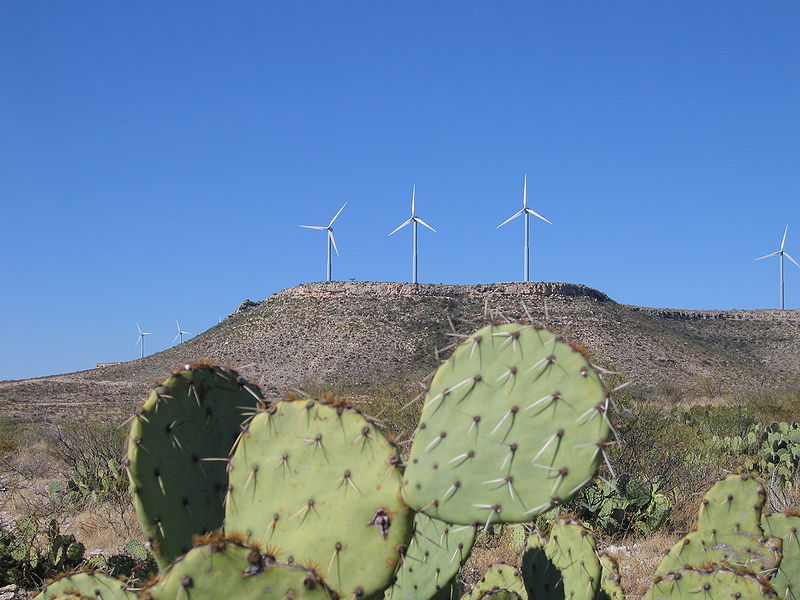
As we close in on the end of 2012 with a winter front keeping temperatures low, Texas achieved a new wind power integration record of 8.638 GW on Dec. 25 at 3:11 p.m according to the Texas grid operator, the Electric Reliability Council of Texas (ERCOT).

Electricity from wind accounted for 25.71% of power being generated and used at that point in time, as the peak demand was 39.847 GW.  Of the 8.638 GW being generated by Texas wind farms, over 84% came from wind farms in West Texas, and 16% came from sites on the Texas coast.

More details can be found in ERCOT’s wind integration report for Dec. 25.

Read Full Post »

Planning for Texas’ energy future must include drought proofing our energy supply with energy efficiency and renewable energy, not propping up old dirty fossil fuel plants.  To that end, we applaud the Electric Reliability Council of Texas (ERCOT – the Texas electric grid operator) for calling Luminant’s bluff to shut down the aging Monticello coal fired plant in North Texas, and finding that we don’t need to pay a premium to run one of Texas dirtiest coal plants to keep the air conditioners running.

In October of this year, the EPA announced new regulations (called the Cross-State Air Pollution Rule or CSAPR) to reduce air pollution from industrial facilities like coal-fired power plants on downwind communities. Prior to the release of this new rule, TXU/Luminant, the largest power generating company in Texas, blamed the impending EPA regulations for job losses and subsequently announced it would be shutting down two of its coal units at Monticello.

Three Texas Luminant plants (Monticello, Martin Lake, and Big Brown) are some of the dirtiest coal plants in the country, and would be impacted by any new air pollution rules the federal government might impose.  But compared to other coal plants, these three plants alone are:

  • 46.8% of all Texas coal plant      emissions (19 existing coal plants)
  • 41.5% of all Texas coal plant SO2      emissions
  • 36.0% of all Texas coal plant PM-10      emissions
  • 30.6% of all Texas coal plant NOx      emissions
  • 71.7% of all Texas coal plant CO2      emissions

and by all
rights should clean up their act or shut down.  However, a report from TR Rose Associates shows in detail how Luminant’s shuttering of these coal plants is most likely due to poor financial management rather than regulation of their air quality emissions.

Right now in Texas, the drought and the expected heat wave next summer is far more of a problem than U.S. Environmental Protection Agency (EPA) rules for water intensive plants like coal and nuclear electric generation plants.  If we are to keep the lights on next summer, the Governor, the Texas Commission on Environmental Quality and the Public Utility Commission of Texas should develop a plan to use energy more wisely and efficiently during the summer and not worry about the shuttering of dirty old coal plants.

After receiving notice that Luminant, had filed a Notification of Suspension of Operations for Monticello Units 1 and 2, ERCOT – the grid operator – had to make a determination about whether it was okay for Luminant to retire the units rather than idle them so that ERCOT could call on them to run in a grid emergency.  This is what ERCOT calls a “Reliability Must Run” (RMR) status determination.  An RMR status for the old Monticello units would have meant that Luminant might have been getting paid a premium to run these units at full capacity next summer, with almost no limits placed upon the type or amount of emissions during that activity, the implications for Dallas/Ft Worth’s air quality would probably have been significant.

According to a release by ERCOT, “As required by Protocol Section 3.14.1(1), ERCOT has completed its analysis and determined that Monticello Units 1 and 2 are not needed to support ERCOT transmission System reliability (i.e., voltage support, stability or management of localized transmission constraints under first contingency criteria). ERCOT, in coordination with Oncor, has identified Pre-Contingency Action Plans (PCAPs) and Remedial Action Plans (RAPs) which will be used to ensure transmission security without the need for RMR Agreements associated with these Resources. . . Based upon this final determination, the Resources may cease or suspend operations according to the schedule in their Notice of Suspension of Operations.”

So to recap:

  • Luminant threatens to shut down its two old units at Monticello coal-fired generating plant and blames the new EPA Cross State Air Pollution Rules.
  • A report from TR Rose Associates shows Luminant’s shuttering of these coal plants is most likely due to poor financial management rather than regulation of their air quality emissions.
  • ERCOT determines that these Monticello units are NOT needed to maintain grid stability.

Luminant 0 : State of Texas 2

Read Full Post »

As temperatures soared yesterday, ERCOT estimates that electricity usage reached an all-time peak high (breaking Wednesday’s record) with Texans using 60,157 MW of power – flying past the official record set on August 31, 2000 when 57,606 MW of power was consumed by Texans in the ERCOT service region.

“Texas is experiencing a very serious energy emergency,” said David Power, Deputy Director of the Texas office of Public Citizen, “and we are urging everyone to shut off any unnecessary appliances to conserve energy.”

For tips on how to conserve energy, go to http://www.texasishot.org/.

Tom “Smitty” Smith, the Director of the Texas office of Public Citizen applauds the Electric Reliability Council of Texas (ERCOT)’s heroic efforts in keeping the lights on under enormous stress. “They are doing a great job, however without the assistance of all Texans in conserving energy during this unusual heat event they may not be able to do so for long.”

Read Full Post »

Oak Grove coal fired power plant was one of the plants that caused rolling blackouts in Texas on February 2, 2011ERCOT just released an updated list of all of the power plants that were not operating Feb 2, contributing to the power shortages that caused the rolling blackouts.  That document is here, but we present the data below for your convenience.

Notice a trend? Natural gas and Lignite coal were the main power sources that couldn’t cope.

Meanwhile, the wind really saved our bacon. And since wind companies’ standard operating procedure is to bid into the market at $0 for their extra capacity (no fuel charge, so it doesn’t cost them anything to turn on the extra turbines if the wind is blowin’: unlike a gas plant that has to, you know, pay for their gas. Assuming they can get gas, that is.) wind did not contribute to the high prices of energy or manipulate the market.

For an even more in depth rundown, please see our testimony our Deputy Director, David Power, gave in front of a special joint session of the Senate Business and Industry and the Senate Natural Resources Committees.

PS- Sorry if the formatting on this list is hard to read- we tried as best we could to get all the data on here. (more…)

Read Full Post »

Come close together, cats and kitties, and gather ’round, while the Powerman gets his story-telling hat- the one with the fine white brim- slips it on and talks about what’s going down with a happening riff:, with a tip o’ the hat to Lord Buckley for those yet to be hip to the flip, we are not talking bout sound. 60.000 cycles per second 60 hertz or one sixtieth of a second, precisely, exactly, over and over, up and down, positive to negative and back again, round and around. You- over in the corner, the group that seems in tune, go ahead and hit an Ohm- I know that you want to. Now don’t that sound mighty fine, but take it down real low, just a hum, the cats might have to carry this tune ’cause it’s down kinda a low, around 60 cycles or so. Now there’s a Ohm that’s fine to hear and hum that travels, it’s nice and it’s clear, and kitties don’t worry if the tone hunts around, that’s fine, it’s how it works, now I’ll tell you what’s going down.

Back in the day, not so long ago, there were wizards walked the earth mighty and proud. They worked with lightning, electricity we say, with sparks and bolts that could knock you down, pick you up and smack you around and kill a cat if you didn’t know the rules, it wasn’t nothing to play round with now, can you dig it? I knew that you could. (more…)

Read Full Post »

Electric Reliability Council of Texas (ERCOT) just announced board of directors’ chair, Jan Newton, has resigned citing personal reasons.  Ms. Newton served on the ERCOT board since 2006 and became the chair in 2008.

Her resignation is the second major departure from ERCOT in the past eight months. In September of 2009, CEO Bob Kahn submitted his and ERCOT is still in the process of a nationwide search for his replacement.  Conjecture about the possibility that the Texas Public Utility Commission (PUC) chair, Barry Smitherman, (who also serves on the ERCOT board of directors as a ex-officio member) had thrown his hat in the ring for the position was cut short when Chairman Smitherman announced publically that he had decided not to pursue the job. 

At the time, while energy watchdogs agreed that Smitherman was highly qualified for the ERCOT job, they were also concerned that such an employment bid posed a conflict — first as a PUC commissioner charged with establishing the rules for ERCOT’s operation and, second, as a board member (albeit a non-voting one) of the agency he was asking to hire him. It was also unclear whether the laws governing the PUC would allow a commissioner to seek the ERCOT job.  Texas’ Public Utility Regulatory Act says commissioners can’t seek employment with a “public utility” while serving on the PUC.  ERCOT doesn’t technically qualify as a public utility, however industry insiders felt it was a gray area, and the spirit of the law looked prohibitive.  So the search goes on.

Michehl Gent, who also joined the board in 2006, will step up as the incoming chair.  Gent was former president and CEO of the North American Electric Reliability Corp.

Read Full Post »

So put on a sweater and crank up the thermostat! That was the major trend late last week and over the weekend, when arctic weather led Texas to set another winter power usage record.  According to the Abilene Reporter News,

The Electric Reliability Council of Texas (ERCOT), the grid operator for most of the state, reported a winter record of 55,856 megawatts Friday between 7 and 8 a.m. to erase the previous high of 52,001 set just 12 hours previously between 7 and 8 p.m. Thursday.

Those of you paying close attention may recall that last year Texas also set the record for summer energy consumption.

This year Texas used more energy staying cool in the hot hot summer, and more energy staying warm in the cold, cold winter, than in any other time in the past.

It has been so unusually cold in North America that “wintry weather sweeping across the Northern Hemisphere has slowed coal deliveries in parts of the U.S. South.” Though we’re feeling the chill here, but its actually been unseasonably warm in most other parts of the world like Greenland where they usually count on that cold to re-form ice sheets — some scientists are even saying 2010 will very likely be one of the warmest on record.

In just a year Texas has faced searing hot summers, cripplingly cold winters, devastating drought, no coal for frosty’s nose… makes you wonder if there’s something bigger going on out there.  Like some sort of, oh I dunno, massive shift — a massive change leading to extreme weather events. Not sure what to call it now, I’ll have to get back to you on that one.

###

By promoting cleaner energy, cleaner government, and cleaner air for all Texans, we hope to provide for a healthy place to live and prosper. We are Public Citizen Texas.

Read Full Post »

Op-ed originally published in Sunday’s Amarillo Globe:

Column – Andy Wilson: Perry spews hot air on warming

AUSTIN – Gov. Rick Perry’s recent essay (“EPA ‘science’ doesn’t add up in global warming equation,” Dec. 27, 2009) is full of hot air and not much else.

The governor’s outrage produces more heat than light, revealing his ignorance of science and penchant for quoting dubious and discredited economic studies funded by energy companies.

The real inconvenient truth is that Texas cannot afford to make meaningless political statements any longer, especially when there’s work to be done – carbon regulation is coming whether the governor throws a tantrum or not. We can shout at the wind or harness it into a clean energy future.

Planning for a low-carbon future now will pay dividends in the future as the world comes to Texas for the clean energy we can supply in abundance. But if we choose to pout rather than produce, we risk missing the clean energy train.

Already, Texas wind turbines are providing electricity, not to mention jobs and tax revenue, and we’re blessed with some of the best solar potential of any state. According to data from the Electric Reliability Council of Texas, West Texas families pay less for their electricity, thanks in large part to all those wind farms. Peer-reviewed economic studies, including one by the Union of Concerned Scientists, show Texas families stand to save $980 annually in energy costs by enacting clean-energy legislation.

The scare-tactics scenarios the governor laid out use phony statistics from studies underwritten by dirty energy lobbyists who are afraid of competition from these low-carbon upstarts. If you dig deeper into these studies, even under their highest cost projections, U.S. economic growth remains robust and millions of new jobs are created, hundreds of thousands of which would be in Texas.

Given our high-tech, manufacturing, and energy leadership experience, Texas should be attracting green energy technologies already. But instead, we’re losing major solar and battery manufacturing to states which are less sunny but more savvy, such as Pennsylvania and Michigan.

Maybe Perry should spend less time posturing and complaining about science he doesn’t understand and more time enacting strong policies to attract clean energy jobs and industry to Texas, the same way Amarillo has in their recent announcement to bring as many as 750 new wind turbine manufacturing jobs to the area.

The truth about the hacked e-mails Perry references that purport to discredit global warming is this: It’s a tempest in a teapot, and every scientist knows it. If we’re looking for a “smoking gun” that disproves the settled science of climate change, we would need glaciers and ice caps to stop melting at record levels worldwide. We would need temperatures and drought throughout Texas to recede, rather than having the last decade be the hottest and driest on record.

Since we only depend on the research of scientists at the University of East Anglia, a town and university so small, I challenge you to find it on a map, for a very small portion of the corpus of scientific knowledge on climate change, we would need much more than a few choice words from scientists behaving badly to contradict that. To discount all climate science based only on these emails would be the same as disqualifying University of Texas from playing in the Rose Bowl because of the criminal misbehavior by one of their bench wide receivers.

But the good news is that whether you believe in global warming or not, all of our tools to solve it are the same tools we need to solve our current crises and create a better future for Texans.

Worried about unemployment? Energy security? The loss of American manufacturing? Clean energy development cuts into all of these problems, and just happens to help save the planet while we’re at it.

Everybody wins.

So at the start of a new decade, let’s be winners, not whiners. Texas should be getting in front of federal legislation and putting in place the policies that ensure that the nation will turn to us for their future renewable energy needs for the 21st century, the same way they have for the past century with oil and gas.

Doing anything less, Gov. Perry, certainly seems … well, un-Texan.

Andy Wilson is the Global Warming Program director for Public Citizen’s Texas Office.

###

By promoting cleaner energy, cleaner government, and cleaner air for all Texans, we hope to provide for a healthy place to live and prosper. We are Public Citizen Texas.

Read Full Post »

Congratulations to San Angelo, Texas, where a new 150 MW wind farm is up, spinning, and on with commercial operations.  According to North American Wind Power,

The project’s 100 General Electric 1.5 MW turbine generators are expected to generate more than 525,000 MWh of wind energy per year, which will be sold into the ERCOT system. Approximately 200 jobs were created during the nine-month construction period and 10 full-time professionals will be employed at the now-operational facility. Padoma Wind Power, an NRG subsidiary, developed the project, which is capable of powering more than 100,000 Texas homes.

###

By promoting cleaner energy, cleaner government, cleaner cars, and cleaner air for all Texans, we hope to provide for a healthy place to live and prosper. We are Public Citizen Texas.

Read Full Post »

HEAT_WAVE_072605Just four days into summer, and we’re already are setting records for energy consumption in Texas.  Yesterday Reuters reported that the Texas grid had set a new record for peak energy consumption in the month of June.  With temperatures already in the 100s in our largest urban ares, thermostats are cranking across the state, and energy bills are going up.

Texas consumers used 60, 452 MW of energy in the hour ending at 5 o’clock yesterday, blowing last year’s June record of 59,642 MW out of the water.

But today ERCOT is predicting that Texas will set a new record for electricity consumption.  Period.  By about five o’clock this afternoon, the time of day when the the sun is shining brightest and A/Cs run hardest, Texas will be consuming more energy at one time than we ever have in our history.

According to the Ft. Worth Star Telegram,

The Electric Reliability Council of Texas, which oversees the power grid that serves about 22 million Texans, forecasts that power demand will peak today at 62,450 megawatts and at 63,589 megawatts Thursday. The record is 62,339 megawatts, set Aug. 17, 2006, ERCOT spokeswoman Dottie Roark said.

If we’re reaching record energy use this early in June, I don’t even want to think about how bad its going to get in July and the dreaded August.  Global warming, indeed.  Don’t say we didn’t tell you so.

But no need to worry about outages, ERCOT says.  The grid has more than 72,700 megawatts of available generation capacity, plenty to serve on even the hottest days.

So wait a minute.  If we have 10,000 MW of extra power lying around, why is Texas rushing to build 12 new coal plants to provide tons of baseload power?  Judging by this recent run of records, looks like what we really need is *peak power.

Not sure of the difference?  An aside for the uninitiated.  There are two main classifications of power that run our modern lives: baseload, and peak.  Baseload is steady amount of power we need under normal circumstances (because as a society we’re always doing something that requires energy), and peak is the extra energy we need when we are all doing something at the same time.  Think about baseload and peak power as you would about keeping your body hydrated.  We always need to be drinking a certain amount of water to stay healthy and functioning (baseload aqua), but when we are working out or being active outside, need even more on top of that (peak gatorade).

Baseload power is largely provided by the old dirty standbys — coal and nuclear (unless you’re in Houston, in which case it is gas in abundance, baby — one of the reasons power in H-town is so expensive).  Baseload is the huge, slow, steady sort of power — the kind we have plenty of.

In Texas, peak power is generally produced by gas turbines.  When it starts to reach that key hot afternoon time, your energy provider flips the switch to turn on a quick revving gas turbine to turbo charge the grid with enough power to keep all those fans spinning and air conditioners blowing.

Another source of peak power, though less common currently, is of course solar power.  Solar produces peak power because just as the day gets hottest, and we need power to keep us cool the most — the sun is shining brightest!  Match made in heaven, really — solar and the need for peak energy.

So why  is Texas trying to build 8500 MW + 9149#of coal MW of additional baseload power from coal and nuclear plants when what we really need is peak power, and solar is such a natural fit to produce peak energy?

Good question.

Read Full Post »

stp-water-pond2HB 2721 threatens to fast-track water permits for nuclear plants, which use vast quantities of water. Water is precious, and Governor Perry has just requested federal aid for all 254 counties in Texas due to statewide drought. Water permits should be given careful scrutiny, and not be rushed. This bill, which will be heard tomorrow on Earth Day, would actually deny citizens the right to a contested case hearing for these water permits!

According to Greg Harman over at the San Antonio Current’s QueBlog:

To cool down the superheated water used to create electricity can take hundreds of thousands of gallons of water per minute. According to the Sustainable Energy & Economic Development (SEED) Coalition fighting nuclear power in the state, the plants proposed at Comanche Peak in North Texas would require104,000 acre feet per year: 33.8 billion gallons.

To ease the potential political stew that could come from the plants’ permit applications (if they are built), Canton-based Representative Dan Flynn filed a bill to fast-track the water permitting process. (Dan was joined by Houston’s Rep. Bill Callegari as co-author a couple days after the bill was filed and has since also been joined by reps Randy Weber, Tim Kleinschmidt, and Phil King.)

Under House Bill 2721, the Texas Commission on Environmental Quality must create “reasonably streamlined processes” to move those applications along. One key way to move a controversial permit it to not allow the TCEQ refer it to the State Office of Administrative Hearings for a public airing. (more…)

Read Full Post »

Follow

Get every new post delivered to your Inbox.

Join 3,136 other followers