According to NBC News, the State Department announced today that it will take more time to review the controversial Keystone pipeline proposal before a decision is made, and that will likely be after the midterm elections in November. Click here to read the story.
Posts Tagged ‘Keystone Pipeline’
Keystone decision delayed again.
Posted in Global Warming, pipelines, Tarsands, tagged Keystone decision, Keystone Pipeline, Texas, the State Department on April 18, 2014 |
Letter Calling for Congressional Oversight Hearings on Keystone XL Pipeline
Posted in Energy, pipelines, Safety, Tarsands, tagged Keystone Pipeline, keystone xl, Public Citizen, public citizen texas, Tar Sands, Texas, transcanada on November 19, 2013 |
Dear Senators and Representatives,
Last Tuesday (Nov. 12), CBS reported that nearly 50 percent of the welds on a section of the southern segment of the Keystone XL pipeline were faulty. That revelation was based on a Sept. 26, 2013, warning letter to pipeline owner TransCanada from the Pipeline and Hazardous Materials Safety Administration (PHMSA). It was part of a broader story about problems with Keystone XL’s southern segment that included Public Citizen’s own investigative report, also released last week.
In the report, we documented 125 excavations TransCanada made to remedy possible “anomalies,” welds, dents or other problems in the southern segment of the pipeline, which runs from Oklahoma through Texas. In conjunction with the report, we sent a letter on Nov. 11 to Congress asking for oversight hearings.
Since then, we have reviewed the two letters cited by CBS, reviewed other PHMSA warning and corrective action letters sent to TransCanada, and spoken to a PHMSA official about some of the correspondence.
The Sept. 26 letter from PHMSA to TransCanada said that “TransCanada experienced a high weld rejection rate” on the section of the pipeline known as “Spread 3” and that “205 out of the 425 welds, or 48.2 percent,” required repairs. The letter explained that TransCanada employed a welding process that was not a “previously qualified procedure” and “failed to use properly qualified welders.”
In an earlier, Sept. 10 warning letter, PHMSA said field inspectors found dents in pipe that appeared to be the result of rocks in the backfill used around it. The letter said TransCanada did not ensure that the pipe was installed “in a manner that minimizes the possibility of damage to the pipe.”
Damon Hill, a Washington-based public affairs analyst for PHMSA, said in a phone interview that after the letters were sent, PHMSA had “gone out and conducted inspections.” However, he said he could not provide dates of the inspections, confirm that they focused on the problems identified in the letters, or give even an approximate time frame for providing information on the results of these inspections.
Hill said, “The results of the inspections won’t come out until we issue an enforcement order.” He also said, “You’re trying to get me to say something specific, and I am not going to tell you something specific.”
Meanwhile, that section of the pipeline is scheduled to be filled with tar sands crude within a matter of weeks.
The construction problems and the lack of information about inspections are particularly alarming because of TransCanada’s history. The first phase of Keystone XL spilled 14 times in the first 14 months of its operation, according to a U.S. State Department report, and TransCanada’s Bison natural gas pipeline exploded within the first six months of operation.
Moreover, the number of weld problems has implications for the entire southern segment. If 205 repairs are needed on a single section, how many flaws are there likely to be in the rest of the pipeline’s 485 miles?
In light of the above, we firmly believe that the following should take place:
- PHSMA should ensure correction of the problems identified in its letters, inspect the corrected work, and make the process and results publicly available and readily accessible.
- PHMSA should inspect all of the “anomalies” indicated by our report and make the process and results publicly available and readily accessible.
- Because of the high number of problems identified in PHMSA letters and our report, PHMSA should inspect the entire southern segment of Keystone XL. PHMSA should conduct a quality assurance review, and because the quality of the welds is critical to ensuring that the pipeline won’t leak or rupture, another hydrostatic test and caliper inline test should be complete before it is filled.
- Congress should conduct oversight hearings to ensure that the pipeline is safe for the public and the environment.
- All of the above should be completed before the pipeline is filled with tar sands crude and put into use.
Our report and PHMSA’s own letters raise the specter of a pipeline rife with construction flaws from its start in Cushing, Oklahoma, to its end at Texas’s Gulf Coast. Congress has a responsibility to ensure that flaws already identified and any undiscovered flaws do not result in a public health or environmental disaster. Texas’ waters should not be put at risk of contamination from pipeline breaks or spills.
Sincerely,
Tom “Smitty” Smith, Director
Public Citizen’s Texas Office
1303 San Antonio St.
Austin, Texas
(512) 477 1155
(more…)
Congress Should Investigate Construction Problems on Keystone XL Southern Segment
Posted in Energy, Safety, Tarsands, tagged Keystone Pipeline, keystone xl, Keystone XL Southern Segment, PHMSA, public citizen texas, Tar Sands, Texas on November 19, 2013 |
Public Citizen today called for congressional oversight hearings and a thorough investigation of the southern segment of the Keystone XL pipeline because of reports of serious flaws and a warning by a federal agency that nearly half the welds in one section of pipe required repairs.
In a letter sent to Congress today, we said startup of the southern segment of Keystone XL, which runs from Oklahoma through Texas, should be delayed until the inspection is complete and the public can be certain that the pipeline is safe.
Lamar Smith should hold climate hearings in Texas
Posted in Global Warming, Good Government, tagged climate change, Global Warming, intergovernmental panel on climate change, Keystone Pipeline, lamar smith, Public Citizen, public citizen texas, renewable energy, Renewables, san antonio express news, solar, solar power, Texas, Tom "Smitty" Smith on September 4, 2013 |
This article written by Tom “Smitty” Smith, director of Public Citizen’s Texas office, appeared on the editorial page of the San Antonio Express-News on Sept. 2
The newest report from the Intergovernmental Panel on Climate Change, leaked to media earlier this week, is frightening and conclusive.
The panel of several hundred scientists, which won the 2007 Nobel Peace Prize, says the odds are at least 95 percent that humans are the principal cause of climate change. The panel predicts an increase of 5 degrees Fahrenheit by the end of the century and warns that a rise of that magnitude would cause “extreme heat waves, difficulty growing food and massive changes in plant and animal life, probably including a wave of extinction,” according to the New York Times.
Yet U.S. Rep. Lamar Smith (R-Texas), chair of the Committee on Science and Technology, claims the science is uncertain about how much of the warming is caused by humans.
(more…)
Public Citizen’s Legislative Wrap-Up: Where We Made Progress & Avoided Backsliding
Posted in Air Quality, Austin Energy, Budget, Climate Change, Coal, Coal Plants, Diesel, Efficiency, Energy, Global Warming, Nuclear, pipelines, Radioactive Waste, Renewables, solar, Sunset, Tarsands, Texas Legislature, Utilities, wind, tagged Air Quality, Austin, Austin Energy, Clean Energy, climate change, Coal, coal plant, Energy Efficiency, Global Warming, Keystone Pipeline, Public Citizen, public citizen texas, renewable energy, Renewables, Rick Perry, solar, solar power, Texas, Texas Legislature, wind on June 17, 2013 |
 With the regular session behind us and energy and environmental issues not likely to find a place in the special session, it’s a good time to look at what we accomplished.
Our wins came in two forms – bills that passed that will actually improve policy in Texas and bills that didn’t pass that would have taken policy in the wrong direction.
We made progress by helping to get bills passed that:
- Expand funding for the Texas Emissions Reduction Plan (TERP) by about 40%;
- Create a program within TERP to replace old diesel tractor trailer trucks used in and around ports and rail yards (these are some of the most polluting vehicles on the road);
- Establish new incentives within TERP for purchasing plug-in electric cars; and
- Assign authority to the Railroad Commission (RRC) to regulate small oil and gas lines (these lines, known as gathering lines, are prone to leaks); and
- Allows commercial and industrial building owners to obtain low-cost, long-term private sector financing for water conservation and energy-efficiency improvements, including on-site renewable energy, such as solar.
We successfully helped to stop or improve bad legislation that would have:
- Eliminated hearings on permits for new pollution sources (the contested case hearing process is crucial to limiting pollution increases);
- Eliminated additional inspections for facilities with repeated pollution violations;
- Weakened protections against utilities that violate market rules and safety guidelines;
- Eliminated property tax breaks for wind farms, while continuing the policy for other industries;
- Granted home owners associations (HOAs) authority to unreasonably restrict homeowners ability to install solar panels on their roofs; and
- Permitted Austin City Council to turn control of Austin Energy over to an unelected board without a vote by the citizens of Austin.
We did lose ground on the issue of radioactive waste disposal. Despite our considerable efforts, a bill passed that will allow more highly radioactive waste to be disposed of in the Waste Control Specialists (WCS) facility in west Texas. Campaign contributions certainly played an important roll in getting the bill passed.
We were also disappointed by Governor Perry’s veto of the Ethics Commission sunset bill, which included several improvements, including a requirement that railroad commissioners resign before running for another office, as they are prone to do. Read Carol’s post about this bill and the issue.
With the legislation over and Perry’s veto pen out of ink, we now shift our attention to organizing and advocating for a transition from polluting energy sources that send money out of our state to clean energy sources that can grow our economy.
We’re working to:
- Promote solar energy at electric cooperatives and municipal electric utilities;
- Speed up the retirement of old, inefficient, polluting coal-fired power plants in east Texas;
- Protect our climate and our port communities throughout the Gulf states from health hazards from new and expanded coal export facilities;
- Fight permitting of the Keystone XL and other tar sands pipelines in Texas;
- Ensure full implementation of improvements made to TERP; and
- Develop an environmental platform for the 2014 election cycle.
Our power comes from people like you getting involved – even in small ways, like writing an email or making a call. If you want to help us work for a cleaner, healthier, more sustainable future, email me at kwhite@citizen.org. And one of the best things you can do is to get your friends involved too.
Texas Landowner to Testify Before Congress About Property Rights Abuses
Posted in Property Rights, Tarsands, tagged Eminent Domain, Keystone Pipeline, keystone xl, Texas, transcanada, washington on April 16, 2013 |
Julia Trigg Crawford, a Texas landowner fighting a legal battle with TransCanada over the rights to her family’s farm, will be in Washington on Thursday to testify in front of the Subcommittee on the Constitution and Civil Justice during a hearing on the Private Property Rights Protection Act. Ms. Crawford will be discussing her personal experience with the use of eminent domain by a foreign company, as it is being used by the Keystone XL pipeline.
The bill filed in the 112th Congress as H.R.1433 can be read here.
The hearing will begin at 9am ET on Thursday and may be covered on C-Span in case you want to catch Julia’s testimony.
Public Citizen and Experts Highlight Looming Threat Posed by Repurposed Pipelines in Texas
Posted in Tarsands, tagged exxonmobil, Keystone Pipeline, Pegasus, Public Citizen, Texas on April 9, 2013 |
Arkansas Spill Points to Problems With Diluted Bitumen Crude Transport Through Aging, Repurposed Pipelines; Tar Sands Crude Poses a Threat to Texas Drinking Water, Home, and Public Health
The recent Good Friday tar sands crude spill in an Arkansas neighborhood and an earlier catastrophic spill in Michigan highlight the dangers of transporting large volumes of tar sands crude into the United States through aging pipelines, warn Public Citizen and others.
ExxonMobil Corp. is still cleaning up thousands of barrels of Canadian tar sands crude spilled from the aging Pegasus pipeline near Little Rock, Ark. Michigan residents are still dealing with the fallout from a devastating pipeline rupture in 2010.
“Texas not only has the same 65-year-old Pegasus pipeline coursing through the state but also has the 34-year-old Seaway line, both slated to carry Canadian tar sands or diluted bitumen (Dilbit) crude,” said Rita Beving, Public Citizen consultant.
The Pegasus and Seaway pipelines travel within a few miles of medical facilities, schools, churches and community subdivisions. Both pipelines cross tributaries and are within a few miles or underneath existing water supplies for many Texas cities (See Map of Pegasus Pipeline route through Texas and affected communities and List of affected communities along the Seaway Pipeline route through Texas). The Seaway passes near Dallas, and is slated to carry more tar sands crude than the combined pipeline segments of Keystone XL, up to 850,000 barrels per day.
Not unlike other tar sands spills, the Pegasus pipeline spill near Little Rock forced the evacuation of people from dozens of homes. In 2010, the largest onshore spill in U.S. history occurred in Michigan, where a pipeline break on a 43-year-old pipeline spewed tar sands into the Kalamazoo River. This Enbridge Lakehead B spill resulted in residents being evacuated up to six miles away, as high levels of benzene and hydrogen sulfide became airborne and sickened local residents. More than 1.1 million gallons of tar sands or dilbit spilled into the river and traveled more than 35 miles along the waterway. Almost three years and $850 million later, the problematic spill is still not cleaned up, and Enbridge has now been ordered by the U.S. Environmental Protection Agency (EPA) to dredge the river.
Children living near the Michigan spill reported cases of vomiting, upset stomach, shortness of breath, lethargy, headaches, rash, eye irritation, sore throat and cough within the first week. Adults experienced similar symptoms, and pets suffered from continuous vomiting and diarrhea. The EPA established that benzene levels in the area near the spill were exponentially higher than the standard established as safe for human exposure.
Dr. Riki Ott, a marine toxicologist with experience in crude oil spills including the Exxon Valdez and the Michigan spill noted, “In Michigan, we had 16-year-olds having seizures, and adults with dizziness and symptoms of a tightening chest after the Kalamazoo spill. Now you are seeing the same thing happen in Little Rock. It could happen next in your backyard, and you may not even know a pipeline was carrying tar sands until after a spill happens, as many communities haven’t even been told that this is what’s going through the line. This can repeat itself wherever Canadian tar sands is being transported.” (see Human health risks of exposure to tar sands)
“As we see the Michigan spill still being cleaned up today with the the long-term health effects still unknown, we can only anticipate that cities in Arkansas may face similar issues,” said Tom “Smitty” Smith, director of the Texas office of Public Citizen. “Seeing what has now transpired in these other states, and now with both the Pegasus and Seaway pipelines in Texas carrying tar sands crude, a tar sands rupture on aging pipelines is not a matter of if, but when. These incidents beg the question to our lawmakers, ‘What are you going to do to help protect Texas from such spills?”
The Seaway line passes within one to two miles of 8 medical facilities and nursing homes, 45 schools, 56 churches and dozens of Texas communities include Rockwall, Terrell, Corsicana and Royse City, Kaufman, and Baytown. Seaway crosses near tributaries of Lake Lavon, Cedar Creek Reservoir and beneath Richland Chambers Lake – all major water supplies for Dallas and Ft. Worth.
The Pegasus line crosses into Texas northeast of Dekalb and travels within a couple miles of more than 29 Texas communities including Mt. Pleasant, Mt. Vernon, Winnsboro, Canton, Navarro, Polk and Livingston. Upon initial analysis, at least 16 schools and 12 medical facilities are within one to two miles of Pegasus. More than 14 lakes including Lake Cypress Springs, Bob Sandlin, Lake Fork, Cedar Creek Reservoir, Lake Halbert, and five tributaries of Lake Livingston are also crossed by the pipeline. Some of these water supplies serve as drinking water sources and are favorite recreational areas for sportsmen.
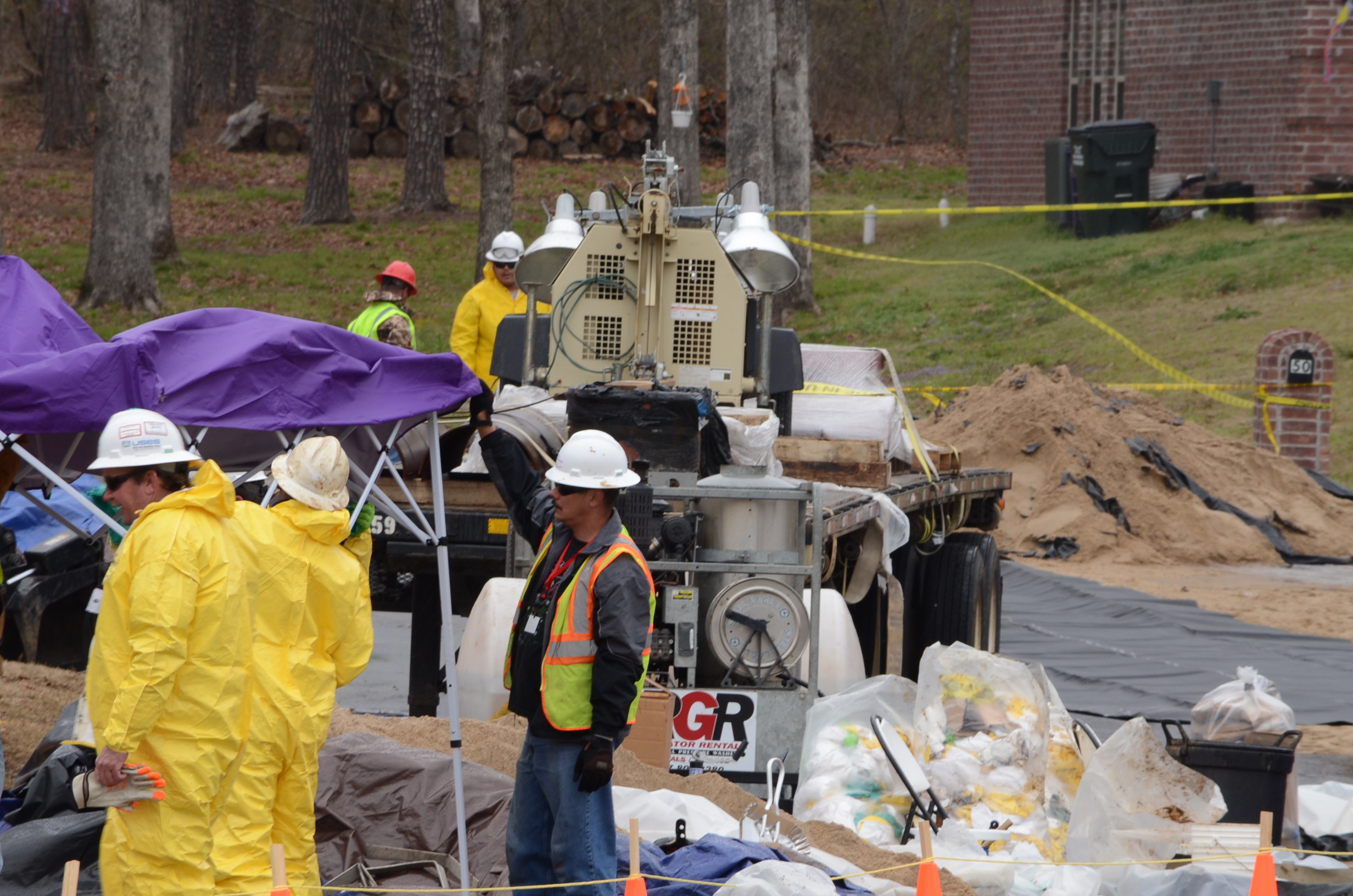
Documentary filmmakers, Elliott Gilbert,II and Joe Capps, run into a cleanup crew in Mayflower, AR.
Elliott Gilbert, a Dallas documentary filmmaker, and his assistant Joe Capps, rushed to the Arkansas spill site after it was discovered. Both commented to Public Citizen about visiting an Arkansas elementary school where they interviewed the principal, who had sent children home due to dizziness, nausea and vomiting. The school was within a half mile of the Pegasus spill.
“After filming and hearing from the school principal and the residents in Arkansas, it definitely gives me pause as to what could happen with communities near Dallas should our area encounter such a spill,” Gilbert said. “I have a young daughter. I shudder to think that could happen near her school.”
As the proposed Keystone XL northern segment awaits approval from the U.S. State Department and the southern segment is now being constructed in East Texas, many worry that repurposed pipelines carrying tar sands are the wave of the future.
“Why should pipeline companies apply for permits and go through tedious environmental impact statements when you can repurpose an old pipeline, with little, if any, environmental scrutiny from a state agency and with little resistance from landowners who already have an existing line in the ground,” asked Beving. “These pipeline companies that are carrying Canadian tar sands are in a race to get lucrative shipping contracts with Texas refineries. Why not get your product to market the easy way with an old repurposed pipeline instead of undergoing permits and review by applying for a new construction permit?”
Beving notes that some companies, such as Enbridge, are twinning or adding additional lines to existing ones as they are doing with the existing Seaway pipeline. “Using existing pipelines and then twinning them is like building your own tar sands superhighway, an interstate for crude oil that you can expand at will with built-in condemnation rights. But this product is more toxic and problematic to clean up,” she said.
Tar sands are mined and then diluted with natural gas condensate and a host of toxic chemicals, according to Chris Wilson, a chemical engineer who has consulted for Public Citizen. Tar sands or dilbit is up to 70 times more viscous, 20 times more sulfuric and 10 times more acidic than conventional crude.

A shot of tar sands from the Arkansas spill pumped into a containment pond.
“Canadian tar sands are not your granddaddy’s West Texas crude,” Wilson said. “It is transported from Canada in a more ‘raw’ form than other forms of oil, and that is what makes it more deadly and more problematic to clean up.”
Added Ed Parten, executive director and political liaison of Texas Black Bass Unlimited, “Lake Fork is the ultimate sportsmen’s fishing destination, known throughout Texas and the world for its premier bass fishing. It is my understanding that Lake Fork was built over this pipeline. Based on what we know with the Michigan tar sands spill, if this pipeline ruptures, it not only will destroy a valuable water supply, but also will devastate this great recreational resource known to fishermen across the country.”
“Texas lawmakers are debating pipeline safety standards for other types of pipelines during this session,” Smith said. “Are they asking the right questions to protect Texans from tar sands? Do they understand the urgency to act now to protect Texas before we have a tar sands spill here? And finally, do they have the political will to enact legislation to protect our state? We need proper notice, disclosure, filing of emergency response plans before operations begin, and a Texas liability fund to protect our state, since these companies are exempt from paying into the U.S. Spill Liability Fund.”
Under The Pipe
Posted in Global Warming, pipelines, Tarsands, tagged Barack Obama, canada, climate change, DilBit, dirty oil, Global Warming, Keystone Pipeline, keystone xl, obama, Oil Spill Liability Trust Fund, Oil Spills, pipeline, Public Citizen, public citizen texas, tar sand, Texas, Texas Oil, transcanada on March 5, 2013 |
![beforenafter1[1]](http://www.texasvox.org/wp-content/uploads/2013/03/beforenafter11.jpg) The Keystone XL pipeline is embroiled in controversy from coast to coast. Environmentalists are rallied by its giant carbon footprint, the damage caused by spills, and the destruction of Canada’s boreal forests. Meanwhile, landowners are being forced to give up their property rights and cope with unacceptable safety issues.
The Keystone XL pipeline is embroiled in controversy from coast to coast. Environmentalists are rallied by its giant carbon footprint, the damage caused by spills, and the destruction of Canada’s boreal forests. Meanwhile, landowners are being forced to give up their property rights and cope with unacceptable safety issues.
More than thirty Texas waterways will be threatened by Keystone XL pipeline spills. Tar sand is very difficult to clean up, especially in water. And, Keystone XL is not required to pay the standard eight cents per barrel tax into the Oil Spill Liability Trust Fund, which means the cost to clean up any spills along the pipeline could become the tax burden of U.S. Citizens. When tar sand comes into contact with water it begins to separate, leaving the heaviest, thickest product on the bottom. Meanwhile, benzene and other airborne toxins are lifted to the surface of the water and evaporate into the atmosphere, directly threatening human life.
 Landowners in Texas have been confronted with having a tar sand pipeline cross their farms and ranches. Ranchers and farmers have no choice where the pipeline lays down on their property. The easement around the pipe is fifty feet wide, and there will be a kill zone around and under the pipe due to its temperature, which may exceed 158 degrees F. A running pressure of 1,600 pounds per square inch introduces the possibility of a stream with enough force to cut a person in two should a small rupture in the pipe occur. But, problems with the pipeline do not stop at inherent danger. The land owners are given a choice of payment for the easement, which requires them to pay taxes on the land under the pipe or, they can have the easement condemned, which leaves them without the right to use that property. In truth, the land owners have no option when companies such as Keystone XL decide that a pipeline should cross their property, except to deal with the risks, or leave.
To make matters worse, the tar sands that would flow through the Keystone XL pipeline won’t even be used in the U.S. – they are destined for export to foreign countries. So, we will incur the risks to our land and water and will suffer the consequences of climate change, but we won’t have any more energy security than we do now. That’s a bad deal. The risks associated with the Keystone XL pipeline are unacceptable. Most importantly, these risks are avoidable. Let President Obama know that you want him reject the Keystone XL pipeline because the risks don’t outweigh the benefits. The recently released draft Supplemental Environmental Impact Statement (SEIS) from the U.S. Department of State acknowledged that construction of the Keystone XL pipeline would create “numerous” and “substantial” impacts on the environment, but it claims the project is better than the alternatives. If you disagree, as I do, send comments on the draft SEIS via email to: keystonecomments@state.gov.
Texans affected by the Keystone XL pipeline – lets get ready to rumble – #NoKXL
Posted in Air Quality, Tarsands, tagged environmental impact statement, Gulf Coast of the United States, Heavy crude oil, Keystone Pipeline, keystone xl, Texas on March 1, 2013 |
Today, the the Department of State released a Draft Supplemental Environmental Impact Statement (SEIS) for the new Presidential Permit application for the proposed Keystone XL pipeline.
- The Draft SEIS is available at: http://keystonepipeline-xl.state.gov/draftseis/index.htm.
The SEIS acknowledges that the construction of the controversial Keystone XL pipeline would create “numerous” and “substantial” impacts on the environment, but they are claiming that the project is a better than any of the alternatives, essentially clearing the project to go ahead.
The report concluded that the tarsands diluted bitumen (dilbit) that the pipeline will transport into and across the U.S. produces 17 percent more greenhouse gases than heavy crude oil refined on the Texas Gulf Coast. In addition, it said the construction phase of the project would result in carbon dioxide emissions equivalent to about 626,000 passenger vehicles operating for a full year.
The Draft Supplemental Environmental Impact Statement, once published by the EPA, starts the clock on the public comment period. At this time, we expect the SEIS to be published sometime next week. Our best guess is Wednesday. From that point, the public will have 45 days to comment on the document, so let’s dust off our legal pads and pens and start drafting our comments. Having spent three days on a bus and marching around the mall in Washington DC in freezing weather with many of you, I know you have a lot to say.
Comments can be addressed to the following mailbox: keystonecomments@state.gov.
Texas Landowner Julia Trigg Crawford Files Appeal Against TransCanada – NoKXL –
Posted in Global Warming, tagged Eminent Domain, Keystone Pipeline, Public Citizen, Texas, transcanada on March 1, 2013 |
We Texans and Public Citizen Support Crawford Family as Legal Action Continues Against Keystone XL Southern Segment – #NoKXL
Yesterday, Landowner Julia Trigg Crawford and her attorney Wendi Hammond announced that they have filed their appeal against TransCanada with the 6th Judicial Court in Texarkana. The brief disputes TransCanada’s attempt at taking Crawford’s property on the basis that TransCanada has yet to prove the company is a common carrier, but is instead a private foreign company utilizing its pipeline for private gain.
“Our appellate brief is now in front the Sixth Circuit Court of Appeals and we are confident this panel of experienced judges will give all the issues the thoughtful consideration and thorough review they deserve,” noted landowner Julia Trigg Crawford. “Since the lower court’s ruling against us in August we’ve worked diligently to elevate the dialogue around property rights and eminent domain abuse.”
“Since before 1920, the Texas legislature wisely limited the enormous power of eminent domain authority to a common carrier subject to the Texas Railroad Commission’s (RRC) jurisdiction and other legal requirements. In the Crawford family’s case, the RRC admitted it does not have jurisdiction over TransCanada’s pipeline, but the trial court allowed TransCanada to take the Crawford’s private land anyway,” commented Hammond, Crawford family farm attorney. “This decision highlights a serious problem, not just for the Crawfords, but for many families across Texas. Now this important matter will be decided by a higher court.”
Groups including We Texans and Public Citizen are supporting Crawford and her family in their continuing resolve to pursue this landowner’s case to a higher court. The groups view this precedent setting case as a private company attempting to take land for private use and foreign profit.
Debra Medina, executive director of We Texans, applauded the Crawford family’s courage in continuing their opposition to the taking of their property. “We agree with the Crawford family in believing that there has been an erroneous ruling against them and hope that the appellate court will right that wrong. In doing so, the court can protect not only the Crawford Family farm, but also set a precedent that will ensure the law is followed and all private property in Texas is duly protected.”
“What’s at stake here is whether the state should allow a public agency to allow condemnation for private gain. The Crawford case is emblematic of the failure of the Texas Railroad Commission to effectively ensure that companies doing business in Texas are indeed a common carrier,” commented Tom Smitty Smith of Public Citizen. “The State has laid this burden of proving up common carrier upon landowners such as the Crawfords, while the proof should be incumbent upon those who want to business here in Texas. The entire process needs to be overhauled.”
“The Railroad Commission allowed TransCanada to have the status of a common carrier, yet the agency has stated that it doesn’t not have the authority to give eminent domain powers to TransCanada,” added Smith. “TransCanada has yet to prove to the court that they are transporting the product for the public good or for the public for hire as required by law.”
“Currently, there is a loophole in Texas law that allows a company to simply check a box on a one page form at the Railroad Commission that allows companies to declare themselves a common carrier without any checks and balances,” noted Rita Beving, North Texas Public Citizen organizer. “Last summer we started a dialogue with the Texas Land & Resource Management Committee regarding this problem. We are hoping the matter of common carrier and eminent domain gets rectified during this year’s legislative session.”
“I’ve testified to legislative subcommittees at our state Capitol, shared my story with the Sunset Commission in their review of the embattled Texas Railroad Commission, and traveled to Washington, D.C. twice to speak to governmental agency representatives and support groups,” Crawford added. “At the heart of this issue is the fact the Texas Railroad Commission has seemingly abandoned Texas landowners. By their own admission, they are aware that companies use the T-4 form to demonstrate to the public that the company is operating as a common carrier pipeline with eminent domain authority when, in fact, the RRC operating permit provides no evidence of that fact at all.”
“What was once just the voice of Texas landowners is now a national issue, with all eyes upon Texas and how our Legislature will step up to repair this grossly flawed land condemnation process,” Crawford concluded. “I stand at the ready to continue shining a light on what’s really happening on the ground to Texas landowners as we protect our land, and we look forward to a positive outcome in our appeal.”
TransCanada has initiated construction of the southern segment of the Keystone XL pipeline along its 485-mile trek from Cushing to the Texas coast. TransCanada will pump Canadian tar sands crude or Dilbit to refineries on the Gulf coast. The northern segment of the Keystone XL awaits approval by the State Department for its presidential permit.
In the meantime Enbridge, TransCanada’s Canadian competitor, has begun surveying for an additional twin line to the existing Seaway pipeline near the DFW area. Both Enbridge’s 36-year old repurposed Seaway pipeline and the new twin line will carry tar sands from Cushing to the coast. The dual Enbridge lines are expected to exceed Keystone’s capacity with 850,000 barrels per day of tar sands crude.
Enbridge is currently responsible for the largest and most expensive onshore spill in history. The Michigan spill occurred in July 2010 carrying tar sands crude through a 43-year old repurposed line. Two years and more than $850 million later, the spill is still being cleaned up on the Kalamazoo River.
“Landowner fights such as that of the Crawford family with TransCanada have sparked a new battle on a whole new front with another Canadian company,” Beving concluded. “Many of us are now getting calls from landowners now worried about Enbridge, which also plans to carry dangerous Dilbit crude through its pipelines from Cushing to the coast.”
Click here to read a copy of the brief.
Austinites join the Washington Climate Forward Rally – both in DC and at home
Posted in Climate Change, Global Warming, tagged climate change, Keystone Pipeline, Oil sands, Texas on February 25, 2013 |
On February 17th, environmental activists gathered in front of the Whole Foods headquarters in Austin, TX to show their support for the Tar Sands Blockade and to raise climate change awareness, adding their voices to the over 40,000 that gathered on the Mall in Washington, DC that same day.
The Keystone XL Pipeline would carry oil from Canada to the Texas Gulf Coast. Around 200 people in attendance at the Austin rally, from many organizations, said the pipeline is environmentally toxic. The protestors chose Whole Foods as the best location for their action because CEO John Mackey recently said “Climate change is not that big a deal.” Chris Wilson with S.T.O.P. (Stop Tar Sands Oil Pipelines) said the oil that will come out from the pipeline will be exported overseas and none will stay in the United States.
Click here to watch the local CBS news affiliate’s coverage.
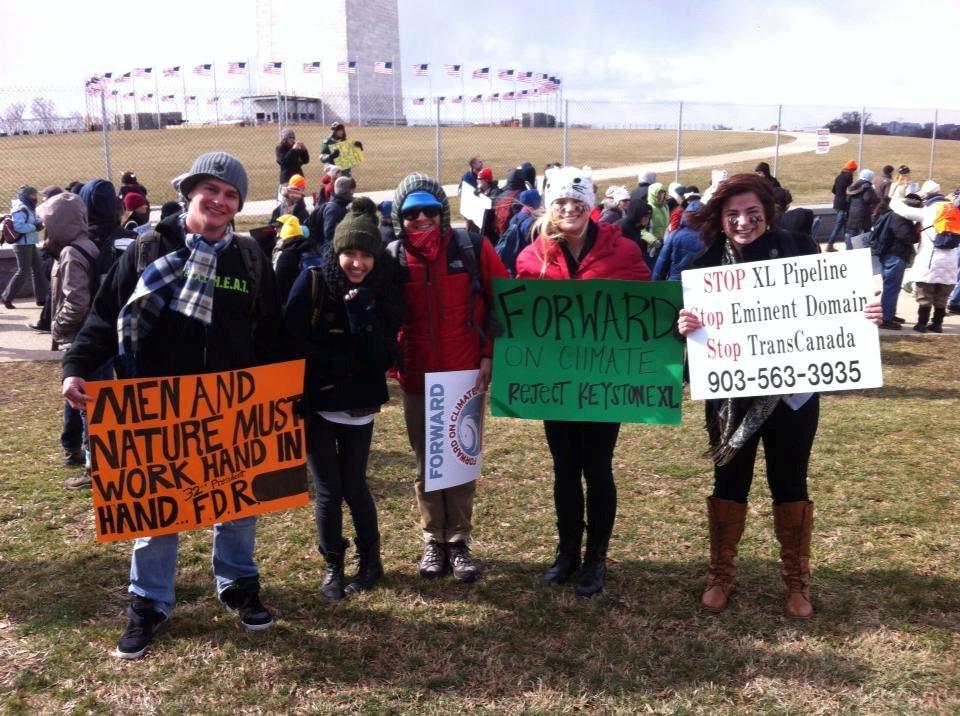
Texans who rode on a bus for 36 hours to Washington, DC to participate in the Climate Forward rally in 30 degree weather with 6 degree wind chill.
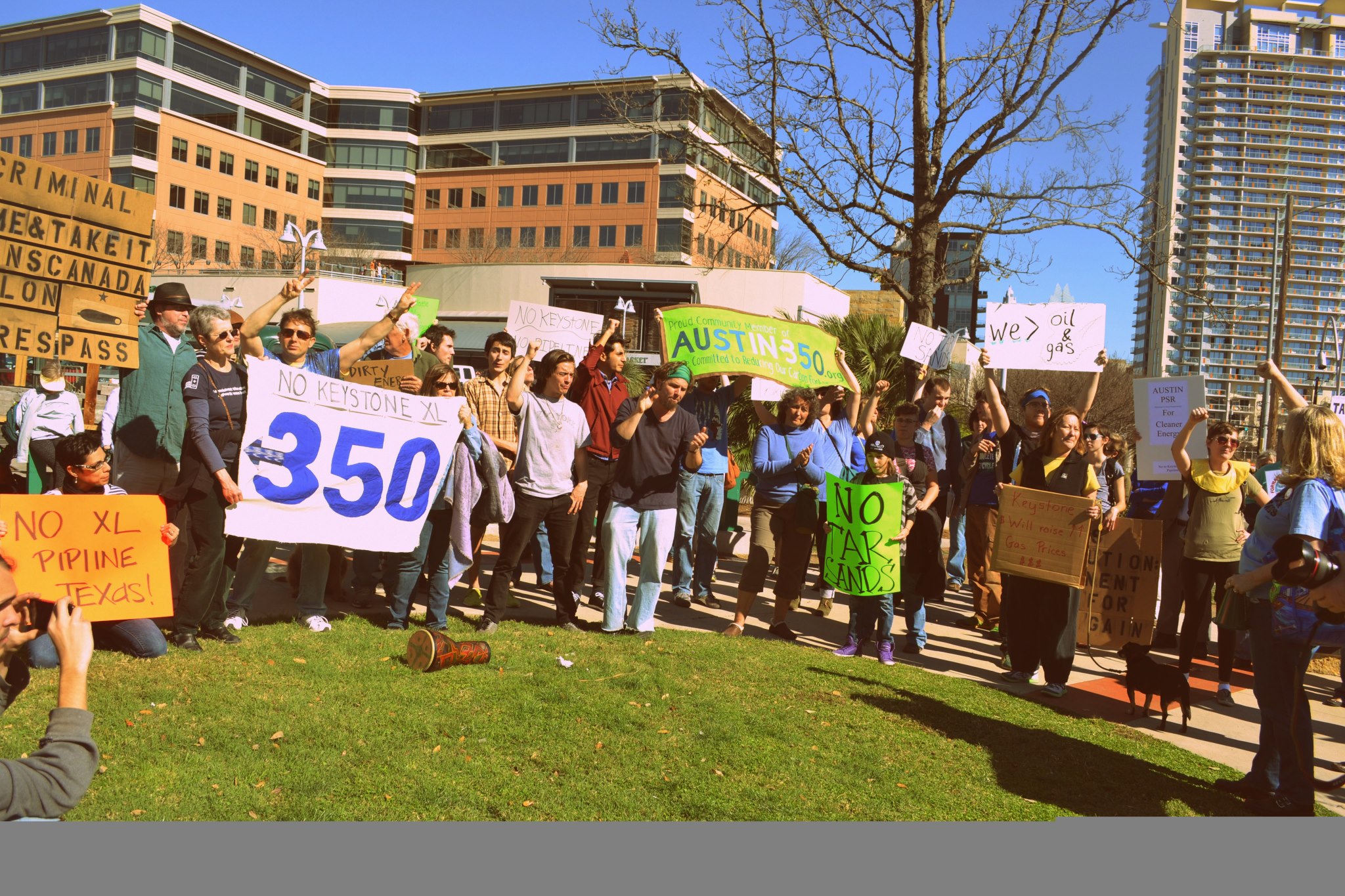
Rally in Austin for those unable to make the trip to DC. – Photo by Sasha Violette
Forward on Climate Rally – A Call to Activism
Posted in Climate Change, Energy, Global Warming, Tarsands, tagged Activism, Austin, climate, dallas, enviornment, Forward on Climate, human rights, Keystone Pipeline, KXL, obama, oil, Public Citizen, public citizen texas, Tar Sands, Texas, tyler, Washington D.C., white house on February 21, 2013 |
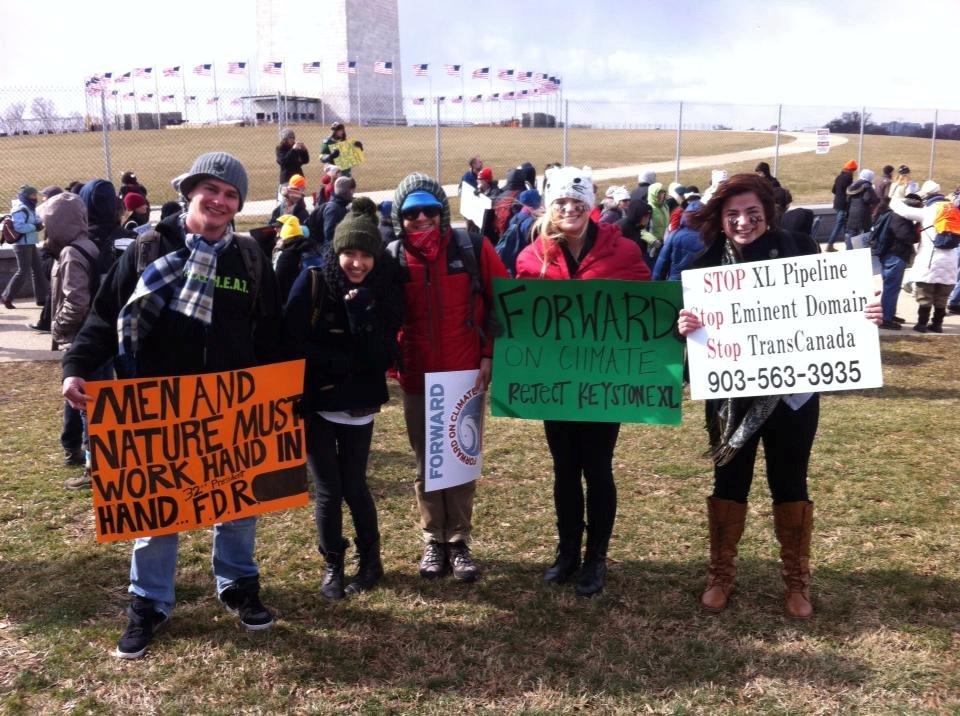 I have been a Public Citizen intern since January of this year. As a Political Science graduate student, in both Undergraduate and Graduate studies I have been immersed in the political process and the theories behind the ideas that have formed our nation. When I was a bit younger, I dabbled in political activism, with issues like civil rights and equal rights, which are still very near and dear to my heart. But, I never took the plunge into becoming a full on activist.
Thursday, February 14th, I had the opportunity, through Public Citizen and The Sierra Club, to get on a bus with 48 other Texans and make the long trek to Washington D.C. for the Forward on Climate Rally. I had been to D.C. several times before, but never for a cause. Our bus departed from Austin, Texas and made stops in Dallas and Tyler. At each stop, new people joined us. Each person on the bus had their own reasons for engaging in this somewhat grueling 30 plus hour bus ride. Each person was motivated enough to take time out of their schedule and commit to a less than comfortable ride on a bus to our nation’s capital.
In the early part of our journey, many people did not know each other. Many of us were coming from different places geographically and in life. As the hours wound on, conversation and ideas began to flow on the bus. People began to relax and conversations began to percolate throughout the bus. After the formalities, discussions began on why we were on this trip. There were people directly affected by the Keystone Pipeline. Others were concerned with climate. Some were just champions of the Earth. For quite a few of my fellow bus riders, activism was old hat. Others, such as one older, retired gentleman, still were hesitant to call themselves activists. Some were believers in the cause, but just there for the exchange of ideas and to observe. But, within the varying reasons for attending the trip, a common thread was clear. Something needs to be done about climate change. That was something everyone could agree upon, regardless of what school of thought they were coming from.
As for me, when I got on the bus, I did not really know which one of these types I was. Climate change has always been a concern to me. I try to live a “green” life. I knew the Keystone Pipeline was bad news from things I had read and heard, but I suppose that I was never mad enough to do anything about it. For me, civil rights and related social issues had always been the most important…
As the trip wore on, we all began to become friends. We shared experiences and ideas. By the time we arrived in D.C., we were no longer a bus full of strangers. There was a feeling that we were a team, and some of us had become quick friends. Our group spanned many different generations and encompassed many different levels of involvement in the cause.
Friday night and Saturday, through some downtime and tourism, the group continued to solidify. Our bonding was increased through a night on the town and sightseeing, but the main event was yet to come.
Sunday, February 17th began by loading on the bus and heading to the Public Citizen D.C. office for breakfast and some interviews with a reporter. Outside, the cold was biting, with a wind chill of 6 degrees. As we prepared to depart for the National Mall, the excitement level was high despite a lack of sleep and the cold weather.
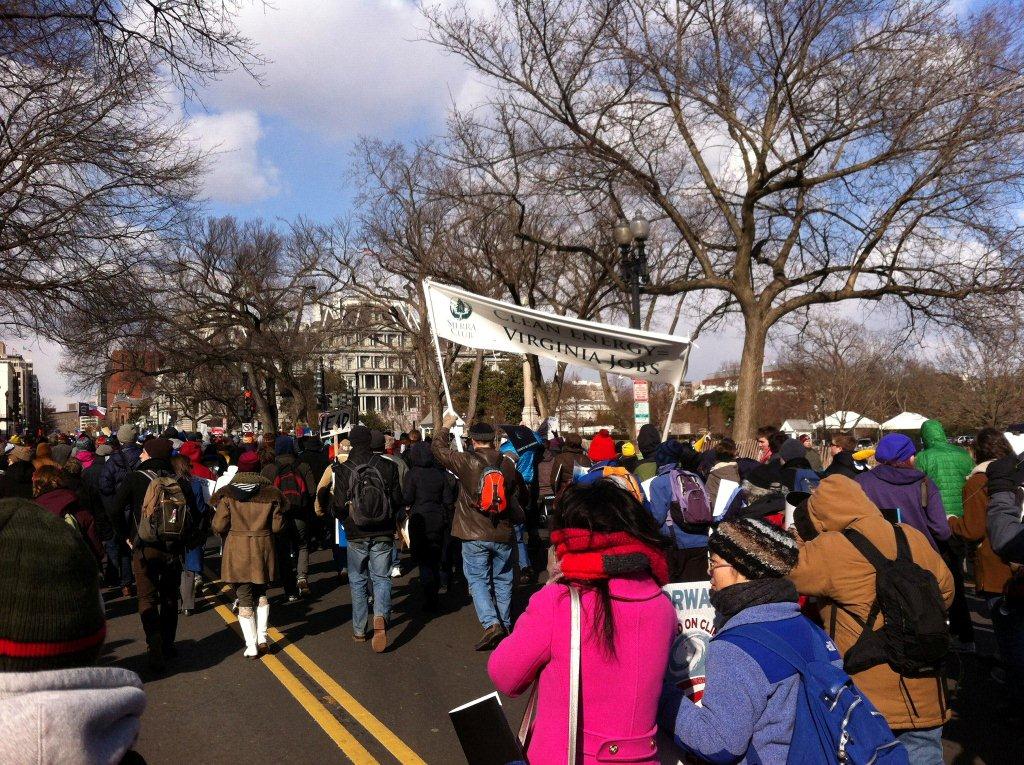 We arrived near the Washington monument to a sea of busses. Hundreds of busses. We arrived about an hour early, and there were people as far as the eye could see ready to participate in democracy. The estimates of number of people at the Forward on Climate rally ranged from 35,000 to 50,000. As the rally began, speakers began to deliver messages from many different points of view. Some were directly affected by the pipeline, other were speaking of climate change and activism. The excitement level of the crowd increased with every speaker. The climax of the rally was the 10’s of thousands of us marching to the White House. The street was packed from curb to curb all the way around the White House. We now know that President Obama was playing golf with Tiger Woods and oil executives, so he did not see the awe –inspiring site of that many people united for our climate. Everywhere you looked there were signs. When you stopped to listen, you could hear chants that would begin with one person and end with a united crowd chanting in solidarity. While marching around the White House, you almost forgot how cold it was. (It was really cold) When we returned to the National Mall, I had a sense of accomplishment. You could not help but feel that we had done something important, united together as a group as varied as any ever assembled. People of different ages, races, economic backgrounds, and geographic locations; all united in for the planet. It was then that something I should have realized all along dawned on me. Climate change and human/civil rights are intertwined. They are so deeply related, that it is almost hard to see the preverbal forest for the trees. Without one, there cannot be the other. It also dawned on me that this is the fight of our generation. This is the legacy that we should pass on to our children and their children. Our Earth and our climate is intrinsically a human right. If we do not take action, there may not be an inhabitable planet for future generations, which would be the greatest violation of human rights in our history. Through the interactions on the bus, the speakers, the sights and the sounds, something that should have been painfully obvious to me was finally made clear.
We cannot be passive observers in this fight against climate change. We cannot be passive observers in things like the Keystone XL, even if we think they do not directly affect us. (It does) The time to remain silent is gone. It is time to call on everyone who knows these things are terrible to use their voice, their right to free speech, and the democratic process to put an end to this insanity. The Earth cannot wait while we sit idly by and do nothing while corporations destroy her under the guise of “progress” and “economics.” We need to stand up and let them know that we will not stand for irresponsible practices and violations of our planet. We must activate to preserve our climate and Earth for future generations. We must let President Obama know that we won’t stand for the Keystone XL.
For me, it is now no longer an option to passively oppose what is going on. Activism is now a necessity. I would urge everyone to use their voice, stand up and be heard.
Rep. Waxman Statement on New Reports on the Climate Impact of Tar Sands and the Keystone XL Tar Sands Pipeline
Posted in Air Quality, Climate Change, Global Warming, Tarsands, tagged climate change, Keystone Pipeline, Oil sands, Texas on January 17, 2013 |
Today, Energy and Commerce Committee Ranking Member Henry A. Waxman issued the following statement on new research from the Pembina Institute and Oil Change International, indicating that the Keystone XL pipeline will accelerate the reckless expansion of the tar sands industry and the climate impact of tar sands and the pipeline will be significantly worse than anticipated:
“The new reports show that TransCanada’s Keystone XL pipeline is the key that will unlock the tar sands. If the pipeline is approved, the world will face millions more tons of carbon pollution each year for decades to come. After Hurricane Sandy, devastating drought, unprecedented wildfires, and the warmest year on record in the United States, we know that climate change is happening now, we have to fight it now, and we must say no to this pollution pipeline now.”
To access the report released at the event, please visit:
Petroleum Coke: The Coal Hiding in the Tar Sands – Oil Change International
The climate implications of the proposed Keystone XL pipeline – The Pembina Institute
Stop Keystone XL Pipeline in Nebraska – protect the Ogallala Aquifer
Posted in Tarsands, Water, tagged Keystone Pipeline, ogallala aquifer, Texas on November 26, 2012 |
Submit a comment to the Nebraska Department of Environmental Quality (DEQ) on how risky the Keystone XL pipeline route is for the Nebraska Sandhills and the Ogallala Aquifer. Help us get over 1,000 comments submitted. Click here to send a comment to the Nebraska DEQ. If you are not from Nebraska, change the comment and let them know how this affects you.
The Ogallala Aquifer is part of the High Plains Aquifer System. It is a vast, yet shallow, underground water table aquifer located beneath the Great Plains in the United States. One of the world’s largest aquifers, it covers an area of approximately 174,000 square miles in portions of eight states. These include South Dakota, Nebraska, Wyoming, Colorado, Kansas, Oklahoma, New Mexico, and Texas.
Support our work!

 ">spousal
Subscribe by Email
Categories
Popular Tags
air pollution Air Quality Austin Austin Energy Barnett shale Carbon Dioxide clean air act Clean Energy climate change Coal coal plant CPS Energy Energy Energy Efficiency Environmental Protection Agency EPA eye on williamson Global Warming green jobs houston Keystone Pipeline natural gas Nuclear Nuclear Power Nuclear Regulatory Commission Public Citizen public citizen texas radioactive waste renewable energy Renewables Rick Perry San Antonio SEED Coalition Sierra Club solar solar power south texas chisme South Texas Project TCEQ Texas Texas Commission on Environmental Quality Texas Legislature texas progressive alliance Tom "Smitty" Smith United States Environmental Protection Agency Citizen Vox Blog
-
350 Challenge

Pages
June 2026 M T W T F S S 1 2 3 4 5 6 7 8 9 10 11 12 13 14 15 16 17 18 19 20 21 22 23 24 25 26 27 28 29 30 Archives
Meta