Feeds:
Posts
Comments

Posts Tagged ‘Renewables’

You may have never heard of Property Assessed Clean Energy (PACE), but it has the potential to make a huge difference in adoption of distributed renewable energy systems, such as rooftop solar installations. PACE allows businesses to borrow money from local governments to work on energy efficiency and renewable energy projects in the buildings they occupy.

Since PACE is funding is loans, there is no real expense to the taxpayer.  On the other side of the coin, it allows businesses to spread out the costs of becoming more environmentally friendly over time, all while lowering their monthly utility costs.  This strategy is a win-win-win for Texans.  Business save money, the environment benefits, and it cost Texans nothing.

The Texas Legislature is currently considering legislation that would move PACE forward for our state.  Senate bill 385 has already cleared the hurdle of the Texas Senate, and now is pending in our House of Representatives. House bill 1094 is still waiting be voted out of the House Committee on Energy Resources.  The House should move forward to adopt this common sense measure.

As of 2013, 27 states and the District of Columbia have PACE legislation on the books to help combat harmful emissions from electric generation.  States from California to Wyoming have enacted PACE programs.  Generally, in these states, the financing terms are 15-20 years.  It works very much like taking out a home loan, or perhaps a better example would be a home improvement loan, but for commercial properties. Disbursing the payments over a longer period of time makes these efficiency upgrades affordable for a wider variety of business.  It also makes upgrades attainable for smaller businesses.

I urge fellow Texans to get in touch with their State Representative and tell him or her to support the PACE bills (HB 1094 and SB 385).  This is common sense legislation that benefits everyone.

Click here to find out who represents you. 

Read Full Post »

It wouldn’t be a Texas legislative session without some truly backwards bills.  Today we have House Bill 2026 by freshman Representative Sanford of Collin county that would eliminate our state renewable energy goals.

BeachWindIn 1999, the state of Texas made a commitment to renewable energy in the form of the renewable portfolio standard (RPS).  That decision played a major role in spurring the development of the wind industry in Texas.

We have now exceeded the renewable energy goals established in the 2005 update to the RPS and Texas has more wind energy capacity than any other state.[1]  On the surface that may seem to indicate that the RPS has been 100% successful and is no longer needed, but that isn’t the case.

One of the major reasons for establishing the RPS was to encourage diversification of our energy sources, which ultimately makes us more resilient to physical and economic forces that can impact the availability and price of energy sources.  While wind energy has increased from zero percent when the RPS was first established to around ten percent today, other renewable energy sources are still largely absent from our energy portfolio.

With more solar energy potential than any other state, Texas should be the center point of the solar industry as well.[2]  Instead we are lagging behind states with far less solar resources, such as New Jersey and Pennsylvania,[3] and are paying the price in missed opportunities for job growth and new generation capacity that can produce during peak demand.

Solar companies invest in California and other states, because smart policies created attractive markets in those places.  California has 1,505 solar companies compared to Texas’ 260. Even New Jersey has more, with 382.[4] Texas should be doing more, not less to attract solar businesses to our state.

SolarInstallProjections showing that we won’t have enough electricity to meet demand by 2020.[5]  The maximum wholesale price of electricity has been set to triple by 2015, without even determining what the cost to consumers will be.  There have been workshops and meetings to consider the prospect of implementing a capacity market in Texas, which would raise costs even more.  But little time has been spent considering simpler, cheaper solutions such as expanding efficiency and demand response (where customers get paid to reduce there energy usage for short periods of time when demand is high) and getting more solar capacity built in Texas.  Solar is most productive when we need it the most – on hot, sunny afternoons.

The RPS should be retooled to focus on solar and other renewable energy resources that are most capable of producing during peak demand.  Millions of dollars could be saved in the wholesale electric market if we had more solar panels installed.[6]

Solar, like wind, also has the benefit of needing very little water to operate.  Solar photovoltaic (PV) installations need an occasional cleaning to keep performance high, but the amount of water need is minimal in comparison to fossil fuel options.  Coal-fired generators need billions of gallons of water to operate each year[7] and while natural gas-fired generations consume less water than coal-fired generators, they still use more than solar, even without accounting for the millions of gallons of water used to extract the gas with hydraulic fracturing.[8]  Including more renewable energy in our portfolio will make our electric grid less vulnerable to drought[9] and will free up water supplies that are desperately needed for human consumption and agriculture.

Abandoning the RPS now would send a terrible signal to renewable energy companies that are deciding where to establish their businesses.  Our state made a commitment that isn’t set to expire until 2025 at the earliest.  There is no good reason to abandon the policy now.  We should be moving in the opposite direction of what is proposed in HB 2026.  Instead of giving up on a policy that has been successful, we should be looking at ways to build on that success and benefit our state.


[1] AWEA. “Wind Energy Facts: Texas.” Oct 2012. http://www.awea.org/learnabout/publications/factsheets/upload/3Q-12-Texas.pdf.

[2] NREL. “U.S. Renewable Energy Technical Potentials: A GIS Based Analysis.” July, 2012. Pg. 10-13. http://www.nrel.gov/docs/fy12osti/51946.pdf.

[3] SEIA. Solar Industry Data. http://www.seia.org/research-resources/solar-industry-data#state_rankings.

[4] SEIA. State Solar Policy. http://www.seia.org/policy/state-solar-policy.

[5] “Report on the Capacity, Demand, and Reserves in the ERCOT Region.” Dec 2012. Pg 8. http://www.ercot.com/content/news/presentations/2012/CapacityDemandandReservesReport_Winter_2012_Final.pdf.

[6] Weiss, Jurgen, Judy Chang and Onur Aydin. “The Potential Impact of Solar PV on Electricity Markets in Texas.” The Brattle Group.  June 19, 2012. http://www.seia.org/sites/default/files/brattlegrouptexasstudy6-19-12-120619081828-phpapp01.pdf.

[7] “Environmental impacts of coal power: water use” Union of Concerned Scientists http://www.ucsusa.org/clean_energy/coalvswind/c02b.html

[8] http://www.ucsusa.org/clean_energy/our-energy-choices/energy-and-water-use/water-energy-electricity-natural-gas.html

[9] Wu, M. and M. J. Peng.  “Developing a Tool to Estimate Water Use in Electric Power Generation in the United States.” Argonne National Laboratory – U.S. Department of Energy. http://greet.es.anl.gov/publication-watertool.

Read Full Post »

algae-open-pondChlorella sp. is a species of algae that has a significant proportion of fatty acids to its body mass. For humans, this can be a problem. But, in a world needing more clean energy, fatty biomass is considered a promising option by many scientists and engineers.

Why algae? Algae can grow in a body of water almost anywhere. We don’t need to use any of our precious farmland to grow it. Water conservationists may initially be concerned, but a group of scientists found that Chlorella sp. thrives in our waste water. Not only that, it cleans up the water, removing ammonia and a host of toxic metals. According to their report, the algae could be used to help clean up waste water at municipal water treatment plants then harvested for biofuels.

graph_algaeI had a chance to speak with Dr. Martin Poenie, Associate Professor in Molecular Cell & Developmental Biology, at The University of Texas at Austin. The Poenie Lab is helping to develop a technique for harvesting the oils from algae that could greatly reduce cost. Dr. Poenie also told me algae can be a significant source of phosphates, which we use in fertilizers. One of the most significant things about algae biofuels, is their small carbon footprint and high energy content. CO2 is sequestered during the growth phase of the algae and it is not released until the fuel is burned. On the whole, biofuels from algae look promising, and the variety of products that can be derived from it will make algae farming even more profitable.

Texas could do more to capture the energy and job benefits from this home grown energy source. Texas Legislature should act to strengthen renewable energy goals. HB 303, SB 1239, and HB  723 would all be good steps in the right direction.

Read Full Post »

Texas Capitol - north viewTwo bills have now been filed in the Texas House that would expand the state’s goals for renewable energy.  Representative Rafael Anchia‘s bill, HB 723, would establish goals for growing renewable energy installations other than large-scale wind through 2022.  Similarly, Representative Eddie Rodriquez‘s bill, HB 303, would establish a goal for solar installations and increase the existing goal (which was met 15 years ahead of schedule) for all renewable energy for 2020.

We applaud these efforts and the leadership that Rep. Anchia and Rep. Rodriquez are showing by filing these bills.  These proposals recognize that success is a good thing and something we want more of.  You wouldn’t think that would need saying, but when a state agency recommends tossing out a successful policy, I start to wonder.  Texas’s renewable energy goals have been extraordinarily successful.  Not only have the goals been met ahead of time, but they have spurred development of the wind industry in Texas, bringing economic benefits to rural parts of West Texas, as well as to manufacturing centers.  On top of that, wind energy is helping to keep electric bills lower.

A carpenter doesn’t throw away her hammer just because she finished building her first book shelf and Texas shouldn’t repeal it’s renewable energy policies, just because we’ve met some of our goals (remember, the non-wind goal was never enforced).  Wind energy does now makes a substantial contribution to meeting the state’s electrical needs – it contributed a record 26% this past Christmas day, but solar energy is still very underutilized (accounting for less than 1% of energy on the ERCOT grid, which serves 85% of the Texas population) and the geothermal energy industry is still getting off it’s feet.  As Rep. Anchia and Rep. Rodriquez’s bills show, this successful policy tool can be adjusted to keep moving Texas forward.

Read Full Post »

The Solar Energy Industries Association (SEIA) has taken a step that any self-respecting supporter of renewable energy should do – ditched the American Legislative Exchange Council (ALEC).  This relationship looked a lot like the fabled one between the scorpion and tortoise.

Despite members such as the SEIA and the American Wind Energy Association (AWEA), ALEC has decided to make a nationwide push to roll back renewable energy portfolio standards (RPS) that have been enacted in many states.  The RPS sets a percentage of electricity consumed that must be derived from renewable energy sources, such as wind or solar.  The Texas RPS, passed in 1999, has helped propel the state into its role and a wind industry leader.  At one point last month, the ERCOT electric grid (which encompasses most of Texas) was getting 26% of its power from wind turbines.

congratulationsIt pleases me to see good organizations such as SEIA leaving the backward notions of ALEC behind and I hope that other well-meaning organizations, businesses and elected officials will take a hard look at the facts and do the same.  ALEC has perverted the legislative process to suit its needs.  Model bills are developed behind closed doors to fit certain member industry desires and are then pushed for adoption in as many states as possible.  Of course, as SEIA has likely discovered, not all members are equal and its the big boys that get to make the rules of the game.

Numerous polls and studies show widespread support for renewable energy, but nothing speaks so loud as money.  Only when the coffers at ALEC dry up will they stop pushing this kind of backward legislation.

It remains to be seen whether ALEC’s effort to repeal the RPS will gain any traction in Texas.  Here’s to hoping that saner heads prevail and send ALEC packing.

Read Full Post »

Advocates fault PUC for turning a blind eye to industry as Texas falls behind

Solar energy backers rallied outside the Texas Public Utility Commission [last] week seeking enforcement of a seven-year-old law that would boost electric generation from geothermal, biomass and the state’s ample supply of sunshine.

Public comment [ended Friday]on proposed rulemaking at the PUC, which has been reluctant to embrace the non-wind portion of the so-called renewable portfolio standards passed by the Texas Legislature in 2005. With those standards calling for generation of about 500 megawatts of renewable power from non-wind sources by 2015 and 3,000 megawatts by 2025, the Clean Energy Works for Texas Campaign sent petitions to the PUC urging it to carry out the law’s provisions. The group estimates that more than 6,000 individuals across Texas and 50 businesses or organizations lent their signatures in support.

“Why aren’t we seeing the clean energy we’ve demanded from our legislators? Why aren’t we seeing the thousands of new green jobs, new energy businesses and new tax revenues for our underfunded schools?” asked activist Dave Cortez of the Texas BlueGreen Apollo Alliance. “Four words: The Texas Public Utility Commission – a government agency run by unelected commissioners who have the power to take state law and misinterpret it, sit on it, lambast it, everything but implement it and ultimately say, ‘No, sorry. We don’t like it.’”

The PUC’s stand, as articulated by Chairman Donna Nelson, stresses the fact that wind power’s success has eclipsed the minimum renewable standards set in the law many times over. And, she argues that the law’s instructions on non-wind energy are not mandatory, a point of contention with solar backers. Moreover, she has said propping up solar power would increase electric bills and that the commission is not in the business of favoring one type of energy generation over another.

Executives from two Austin-based solar companies who attended the rally said each had respectively grown from only two employees to at least 25. And, with the business climate unfriendly to solar in Texas, they said, both companies are making upcoming expansions in a state more hospitable to their interests.

“The bad news is we’re in the process of opening a second office, and the second office will be in California,” said Tim Padden, founder of Revolve Solar. “I would rather be in Dallas, San Antonio or Houston, but the reality is California has taken a stand to support the development of the solar industry seriously by setting statewide goals and local support for their solar companies. I want to see this happen here in my home state. These could be Texas jobs.”

Stan Pipkin of Lighthouse Solar, an Austin-based solar design integration firm said his own company has shown an almost identical job growth and will also be opening offices in California.

“I’m deeply concerned that Texas is not taking advantage of the energy resource we have in most abundance,” he said. “Texas is currently 10th in solar capacity. This is absolutely confounding given our solar resource, our electric demand and our shortage of reserve capacity. It just doesn’t make sense.”

By Polly Ross Hughes

Copyright September 14, 2012, Harvey Kronberg, www.texasenergyreport.com, All rights are reserved.  Reposted by TexasVox.org with permission of the Texas Energy Report.

The PUC has put the non-wind RPS on the agenda for its open meeting this Thursday.  We need you to be there to show your support for moving forward with the rulemaking process.  Please email kwhite@citizen.org if you are interested in attending.  The meeting will be in the Commissioners’ Hearing Room on the 7th Floor of the William B. Travis building at 1701 N. Congress Ave, Austin.

Read Full Post »

Orbach: $1 billion for energy storage research could launch state’s next energy era

Watch for the University of Texas at Austin to soon make a $1 billion pitch to lawmakers aimed at unleashing the state’s vast potential to lead the nation and even the world in renewable energy production.

Ray Orbach, director of UT’s Texas Energy Institute, has compiled what he considers a compelling case for a large public investment in battery storage research meaningful enough to launch Texas into a new energy economy that taps the state’s enormous potential capacity for solar, wind and geothermal power generation.

“I really would like to have a crash program. My thought is it could be comparable to the cancer initiative,” he told Texas Energy Report. “I would like to see it in the billion-dollar range. My point is the potential is there. I just think it’s crazy not to sit down and optimize it for Texas.”

Orbach said a new study found that Texas has the potential to lead the nation in nearly every form of renewable energy. In concentrating solar alone – which allows for fluctuations that make it more economical – tapping just one percent of Texas’ total capacity could generate electricity equivalent to the entire needs of the ERCOT (Electric Reliability Council of Texas) power grid, he said.

“We have as much energy potential above ground as we do below ground,” Orbach said this week to an audience attending a symposium sponsored by the Texas Public Utility Commission called “Renewable Solutions for Energy Prosperity in Texas.”

Citing a just released July study called “U.S. Renewable Energy Technical Potentials: A GIS-Based Analysis,” Orbach laid out what’s in it for Texas if the state’s leading scientific minds solve the energy storage puzzle:

Urban utility-scale photovoltaics:  Texas has the highest estimated potential (13 percent of the U.S.)

Rural utility-scale photovoltaic: Texas has the highest estimated potential (14 percent of the U.S.

Rooftop photovoltaic’s: Texas has the second-highest estimated potential (9 percent of the U.S.)

Concentrating solar power: Texas has the highest estimated potential (20 percent of U.S.)

Onshore wind power: Texas has the highest estimated potential (17 percent of U.S.)

Offshore wind power: Hawaii has the highest estimated potential, while Texas has 6 percent of U.S.

Enhanced geothermal systems: Texas has the highest estimated potential (10 percent of U.S.)

“The opportunities are so enormous. I was stunned,” Orbach said of his reaction when he read the study that takes into account environmental and land-use constraints, and topographical limitations.

Because each of the renewable capacity calculations is based on the same total land, Orbach said Texas leaders need to determine how to best optimize the state’s renewable resources with decisions about which fuel mix to pursue and where. In an interview, he acknowledged that political and economic considerations would pose major challenges, but he suggested a planning commission appointed by the governor and legislators could help navigate those.

Think of the planning concept as akin to the Texas Railroad Commission’s early history in setting production limits to ensure that oil and gas resources would last longer with conservation measures such as adequate well spacing, he said.  And think of state’s commitment to building CREZ (Competitive Renewable Energy Zones) transmission lines to transport wind energy as a parallel to the research commitment needed to solve the problem of energy battery storage for wind and solar.

With its federal production tax credits, Orbach said wind has posed pricing issues for ERCOT’s wholesale competitive market. But he insisted he’s a free-market advocate who does not think wind or solar would need any subsidies to compete. As for kick-starting research to solve energy storage issues, he said Texans should think of that as an investment that would repay itself many times over.

“Our future will depend on our ability to store base load electricity from fluctuating sources. We are truly blessed with intellectual and energy sources. It’s time for a zoning, an optimization of how we use these wonderful resources for the benefit of citizens in this state,” Orbach said. “This is not just a Texas issue. The market for what we produce in Texas is global. You can think outside the boundaries of our state for these opportunities.”

In addition to the big picture, some of Texas’ energy opportunities have hardly been discussed, he said. The potential for enhanced geothermal energy alone, he said, is 384 gigawatts. That’s equivalent to five times the total ERCOT load.

Geothermal energy taps into underground heat, and fracturing underground rock is one way to release the heat. He points to natural gas wells hydraulically fractured in the Barnett Shale of North Texas and their future to be repurposed in 10 to 20 years for renewable energy production. The wells have already fractured rock at a depth of 8,000 to 10,000 feet where temperatures range from 200-300 degrees Fahrenheit, he noted.

“What happens when those wells are played out? Do we just cap them and walk away? They are a source of potential enhanced geothermal energy. We have the sources now that we’re using for liquids and gas and oil that in fact may well be available in the future for enhanced geothermal,” Orbach said.

Meanwhile, the price of solar panels is dropping sharply as China floods the market with panels at 80 cents a watt, he said. Consequently, solar installations in the first half of this year doubled to 1,254 megawatts over the 623 installed in the first six months of 2011. That’s the size of a nuclear reactor, he said, and this year it will amount to two.

“It’s a revolution,” he added. “It’s a sign for those of us interested in solar and wind and renewable energy that there’s an opportunity here for Texas to be mined.”

By Polly Ross Hughes

Copyright September 14, 2012, Harvey Kronberg, www.texasenergyreport.com, All rights are reserved.  Reposted by TexasVox.org with permission of the Texas Energy Report.

Read Full Post »

Yesterday, Clean Energy Works for Texas – a coalition consisting of Public Citizen, Sierra Club, Texas BlueGreen Apollo Alliance, Progress Texas, Clean Water Action, Environment Texas, North Texas Renewable Energy Group, North Texas Renewable Energy Inc., SEED Coalition, Solar Austin, Solar San Antonio, Texas Campaign for the Environment and  Texas Pecan Alliance – filed a petition with the Public Utility Commission of Texas (PUC) asking for a rule-making to implement the non-wind renewable portfolio standard (RPS).

A law passed by the Texas Legislature in 2005 established that at least 500 megawatts (MW) of the electricity used in Texas would come from renewable energy sources other than wind by 2015.  The PUC, however, has failed to establish rules to ensure that this goal is reached.  Clean Energy Works for Texas calls on the PUC to fulfill its statutory duty and create rules to ensure that the goal is reached.  The petition also proposes and expansion of that goal to 3,000 MW by 2025.

The non-wind RPS would provide a level of certainty for investors considering Texas for clean energy projects.  While the wind industry has thrived in Texas, thanks, at least in part, to the RPS, other renewable energy industries have lagged behind.  Implementation of the non-wind RPS would send a signal to investors that Texas is open for business.   At at time when nearly a million Texans are looking for work, developing 21st century industries here in Texas should be a priority.

Texas has immense solar resources, as well as substantial geothermal resources that, if developed, could be providing the State with additional electricity that it needs.  Electricity market regulators and policy-makers have had numerous discussions about electricity generation shortages over the past year.  The petition filed by Clean Energy Works for Texas offers a solution – and it’s one that can be expanded upon in the coming years.

Please visit www.CleanEnergyWorksForTexas.org to learn more and send an email to to the PUC in support of the non-wind RPS.

Read Full Post »

On a blustery and brilliantly sunny Texas winter day a couple hundred Central Texas citizens, that included officials and solar enthusiasts, gathered on what had been an empty 380 acre field only three years ago to usher in a new era of “drought-proof” energy for the City of Austin.

Former Austin Mayor Will Wynn, PUC Commissioner Rolando Pablos, Austin Councilmember Bill Spelman, Travis County Commissioner Ron Davis, Webberville Mayor Hector Gonzales, Austin Energy General Manager Larry Weis, Austin Councilmember Chris Riley, Austin Mayor Lee Leffingwell and Mark Mendenhall of SunEdison.

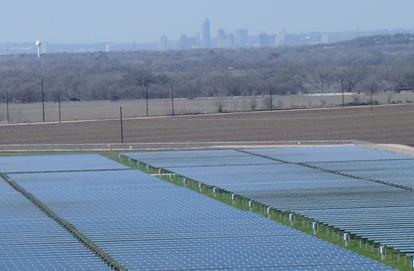
On Friday, January 6, 2012, Austin Energy held a grand opening ceremony for their new Webberville Solar Project, the largest facility in Texas and among the largest in the nation with 127,728 ground mounted solar panels that rotate with the sun and will generate 30 megawatts (MW) of electricity – enough to power 5,000 homes annually.

A number of years ago, the City of Austin purchased this land planning to install a new coal-fired power plant.  When those plans fell through, a landfill was proposed for the site that now boasts 280 acres of solar panels with a view of downtown Austin along its horizon.

Public Citizen says kudos to the City of Austin and Austin Energy for their vision and efforts in completing this project.  Given that the State Climatologist is warning us that Texas can expect up to 5 more years of the current drought cycle, this project came just in time to help provide our community with drought–proof electricity during the peak use times – that will come in handy next summer.

Read Full Post »

The Electric Reliability Council of Texas (ERCOT), the operators of the Texas electric grid, has released its Emerging technologies report that includes the state of renewables on the Texas grid.

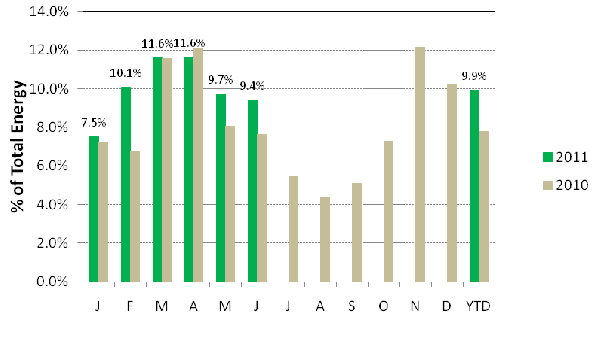
Monthly wind energy graph

Some interesting facts show that wind generation continues to provide a significant amount of energy to the grid as the technology matures, new turbines are developed and better tools are put in place to maximize the turbines generation. The effects of the CREZ (certified renewable energy zone) transmission line build out are starting to be seen as congestion from wind rich west Texas is reduced and more energy is being able to be delivered to the major urban ares. The report shows that wind generation provided 9.9% of the total energy used from January thru June of this year.

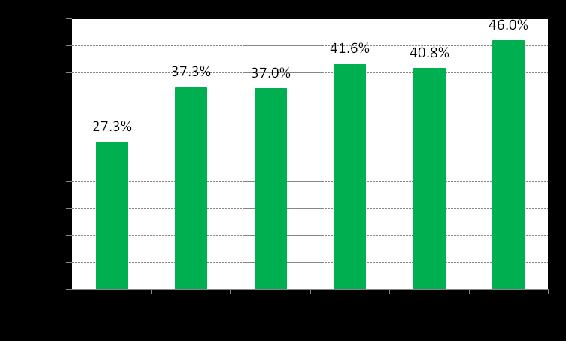
Other good news is that the capacity factor (100% capacity factor would be a perfect generator running flat out all of the time all 8760 hours of the year) for the wind fleet has now reached 38.3%  and continues to increase, that’s better than a lot of natural gas plants.

In addition on June 19, 2011, at 10:26 PM, ERCOT set a record for instantaneous wind generation of 7,355 MW (which represented 77.6% of installed wind generation capacity and 14.6% of the ERCOT load at the time).  This broke the previous instantaneous wind generation record of 7,227 MW set on December 10, 2010. So much for wind not working in the summertime.

The amount of wind produced energy continues to increase and the new coastal wind farms have been a major contributor.  According to the CEO of ERCOT wind has saved us a couple of times this year. Back during the February 3rd rolling blackouts the wind farms played a large roll in keeping the grid running when the aging fleet of fossil fuel generators, along with some brand new ones, failed in the cold.  Then during the current heat wave, the coastal wind farms supplied around 2000 mw of much needed energy during one of the highest energy demand days, keeping the lights on. Perhaps the PUC should start paying more attention and let us add some solar to the mix instead of letting the 500mw non-wind project expire as they did.

ERCOT Wind Generation Capacity

Recently San Antonio put out a request for a large solar project and was bombarded with proposals.  ERCOT then announced they are planning to un-mothball several old gas plants just in case we run short on energy again.  It’s the same thing we saw during the legislative session – the fossil fuel companies got to keep billions in tax breaks but solar didn’t get a dime.   Now the PUC is having a meeting (August 22nd) on how they can “fix” the market to get more generation built when they already have the tools and the opportunity staring them in the face.

During a recent ERCOT meeting held at the peak of the energy demand, I over heard folks saying how “it sure would be nice to have some more solar on the system.” Perhaps the politicians should get out of the way and let the engineers do their job.   The public power utilities (municipally owned and rural electric cooperatives) are leading the way.  San Antonio is looking to build 400mw utility scale solar, Austins 30mw Webberville project moving along and several other Munis and Co-ops looking to build solar projects.  But where is the much vaunted deregulated energy market when we need them?  Relying on 30-50years old smelly, toxin spewing existing fleets – or business as usual.

As Texas bakes in the the record summer heat wave and our scarce water resources are being sucked up by traditional power plants ( a typical coal plant can use 10 million gallons of water a day) low impact non polluting energy sources are being allowed to languish on the sidelines. Its time to get with it, and bring some new industries, more jobs and clean renewable energy to the Texas grid to keep the lights on and meet the EPA regulations for clean air and water for us and our children to enjoy. Companies want to build 3000 MW of offshore wind beyond the barrier islands south of Corpus Christi, and there is a 10,000 mw farm that is in the plans to be built up in the Panhandle.

To paraphrase, the answer my friends truly seems to be blowing in the wind, just as the sun comes up every morning.

Read Full Post »

Over the past couple of years, there has been a heated debate involving the potential EPA implementation of allowing a greater percentage of ethanol in gasoline.  The current volume percentage of ethanol allowed is 10% for vehicles made between the years 2001 and 2006. Recently, the EPA has been discussing the approval of what is known as E15 (15 volume percent ethanol blended with gasoline), and in October of 2010, the request was waived for the implementation of E15 to be allowed in vehicles made in 2007 and later.  Taking these two decisions into consideration, this now allows for E15 use in vehicle makes 2001 and newer, lighter-make vehicles into the commerce division.  Studies have shown that E15 is likely to result in somewhat lower evaporative emissions compared to fuel currently sold in much of the country (E10) as a result of the lower volatility of E15 under the partial waiver conditions. There are currently two conditions that must be met.  These conditions take into consideration the concerns of the community.  One condition of the waiver involves the mitigation of the possibility of citizens misfueling E15 in the wrong vehicles.  The other condition addresses the fuel and quality of the ethanol.

Sign indicating ethanol at gas station

On January 21, 2011, the EPA did in fact grant a partial waiver for E15 for use in MY2001-2006 light-duty motor vehicles. These decisions were based on test results provided by the U.S. Department of Energy (DOE) and other information regarding the potential effect of E15 on vehicle emissions. Taken together, the two actions allow, but do not require, E15 to be introduced into commerce for use in MY2001 and newer light-duty motor vehicles if conditions for mitigating misfueling and ensuring fuel quality are met. The EPA is still in the process of completing work on regulations that would provide a more practical means of meeting the conditions.

These new waivers implemented earlier this year by the EPA have cattle ranchers in an uproar as well.  But what could the Texas livestock industry possibly have to do with the newest ethanol implementations? According to the Texas and Southwestern Cattle Raisers Association (TSCRA), the new 50% increase in ethanol-gasoline allowance, is detrimental to the costs of their livestock production.  The TSCRA claim that such a dramatic increase in ethanol permittance will have serious negative repercussions for their cattle ranches.  A statement made by TSCRA president and fellow rancher, Dave Scott, indicated that these high levels of corn based ethanol are one of the most influential factors in driving price increases in corn products, including the feed for cattle.  This is a clear indication of the dangers we create once we begin to place our food and fuel in competition against one another.  In 2008, according to the US Department of Agriculture, feed for livestock reached its record high at $45.2 billion.  This was an increase of more than $7 billion from 2007.  With the cost of feed for livestock and newer, higher levels of ethanol being so intertwined with each other, we will only be seeing an even more dramatic rise in the cost of feed for cattle production…and more unhappy ranchers.

Our nation’s food supply and methods of transportation must find a way to compromise and divert their routes of competition elsewhere because both are at serious risk in the future.

Read Full Post »

The US Department of Energy (DOE) announced $27 million in projects to advance solar development and manufacturing through its SunShot Initiative whose goal is to achieve cost competitive solar energy by 2020.

The hope is that the SunShot initiative can reduce the total costs of photovoltaic solar energy systems by about 75 percent so that they are cost competitive at large scale with other forms of energy, without subsidies, before the end of the decade.  This level of cost reduction would make the cost of solar roughly $1 a watt – which would correspond to roughly 6 cents per kilowatt-hour – spurring the broad deployment of solar energy systems across the country and, at these price points, helping regain American economic competitiveness in the global market for solar photovoltaics.

The SunShot program builds on the legacy of President Kennedy’s 1960s “moon shot” goal, which laid out a plan to regain the country’s lead in the space race and land a man on the moon. The program hopes to aggressively drive innovations in the ways that solar systems are conceived, designed, manufactured and installed.

In addition to investing in improvements in cell technologies and manufacturing, the SunShot initiative will also focus on steps to streamline and digitize local permitting processes that will reduce installation and permitting costs. To achieve the SunShot goal of reducing the total installed cost of large scale solar electricity by about 75 percent, DOE will be working closely with partners in government, industry, research laboratories and academic institutions across the country.

For more information and to follow the initiative’s progress, visit the SunShot Initiative webpage.

Read Full Post »

Guest contributer - Paul Sadler

Paul Sadler is the executive director of the Wind Coalition, and a former Texas state legislator.  He responds to the recent comptroller report which he believes did not accurately represent the job creation potential of wind energy

If we are to believe a recent report from the comptroller’s office (“An Analysis of Texas Economic Development Incentives 2010″), wind energy creates only 500 jobs in Texas.

And if we are to believe another claim by the comptroller’s office, a weekend of Formula One racing at a taxpayer-subsidized track in Austin will bring 5,000 jobs. In other words, even though Texas is the sixth-largest producer of wind energy in the world, with enough installed capacity to power 2.5 million homes, we are supposed to believe it produces one-tenth the number of jobs as expensive cars driving along a track.

Texas Comptroller Susan Combs has indicated she does not believe the statute authorizing her report on economic development incentives allows her to look at the total economic impact of wind energy as she did for a Formula One race.

So, let’s introduce some facts missing from the comptroller’s report. (more…)

Read Full Post »

Yesterday, Lt. Gov. David Dewhurst said cold weather had knocked out about 50 of the 550 power plants in Texas, totaling 8,000 megawatts.  We can’t tell you which plants were down because that information is considered “confidential under market rules.”  According to ERCOT’s website, its market rules “are developed by participants from all aspects of the electricity industry” and reviewed by the Public Utility Commission. This coupled with an increase in demand caused the Electric Reliability Council of Texas to launch the longest period of planned outages in state history, affecting 1.4 million consumers before being halted mid-afternoon.

What we do know is wind energy played a major role in keeping the blackouts from becoming more severe. Between 5 and 7 am yesterday morning (the peak of the electricity shortage) wind was providing between 3,500 and 4,000 MW, roughly the amount it had been forecast and scheduled to provide. That is about 7% of the state’s total electricity demand at that time, or enough for about 3 million average homes. (more…)

Read Full Post »

Dean Kamen is known for his many inventions, some of which have transformed the world, from the insulin pump and an all-terrain wheelchair to portable water purification systems and robotic prosthetic limbs. Of course, others, like his Segway self-balancing electric scooter (which visitors to the Texas capitol will see whizzing past with curious sightseers holding on for dear life), became more of a pop-culture phenomenon than a major boost to his pocketbook.Austin capitol segway tourists

His love for science, technology, engineering and innovating has made him wealthy and in 1986, Kamen bought a tiny, 2-acre private island off the coast of Connecticut in Long Island Sound, where he began bumping heads with the local authorities from the town of Southold, N.Y., which has jurisdiction over the island, when he wanted to put up a wind turbine.  Like our Governor Perry, he made noises about seceding, but eventually did receive his variance to build his personal wind turbine. That turbine, coupled with the use of solar panels, provides the island with all its power. He replaced all the island’s lighting with LEDs, which cut down his in-house energy consumption by 70 percent, thus creating the most carbon-neutral kingdom (his pseudo island nation kingdom) on the planet — “carbon-negative,” in fact.

Kamen’s methods may sometimes seem childish and self-serving, but he claims to use mirth to attract attention to what he considers his most important work: inspiring others to think outside the box in developing new ways to live better lives and he hopes to inspire young people to follow his lead in seeking out innovation so that they, too, can become island rulers — or at least the masters of their fates.

Let’s hope that he does inspire people in this country to innovate and they can lead us into a new energy future.

###

By promoting cleaner energy, cleaner government, and cleaner air for all Texans, we hope to provide for a healthy place to live and prosper. We are Public Citizen Texas.

Read Full Post »

Older Posts »

Follow

Get every new post delivered to your Inbox.

Join 3,196 other followers