Feeds:
Posts
Comments

Posts Tagged ‘Rick Perry’

By Michael Tahmoressi, St. Edwards student and Public Citizen intern

Texas can be characterized as a pay to play environment.  Politicians bend to their districts business interests and gubernatorial appointees seem to be selected based on the amounts they contribute to the governor.

Contributions Equal Access and Appointments

Rick Perry has taken this to a new extreme with the deal he appears to have struck with Harold Simmons, a billionaire chemical industry mogul whose latest project is a radioactive waste repository in Andrews county Texas. Simmons single handedly pushed his project forward, boasting about it in a rare interview in 2006.  Click here to read D Magazine’s article “Harold Simmons is Dallas’ Most Evil Genius.

State engineers and geologists strongly objected to licensing the dump, expressing concern that radioactive material could contaminate groundwater in the region.  Three staff scientists at the Texas Commission on Environmental Quality resigned rather than sign off on the licenses. Nevertheless, Rick Perry spearheaded the approval of the waste dump, operated by Waste Control Specialists (WCS) and the TCEQ executive director, Glenn Shankle, approved the application, just a few months before he went to work as a lobbyist for WCS.  Click here to read Public Citizen’s report The Repository and the Risk.

The next step of the plan was to open the facility up to allow other states to dump their waste in the site.  That decision lay in the hands of the Texas Low-Level Radioactive Waste Disposal Compact Commission (TLLRWDCC), comprised of six Texas commissioners appointed by Perry.  Two additional commissioners appointed by Vermont fill out the Compact Commission.  In 2010, eleven days after Governor Perry was re-elected, the Compact Commission voted 5-2 to approve rules that would make Texas the radioactive waste disposal site for the country.

The Texas Sunset Advisory Commission flagged this potentially huge liability problem in its report on the Texas Commission on Environmental Quality:

“Texas, and not the Compact Commission nor the disposal facility licensee, holds liability for compact waste brought into the state. Low-level radioactive waste can be radioactive for a long time, and potential future contamination could not only have a severe impact to the environment and human health, but to the State, which bears the ultimate financial responsibility for compact waste disposal facility site.”

A Texas observer article goes on to explain that the state would not only be forced to take care of any potential contamination problems but also the closure of the waste dump. This is clearly illustrates the biggest problem in our state the power does not lie in the hands of the people but in the business sector. Click here to read the article from the Texas Observer.

Double Dipping: An Acceptable Practice?

The case of State Represenative Joe Driver, (R-Garland) is another example.  Driver, who was convicted of felony abuse of official power, admitted in an interview in 2006 that he pocketed taxpayer money for travel expenses that his campaign had already paid. Click here to read the Texas Tribune article.  For years he had been double dipping, submitting the same receipts to his campaign and the state for airline tickets, meals, incidentals; collecting thousands of dollars in state mileage reimbursements for travel in vehicles for which his campaign had already spent more than $100,000 since 2000. This resulted in his campaign covering these travel costs, while he pocketed the profit by reimbursing himself with taxpayer money.

The Attorney general has not done enough to stop criminals like Driver.  Abbott’s ethics probes have been terribly inadequate.  Of the 57 probes he has started since his term in office began in 2002 only half of those resulted in convictions and a majority of those were for only minor infractions.

Abbott is a power broker with a political war-chest of over 8 million dollars.  Ninety nine percent of that can be traced back to business interests, more than $1 million from the business sector with the top contributors Houston homebuilder Bob Perry who gave the attorney general $470,265 in addition to Houston’s John Nau, Kenny Troutt, who made a fortune from his Excel phone company and energy and water investor T. Boone Pickens following close behind.

Texans need a justice agency they can trust to stop this hijacking of our democracy politicians that are either being rented by big business lobbies or are trying to get a cut of the action.

It Was A Gift, Not a Contribution

Legislative power broking has become normal practice in Texas.  Lobbyists’ daily activities in the capital involve massaging the backs of legislative members and their staff with gifts of food and activities, and functional bribes, in the form of monetary campaign promises or the problem State Representative Kino Flores (D-Palmview) in the valley encountered.

Flores had been receiving money from local businesses for years and not properly filing required reports on them. He was indicted for accepting gifts and failure to report them to the state. Overall, he failed to disclose $115,000 to $185,000 of income each year from 2004 to 2009.

Blatant corruption taints our democracy, how can citizens believe in their governments officials to manage the state, when the balance of power has gradually shifted to the moneyed elite. The general population is so removed from policy implementation they usually only show interest in issues that directly affect them; making it appear that they are okay with a level corruption when the reality is that they are unaware of the corruption or feel powerless to do anything about it. This is inherent to our economic system that demands efficiency and results at the expense of ethics.

Politicians for Sale or Rent, Rooms to Let – 50 Cents

Politicians aren’t for sale in Texas, they are for rent.  There was a study done by Larry Bartels professor at the Woodrow Wilson School of Government about economic inequality and congressional response. Bartels found that senators are more likely to respond to concerns brought forward by members of the top ⅓ of their district’s total constituency. Bartels also found that senators never voted or responded to the concerns of the lower economic ⅓.  Click here to read the report.

If the game is rigged towards the top ⅓ of our population because money buys influence, what are the rest of us supposed to do to get our voices heard? 

Tom “Smitty” Smith of Public Citizen and 15 other advocates from legislative watchdog groups had an answer. On April 10th, testifying in front of the Texas Sunset Advisory Committee they urged the committee to make the Texas Ethics Commission (TEC) an enforcement agency and to expand their authority to investigate beyond minor infractions.  In addition, they recommended that a TEC enforcement director be given greater authority to subpoena records, that the legislature expands what is disclosed by candidates each election cycle and that they create a limit on the amount that individuals can contribute.

Public watchdogs speaking out against corruption at the TEC Sunset hearing is tantamount to sustaining what is left of our democracy in Texas. It’s impossible to place personal responsibility on the people for not participating in rooting out corruption because the power is not in their hands and the very folks responsible for representing them are being bought by big business groups.

Public Citizen and other watchdog groups are the vanguard of citizens who are committed to accountability.  We hold those in the government, who believe their positions put them above the law, accountable and demand that there be a reverse in the flow of power back to the people.  Public hearings like the one on April 10th allow us the ability to present our grievances.

The system may be sluggish and cumbersome, but Public Citizen is committed to maintaining and expanding a network of allies who are committed to holding Texas government officials accountable for the misuse and abuses of power.

Read Full Post »

On Friday, Governor Perry announced he is appointing Toby Baker, a former policy and budget advisor to Perry on energy, natural resources and agriculture, to replace Garcia who continues to serve in a TCEQ commissioner’s spot that officially expired in August 31, 2011.  Mr. Baker’s term will begin April 16 and will expire Aug. 31, 2017.

At the governor’s office, Baker has also served as a liaison between the office and Texas Legislature, Railroad Commission, TCEQ, Texas Parks and Wildlife Department, Texas Department of Agriculture and the Texas Animal Health Commission. Formerly, he also worked as a natural resources policy advisor to Sen. Craig Estes (R-Wichita Falls) and is a former director and clerk of the Texas Senate Subcommittee on Agriculture, Rural Affairs and Coastal Resources.

Read Full Post »

A new Texans for Public Justice report finds that most of Governor Rick Perry’s Texas Enterprise Fund (TEF) projects failed to deliver on their 2010 job promises. The study analyzes compliance reports filed by 65 companies that received $350 million to create Texas jobs in 2010.

“Governor Perry’s jobs’ stimulus program is a classic example of government waste, fraud and abuse,” said Texans for Public Justice Director Craig McDonald. “The Enterprise Fund has an alarming rate of defaulting on the Governor’s jobs promises.”

A summary that Governor Perry’s office published in August suggests that $440 million in taxpayer TEF grants have created 59,600 Texas jobs. Perry claimed in an October presidential debate that TEF has produced 54,600 jobs. Putting aside five TEF projects that make fraudulent job claims and a sixth project that appears to be undergoing an audit, TPJ found evidence that TEF had created 22,349 jobs by the end of 2010. That number amounts to 37 percent of the job claims made by the Governor’s Office.

Analyzing the 65 TEF projects, the new report found that:

  • 24 projects (37 percent) failed to deliver on their original 2010 job promises;
  • 17 projects (26 percent) complied with their 2010 job commitments;
  • 11 failing projects were terminated prematurely (17 percent);
  • 7 projects are troubled (11 percent), usually because they defaulted on 2010 job pledges but covered the shortfall with job credits earned by exceeding their job targets in past years;
  • 5 projects (8 percent) fraudulently claim that they created more jobs than they actually did (this category includes most of TEF’s largest grants); and
  • One project claimed “new” jobs that had hiring dates predating its TEC contract.

Click here to read the full report, Con Job: Most Enterprise Fund Grantees Failed to Deliver in 2010.

Read Full Post »

http://www.greenpeace.org/usa/en/news-and-blogs/campaign-blog/is-the-epa-trying-to-destroy-rick-perrys-texa/blog/36841/

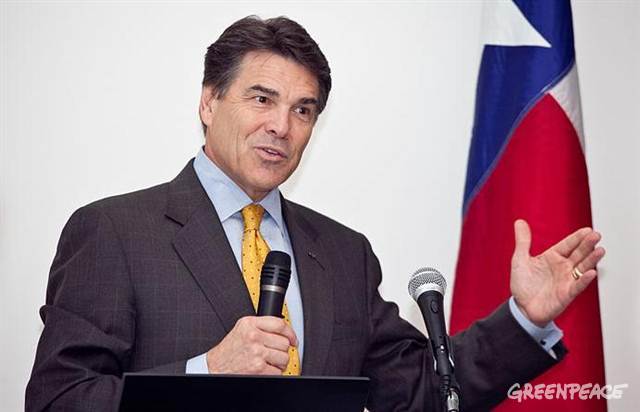
Earlier this month Rick Perry denied the reality of climate change at a presidential debate. This week Governor “Good-Hair” has continued his crusade of fact fabrication and blamed the loss of 500 Texas jobs on the EPA and its new regulations (called the Cross-State Air Pollution Rule or CSAPR). This accusation came just after TXU/Luminant, the largest power generating company in Texas, announced it would be shutting down two of its coal units. While Luminant is taking a step in the right direction, this unethical tactic of blaming impending EPA regulations for job losses has become old hat for politicians like Perry and large fossil-fuel corporations like Luminant.

Accusations like this are nothing new. The fossil-fuel industry shrilly shouted the same kind of job-killing rhetoric over forty years ago when the Clean Air Act was passed. Instead of killing jobs, however, the Clean Air Act created them. Many studies have shown that the economic benefits, including job creation, of making polluters clean up their act far outweigh any negative impacts (such as layoffs at plants).

Unfortunately, it looks like President Obama has been drinking the same Industry-financed kool-aid as his main opponent. The President has announced that these crucial smog-reducing rules will be pushed back to 2013 (at the earliest). President Obama should be ashamed of his decision to delay these rules. He has, in effect, sacrificed human lives and the lungs of children because big-energy lobbyists have whined about it. The excessive pollution from Luminant’s three dirtiest coal plants is estimated to cause one premature death every three days. Whether Obama or Perry (as the likely candidate) wins the next presidential election, it looks like neither will stand up to corporate polluters for the sake of American lives. Visit Greenpeace online to sign a petition asking Obama to reverse this decision.

The EPA’s purpose is not to coddle fossil-fuel industries, nor to ensure their profit margins stay at ideal levels – it exists to protect human and environmental health. If companies in Texas like Luminant cannot conduct their business responsibly and acknowledge the pollution and harm they cause, then they must be held accountable by the public and our leaders.

Texans are paying the price for the cowardice of our politicians and the irresponsibility of these large energy corporations. These Luminant plants are some of the dirtiest coal plants in the country. Why should we have to pay higher medical bills and environmental clean up costs so that companies like Luminant can maximize profits?

This report from TR Rose Associates shows in detail how Luminant’s shuttering of these coal plants is most likely due to poor financial management. Considering that these plants are practically worthless for Luminant it makes sense for them to shut them down. This retirement has everything to do with the energy market and Luminant’s mismanagement of their resources and very little to do with any new EPA regulations.

Luminant should follow the example of the TVA, who announced back in April the closure of 18 coal plants. TVA further committed to retraining their workers for jobs in energy efficiency and renewable energy – both fields which are likely to employ more people than traditional fossil-fuels. Luminant could easily end this boondoggle and shut down all three of their large, old, dirty plants: Monticello, Martin Lake, and Big Brown. Texas has some of the best solar, wind and geothermal potential in the country. There is no reason, or excuse, for TXU to lay off any workers from any of these old plants, when the company could easily retrain them and invest in geothermal plants throughout that region. If these workers are abandoned it will be Luminant’s fault, not EPA’s.

These regulations should be seen as an opportunity for Texas to embrace renewable energy generation and to transition our power generation (and the relative jobs) to new facilities and programs that use this century’s technology, not last century’s. Luminant and Governor Perry should stop scapegoating the EPA and take responsibility for the health of the public and the future of energy generation in Texas. We Texans should do all we can to encourage and promote that kind of action.

Read Full Post »

Gov. Rick Perry has replaced all six of the Texas commissioners who sit on the Texas Low-Level Radioactive Waste Disposal Compact Commission reappointing only two previously serving commissioner.  The TLLRWDCC commissioner terms were modified by Senate Bill 1605 as part of the 82nd Legislature giving Perry the ability to replace commissioners whose positions he didn’t like with new commissioners.

The appointees were:

  •  Eric J. Doyal of Houston, a senior associate at Capital Point Partners. He is appointed for a term to expire Sept. 1, 2013.
  • Andrews County Judge Richard H. Dolgener, Dolgener was first appointed in 2008 and is appointed for a term to expire Sept. 1, 2015.
  • Milton B. Lee II of San Antonio, a registered professional engineer and retired CEO of CPS Energy who left amid the shakeup following the municipally owned utility’s failure to disclose a dramatic price increase in the estimated cost of two new nuclear reactors to the City Council before a major bond vote.  He is appointed for a term to expire Sept. 1, 2013.
  • Linda Morris of Waco, a licensed medical health physicist and the Department Chair of the  Environmental Health & Safety Technology Department at Texas State Technical College. She is appointed for a term to expire Sept. 1, 2017.
  • John Matthew Salsman of College Station, a certified health physicist and the director of Environmental Health and Safety at Texas A&M University. He is appointed for a term to expire Sept. 1, 2017.
  • Robert Wilson of Lockhart, an attorney and partner at Jackson, Sjoberg, McCarthy and Wilson. He is re-appointed for a term to expire Sept. 1, 2017, and will serve as chair of the commission for a term to expire at the pleasure of the governor.

Read Full Post »

It is looking like the 2012 election will be dominated by the Super PAC.  If you thought your voice counted for little before, check out this MSNBC story on the new powerhouse super PAC called “Make Us Great Again” which, while claiming it is independent, just launched a website filled with photos of Rick Perry and campaign bullet points about the governor’s record creating jobs and lowering taxes in Texas.  No mention about slashing public education funding or what types of jobs were created in the state.


Read Full Post »

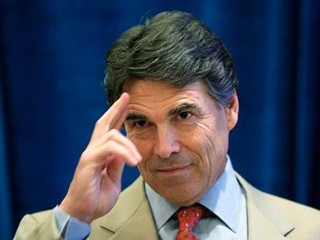
Review Highlights of a Decade of Texans for Public Justice’s Perry-related Research

NOW

THEN (as TAMU Yell Leader)

Texas Governor Rick Perry is unknown to much of America.  Texans for Public Justice (TPJ) has followed this politician since he became governor in late 2000, publishing numerous reports on Perry’s politics and policies.  With talk of a Perry presidential campaign escalating, “The Rick Perry Primer” summarizes the highlights of a decade of TPJ’s Perry-related research.

“The Rick Perry Primer” is available at TPJ.ORG.

Read Full Post »

The EPA under Perry . . . what would that look like?  I don’t know about you, but that thought sends cold shivers down my spine, even on a 104 degree day.

The Austin American Statesman takes a look at what the EPA might become with a Perry White House.  Public Citizen’s own “Smitty” weighs in:

Perry environmental stance would transform EPA

By Asher Price
AMERICAN-STATESMAN STAFF

As governor of Texas, Rick Perry has argued that the U.S. Environmental Protection Agency has strangled business and interfered with state environmental efforts, and he has championed a half-dozen lawsuits challenging federal air pollution and greenhouse gas regulations.

The dispute with the EPA serves as a proxy for larger Perry arguments about states’ rights versus federal power. It “illustrates how Washington’s command-and-control environmental bureaucracy is destroying federalism and individuals’ ability to make their own economic decisions,” Perry wrote in his book “Fed Up! “

So, should he run for the White House and win, how would a President Perry treat the EPA?

From his rhetoric and record as governor, one might think that he’d be tempted to dissolve the agency. He has actively loosened regulations in the name of economic development and denied that scientific consensus exists on climate change, ascribing anxieties about greenhouse gases to a “secular carbon cult.”

But on the campaign trail, he is likely to tell a story about environmental accomplishment. He will point to improvements in air quality in the state’s major cities, and he will note that the state leads the nation in wind power. And he will say that Texas has done it by working with industry, not being its adversary.

“If the EPA thinks a sweeping mandate is required to spur the creation and adoption of alternative energy sources, they need to know the private sector is already making that happen here in Texas, helped by incentives from this state,” he said in a news conference after Obama’s victory in 2008 .

The state’s wind industry won its greatest boost from a 1999 mandate by the Legislature that Texas utilities buy a certain amount of power from renewable sources as part of a grand bargain to deregulate the state’s electricity market. In other words, wind power got a foothold because of just the sort of big government edict that Perry abhors.

To his credit, he encouraged a $5 billion ongoing plan to build transmission lines from West Texas and Panhandle wind farms to the state’s population centers, said Tom “Smitty” Smith, the head of the Austin office of Public Citizen, a government watchdog group. The lines will be paid for by utilities, which will pass costs on to ratepayers.

Perry also could repeat a claim about improvements to the state’s air quality. Between 2000 and 2010 , he noted in a news release last year and in a letter to President Obama, “the Texas clean air program (has) achieved a 22 percent reduction in ozone and a 46 percent decrease in (nitrogen oxide) emissions.”

PolitiFact Texas rated that statement as Half True: UT chemical engineering professor David Allen told the Statesman that it’s difficult to say quantitatively whether federal or state regulations were primarily responsible for the emission reductions. A quarter of the state’s nitrogen oxide pollution comes from industrial sources, which are mainly what the state regulates, but much of the rest comes from cars and other mobile sources, which the federal government regulates.

The point of Perry’s statement, in any case, was to say to the federal government, “Hands off; we can handle environmental issues ourselves.”

“It isn’t necessary to bludgeon job creators with hefty fines and penalties in order to make progress,” he writes in “Fed Up!” “It is better to work with business and harness American innovation — the same innovation that drives our economic success — in the realm of pollution control.”

One example: In the mid-1990s, Texas opted to issue so-called flexible permits that set facilitywide emission limits. The permits, strongly defended by Perry, set overall emission caps for facilities, rather than particular limits on emissions from a single boiler.

The flexible permit program “is like saying, ‘As long as you go 55 miles per hour, on average, in a month, you can go 100 or 125 some days,’” Neil Carman, air quality specialist at the Lone Star chapter of the Sierra Club, once told the American-Statesman . “It allows excessive kinds of pollution if you play that game.”

Federal regulators say the permits leave them in the dark about how many gases particular parts of a plant are belching into the air, and they are demanding an overhaul to the permitting program. The upshot has been hot rhetoric over the past two years between Perry and EPA officials. (The EPA now appears to have the upper hand, as some refiners, utilities and manufacturers have been working with federal authorities to revamp their permits.)

According to several measures tracked by the Environmental Defense Fund, Texas is the nation’s leading polluter. Its national rank among emitters of sulfur dioxide, which contributes to acid rain and smog, actually rose during Perry’s tenure from fifth in 2000 to third in 2009.

But the state’s pollution might be as much a reflection of the richness of Texas’ industrial base as a comment on environmental compliance.

Perry “approaches the issues from a very libertarian bent,” said Jim DiPeso , policy director of Republicans for Environmental Protection. “The EPA would be in for some significant budget reduction. There would be no new intiatives, no regulatory programs that would be initated. There’d be litigation from environmental groups that believe he’s not enforcing the Clean Air Act and Water Act as robustly as the law provides.”

“Any regulatory programs would be really throttled back,” he said. “He has shown no interest in climate policy at all. He doesn’t accept the science.”

With the governor’s blessing, Texas Attorney General Greg Abbott is challenging at least six EPA greenhouse gas-related regulations. The state’s underlying argument: The fundamental finding that greenhouse gases are a public health threat is scientifically flawed.

The federal government is pushing “hastily enacted, cascading regulations” on states and businesses, Abbott argued in a June brief filed on behalf of nine states in federal court.

Perry’s approach to energy, DiPeso said, “would be to produce more,” rather than discourage the development of energy projects, such as coal plants, that emit greenhouse gases associated with global warming.

“In terms of energy, (Perry) would pursue what many Republicans call the ‘all of the above’ strategy, with more energy development offshore and onshore,” DiPeso said.

Individuals and committees associated with energy, the extraction of natural resources and waste disposal contributed just short of $14 million to Perry’s campaigns between Jan. 1, 2001, and Dec. 31, 2010, according to Texans for Public Justice, a nonprofit that tracks money in politics. Overall, donors gave more than $102 million to his campaign during that period.

His top individual donor during that time was homebuilder Bob Perry, who contributed $2.5 million and has supported property rights efforts unsympathetic to endangered species protections. Ranking behind him was investor Harold Simmons, who owns Waste Control Specialists. In 2008, over the objections of environmental groups and its own staffers, the state environmental commission approved a license for Waste Control Specialists to build a dump near the New Mexico border for disposal of radioactive waste related to Cold War-era uranium processing. Three agency staffers quit in protest.

Broadly speaking, the Texas Commission on Environmental Quality has shown itself to be sympathetic to business interests. In several prominent cases, its commissioners, appointed by Perry, have ignored the recommendation by the agency’s public interest counsel to deny major air and waste disposal permits.

In requests for permission to build a coal plant about 100 miles northeast of Austin, to reopen a copper smelter in El Paso and to dispose of various kinds of waste at the West Texas radioactive waste landfill, the commission sided with recommendations by its executive director over those of the public interest counsel. By some empirical measures, its enforcement arm is weak. A 2009 Notre Dame Law Review article comparing 15 states found that Texas spent less on environmental programs than all but one on a per capita basis. And in the recent round of budget cuts, the commission suffered disproportionately high cuts of 30.2 percent.

Perry himself earned the ire of environmental groups for trying to fast-track the permitting of as many as 17 new coal-fired power plants in 2006. Most were never built.

An EPA under a President Perry “would be more effective, accountable, pragmatic and realistic,” said Kathleen Hartnett White , a former environmental commission chairwoman and a Perry appointee to the board of the Lower Colorado River Authority. She also is a fellow at the Texas Public Policy Foundation, a small-government think tank.

Under Perry, the commission “operated under the rule of law and has not stretched it or contracted it,” she said.

“The current EPA really stretches the limits of law in which they operated,” she said. “They need to be more accountable to Congress and to the states. Needless to say, the governor would give more respect for state authority.”

Perry also would have “higher standards for science,” she said, echoing arguments that the attorney general has made in disputing the EPA’s finding that carbon dioxide emissions endanger public health.

Despite those claims, there is consensus among scientists that humans contribute to climate change. An international climate change panel of more than 2,000 scientists came to just that conclusion in 2007.

“Climate change is occurring, is very likely caused by human activities, and poses significant risks for a broad range of human and natural systems,” concluded a May report of the National Research Council, which is charged with advising Congress on health and science policy. “Each additional ton of greenhouse gases emitted commits us to further change and greater risks.”

The best guide to a Perry EPA might be an early Bush EPA, which was concerned with energy development.

Among other things, the Bush administration downplayed and edited work by EPA scientists warning about climate change and sought to loosen rules about putting power plants near national parks.

But upon Bush’s departure from office, Richard Greene , then the head of EPA’s regional office in Dallas, told the Statesman, “A claim can rightfully be made by the Bush EPA that air is cleaner, water is purer, and land is better protected than it has been in three generations.”

Environmentalists would beg to differ. But a Perry administration could be even worse for environmentalists’ interests, Smith said.

He said Perry criticizes EPA initiatives that had roots — if weak ones — in the Bush administration, such as more stringent smog standards, and tougher rules on power plant emissions.

A Perry EPA, Smith said, “would pander to the polluters.”

asherprice@statesman.com;445-3643

Read Full Post »

Texas Railroad Commissioner Barry Smitherman, appointed to his new post exactly one week ago, received the Conservative Republicans of Texas’ (CRT) first endorsement of the 2012 political season on Friday.

Formerly the chairman of the Texas Public Utility Commission (PUC), Smitherman was appointed last Friday to the Railroad Commission by Gov. Rick Perry to fill the vacancy left by Michael Williams, who is running for U.S. Congress.

Smitherman spent his last seven years at the PUC, is a former Harris County Assistant District Attorney and also worked in public finance for Bank One, JP Morgan and Lazard Freres.

The CRT praised Smitherman, among other things, as a “pro-life” candidate, even though the Railroad Commission regulates the Texas energy industry and has no public policy duties regarding reproductive health, including elective abortions.  They went on to tout him as a champion of the free market and a pro-family, pro-business conservative.

If this is indeed how it plays out, then it is business as usual at the Railroad Commission and fracking operations will flourish in Texas, regardless of the harm it does to adjacent communities.

Read Full Post »

An unnamed Republican campaign veteran told the Washington Post that Texas Governor Rick Perry has decided to run for President, though the official word from the Perry camp is still a definite maybe, stating that Mr. Perry has surveyed the field and decided to get in the race later this summer.  The thinking from republican sources  is that apparent front-runner Mitt Romney “does not reflect the Republican Party” and is therefore vulnerable to a credible challenge from the right, especially after Mr. Romney’s recent squishy remarks on global warming.  So the Texas governor is running as a climate change denier.

In a Stanford University report researches have found that “candidates running for office can gain votes by taking green positions and might lose votes by expressing skepticism about climate change.” A study entitled “The Impact of Candidates’ Statements about Climate Change on Electoral Success in 2010: Experimental Evidences,” reveals that taking a “green” position on global warming attracts votes from Democrats and Independents, while expressing skepticism about the warmist theory alienates those same voters. On the Republican side there was no significant impact either way, so it looks like Perry intends to look to his base.

Read Full Post »

photo by: Bob Daemmrich

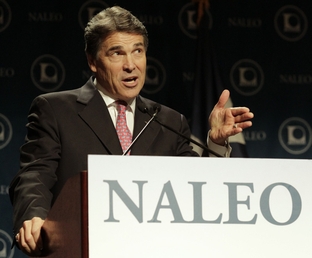
In an interesting twist to what had been a post-session, pre-presidential run period of  crowds chanting “Run, Rick, Run!” everywhere he has shown up, probably reminiscent of the Governor’s A&M yell leader years, Rick Perry was subtly called to task for anti-immigrant efforts during both the regular and special session of the 82nd legislature, then shunned by San Antonio Mayor Julian Castro, and left standing as dead air fell upon the room before someone stepped in to introduce the Governor as he addressed the National Association of Latino Elected and Appointed Officials (NALEO).  Not a good sign from the hispanic community for someone who is considering a run for the presidency.  The San Antonio Current posted this update in thier QueQue blog.

Castro punks Perry

Fresh from his renewed push to dismantle so-called sanctuary cities at the Texas Lege, Governor Rick Perry addressed the National Association of Latino Elected and Appointed Officials to a subdued hostility last week. Harassed and derided by protesters on the street, Perry also took heat from none other than Mayor Julián Castro inside before reaching the podium. Referencing Perry’s effort to, not once but twice, push controversial immigration measures through the Lege, Castro said, “We’ve seen in the State of Texas the call for Arizona-type legislation. We have seen, in this legislative session, easily the most anti-Latino agenda in more than a generation, pursued without shame.” Castro left the stage without even introducing the governor. After an awkward five-minute pause, Republican convert and South Texas state Rep. Aaron Peña took to the mic, introducing Perry by praising him as a tax-cutting, experienced leader.

Protesters outside Perry’s speech scoffed at his presence at the NALEO luncheon, saying it was nothing more than a move to gauge support among Latinos while pondering a White House bid. “It’s insulting for us,” said Diana Lopez, an organizer with Southwest Workers Union. “He wants to run for president, that’s why he’s here. He wants to be seen with these people.” If Perry hopes to sway Hispanics, his San Antonio reception suggests he’s got a lot of work ahead of him. New projections from NALEO released last week estimate at least 12.2 million Latinos will turn out in the next presidential election, an increase of 26 percent from 2008. And Latinos in Texas, NALEO says, are likely to account for over 20 percent of the Latino vote.

If this is the response he got from hispanic leaders here in Texas, will the rest of the Latino’s in the U.S. soon be chanting “Run, Rick, Run – back home to Texas” if he pursues his candidacy for president?

Click here to read about an environmental justice issue for Latinos.

Read Full Post »

But here in TexasLast week, Public Citizen, the Sustainable Energy and Economic Development (SEED) Coalition, Texas League of Conservation Voters, Environmental Defense Fund and the Natural Resources Defense Council wrote to Governor Rick Perry urging him to veto House Bill 2510, “An Act relating to exempting the intrastate manufacture of certain incandescent light bulbs from federal regulation.”  

House Bill 2510 asserts that light bulbs manufactured in Texas and offered for sale and use within Texas are exempt from federal legislation requiring improved light bulb efficiency.  The environmental groups urged the Governor to veto this Bill for several reasons.

  1. This Bill is futile because it sets out conditions that almost certainly cannot be met.  Under the Bill, all of the specialized components used to make incandescent light bulbs must be made in Texas. But there is no evidence that light bulbs could be cost-effectively made from materials located in Texas.  Indeed, tungsten, a critical component of incandescent bulbs is not mined in Texas.  Earlier this year, Governor Brewer of Arizona vetoed a similar light bulb bill passed by the Arizona legislature because she recognized that the conditions of the bill could not be met.
  2. Even if the Bill were not futile as a practical matter, it will not achieve the outcome claimed since the Bill is expressly preempted by federal law and contrary to the numerous decisions of the Supreme Court. 
  3. This Bill sends the wrong signal about the direction that Texas’s economy is heading.  This Bill tells the world that Texas is moving backward, embracing the out-dated technologies of the Nineteenth Century. 

In fact, the opposite is true.  Texas has several companies researching, designing and manufacturing the most advanced LED lighting.  Just this past February the governor sought to move Texas forward by awarding an Emerging Technology Fund grant to an advanced LED lighting company.   This is the right direction for Texas.  But if the Governor doesn’t veto House Bill 2510 and it goes into effect, we will signal that Texas is embracing the past rather than the future.

Read Full Post »

Texas State Senator Mike Jackson added an amendment to the ethics bill (HB 1616) only 48 hours before the regular session ended and seems to be regretting that decision.  Now he wants Gov. Rick Perry to veto his own legislation. 

The amendment was written so that candidates would have been able to expunge from their record any complaint if the candidate could prove it was a mistake in good faith.  According to the bill, candidates would have 14 business days after a complaint was filed to “fix” their reports without penalty so long as there was no “intent to mislead or to misrepresent the information contained in the report.”

However, there was no limitation on how large of a donation could be dismissed and the bill would have the unintended consequence of allowing a candidate to hide a pattern of misreporting potentially embarrassing donations by claiming they were an accounting or typographical error or misunderstanding of reporting requirements.  The bill would also remove the incentives to accurately report campaign contributions and expenditures as well as reduce the Texas Ethics Commission’s revenue from fines.

If Jackson does not get a veto from Perry, he has placed an amendment on to the special session’s Fiscal Matters Senate bill (SB 1) to repeal his earlier amendment.  Although SB 1 is controversial in many respects, the new amendment is a bright spot for proponents of campaign finance reform. The amendment would have been destructive to the campaign process and allowed candidates a loophole in which to exploit. Campaign finance laws need to be reformed but not in this way. Sen. Jackson did well to fix his mistake with his amendment in the special session and should be recognized for owning up to it.

Read Full Post »

In spite of, Governor Rick Perry’s designation of this past Easter weekend as official days of prayer for rain, Texas is expected to break its yearly record for the number of acres burned by wildfires, with officials warning that today through Wednesday would see a high risk of fresh blazes.

2006 set the previous record of acres burned in one entire year at 1.94 million. So far this year, the figure is 1.84 million, and we’re just in April.  We’ve still got summer and a lot of the fire season left.

Meanwhile, a state report has found that many of the Texas counties that endured the worst damage from this month’s wildfires received only a small portion of the more than $128 million the state awarded to volunteer fire departments over about a decade for training and equipment.

According to the State Firemen’s & Fire Marshals’ Association, there are 1,042 volunteer departments in Texas with about 28,000 firefighters and these make up the first line of defense for many of the counties that have been battling wildfires recently.

The sunset commission’s analysis, which was released in January and is currently being considered by the Texas Legislature, found counties with a low risk for wildfires had received a greater share of the $128 million handed out through the Texas Rural Volunteer Fire Department Assistance Program than many of those with the highest risk.  Specifically, 59 of the 74 counties determined to have a high risk for wildfires got less than $1 million in grant money for their volunteer fire departments from 2001 through 2009.

Three of the high-risk counties that received less than $1 million — Tom Green, Andrews and Palo Pinto — have been significantly affected by the current fires.

Andrews County is home to WCS’s hazardous waste dump, that could soon be open to “low-level” radioactive waste coming into the state from all over the country.  In addition to radioactive waste disposed of at the site, thousands of truckloads of radioactive waste could be traversing the Texas countryside over roads in counties prone to wildfire.  If an accident happens while our first responders are working to the point of exhaustion at local wildfires, I shudder to think about the consequences to the folks near an accident and the liability to the state.  I think the Governor needs to expand the parameters of his call to prayer.

Read Full Post »

The Dallas Morning News took a look at Governor Rick Perry‘s State of the State address and folks around the state had some interesting thoughts on the veracity of his statements.  Click here to read the story.

For those who didn’t watch Governor Rick Perry‘s State of the State address, we have provided the text of his prepared remarks. (NOTE: Gov. Perry frequently deviates from prepared text.)   Or you can watch it below.

If you did watch or after you read the speech, we’d really like to get your thoughts on, what some have termed, a view of Texas that is part of an alternate reality.

  Governor Rick Perry – State of the State 2011 (more…)

Read Full Post »

Older Posts »

Follow

Get every new post delivered to your Inbox.

Join 3,196 other followers