Feeds:
Posts
Comments

Posts Tagged ‘San Antonio’

San Antonio Kick-Off is scheduled for Wednesday, March 13, 2013 at the Whole Foods Market Meeting Room, 255 E. Basse Rd. #130, San Antonio, TX, 78209

RSVP here!

This past year, Texas experienced one of its worst droughts: Reservoirs dipped to record lows, and as many as 500 million trees across Texas died.  In San Antonio, it seems everyone knows the level of the Edwards Aquifer, and recent storms have not brought adequate relief or repaired this damage.

The good news is that we can save millions of gallons through common-sense, cheap solutions like fixing leaky pipes and recycling water that we have already collected. But we need YOUR help. The best way to learn more and get involved is to join San Antonio’s Save Texas Rivers Kick-Off Wednesday, March 13 at 6:30PM.

Environment Texas will discuss Texas water policy, the importance of conservation, and ways to ensure a sustainable water future. RSVP here and bring a friend!

Read Full Post »

A survey done by Solar Austin at the beginning of 2012 shows there are at least 615 full-time solar energy jobs in Austin.  These jobs include manufacturing, R&D, solar installation, financial and engineering consultants.  Adding standard jobs multipliers the total direct and indirect employment supported by the Austin solar industry is 1,180 to 2,190 jobs.

The job figures in Solar Austin’s survey did not include the 240 local job years of employment created by the 30-Megawatt solar park at Webberville east of Austin.  The group says the job potential for rooftop solar is even greater.

In 2004, Austin Energy began a rebate program to promote rooftop solar panel installations.  It was the first program of its kind in Texas. Austin has since founded and funded institutions that develop new clean energy technology and businesses resulting in clean-tech start-ups, spin-offs, and expansions with many of the jobs at family-wage scale – solar electric system installers making $36,000 a year, solar manufacturing jobs averaging $50,000 a year, and solar engineering paying $75,000 and more annually.

In spite of the potential for job growth, the group pointed to Austin’s south where San Antonio’s public utility CPS, has begun funding solar rebate programs that have overtaken Austin’s and challenged the city to continue to capitalize on their previous commitment, taking it to the next level to make Austin a renewable energy industry cluster in the same way it has electronic manufacturing and software clusters.

We want thousands of jobs in renewable energy, not hundreds!,” says Public Citizen’s Texas director, Tom “Smitty” Smith.

Take a look at the 4 page flyer on the survey put out by Solar Austin - Jobs Survey 4-Pager.

Read Full Post »

San Antonio’s dreams of becoming a solar manufacturing hub have been deferred temporarily.  CPS Energy, the city’s municipally owned utility, couldn’t come to agreement with two unnamed finalists and will restart a bidding process that would put San Antonio into the top tier of solar users around the globe by seeking bids for 400 megawatts of solar power, enough to power 80,000 homes, and will require the winning bidder to bring manufacturing jobs to the Alamo City.

San Antonio is trying to marry investment in renewables with economic development in an effort to keep the cost of electricity as low as possible while getting as many jobs as possible, but the city has had a learning curve in this process, yet they remain confident that this vision can come to fruition.

Thirty two companies initially submitted 111 proposals several months ago. The utility then re-opened the bidding process and expected to make a decision by Sept. 1. Even as CPS Energy zeroed in on two finalists, Lewis said, other companies around the globe approached the utility with their own ideas and CPS Energy officials decided to end negotiations and open a third round of bidding after rewriting the specifications of what it wants.

So the problem lies not with no takers, but with many and new ideas coming forward to possibly make this move by San Antonio more profitable.  What this Central Texas metroplex does with this process could set the trend for the country and remains an experiment to watch.

Read Full Post »

The Electric Reliability Council of Texas (ERCOT), the operators of the Texas electric grid, has released its Emerging technologies report that includes the state of renewables on the Texas grid.

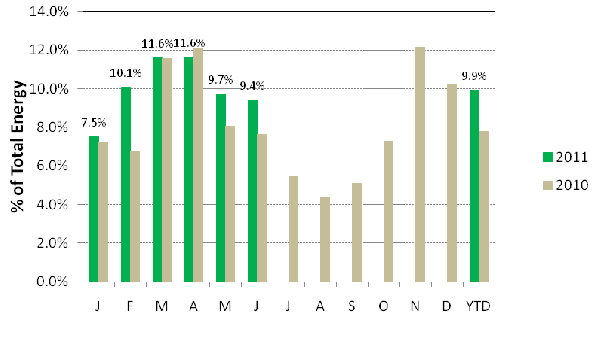
Monthly wind energy graph

Some interesting facts show that wind generation continues to provide a significant amount of energy to the grid as the technology matures, new turbines are developed and better tools are put in place to maximize the turbines generation. The effects of the CREZ (certified renewable energy zone) transmission line build out are starting to be seen as congestion from wind rich west Texas is reduced and more energy is being able to be delivered to the major urban ares. The report shows that wind generation provided 9.9% of the total energy used from January thru June of this year.

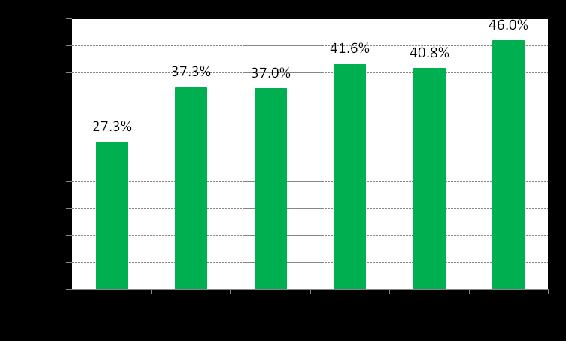
Other good news is that the capacity factor (100% capacity factor would be a perfect generator running flat out all of the time all 8760 hours of the year) for the wind fleet has now reached 38.3%  and continues to increase, that’s better than a lot of natural gas plants.

In addition on June 19, 2011, at 10:26 PM, ERCOT set a record for instantaneous wind generation of 7,355 MW (which represented 77.6% of installed wind generation capacity and 14.6% of the ERCOT load at the time).  This broke the previous instantaneous wind generation record of 7,227 MW set on December 10, 2010. So much for wind not working in the summertime.

The amount of wind produced energy continues to increase and the new coastal wind farms have been a major contributor.  According to the CEO of ERCOT wind has saved us a couple of times this year. Back during the February 3rd rolling blackouts the wind farms played a large roll in keeping the grid running when the aging fleet of fossil fuel generators, along with some brand new ones, failed in the cold.  Then during the current heat wave, the coastal wind farms supplied around 2000 mw of much needed energy during one of the highest energy demand days, keeping the lights on. Perhaps the PUC should start paying more attention and let us add some solar to the mix instead of letting the 500mw non-wind project expire as they did.

ERCOT Wind Generation Capacity

Recently San Antonio put out a request for a large solar project and was bombarded with proposals.  ERCOT then announced they are planning to un-mothball several old gas plants just in case we run short on energy again.  It’s the same thing we saw during the legislative session – the fossil fuel companies got to keep billions in tax breaks but solar didn’t get a dime.   Now the PUC is having a meeting (August 22nd) on how they can “fix” the market to get more generation built when they already have the tools and the opportunity staring them in the face.

During a recent ERCOT meeting held at the peak of the energy demand, I over heard folks saying how “it sure would be nice to have some more solar on the system.” Perhaps the politicians should get out of the way and let the engineers do their job.   The public power utilities (municipally owned and rural electric cooperatives) are leading the way.  San Antonio is looking to build 400mw utility scale solar, Austins 30mw Webberville project moving along and several other Munis and Co-ops looking to build solar projects.  But where is the much vaunted deregulated energy market when we need them?  Relying on 30-50years old smelly, toxin spewing existing fleets – or business as usual.

As Texas bakes in the the record summer heat wave and our scarce water resources are being sucked up by traditional power plants ( a typical coal plant can use 10 million gallons of water a day) low impact non polluting energy sources are being allowed to languish on the sidelines. Its time to get with it, and bring some new industries, more jobs and clean renewable energy to the Texas grid to keep the lights on and meet the EPA regulations for clean air and water for us and our children to enjoy. Companies want to build 3000 MW of offshore wind beyond the barrier islands south of Corpus Christi, and there is a 10,000 mw farm that is in the plans to be built up in the Panhandle.

To paraphrase, the answer my friends truly seems to be blowing in the wind, just as the sun comes up every morning.

Read Full Post »

CPS Energy, San Antonio’s municipal utility, has announced plans to shut its two-unit, 871-megawatt JT Deely coal station down by 2018. The utility estimates this move could save as much as $3 billion in environmental upgrades needed for these aging coal-fired units to comply with pending federal regulations.

CPS Energy is the nation’s largest city-owned utility and supplies both natural gas and electricity to the nearly 1.4 million residents of 9th largest city in the US.  San Antonio is on a path to reduce its reliance on fossil-fueled generation and boost its use of renewable resources, such as wind and solar power, to 20 percent, or 1,500 megawatts, by 2020.

Stricter regulations being formulated by the U.S. Environmental Protection Agency to reduce air and water pollution as well as to control coal waste are expected to force retirement of between 30,000 and 70,000 megawatts of coal generation in the next few years, according to industry studies and San Antonio’s efforts to get ahead of these regulations is pushing them to the forefront of a new energy future here in Texas.

Read Full Post »

San Antonio’s electric utility, CPS, has halted their negotiations on a power purchase agreement between CPS and STP’s expansion units 3 and 4.  CPS’s CEO, Doyle Beneby, announced that CPS and NRG have mutually agreed to terminate their PPA negotiations at this point. 

It would appear that the issues facing NRG’s Japanese partners (including Tepco, the beleaguered owners of the doomed Fukushima nuclear plant) are giving everyone pause in their relentless pursuit of the STP expansion.

Read Full Post »

Map of Texas highlighting counties served by t...

Texas counties served by AACOG

San Antonio, which sits just north of what many say is one of the largest oil and gas reserves in the country known as the Eagle Ford, is a heart beat away from violating federal air quality standards for ground-level ozone. It seems it is only a matter of time before the increased emissions from the Eagle Ford could drift up on prevailing winds, pushing the area out of compliance.

With drilling expected to increase over the next decade, those responsible for this region’s air quality say the increased pollution could make it difficult to remain under federal limits.  In the past decade, San Antonio’s ozone levels have decreased by 13 percent while its population has increased 13 percent, managing to stay just ahead of federal standards.  However, once a region falls out of compliance, efforts to get back in are time-consuming, politically unpopular and expensive.

It is going to be a tough contest for the environment to compete with the hype about the economic benefits (which always fail to take into account the economic costs to the region for these types of activities – increased health care costs, decreased quality of life costs, and the cost of coming back into compliance with federal air quality standards).

According to a study by the Center for Business Research at the University of Texas at San Antonio and commissioned by America’s Natural Gas Association:

Activity in the Eagle Ford in 2010 alone generated more than $2.9 billion in total revenue, supported roughly 12,600 full-time jobs and provided nearly $47.6 million in local government revenue.

Last year there were 72 active oil leases, some of which may have more than one well, and 158 producing gas wells.

However, the number of drilling permits issued by the Texas Railroad Commission, which regulates the state’s oil and gas industry, has reached 1,132 as of February. In just one year, the output of crude oil, condensate and other liquids nearly quadrupled to 3.9 million barrels.

And the boom has just begun; the UTSA study forecasts that 5,000 more wells could be drilled by 2020.

So far, no regulatory agency has begun comprehensive air monitoring in the Eagle Ford area, meaning there’s no baseline to measure any increased pollution.

Models for other regions of the country show drilling and related emissions can increase ground-level ozone significantly and the sheer volume of drilling that’s expected over the next decade, will require Alamo Area Council of Governments (AACOG) to add a new category, for drilling and recovery, into its air pollution forecasting models.

The San Antonio Express News writes about the area:

The Eagle Ford shale covers a swath roughly 50 miles wide and 400 miles long, from Maverick and Webb counties sweeping north and east up to Leon and Houston counties, but not including Bexar County. Unlike other large shale formations that have recently been tapped, the Eagle Ford includes a good deal of oil, mostly along the northern reach.

Because oil prices are high and natural gas prices low at the moment, there’s more activity in the oil region at this time, industry analysts say.

Drilling has occurred in South Texas for decades, but the oil and gas trapped in the deeper, dense rock layers once were too expensive to reach. Advances in drilling technology, most notably hydraulic fracturing and horizontal drilling, have allowed an unprecedented amount of hydrocarbons to be extracted.

“Fracking,” as it’s known, forces millions of gallons of water, mixed with sand and a variety of chemicals, into shale formations, forcing open fissures to allow the natural gas and oil to escape. Horizontal drilling allows for one hole to be drilled vertically, then one or more pipes to branch out into the shale.

Together, these techniques have spawned a natural gas boom in the country, with some industry experts estimating a 100-year supply of a fuel that burns more cleanly than coal and could help push the country toward energy independence.

In other parts of the country the boom is well under way, and as drilling has increased, so have complaints about its environmental impacts, most notably drinking water contamination.  While it remains unclear whether fracturing has contaminated drinking water, the EPA last month agreed to study the entire life cycle of the gas production process, to determine how it can affect drinking water supplies.

While water has gotten the lion’s share of the attention thus far, air quality concerns also are increasing and seem to be the area of most concern to San Antonio as they look toward increased drilling activities in the region.  Let’s hope they can stay ahead of this new boom.

Read Full Post »

So now San Antonio is sitting back watching with a knowing eye as NRG/Toshiba (formally know together as NINA) approaches the City of Austin with the hope that Austin hasn’t been paying attention to what they put San Antonio through just a year ago.

Greg Harman of the San Antonio Current provides an update to his readers:

Though the nuclear discussion in city circles has cooled dramatically since CPS Energy extracted itself from a 50-percent share in the proposed doubling of the South Texas Project nuclear complex down to a mere 7 percent, the project’s key boosters have continued scrambling to make the project as attractive as possible to the U.S. Department of Energy and — more recently — the Japan Bank for International Cooperation. To pretty-up the massively expensive project (in the course of the local debate, it shot from around $8 billion to $18 billion), NRG and Toshiba have rounded back on Austin, hoping to win a change of heart from a newer mayor and council. Years back, the city, a 16-percent partner in STP’s Units 1 and 2, voted not to partner on the expansion, citing concerns for both likely cost overruns (how prescient) and the troubling question of how to dispose of the high-level radioactive waste that is left behind.

Click here to read the whole blog post.

Read Full Post »

Future's so brightCPS Energy CEO Doyle Beneby announced that the utility will acquire an additional 50 megawatts of solar power and that the company chosen to build the new plants for it will be required to locate a portion of its business in San Antonio.  Currently the negotiations include a leading solar manufacturer to locate a small office in the area and invest in an educational center at one of the solar sites with a larger goal of having a solar company locate a manufacturing plant or perhaps an assembly plant in San Antonio.

San Antonio is trying to do locally, what the State should be doing – luring new renewable industries and jobs to Texas.  As CPS and San Antonio take the lead in fulfilling their potential as a clean energy hub, let’s hope the State takes notice and begins to follow suite.

Read Full Post »

A couple of weeks ago an outage at South Texas (Nuclear) Project (STP) occurred when unit 2 automatically shutdown due to an ”equipment failure”.  This outage triggered a reliability deployment of LaaRs (Load Acting as a Resource) event at ERCOT.  This shifting of load to cover an unexpected event can be quite expensive and the retail electric providers who purchase their electricity from STP will bear the brunt of that cost.

South Texas Nuclear Plant entrance from NRC.gov

One of these two reactors isn't working. And they call renewable energy unreliable!

South Texas Project has since announced it will extend its Unit 2 outage to repair a seal-housing gasket on a reactor coolant pump, which moves water through the steam generator.   The company has decided that, while the gasket’s condition is within operating criteria, STP will make the needed repairs, while they also continue to run unit 1.

A repair schedule is being finalized and restoration of the unit is projected to be completed sometime in November, but we here wonder if it won’t be even into December before it is repaired.

In the meantime, Austin Energy, which gets 27% of its energy from STP, and San Antonio’s CPS, which gets 38% of its energy from STP will be purchasing energy from other sources to make up for the loss from the STP outage.  Let’s hope we don’t have a major cold front come in before STP unit 2 is back online, or these energy companies could be looking at a lowered earnings projection for their final quarter.

This continues a banner few weeks for the nuke industry, who had to shut down Vermont Yankee because of a radioactive water leak and an unexplained transformer explosion at Indian Point 2, a reactor just 24 miles north of New York City, a known secondary target of terrorists on 9/11.

###

By promoting cleaner energy, cleaner government, and cleaner air for all Texans, we hope to provide for a healthy place to live and prosper. We are Public Citizen Texas.

Read Full Post »

CPS Energy in San Antonio continues to move forward with its renewable plans under Mayor Julian Castro. A major new solar announcement, just as its 14 MW solar system is getting finished, is good news indeed. San Antonio has been a leader in wind energy and now leads the state in solar, where is the leadership in the other cities and the state? They should take a long hard look in the mirror, and then go visit the new green leader, way to go San Antonio.

From the CPS web site.

CPS Energy Rising to Be National Leader in Green Power

10/07/2010

CPS Energy’s renewable energy portfolio will increase by 30 megawatts (MW) with this week’s signing of a new 25-year purchase power agreement (PPA) with SunEdison, a global leader in delivering solar electricity. With the SunEdison agreement, CPS Energy now has 44 MW of solar generation under contract, solidifying its position as the leader in renewable energy resources among municipally owned utilities in the nation.  The contract moves CPS Energy closer to its vision of providing customers with 1,500 MW of renewable energy (wind and solar) by 2020.

“The market for solar energy continues to improve, and this agreement takes advantage of that,” said President and CEO Doyle Beneby. “In addition to more than 40 MW of solar generation, CPS Energy has rebates that incentivize the use of solar by homeowners and businesses, and a developing distributed-generation program. With 300 days of sunshine each year, it just makes sense that San Antonio becomes a hub for solar energy in the U.S.”

By fall of 2012, Maryland-based SunEdison is expected to complete installation of 120,000 single-axis tracking photovoltaic (PV) panels that will follow the sun throughout the day, generating a total of 30 MW at three locations across the CPS Energy service area. The three locations will be announced later this year, and construction is expected to begin in early 2012. The combined energy output of the three facilities is expected to be approximately 54,000 megawatt hours—enough to power about 3,700 homes.

“We are pleased to provide this long-term, renewable energy solution for our customers,” added CPS Energy Chief Sustainability Officer Cris Eugster.  “In addition to helping us meet our goal to provide 100 MW of solar generation by 2020, we’re also looking to SunEdison to be a key partner in transforming San Antonio into a national hub for solar energy.”

“SunEdison is committed to the growing Texas solar energy market, and we look forward to expanding our utility scale presence in the state in 2011,” said Carlos Domenech, President of SunEdison.  “Our development capabilities, financing power and execution track record enables municipal utilities, like CPS Energy, to benefit from economically viable solar solutions.”

###

By promoting cleaner energy, cleaner government, cleaner cars, and cleaner air for all Texans, we hope to provide for a healthy place to live and prosper. We are Public Citizen Texas.

Read Full Post »

This is Andy checking in from Vegas and Netroots Nation: sheesh, we leave Texas for a few days and the wheels start to come off the bus, don’t they?  Of course, our fearless and tireless leader, Tom “Smitty” Smith is there to handle everything, as he has done for the last 2 and a half decades.

This ran in today’s Texas Energy Report, but want to give all of our Public Citizen Texas members and followers a taste if you’re not a subscriber to the Energy Report.

Tom Smitty Smith, Director of Public Citizen TexasSMITTY: TWO CITIES TOOK OPPOSITE PATHS IN SELECTING UTILITY GM

An Op-Ed by Public Citizen’s Tom “Smitty” Smith.

The recently announced new general managers for Austin and San Antonio couldn’t be more different, and may have huge economic repercussions for both cities.

Austin has chosen Larry Weis, a “green” general manager from Turlock, California, Irrigation District. San Antonio’s CPS Energy has chosen Doyle N. Beneby Jr., from Exelon Corp. While Mr. Weis opposes nuclear power due to its costs, Mr. Beneby comes from a utility that has the largest nuclear assets in the country.

The process that each city underwent in selecting their new managers stands in stark contrast with one another. Austin announced its finalists over a month ago and invited the public to question the candidates.

CPS kept its candidates secret. In light of this lack of information, I am left to wonder what San Antonio’s fate will be given the recent track record of Exelon. Could Mr. Beneby signal the re-nuclearization of San Antonio or does he represent a future of renewable energy and green power?

Although San Antonio is still reeling from the trebling of cost of expanding the South Texas Nuclear Project, the CPS board has chosen someone from Exelon, which has tried and failed to buy NRG Energy, CPS’s partner in the nuclear expansion project, while simultaneously trying to develop another nuclear plant near Victoria.

While Exelon does have a mix of fossil fuel, hydroelectric, solar, landfill gas and wind generation sources, it only amounts to a meager 7 percent of its generation assets. The other 93 percent is nuclear.

Since the public was not privy to the public utility’s selection process, we are left to speculate what Beneby ‘s plans are. (more…)

Read Full Post »

PUBLIC CITIZEN’s TEXAS OFFICE is a

Public Citizen is an Earthshare of Texas MemberApril is Earthday, give at HEB to Earthshare

Celebrating Earthday in April, look for this tearpad at HEBs and give to Public Citizen’s Texas office through Earthshare

Public Citizen’s Texas office is pleased to announce that H-E-B has selected EarthShare of Texas to be the beneficiary of its in-store coupon promotion for April, in recognition of Earth Day. This means that customers can tear off and add check-out coupons worth $1, $3, or $5 to their total bill.

In November, H-E-B’s San Antonio region stores will feature EarthShare of Texas — giving H-E-B’s San Antonio customers the opportunity to support environmental work in the San Antonio area.

Look for the EarthShare of Texas display and tear-off coupons at the check-out stands in your local H-E-B and Central Market stores beginning in late March through April.  Help support Public Citizen, EarthShare of Texas and the Texas environment!

###

By promoting cleaner energy, cleaner government, and cleaner air for all Texans, we hope to provide for a healthy place to live and prosper. We are Public Citizen Texas.

Read Full Post »

The National Wildlife Federation and the Lone Star Chapter of the Sierra Club have created a splash with their latest report: Drop by Drop: 7 Ways Texas Cities Can Conserve Water.

Austin should be proud. Out of 19 cities studied in this report, our capital city was highly ranked on outdoor water ordinances and has an aggressive toilet replacement program. San Antonio has also set the bar high for effective and diverse water efficiency programs across the country. The cities surveyed were measured on: water pricing structure, water saving goals, toilet replacement, conservation funding, and outdoor watering. Though many cities and towns across the nation have made great strides to reduce water use, the report’s conclusion is that most cities are not doing as much as they could to efficiently use existing water supplies. (more…)

Read Full Post »

Statement of Tom “Smitty” Smith, Director, Public Citizen’s Texas Office

Today’s announcement that as a part of a settlement with NRG Energy, CPS Energy will withdraw its application for a federal loan guarantee for the South Texas (Nuclear) Project (STP) expansion and end further investment in the project demonstrates nuclear plants are too costly and too risky to build.

CPS Energy and the San Antonio City Council have signaled their desire to stop throwing good money after bad at STP, a message we hope will tell the U.S. Department of Energy that this plant is a poor candidate for federal loan guarantees. This debacle should show the federal government that nuclear loan guarantees are a fundamentally flawed and wasteful use of taxpayer money.

At $18.2 billion, the cost of STP has already tripled in just a year. When STP 1 and 2 were built, they ended up being six times over-budget and eight years behind schedule, and STP 3 and 4 look like they are on track to beat out that poor performance record.

Today’s announcement is a victory for the many citizens of San Antonio that have worked so hard in the last year to bring openness and accountability to the city’s participation in this project. We applaud CPS for wisely seeing the futility of wasting more time and energy on this flawed nuclear endeavor. We hope that they will be satisfied with the deal they’ve gotten and avoid the temptation to increase their ownership in the project. CPS has finally reached a settlement that shields San Antonio ratepayers from the financial risks of yet another nuclear deal gone wrong. Any future investment would throw that protection to the wind.

On Thursday, the City Council will vote on a proposed rate increase for CPS. The City Council should put a firewall in that proposal to ensure that no unauthorized money will be siphoned off to buy a bigger stake in STP.  San Antonio can’t afford to let this rate increase become a back door to continued nuclear investment.

We also have to wonder how NRG will move forward, without another clearly delineated partner in the project. Less than a month ago, NRG announced that if CPS “does not meet future obligations representative of its ownership interest in the site”, they “will wind down the project as quickly and as economically as possible.” We certainly hope that NRG CEO David Crane will remain true to that expressed intent to protect his shareholders from the next financial failure in a long historic line of overly expensive, poorly executed nuclear projects.

###

By promoting cleaner energy, cleaner government, and cleaner air for all Texans, we hope to provide for a healthy place to live and prosper. We are Public Citizen Texas.

Read Full Post »

Older Posts »

Follow

Get every new post delivered to your Inbox.

Join 3,192 other followers