Feeds:
Posts
Comments

Posts Tagged ‘TCEQ’

Just before Earth Day, the House of Representatives once again demonstrated its commitment to protecting the fossil fuel industries that fund many of the members campaigns instead of protecting the people of our state from the devastating impacts of climate change by passing HB 788. The bill requires the Texas Commission on Environmental Quality (TCEQ) to permit greenhouse gas emissions, which cause climate change, but would remove the agency’s authority to limit such emissions.

You might wonder “what’s the point?”  The point is to take control of greenhouse gas permitting for Texas facilities from the Environmental Protection Agency (EPA) and place it in the hands of our state environmental agency – which has a much cozier relationship with industry.  While EPA may ultimately prefer that states take responsibility for such permitting, we hope they wouldn’t support such a ineffective system as is proposed in HB 788.

Adding insult to injury, the author of the bill, Representative Wayne Smith, took advantage of the opportunity to spread misinformation.  Smith stated, “…the terms ‘climate change’ and ‘global warming’ are based on an unfounded science,” claiming this language was struck to remove the politics from the bill.  His remarks epitomizes a legislature that continues to threaten the health and safety of the people it should protect through weakened environmental regulations.

In fact, removing language which has been in Texas’ Health and Safety Code for 22 years which gives TCEQ the authority to limit greenhouse gases put the politics in the bill and took the science out of it.  Governor Rick Perry is an avid climate change denier and may have influenced the drafting of HB 788.

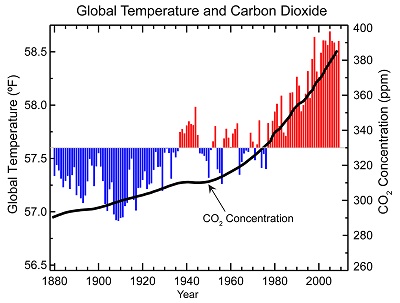
This type of misinformation does a disservice to Texas citizens who must endure the harmful impacts of climate change, such as drought, wildfires, sea-level rise and more volatile weather patterns. These changes have already cost our state billions of dollars and numerous lives.  Climate change is happening now and given the big jump in carbon dioxide (CO2) emissions last year, we’re probably in for more harmful impacts than many predicted just a few years ago.

Image

This graph compares increasing CO2 levels (dark line) to increasing average global temperature over the last century (blue and red bars).

Although our efforts to stop or amend HB 788 in the Texas House were unsuccessful and it was disheartening to hear Representative Smith’s comments, Earth Day brought a refocusing on facts.

The Committee on International Trade and Intergovernmental Affairs held a hearing on Global Climate Change and Trade.  Attendance was sparse in the audience, but a stellar line-up of scientists, delegates, and business representatives took the witness stand to testify on the fact of climate change.

HB788 was mentioned in anonymous fashion as a bad greenhouse gas bill on several occasions.  But, the most glaring comments were directed at Texas’ lack of policy to address climate change.  Cynthia Connor, the Resource Security Policy Adviser for the British Consulate General in Houston spoke in serious tones.  Her message was that Texas has a responsibility to adopt climate change policies to protect $20 billion in Texas investments by UK-owned business, which are responsible for  70,000 jobs.

Almost all of the witnesses addressed Texas’ policy of climate change denial.  To their credit, most of the Representatives on the committee asked questions to confirm the scientific findings, how climate change affects Texas, and how our climate change policies compare to the rest of the modernized world.  The general consensus is that Texas lags far behind the rest of the world.  Texas fails to acknowledge the potential harms of climate change and ignores its responsibility to lead the nation in ethical energy policies as the top producer of oil and natural gas.

While these weren’t messages of hope, at least they were based in scientific facts and observations.  At least for a brief time, science was recognized in our state capitol.

We must each do what we can to reduce our personal impact and we must convince our elected officials that the time for climate change denial is over.

HB 788 is now being considered in the Texas Senate.

Email your Texas state senator to oppose HB 788 and protect Texas’ climate, economy and people.

Read Full Post »

The comment period for the proposed new TCEQ Compliance History rules was extended in large part due to Public Citizen making the public aware that the TCEQ had run test scores on their data from the previous year’s posting but were not willing to release that information to us, the Austin American Statesman or the public.  When they did release the data and then subsequently extend the comment period, the data was not in a format that was useful to most folks.

After much wrangling with the agency, they finally released the test scores this afternoon and they can be accessed below:

Proposed Chapter 60 Compliance History Test Scores

The test Compliance History scores for proposed revision to 30 TAC Chapter 60 (Compliance History) rule are available here.

The test Compliance History scores available below are intended to provide approximations of what scores might look like under the Commission’s proposed Chapter 60 (Compliance History) rule.  These scores were generated as part of the agency’s proposed rulemaking process.

These are not official Compliance History scores and therefore, are not subject to the Chapter 60 appeal process. Due to computer programming limitations during rule development , individual scores do not reflect all aspects of the formula as proposed. Rather, the scores represent approximate numbers using a simplified model, as explained below. Limitations include the following:

  • The scores were generated using applicable compliance-history data from September 1, 2006–August 31, 2011, made public on October 1, 2011 and thus to regulated entities so they can make corrections, as necessary, since that date.  Upon rule adoption, new compliance-history scores will be generated using data from September 1, 2007–August 31, 2012.
  • The scores do not accurately reduce points for compliance with administrative orders. Under the proposed rule, two years after the effective date of an order, if an entity is compliant with all ordering provisions and has resolved all violations, the points attributable to that order will be reduced.  The reduction will be 25 percent for year three, 50 percent for year four, and 75 percent for year five.  The simplified model does not take into consideration compliance with the order. Therefore, under the simplified model, all orders receive the total reductions allowed each year under the proposed rule.  Entities that have not yet achieved compliance with an order receive a reduction under the simplified model that is not warranted.
  • Points awarded for “small entities” are not completely reflective of the proposed rule.  Under the proposed rule, points are allocated to small entities.  The simplified model allocates points for small businesses but does not allocate points for small cities and counties.
  • Reductions for voluntary programs are not completely reflective of the proposed rule.  The proposed rule allows for a maximum 25% reduction of compliance history points for implementing voluntary programs, such as an environmental management system.  If an entity has multiple voluntary programs, the simplified model does not accurately apply reductions for all programs.
  • Changes to the proposed formula and associated compliance-history components may be made as part of the rule adoption process.  Any changes to the proposed formula or components as a result of the rulemaking process would change scores that will be calculated on September 1, 2012.

To download test Compliance History scores click the link below:

http://www.tceq.texas.gov/enforcement/history/compliance-history-test-data.html

Please note that these reports are large files and, depending on your connection speed, may take several minutes to download.

These scores will only be available to download for the duration of the Chapter 60 public-comment period, which has been extended and will close on March 23, 2012.

You may comment on this rule via eComments.

We have provided sample comments for you to use in submitting your own.  We have also provided information on where and how to submit your comments below.

Comments of _Your name here_ on 2011-032-060-CE: HB 2694 (4.01 and Article 4): Compliance History Draft Rules.

Polluter-friendly amendments, proposed in the Texas Commission for Environmental Quality’s new regulatory rules, serve to increase the degree of noncompliance a company is permitted with no consequence. More noncompliance means more unauthorized toxins in the air, water, and ground in communities across Texas.

We are unsatisfied with the compliance history proposals because:

  • The TCEQ has jurisdiction over 250,000 entities all around the state. Holding one public hearing at 10 a.m. in Austin does not give citizens enough of an opportunity to give feedback. I would like to have a meeting hosted at the TCEQ office in my region so that I can participate in this process.
  • Increased compliance history leniency will cut the percentage of companies considered unsatisfactory from 5% to a mere 3% without reducing an ounce of pollution.  Compliance standards should be raised the longer a regulation has been in place, not made less effective by changing the unsatisfactory rating cutoff from 45 to 55 noncompliance points.
  • The executive director will be able to pardon polluters at his discretion—instead of adhering to a standard protocol. Why have formal classifications if the director can reclassify an entity or decide that a repeat violator charge should not apply? This is a nontransparent, unstipulated and unacceptable loophole.
  • Polluters will improve their compliance history score by signing up for supplemental environmental programs, regardless of effectiveness. Mere participation in a voluntary pollution reduction points does not warrant a 5% reward. The formula should call for measured returns for measured results.
  • The TCEQ has not presented information that calculates how the new formula will affect entities. Given the denseness of the proposal’s language, I would like to have a way to interpret the new compliance history ratings.
  • The proposed language for repeat violations would make it very difficult for any facility with many “complexity points” to ever be considered a repeat violator. Because so many points are given for different kinds of permits, authorizations and even hazardous waste units, getting to “25” complexity points will be easy for any large industrial facility or major entity, meaning that the only way they would be penalized for being a repeat violator would be to have four or more violations over the last five years.

I urge you to utilize TCEQ’s rulemaking process to implement changes that will benefit the health, communities, and resources of Texas citizens and not the pocketbook interests of businesses.

Comments due by 5pm on March 23, 2012.

Texas Register Team – MC 205 General Law Division Office of Legal Services TCEQ P.O. Box 13087 Austin, TX 78711-3087

Tips on Commenting Effectively

You will be providing comments for the rulemaking – 2011-032-060-CE: HB 2694 (4.01 and Article 4): Compliance History

  • Identify who you are and why the regulation affects you;
  • Explain why you agree or disagree with the proposed rulemaking;
  • Be direct in your comment; and
  • Offer alternatives, compromise solutions, and specific language for your suggested changes.

Read Full Post »

Get tough on environmental crimes

Texas law requires that the our state environmental agency, the Texas Commission on Environmental Quality (TCEQ), consider a facility’s past compliance when making decisions regarding permits or inspections.  In fact, a facility’s Compliance History score affects every bit of its business with the TCEQ.

New rules currently proposed by the TCEQ to the Compliance History program would possibly bump up thousands of previously categorized “poor” performers to an “average” classification without having removed an ounce of pollution from our air and water.  The TCEQ has introduced even more limitations which will only further serve to keep every facility average.  These changes include increasing the score by which a performer falls into the poor category, separating repeat violations by media (i.e. administrative violations vs specific emissions violations), giving the TCEQ Executive Director extraordinary authority to change a facility’s classification, and handing out bonus points for ill-defined and unregulated voluntary measures that a facility can implement.

If the Compliance History program reforms go forward as currently written, we will be missing out on two major opportunities by continuing to pretend that all facilities in this state are average.

  • First, we miss a chance to implement the type of regulation that a lot of people in our state prefer.
  • Second, and most importantly, we miss a huge opportunity to try to clean up the air and water around our state in a business friendly manner.

At a time when the challenge of grappling with an increasing array of environmental and health threats to our state and its population gets harder every day, we cannot afford to let such opportunities pass us by.  We urge the TCEQ to reconsider its Compliance History rules, and deliver a program that works to the people of the state of Texas.

The public has a chance to weigh in on these rules and we ask you to consider coming to the public hearing on March 6th or sending comments to the TCEQ by March 12th.  Tell them:

  • Don’t pardon the polluters by increasing the threshold for being declared a poor performer
  • Don’t give the executive director the right to pardon polluters
  • Don’t give polluters a get out of jail free card for signing up for “defensive polluting” classes

As we know from our criminal justice system, swift sure and certain punishment deters crime.  We should apply these lessons to environmental crime too

Public Hearing : TCEQ will hold a public hearing on this proposal in Austin on March 6, 2012 at 10:00 a.m. in Building E, Room 201S, at the commission’s central office located at 12100 Park 35 Circle.

Comments can be submitted  by March 12, 2012.

Tips on Commenting Effectively

You will be providing comments for the rulemaking – 2011-032-060-CE: HB 2694 (4.01 and Article 4): Compliance History

  • Identify who you are and why the regulation affects you;
  • Explain why you agree or disagree with the proposed rulemaking;
  • Be direct in your comment; and
  • Offer alternatives, compromise solutions, and specific language for your suggested changes.

Read Full Post »

Waste Control Specialists LLC (WCS) is seeking several amendments to its Radioactive Material License # R04100 from the Texas Commission on Environmental Quality (TCEQ).  Five of the amendments request design changes to the Compact Waste Disposal Facility (CWF) and the Federal Waste Facility (FWF) for commercial and federal low-level radiactive waste disposal. The other two amendment applications set forth new Waste Acceptance Criteria that includes rates and contract considerations and new pavement design considerations.

Just as important, TCEQ is considering revising language and definition for waste of international origin, acceptance criteria, reporting of inventory and liability coverage as well as the issued TCEQ waste water permit.

TCEQ is accepting public comments and requests for a public meeting.  These can be submitted by mail to:

the Office of the Chief Clerk
MC 105
TCEQ
P. O. Box 13087

or electronically at www.tceq.state.tx.us/about/comments.html by December 17th.

If you need more information about the license application or the licensing process, please call the TCEQ Office of Public Assistance at 1-800-687-4040.

We will post the link to the amendment applications as soon as we are able to find them.  TCEQ recently migrated its database and the links no longer work.  Makes finding materials to base written comments on a bit more complicated.

Read Full Post »

Yesterday, the Senate named its conference committee members (conferees) for the important TCEQ Sunset Bill (HB 2694).

The Senate version of the bill that the conference committee is considering was significantly better than the bill that came out of the House.  Please call the senate conferees this week and tell them you want them to pass out the Senate version of the bill as it is, without any of the House amendments If you have not already done so, also call the house conferees and if you live in the district of any of the House conferees, do let them know that you are a constituent when you call.

The Senate conferees named were:

  • Joan Huffman (Chair) of Southside Place (District 17) – 512-463-0117
  • Troy Fraser of Horseshoe Bay (Distict 24) – 512-463-0124
  • Glenn Hegar of Katy (District 18) – 512-463-0118
  • Juan Hinojosa of McAllen (District 20) – 512-463-0120
  • Robert Nichols of Jacksonville (District 3) – 512-463-0103

The House conferees named were:

  • Wayne Smith (Chair) of Baytown (District 128) – 512-473-0733
  • Dennis Bonnen of Angleton (District 25) – 512-463-0564
  • Lon Burnam of Fort Worth (District 90) – 512-463-0740
  • Warren Chisum of Pampa (District 88) – 512-463-0556
  • Charlie Geren of Fort Worth (District 99) – 512-463-0610

Read Full Post »

Towards the end of January an independent panel of judges, the Office of Public Interest Counsel, and the EPA all recommended that the Texas Commission on Environmental Quality deny the proposed permit for the Las Brisas petroleum-coke burning plant based on its multiple deficiencies and clear violations of the Clean Air Act. The Perry-appointed commissioners approved it anyways. According to its permit, Las Brisas will emit 220 pounds of mercury, 100 pounds of lead, 8,096 pounds of sulfur dioxide, and 1,767 tons of particulate matter every year.

Communities in Corpus Christi are left with few options: the ultimate authority of the EPA, and the leadership of their elected officials.

“This is my hometown, and I love it,” Rebecca Lyons, a graduating honors student at TAMU Corpus Christi, told Matt Tresaugue of the Houston Chronicle back in January, “But I don’t want to raise a family here because of the health risks…There has to be a better way.”

After hundreds of letters, petitions, and phone calls made to the EPA, Corpus Christi residents are taking their fight to the online world. Join us!


Take Action Online!

Copy and paste this status and video to the EPA’s Facebook pages!

Corpus Christi doesn’t want Las Brisas. Stop the air permit now! http://bit.ly/merA7n

EPA’s Facebook Page: http://on.fb.me/X4FYe

EPA Region 6 Facebook Page: http://on.fb.me/lBXW9C

Administrator Lisa Jackson’s Facebook Page: http://on.fb.me/130rQ6

Are you on Twitter? Tweet with us!

@epaGOV @lisapjackson I want clean air! Stop the Las Brisas air permit in Corpus Christi, TX!
http://bit.ly/merA7n

Ready to go the distance?

Ask your elected officials if they support responsible growth, or Las Brisas. Copy and paste this to their Facebook pages:

I’m a voting constituent, and I don’t want Las Brisas. Do you?
http://bit.ly/merA7n

US House Rep Blake Farenthold: http://on.fb.me/f2XnkP

State Rep Connie Scott: http://on.fb.me/jj0qJv

State Rep Todd Hunter: http://on.fb.me/mpSG5d

Mayor Joe Adame: http://on.fb.me/km137a

State Senator Judith Zaffirini: http://on.fb.me/lbxOW5

State Senator Juan “Chuy” Hinojosa does not have a Facebook page.
Send his office an email instead!

Read Full Post »

Chairman Bryan Shaw, Ph.D.

Commissioner Buddy Garcia

In a completely un-shocking and saddening display of administrative arrogance, the Texas Commission on Environmental Quality (TCEQ) commissioners Bryan Shaw and Buddy Garcia granted an air permit for the proposed Las Brisas coal plant. Commissioner Carlos Rubinstein abstained from voting due to being briefed on the permit when he previously served as deputy executive director.

The two commissioners who voted to approve the permit did so despite the fact that this permit has been recommended against twice by the State Office of Administrative Hearings (SOAH) judges who presided over the contested case hearing and deliberated for months on the specifics.

Again today at the TCEQ hearing both judges recommended against issuance of the permit, and the TCEQ’s own Office of Public Interest Council also recommended denial of the permit.

In addition there were lawyers speaking for the thousands of members of the Clean Economy Coalition (based in Corpus Christi where the Las Brisas plant is proposed), Sierra Club, and EDF, all of whom are against issuance of this permit.  But after only 45 minutes of testimony during the public hearing, TCEQ Chairman Bryan Shaw recommended granting the permit application stating that he didn’t  believe the merits of the facts before the commission would require or warrant (the state agency to remand it), based on his understanding of the rules in place.

Earlier this week, the EPA had asked the Texas commission to not issue the permit until the two agencies could work together to resolve various issues, stating that they were concerned about a lack of consultation with them and that the plant could violate federal clean air standards.  They further wrote that they had “strong concerns about the public health and environmental impacts” the plant would pose.

Commissioner Shaw said the EPA’s letter could not be considered because it was not part of the official record of Wednesday’s proceeding so it had no impact on their decision.

This permit is illegal, and the TCEQ commissioners have broken both federal (Clean Air Act) law as well as Texas law in granting it. The EPA also now requires greenhouse gas permitting for any new facilities permitted after January 1, 2011 – but the TCEQ commissioners wouldn’t consider any comments regarding this important factor. Still, Las Brisas will need to acquire such a permit from the EPA before they can begin construction, much less operation, of their proposed coal plant.

The facts in this case are clear. The permit does not meet the minimum standards necessary to protect human health and the environment, and the people who have actually investigated the particulars of this case have consistently and continually recommended against this permit.

Nevertheless, those who have the power to make the decision (the TCEQ commissioners) continue, as they have in the other coal plant cases, to ignore the concerns of the public, the medical communities, environmental groups, and even their own staff.  Instead they make these permitting decisions based on politics and act as a rubber stamp for pollution.

TCEQ is up for “sunset” review at the Texas legislature this year.  When asked at the Texas Sunset Advisory Commission hearing if the TCEQ had the authority to deny a permit, they answered yes, but given the history of new coal plant permits approved over the past decade, one would be hard pressed to determine what, if any, criteria would cause the state agency to exercise their authority.

In the months leading up to this decision, citizens from around the state have been letting the Sunset Commission know that they believed the TCEQ was broken, and they believe the agency that is supposed to protect our health and environment does the opposite.

The CEC and other people closely affected by this plant are outraged at this decision, but the whole state of Texas needs to be.

Although Las Brisas is the worst of the most recent coal plant permits to be issued by TCEQ there have been other, deficient coal plant permits granted within the last few months throughout Texas near Bay City, Sweetwater, and Victoria.

Please call your Texas legislator and ask them to ensure that TCEQ Commissioners will have to follow the decisions of the administrative judges who rule on these cases, instead of simply ignoring their concerns and the concerns of the public.

###

By promoting cleaner energy, cleaner government, and cleaner air for all Texans, we hope to provide for a healthy place to live and prosper. We arePublic Citizen Texas.

Read Full Post »

The much anticipated hearing between the Environmental Protection Agency and Texas regarding the regulation of greenhouse gas emissions will occur this morning in Dallas, Texas.  The hearing is set to begin at 10:00 AM and is expected to continue through 7:00 PM this evening.  The hearing will be held at the Crowne Plaza Hotel in the Market Center and will assemble both the public and concerned citizens of Texas for dissent and opinion on the issue.  Many members of the community will be in attendance, as well as other battlemen fighting for justice, including the Sierra Club and of course, Public Citizen, represented by our very own pirate coal activist Ryan Rittenhouse! We will be making our voice heard this morning in Dallas in hopes of changing the current regulations concerning emission standards.  Businessweek has quoted Neil Carman of Sierra Club on the issue, who has assessed that the new rules of the EPA will not in fact be costly to implement whatsoever.

The latest controversy involves the decision made late last year that the EPA would in fact be taking over the permitting process regarding emission regulation in Texas.   In response, Texas is now currently suing the EPA to try and halt their implementation plan which would essentially call for more rigid regulation standards in either new or existing power plant and/or oil facilities.

Old Cowboy western shootout picture

EPA vs. Texas: Emissions Shootout

Texas claims that the EPA is overstepping the state’s authority with respect to emission setting standards.  The EPA’s justification for taking over the permitting process is related to Texas rejecting to comply with the EPA’s new greenhouse gas rules issued earlier this year.  The EPA claims that Texas has left them no other choice but to take over, not only because of the hot-headed letter we sent to EPA refusing to comply with the Clean Air Act, but also since Texas is also the leading nation in greenhouse gas emissions as well as industrial pollution.   By holding this hearing, the EPA is allowing both environmental advocacy groups as well as the public to voice their opinion before the final decision is rendered concerning emission standards.

Will the outcome of this battle prove to be victorious? Tune in next time to find out!

Related Articles:

http://www.businessweek.com/news/2011-01-06/epa-texas-feud-escalates-over-new-carbon-regulations.html

http://www.chron.com/disp/story.mpl/ap/tx/7381200.html#drop

http://www.bizjournals.com/sanantonio/print-edition/2011/01/14/epas-takeover-of-permitting-to-have.html

Read Full Post »

The Texas Sunset Advisory Commission will make its recommendations on how and whether to allow such state agencies as the Railroad Commission, the Public Utility Commission and the Texas Commission on Environmental Quality to stay in business, tomorrow, January 12th.

The meeting convenes at 8 a.m. in the Senate Finance Committee room Room E1.036, Capitol Extension, 1400 Congress Avenue, Austin, Tx.  However, we don’t expect the Commission to get around to the Railroad Commission or TCEQ until after noon and the final Vote on Commission Recommendations to the 82nd Legislature is the last thing on their agenda.

Meeting materials are available on the Sunset Commission’s website at http://www.sunset.state.tx.us/whatsnew.htm.

Staff reports on the above agencies are available at http://www.sunset.state.tx.us/82.htm.

If you want to watch the meeting via the internet rather than attending, access is available through a live  broadcast at www.senate.state.tx.us/bin/live.php.

Current status of the proceedings will be posted at www.sunset.state.tx.us.

Join this meeting however you can.  It should prove to be interesting.

Read Full Post »

It’s well after 10pm and the crowd at the Sunset Advisory Commission hearing has dwindled, including the commisioners.  Of the 12 commissioners, I’m only seeing five still on the dias and as the camera periodically pans the audience, one can see that it has thinned considerably since this morning. 

Here at Armadillo Christmas Bazaar Jimmy LaFavre is winding down his final set, and so am I.  Look for updates from folks who were at the hearing (and could actually hear the testimony) tomorrow. 

The Commission will announce their decisions on January 11, 2011, the first day of the Texas 82nd legislature.  We will see then what they do with all the input they have received from agency staff, industry, ordinary citizens and the environmental community.

Read Full Post »

Here I am at the Armadillo Christmas Bazaar people watching Christmas shoppers (for those readers not  from Austin, the Armadillo Bazaar is an annual artist Christmas venue which has been happening in our fair city for 30+ years and runs every day the two weeks before Christmas – yes they are here until 11pm on Christmas eve for those last minute shoppers).  I’m talking to people  about workplace giving and Texas environmental organizations while Jimmy LaFavre is performing about 300 feet away from me. 

At the same time. I’m streaming the Texas Sunset Advisory Commission hearing, which is finally getting around to TCEQ.   I can’t hear anything that is being said (what with that Jimmy Lafavre concert going on in the background), but I keep seeing folks, who showed up at 8:30 this morning ready to testify, finally getting to say their piece.  Many of them have a 3 to 8 hour drive home ahead of them.  All I can say is “Bless their hearts”, they are, in fact, the stuff of which Texas is made and I admire them greatly.

Read Full Post »

The Sunset Advisory Commission has put TCEQ on the agenda for December 15th, following the Department of Transportation and the Railroad Commission. What this means is that public testimony on TCEQ should begin sometime after lunch.

We hope some of you can make it to the December 15th hearing.  Please don’t hesitate to contact us directly with your questions! Feel free to email us at texasfeedback (at) citizen.org.

###

By promoting cleaner energy, cleaner government, and cleaner air for all Texans, we hope to provide for a healthy place to live and prosper. We are Public Citizen Texas.

Read Full Post »

Texans living around the Victoria region attended a town hall in September to express their concerns about the Texas Commission on Environmental Quality (TCEQ) on a number of different issues, including the proposed White Stallion coal plant in Bay City. On the panel were Sunset Commission Chairman Sen. Glenn Hegar, former TCEQ commissioner Larry Soward, the regional administrator of TCEQ for that area, and a lawyer with Blackburn & Carter who often take on environmental cases.

This town hall was one of a series of events held to provide the people of Texas a way in which to voice their concerns to TCEQ. The official Sunset Commission hearing on TCEQ is scheduled for December 15th in Austin. For more video footage of these town halls check our archives and stay tuned to TexasVOX. For more information on the ongoing Sunset review of TCEQ check out Alliance for a Clean Texas.

###

By promoting cleaner energy, cleaner government, and cleaner air for all Texans, we hope to provide for a healthy place to live and prosper. We arePublic Citizen Texas.

Read Full Post »


The list of TCEQ Sunset town halls continues to grow with the addition of a town halls in Nacogdoches the week after Thanksgiving.  The Nacogdoches town hall will take place Tuesday, November 30th from from 7:00 p.m. to 8:00 p.m. at the Parks and Recreation Center.

All are invited to attend these town halls to learn about the current TCEQ Sunset review, and to voice their recommendations for changes that will improve TCEQ. State representatives and senators from the Nacogdoches region have been invited to attend; these town halls provide an excellent opportunity for lawmakers to learn more about TCEQ’s impact in their community.

Read Full Post »

In a three part story, KHOU-TV reports on a four-month investigation into radioactive contaminants in the Houston area drinking water. Revelations that came to light shows hundreds of water providers around the Gulf Coast region are providing their customers with drinking water that contains radioactive contaminants that raise health risks, according to state lab results and public health scientists. The data, from thousands of state laboratory tests from water providers across Texas, provided by the Texas Commission on Environmental Quality (TCEQ), ranged from 2004 to the present.

Watch part one of this investigative report.
Radiation in Houston’s Tap Water

The radiation was first discovered as a part of required testing, under federal regulations, of all drinking water provided by community water systems in America. (more…)

Read Full Post »

Older Posts »

Follow

Get every new post delivered to your Inbox.

Join 3,197 other followers