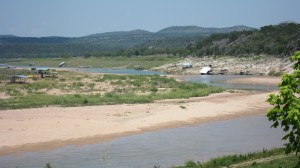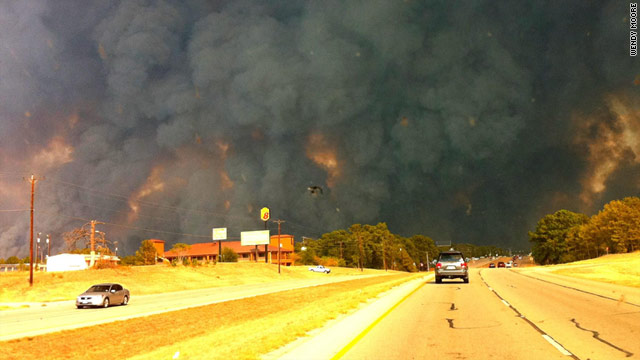
Wildfires rage over Labor Day near Bastrop, TX, southeast of Austin
Our hearts, prayers and thoughts go out to the people currently evacuated and who have lost their homes this holiday weekend. I, myself, having gone through losing a home to fire I send my best to all of you affected, and have already contacting folks via our church to find out how we can help. I’ll post links as soon as I can get them to give directly to disaster relief.
UPDATE: KVUE has a great list they are updating with where to donate. Please give what you can.
This puts into focus several things that have been ruminating in my head all weekend, and it all comes back to this one question– Why does Rice play Texas? This weekend, two of our nation’s best universities met on the football field. And while both Rice and University of Texas can duke it out on relatively equal footing on the basis of academics, Rice is. . . shall we say, not the athletic powerhouse that Texas is. So, why does Rice always begin its football season with a drubbing of 34-9 (hey, tip of the hat for getting 9 points on the scoreboard– I guarantee there will be teas that do less this year), with the Owls now having lost 41 games out of the last 42 meetings to the Longhorns? And here the answer lies with the other goings-on of this long weekend.
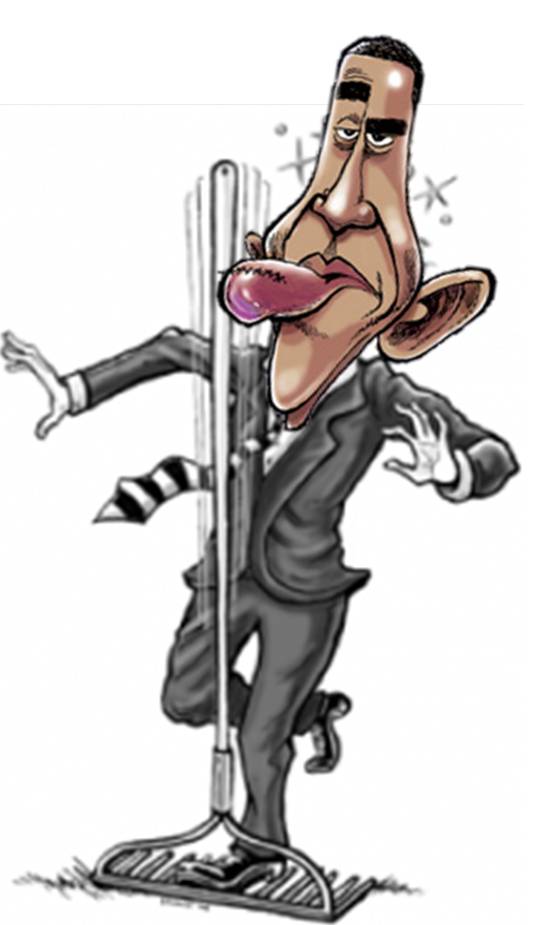
It started with a bang and whimper as our Caver-in-Chief, President Obama, announced he would overrule both the Supreme Court in Whitman v American Trucking Associations and the EPA in pulling back on the agency’s interstate smog rule that has been in the works since the Bush Administration. As Prof of Law Lisa Heinzerling points out in an excellent post over at Grist called Ozone Madness, this decision is wrong based on the law, the science, the economics, and the transparency.
While the President is trying to, I’d assume, take what he sees as the high ground and compromise with those people who claim that these regulations kill jobs, the opposite is, in fact, true. These National Ambient Air Quality Standards, or NAAQS, are set by the Clean Air Act and, defined by the Supreme Court, are to be based on the best available science about what levels of pollutants are healthy for human beings (people like you and me) to breathe. Tea partiers and some of their corporate paymasters in the fossil fuel industry have been caterwauling that these rules will be “too expensive” to implement, and therefore shut down a lot of old, dirty power plants.
 Ummmm.. . . yes, please? Couldn’t we, nay, shouldn’t we shut them down? Our best available science tells us these pollution sources are making us sick. We need these life-saving regulations to help all of the sick children, the elderly, and just the plain folks who suffer from asthma and other respiratory disease. Count up the missed school days, the missed work days, the premature deaths– count how they hobble our economy. How can children compete in a global economy if they are missing days from school sick because they can’t breathe? How much work is done not on time? How much lost productivity have we hamstrung our economic engine with to cater to people who don’t know how to compete in a modern energy economy against cleaner forms of production? Because the new EPA rules won’t shut down all power plants, only those who can’t compete, who can’t run cleanly. And since there is also good evidence to show that these sorts of life-enhancing regulations actually help, not hurt, the economy. It also rebuts the White House’s own stated position that they posted just one. day. earlier. that clean air helps the economy, preventing in this year alone:
- 160,000 premature deaths;
- More than 80,000 emergency room visits;
- Millions of cases of respiratory problems;
- Millions of lost workdays, increasing productivity;
- Millions of lost school days due to respiratory illness and other diseases caused or exacerbated by air pollution.
So aside from the doublespeak and the just plain bad policy, it looked like the Obama Administration is also taking early steps to signal that they will approve the Keystone XL pipeline to bring the world’s dirtiest and most carbon-intensive source of oil on the planet to Texas Gulf Coast refineries, despite weeks of protests involving thousands of people and hundreds of arrests.
 The impact on the climate if this is approved? Well, according to Jim Hanson, one of our top climate scientists, he called it “essentially game over.” Or, as Bill Paxton in Aliens put it: (WARNING: NSFW for swearsies, including the dreaded f-dash-dash-dash word)
[youtube=http://www.youtube.com/watch?v=dsx2vdn7gpY]
Ok, well, all kidding aside because this is deathly serious, as in the fate of the planet’s climate, THIS is what Jim Hanson told climate protesters outside the White House just before he was arrested for his part in the protest.
[youtube=http://www.youtube.com/watch?v=Lii5Q-meoro]
Bill McKibben, environmental activist and one of the ringleaders of the several weeks long protest event, said this on Friday about how this is not the end of the protests, it’s only the beginning:
[youtube=http://www.youtube.com/watch?v=EcBCLXBzYLg]
These are serious stakes. “Game Over” stakes. What does that mean? Well, for climate, if you’ve liked the record-breaking heat this year in Texas, you’re in luck, as this could easily become the new normal with climate change. And with the heat, we’ve got the huge economic impacts of the drought. For farmers and ranchers, the Dallas Morning News is reporting a 5 billion dollar loss. Thats Billion with a B, folks.
So next time someone starts talking about how it’s “too expensive” to deal with climate change, do what the Violent Femmes say to do and “Add it Up.” (warning:song lyrics also NSFW because of those darn swearsies) Loss from hurricanes like Irene, loss from this summer’s floods and tornadoes in Joplin, loss from drought, loss from wildfires, loss to the economy from dirty air (since hotter temperatures mean worse smog), and tell me that just continuing to do nothing and just putting more carbon into the atmosphere is potentially the most expensive thing we can do.

So, what does this have to do with Rice vs Texas? Well, what we have here is political expediency and taking the easy path instead of fighting for what is right. Regulations, regardless of their impact on a multinational corporation’s bottom line, save lives, and improve lives. This is what Ralph Nader fought for when he wrote Unsafe at Any Speed. Corporate whining and their record-breaking profits are not more important than people, and people’s’ rights to breathe clean air, or live in a stable climate. I, for one, am not willing to give up on Central Texas, and let this become the new normal for climate. When I first came to Austin, my literal first impression of the area was “I now understand why people were willing to die at The Alamo to protect this land.”
Decades ago, another President came to Texas to challenge a nation to go to the moon before the end of the decade, and asked an assembled crowd at Rice University the magic question.
“Many years ago the great British explorer George Mallory, who was to die on Mount Everest, was asked why did he want to climb it. He said, “Because it is there.” … But why, some say, the moon? Why choose this as our goal? And they may well ask why climb the highest mountain? Why, 35 years ago, fly the Atlantic? Why does Rice play Texas?“
President Kennedy answered his own question:
“We choose to go to the moon in this decade and do the other things, not because they are easy, but because they are hard, because that goal will serve to organize and measure the best of our energies and skills, because that challenge is one that we are willing to accept, one we are unwilling to postpone, and one which we intend to win.”
Climate change is the same challenge, which I previously hit on in another blog post where I also used this quote. It is certainly one we must be willing to accept, unwilling to postpone, and which we intend to win.
[youtube=http://www.youtube.com/watch?v=ouRbkBAOGEw]
But, most importantly, he notes that “But this city of Houston, this state of Texas, this country of the United States was not built by those who waited and rested and wished to look behind them. This country was conquered by those who moved forward.”
Let me take liberty with JFK’s speech where he talks about the need to build a space industry and replace it with a clean energy economy. “If this capsule history of our progress teaches us anything, it is that man, in his quest for knowledge and progress, is determined and cannot be deterred. The [creation of a clean energy economy] will go ahead, whether we join in it or not, and it is one of the great adventures of all time, and no nation which expects to be the leader of other nations can expect to stay behind in this race for [clean energy]. Those who came before us made certain that this country rode the first waves of the industrial revolution, the first waves of modern invention, and the first wave of nuclear power, and this generation does not intend to founder in the backwash of the coming age of [energy]. We mean to be a part of it—we mean to lead it.”
Our economic torpor, our environmental problems, and yes, our hurricanes and droughts and wildfires, are ALL things we can solve if we are willing to take this same leadership role. Surely there will be pollution in the future, there will be recessions, there will be storms and droughts and fires– but they will NOT be supercharged by an ever-increasing blanket of carbon making our planet warmer and warmer. We must stop doing the same things over and over, relying on fossil fuels, and expecting different results. We must put our courage to the sticking place, and say that we will not allow the voices of a few, economically powerful and well-connected industries to wreak untold havoc on us and our neighborhoods.
You’ll notice, in JFK’s speech, he talks about the costs that a trip to the moon will require. He advocates not spending money recklessly, but in spending a large amount of money to win this challenge.
To be sure, all this costs us all a good deal of money. This year’s space budget is three times what it was in January 1961, and it is greater than the space budget of the previous eight years combined. That budget now stands at 5 billion 400 million dollars a year—a staggering sum, though somewhat less than we pay for cigarettes and cigars every year. Space expenditures will soon rise some more, from 40 cents per person per week to more than 50 cents a week for every man, woman and child in the United States, for we have given this program a high national priority—even though I realize that this is in some measure an act of faith and vision, for we do not now know what benefits await us. But if I were to say, my fellow citizens, that we shall send to the moon, 240 thousand miles away from the control station in Houston, a giant rocket more than 300 feet tall, the length of this football field, made of new metal alloys, some of which have not yet been invented, capable of standing heat and stresses several times more than have ever been experienced, fitted together with a precision better than the finest watch, carrying all the equipment needed for propulsion, guidance, control, communications, food and survival, on an untried mission, to an unknown celestial body, and then return it safely to earth, re-entering the atmosphere at speeds of over 25 thousand miles per hour, causing heat about half that of the temperature of the sun—almost as hot as it is here today—and do all this, and do it right, and do it first before this decade is out—then we must be bold…
However, I think we’re going to do it, and I think that we must pay what needs to be paid. I don’t think we ought to waste any money, but I think we ought to do the job.”
President Obama will be giving a speech on jobs later this week. In it, I’d love to hear even a smidgen of the boldness and realism of Kennedy. I’d love for him to recant his statement on the EPA smog rule, and say that he will stop the Keystone XL pipeline, as it will only increase our dependence on oil when we need to be quitting it. But I doubt it.
But, it could be worse. We could be realistically thinking about electing as President of the United States someone who believes climate change is a hoax, that climate scientists are in it for the money, and the best way to run a state is to slash the budget of the Forest Service, the agency responsible for fighting fires in Texas, by $34 million– almost one-third of its budget– on the eve of one of the most destructive fire seasons ever. It is worth noting that during the sunset hearings on the Texas Forest Service I testified as to the need of the Forest Service to engage in extra forecasting as to what a climate-change-fueled fire season would look like and be prepared to fight it, so this is a little bit of a personal issue for me.
Apologies for the political birdwalk and the sniping at the two likely major-party candidates for the Presidency. What is clear is what JFK was talking about: we must do things like fight climate change not because they are easy, but because they are hard, and because they are a challenge we are willing to accept and unwilling to postpone. It is a fight we must win, it is a fight for our very existence as we know it here in Texas.
This Saturday my alma mater will be coming to Austin to play Texas, and as my BYU Cougars sit as 4.5 point underdogs against the Longhorns, they and we must remember that this is why Rice plays Texas. This is why BYU plays Texas. To challenge ourselves, and organize our best efforts to make us better. That is why Rice plays Texas. And that is ultimately why we must get our head in the game on clean energy and quit our addictions to fossil fuels and their campaign contributions.

###
For updates on where exactly wildfires are raging in Texas, please visit http://ticc.tamu.edu/Response/FireActivity/
Read Full Post »
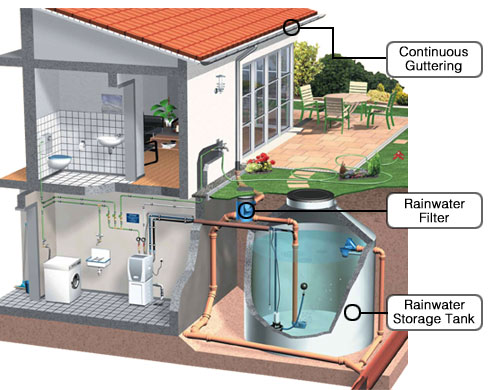
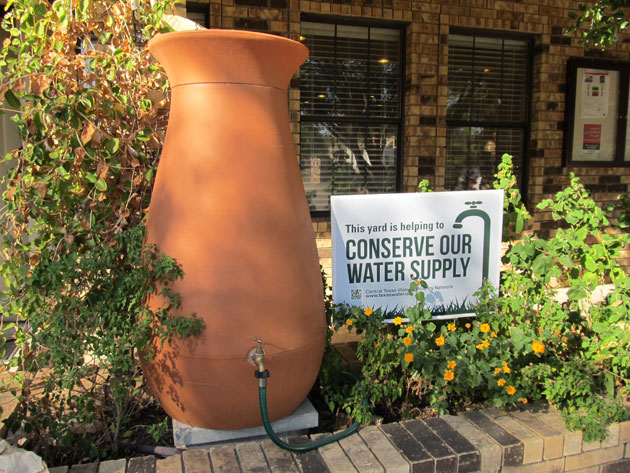 With 88% of Texas in some stage of drought, solutions to this problem are vital to the health of Texas, which has inspired a study funded by Texas State University and The Meadows Center for Water and the Environment to the forefront of this problem. The study explores the possibility of subdivision scale rainwater harvesting systems which would collect the rainwater off the roofs of an entire subdivision to feed the water demands instead of drilling into an existing well that may be already stressed from other residences.