Feeds:
Posts
Comments

Posts Tagged ‘waste control specialists’

Late yesterday, in a stunning rebuke of TCEQ’s decision to deny citizens the right to show how dangerous radioactive disposal would be in West Texas, State District Court Judge Lora Livingston ordered TCEQ to reverse their decision denying the Sierra Club the right to a contested case hearing over the license granted to Waste Control Specialists to operate a radioactive waste dump in Andrews County, just east of the New Mexico border. In her order, Judge Livingston remanded the case back to the TCEQ for a contested case hearing on whether this radioactive waste can be safely disposed of in West Texas.

The Sierra Club’s won a battle in its long fight against a radioactive waste dump in West Texas when the Travis CountyJudge reversed a decision made by the TCEQ three years ago that denied Sierra Club its right to a contested case hearing on the license given to Waste Control Specialists (WCS) for the dump. Sierra Club subsequently filed a lawsuit in District Court to win that hearing, but the court date had been delayed for years.  Yesterday was the first opportunity for opponents to argue before an impartial judge about the TCEQ’s conscious decision to ignore key information about potential problems with the site. The Judge agreed that TCEQ should have granted the Sierra Club the right to oppose the license for the waste dump in a contested case hearing before state administrative law judges and now the TCEQ license has been remanded to the agency to grant the contested case hearing.

Low level radioactive waste is so dangerous that it has to be disposed of in specially designed remote and isolated sites to prevent contamination of water and air.  When Waste Control Specialists applied for a license, the staff at TCEQ reviewed the application and recommended its rejection because of their concerns about the possibility of water intrusion and contamination.  The TCEQ’s executive director overruled the recommendation of the staff and recommended issuing the license.

In light of the staff’s concerns, the Sierra Club requested a hearing on the application. That request was denied and the license was issued by two of the three TCEQ commissioners appointed by Governor Perry. Six months later TCEQ’s executive director went to work for WCS.

New information has recently come to light about the WCS site  pertaining to the potential for water to come into contact with radioactive materials. According to data provided by TCEQ., water has been detected in monitoring wells at the facility for the last several months. An expert report authored by geologist George Rice and entitled, Occurrence of Groundwater at the Compact Waste Facility Waste Control Specialists Facility Andrews County, Texas, points out that infiltration of rainwater and movement of groundwater was already occurring within the buffer zone of the “Compact Waste Site” as recently as this March.

Just last week, the TCEQ granted WCS the right to receive radioactive waste at the site and begin operations despite the Sierra Club’s appeal to State District Court.

Cyrus Reed, Conservation Director of the Lone Star Chapter of Sierra Club said, “This ruling confirms what we have been saying all along. The Sierra Club and its members in West Texas and Eastern New Mexico deserve the opportunity to show that radioactive waste dumped at the WCS site could impact people in the area through airborne radioactive particles and potential groundwater contamination. TCEQ should immediately stop operations at the WCS site and follow the judge’s order and grant the Sierra Club’s request for an expeditious but fair contested case hearing on the license for the dump site.”

Rose Gardner lives within four miles of the WCS radioactive waste facility and was represented in this case by Sierra Club. “I’m very glad about the judge’s decision, since we’ll now have a hearing where we can fully examine radioactive risks to our land and water. We now have more livestock than ever before and having the WCS radioactive waste dump nearby threatens our health and safety. TCEQ blocked this hearing before and needs to be more open with information and opportunities for citizens to participate,” said Gardner.

“This case is of national significance because the dump’s biggest investor is Harold Simmons, one of the largest contributors to Republican political campaigns and attack ads. He helped to fund the “Swift  Boat Veterans for Truth”  and  the “Obama is a Muslim”  attack ads. The Wall Street Journal has reported that Simmons has spent $18 million so far this election cycle and plans to spend a total of $36 million before the end of this cycle. Why would he spend that kind of money?  The amount and types of waste could be vastly expanded by a Republican President or Congress thus increasing the amount of money Simmons can make off of the dump and  increasing the funds he has available to donate to future political campaigns. And if anyone doubts that his political spending will pay off in favorable treatment, all they have to do is look at how successful he’s been in Texas”  said Tom “Smitty”  Smith of Public Citizen’s Texas Office.

“This is a big victory for the citizens of Texas and New Mexico. The TCEQ knew this case was likely to be decided this week, but rushed to sign off on the dump site late last month, allowing radioactive waste to start coming into Texas, showing just how much political pressure Harold Simmons, the chief financial investor of WCS, can exert on Texas politics and agencies. The first shipments of radioactive waste arrived just 10 days ago.  We call on TCEQ to act responsibly and reverse their decision granting that permit,” said Karen Hadden of  the Sustainable Energy and Economic Development (SEED) Coalition.

The SEED Coalition and Public Citizen have been actively involved in opposing the recently adopted rule to open up the WCS facility to accepting waste from the rest of the nation and continue to monitor the transparency and accountability around this rule change.

Read Full Post »

Harold Simmons built a West Texas dump for radioactive waste that is bigger than 1,000 football fields, paid out hundreds of thousands of dollars in campaign contributions and got a permit for it in Texas, and is now working to fill it.

To turn it into a profitable enterprise, the Texas billionaire has now hired lobbyists to urge the Obama administration to expand the types of nuclear waste, including depleted uranium, the dump can accept and award his company disposal contracts.

Click here to read the Bloomberg story on the influence of money on this regulatory issue.

Click here  and here and here and here, to read earlier blog posts about Harold Simmons, his Texas political contributions and the WCS radioactive waste dump.

Read Full Post »

With the Texas Low Level Radioactive Waste Disposal Compact Commission (TLLRWDCC) approving rules that open up of the WCS dump site to out of compact waste, we may soon see low level radioactive waste from Nebraska Public Power District’s nuclear facility heading to Texas.

The deal between WCS and Nebraska’s Cooper Nuclear Station still must be finalized, but the waste they are looking to send would include radioactive resins, filters and other equipment.  Currently, low-level waste from Cooper Nuclear Station is stored in on-site pools that also hold used nuclear fuel rods because no other disposal site took either out of compact waste, or did not take the “hotter” C level waste.

With the opening up of the Texas waste site, you can bet other nuclear power plants around the country are looking to free up space in their spent fuel pools as these aging plants near the end of their planned life.  Many of these plants are at a point where they are looking to get relicensed, and with the lack of a national respository for the spent fuel rods, will need to show that they have adequate on site storage for another 20 years of spent fuel.  Removing “low-level” radioactive waste from on site is going to be important to that process, and Texas is looking good to them as an option to making that happen.

While there was concern about there being enough room at the WCS site for Texas and Vermont (the two states in our Compact), the commission set aside space for our two states, however you can be sure other states will be clamoring for what’s left.  Then what – an expansion of the site?

Oh, just another thing to ponder over.  The San Antonio Current reported in their Que Que blog that in 1992, an earthquake measuring 4.7 on the Richter scale struck Lea County, New Mexico, just across the Texas-New Mexico border from the radioactive waste dump operated by Waste Control Specialists in western Andrews County.

Read Full Post »

Trucks carrying low-level radioactive waste from 38 states could start rolling down Texas highways bound forburial at a dump in Andrews County on the Texas / New Mexico border as early as April,.

The state’s commission (Texas Low Level Radioactive Waste Disposal Compact Commission) overseeing disposal of low-level waste in Texas may approve the final rule changes needed this Friday, March 23rd. State lawmakers cleared the way with a new law passed late in the 82nd legislative session and state regulators still need to sign off on the burial site’s construction, but it seems inevitable that Texas is going to become the nation’s radioactive dumping ground.

The Compact Commisson meeting is scheduled to begin at 9am on Friday, March 23rd in the Texas Capitol Extension at  1400 North Congress, Austin, Texas in Hearing Rm. E1.024,  We’ve provided the meeting agenda below and encourage any who are interested to attend the hearing.

Agenda

1. Call to Order

2. Roll Call and Determination of Quorum

3. Introduction of

a. Commissioners

b. Elected Officials

c. Press

4. Public Comment (Note: Pursuant to Article IV, Section Two (c) of the Commission¿s Bylaws, the Commission [subject to such time constraints as may be established by the Chair] also will provide an opportunity for members of the public to directly address the Commission on each item on the agenda during the Commission¿s discussion or consideration of the item.

5. Discussion and possible action with regard to the final adoption of amendments to Rule 675.23 (Importation of Waste from a Non-Compact Generator for Disposal) (31 TAC 675.23) with changes from the proposed amendments to the rule as published in the Texas Register on January 20, 2012 (37 Tex. Reg. 184).

A) Receive and discuss the report of the Rules Committee (Mr. Lee [Chair], Mr. Salsman, Mr. Saudek, and Mr. Wilson) with respect to its deliberations after the publication of the proposed amendments to Rule 675.23 (31 TAC 675.23) as published in the Texas Register on January 20, 2012 (37 Tex. Reg.184).

B) Receive and act on the recommendations of the Rules Committee with respect to

(i) the final adoption (with changes) of proposed amendments to Rule 675.23 (31 TAC 675.23) as published in the Texas Register on January 20, 2012 (37 Tex. Reg. 184); and

(ii) the filing and publication of Rule 675.23 (31 TAC 675.23) as finally adopted in the Texas Register.

 6. Discussion and possible action on the following petitions for export: A) South Texas Project B) Vermont Yankee C) Luminant

7. Discussion among Commission members about methods of processing and evaluating applications for Agreements for importation of waste for disposal in accord with Compact Commission Rules and with Texas requirements expressed in Chapter 401 of the Texas Health and Safety Code, including quantities and revenue expectations and including possible action to appoint one or more Committees in connection with the processing of applications for Agreements for importation.

8. Discussion on and possible action on Bionomics Request for Import Agreement.

9. Presentation of Site status report and outlook from Waste Control Specialists Inc.

10. Presentation from Advocates for Responsible Disposal in Texas concerning Compact site use plans and issues.

11. Site status report from the Texas Commission on Environmental Quality including discussion of plans for actions on commingling rule change effort and actions on site licensing and disposal site rate case actions.

12. Receive a report from and possibly take action in response on any recommendations from the Committee on the Commingling Rule (Ms. Morris [Chair], Mr. Saudek and Mr.Wilson)

13. Chairman¿s report on Compact Commission activities including reporting on fiscal matters and on status of filling needs for staffing.

14. Discussion and possible action regarding the provisions of existing Compact Commission Rule 675.21(l) (31 TAC 675.21(l)).

15. Determination of date and location of next meeting.

16 Adjourn.

Read Full Post »

Waste Control Specialists LLC (WCS) is seeking several amendments to its Radioactive Material License # R04100 from the Texas Commission on Environmental Quality (TCEQ).  Five of the amendments request design changes to the Compact Waste Disposal Facility (CWF) and the Federal Waste Facility (FWF) for commercial and federal low-level radiactive waste disposal. The other two amendment applications set forth new Waste Acceptance Criteria that includes rates and contract considerations and new pavement design considerations.

Just as important, TCEQ is considering revising language and definition for waste of international origin, acceptance criteria, reporting of inventory and liability coverage as well as the issued TCEQ waste water permit.

TCEQ is accepting public comments and requests for a public meeting.  These can be submitted by mail to:

the Office of the Chief Clerk
MC 105
TCEQ
P. O. Box 13087

or electronically at www.tceq.state.tx.us/about/comments.html by December 17th.

If you need more information about the license application or the licensing process, please call the TCEQ Office of Public Assistance at 1-800-687-4040.

We will post the link to the amendment applications as soon as we are able to find them.  TCEQ recently migrated its database and the links no longer work.  Makes finding materials to base written comments on a bit more complicated.

Read Full Post »

Gov. Rick Perry has replaced all six of the Texas commissioners who sit on the Texas Low-Level Radioactive Waste Disposal Compact Commission reappointing only two previously serving commissioner.  The TLLRWDCC commissioner terms were modified by Senate Bill 1605 as part of the 82nd Legislature giving Perry the ability to replace commissioners whose positions he didn’t like with new commissioners.

The appointees were:

  •  Eric J. Doyal of Houston, a senior associate at Capital Point Partners. He is appointed for a term to expire Sept. 1, 2013.
  • Andrews County Judge Richard H. Dolgener, Dolgener was first appointed in 2008 and is appointed for a term to expire Sept. 1, 2015.
  • Milton B. Lee II of San Antonio, a registered professional engineer and retired CEO of CPS Energy who left amid the shakeup following the municipally owned utility’s failure to disclose a dramatic price increase in the estimated cost of two new nuclear reactors to the City Council before a major bond vote.  He is appointed for a term to expire Sept. 1, 2013.
  • Linda Morris of Waco, a licensed medical health physicist and the Department Chair of the  Environmental Health & Safety Technology Department at Texas State Technical College. She is appointed for a term to expire Sept. 1, 2017.
  • John Matthew Salsman of College Station, a certified health physicist and the director of Environmental Health and Safety at Texas A&M University. He is appointed for a term to expire Sept. 1, 2017.
  • Robert Wilson of Lockhart, an attorney and partner at Jackson, Sjoberg, McCarthy and Wilson. He is re-appointed for a term to expire Sept. 1, 2017, and will serve as chair of the commission for a term to expire at the pleasure of the governor.

Read Full Post »

According to the Fox news station in Salt Lake City, UT, controversy has arisen about EnergySolutions’ plans to dispose of what they call blended radioactive waste at its Clive Facility in the west desert of Utah.

There are three classifications of waste: A, B and C, all radioactive. Only the lowest level, type A, is allowed in Utah, but Energy Solutions says it’s found a way to blend and store the waste safely by mixing higher-level class C waste with low-level waste and labeling it class A – are you buying this, cause I’m pretty skeptical and it just sounds like fiction to me.  This magic would take place at a facility in Tennessee according to EnergySolutions.

EnergySolutions may have found a legal loophole that would allow them to store higher level radioactive waste at the Clive facility, but ultimately, the Utah Division of Radiation Control will decide whether the blended waste can be disposed in Utah.

In the meantime, William Dornsife, executive vice president of WCS, the Texas company building a radioactive waste disposal facility in Andrews County, Texas is telling Utah to bring it on. He wants the waste to go to Texas, not Utah.

Texas is licensed to take class A, B and C waste without the blending alchemy that EnergySolutions is proposing, and there is a lot of money at stake — potentially hundreds of millions of dollars.  WCS and billionaire Harold Simmons are salivating at the opportunity to spend what they probably see as the political capital with which they walked away from the 82nd Texas legislative session earlier this year to rake in the profits at the expense and liability of the Texas taxpayer.

Face it Texas, we are now the radioactive waste capital of the country.

Read Full Post »

The Texas Low-Level Radioactive Waste Disposal Compact Commission will meet Saturday, August 20, 2011, at 10:30 AM in the James Roberts Center, 855 Hwy 176 East, Andrews, TX 79714.  Don’t know yet what they will have on their agenda, but they say it will be posted in the Texas Register and on the Commission website when available.

Click here to read more about legislation that passed this session, opening the state wide to accept radioactive waste from around the country and giving Waste Control Specialists, the operator of the Texas waste site, carte blanche for much of the regulation of this site.

Have Questions?  Contact the Texas Low Level Radioactive Waste Disposal Compact Commission

http://www.tllrwdcc.org
Telephone: 512-820-2930
Mailing Address:
TLLRWDCC
3616 Far West Blvd., Ste. 117, # 294
Austin, Texas  78731
NOTE:  This is a mailing address only and not the physical location of the Commission.

Read Full Post »

All rights reserved by Public Citizen Texas

Infamously dubbed by Dallas Magazine “Dallas’ Most Evil Genius”, socialite and energy tycoon Harold Simmons is no stranger to Texas lobbying.  As this blog previously reported in January, Simmons has contributed $1.12 million from 2001 to September 2010 to Rick Perry significantly increasing his contributions between 6/25/2009 and 9/30/2010 totaling $600,000 in a 15 month period or more than doubling his previous contributions. Now why did Simmons increase his campaign contributions? Perhaps it’s been used to grease the wheels on his  recently passed radioactive waste bill SB 1504 allowing Simmons’ company Waste Control Specialists a monopoly on Texas low-level radiation waste disposal.

Simmons’ money didn’t stop at Perry. According to the Texans for Public Justice, Simmons paid $182, 350 in the 2010 election cycle to 92 members of the House, 94% Republicans and 6%  Democrats. Obviously, all of this is significant because of the recent vote in the House on bill SB 1504. 76% of the members who received Simmons contributions or $138,350 voted with the money, yea, while only 13% or $24, 500 voted nay and 11% or $19,500 abstained from voting. Contrary to a damning report by Public Citizen addressing the dangers of nuclear waste disposal , 84% of the House members who took Simmons’ money voted following the company line while only 16% or 15 members abstained from voting or voted nay.

Simmons granted a rare interview to the Dallas Business Journal in 2006 offering an eerie outlook on his lobbying efforts “It took us six years to get legislation on this passed in Austin, but now we’ve got it all passed. We first had to change the law to where a private company can own a license [to handle radioactive waste], and we did that. Then we got another law passed that said they can only issue one license. Of course, we were the only ones that applied.

Most House Members Who Took Simmons’ Money Voted To Grant Him A Monopoly to Import Nuclear Waste

Simmons BillVote in House No. of Members Percent of Members Total Amount From Simmons Average Amount from Simmons
Yea 108 72% $138,350 $1,281
Nay 36 24% $24,500 $681
Not Voting 6 4% $19,500 $3,250
Totals 150 100% $182,350 $1,216

House Members Taking Simmons’ Money but Bravely Went Against Their Benefactor

House Member Dist. Party Simmons Amount in 2010 Cycle 2nd Reading Vote 5/17 3rd Reading Vote 5/18
Anderson, Charles 56 R $2,000 Absent Absent
Carter, Stefani 102 R $2,000 Nay Nay
Coleman, Garnet 147 D $15,000 Yea Nay
Davis, Sarah 134 R $500 Yea Nay
Dukes, Dawnna 46 D $1,000 Nay Nay
Farrar, Jessica 148 D $500 Absent Nay
Gallego, Pete 74 D $15,000 Nay Nay
Giddings, Helen 109 D $1,000 Nay Nay
*Howard,  Donna 48 D $500 Nay Nay
Hunter, Todd 32 R $2,000 Absent Absent
Issac, Jason A. 45 R $1,000 Nay Nay
Kolkhorst, Lois 13 R $1,000 Nay Nay
*Martinez Fischer, Trey 116 D $1,000 Nay Nay
Reynolds, Ron 27 D $500 Nay Nay
Straus, Joe 121 R $15,000 Not Voting Not Voting
Villarreal, Mike 123 D $1,000 Nay Absent

*Member of House Natural Resources Committee that first approved bill.

Note: If you are interested to see  if your representative voted with the money or even received 2010 campaign contributions from Simmons please visit this link provided by TPJ, Bankroll Call: Correlating Simmons Contributions To Texas House Votes.

Read Full Post »

Senate Bill 1504 (by Seliger: R-Amarillo and Hinojosa: D-McAllen) the riskiest bill for the environment this session will be heard on the Texas house floor on Tuesday, May 17th.  If passed in its current form, the risks include:

  • Risk that we won’t have enough space for our own waste
  • Risk of an unfunded taxpayer liability
  • Risk from a radioactive rollover
  • Risk that we might contaminate the nation’s largest aquifer, which is nearby

This bill divorces the risk from the profit in the Texas radioactive waste industry putting the liability for a private radioactive waste disposal site on the taxpayers of Texas while putting billions into the pockets of a Texas billionaire.

It’s time to call our legislators- Click here to find out who represents you in the Texas House of Representatives (make sure you select” House” as your District Type”) and give your state legislator a callTell them NO on SB 1504.

A report released April 28th by Public Citizen’s Texas office finds that we could expect a substantial increase in radioactive transportation accidents.  According to WCS’s own transportation study, Texas can expect to have 4,500 trucks rumbling across the state on I-10, I-20, I-30, I-40 and I-27 each year.  That works out to 1,000 trucks per highway, or 3 per day.  The state is simply not prepared to deal with the possibility of a radioactive roll over at an emergency response level or at a financial liability level.  In the event of a transportation accident involving radioactive waste, Texas would have only $500,000 available to cover emergency response, health care and property damage costs, that amount is far too little.

Concern about taxpayer liability is also spelled out in the report which claims that the dump site being constructed in Andrews County does not have adequate capacity to receive waste from outside the state.  It cites a 2000 study by the Texas Commission on Environmental Quality (see http://www.tceq.state.tx.us/assets/public/permitting/llrw/entire.pdf for a copy of the study) and an estimate produced by the Texas Low-Level Radioactive Waste Disposal Compact Commission, both showing the site to be short on capacity for just the Texas and Vermont waste it was originally intended to handle.

We are recommending to members of the Texas Legislature that they vote against SB 1504 and not allow importation until the risks have been addressed and capacity at the site exists.  It has taken 30 years to start construction on a site for our own waste. SB 1504 would likely send us back to the drawing board if we don’t have space for our own waste.

The people of Texas are at risk from a leak at the site, which is located dangerously close to the Ogallala Aquifer and is only 150 feet from groundwater.  If the dump site located in the west Texas county of Andrews were to leak, the cleanup cost could be anywhere from three to 50 times the amount set aside by the site operator, Waste Control Specialists (WCS). Two examples of radioactive leaks – include one in South Texas that garnered a $384 million cleanup bill, and another in New York that is estimated at $5 billion.

You can help!

Call your legislator and tell them to not put the cart before the horseTell them NO on SB 1504.When the legislature voted to let a private facility run our Compact Facility, they told us that this would help prevent it from becoming a national dumping ground, and we believed you.  Now SB 1504 is doing just the opposite.  The legislature should first look at taking our Texas waste and study the capacity of the site before turning us into the national dumping ground. Vote No on SB 1504.

Click here to read a copy of the report. (more…)

Read Full Post »

In spite of, Governor Rick Perry’s designation of this past Easter weekend as official days of prayer for rain, Texas is expected to break its yearly record for the number of acres burned by wildfires, with officials warning that today through Wednesday would see a high risk of fresh blazes.

2006 set the previous record of acres burned in one entire year at 1.94 million. So far this year, the figure is 1.84 million, and we’re just in April.  We’ve still got summer and a lot of the fire season left.

Meanwhile, a state report has found that many of the Texas counties that endured the worst damage from this month’s wildfires received only a small portion of the more than $128 million the state awarded to volunteer fire departments over about a decade for training and equipment.

According to the State Firemen’s & Fire Marshals’ Association, there are 1,042 volunteer departments in Texas with about 28,000 firefighters and these make up the first line of defense for many of the counties that have been battling wildfires recently.

The sunset commission’s analysis, which was released in January and is currently being considered by the Texas Legislature, found counties with a low risk for wildfires had received a greater share of the $128 million handed out through the Texas Rural Volunteer Fire Department Assistance Program than many of those with the highest risk.  Specifically, 59 of the 74 counties determined to have a high risk for wildfires got less than $1 million in grant money for their volunteer fire departments from 2001 through 2009.

Three of the high-risk counties that received less than $1 million — Tom Green, Andrews and Palo Pinto — have been significantly affected by the current fires.

Andrews County is home to WCS’s hazardous waste dump, that could soon be open to “low-level” radioactive waste coming into the state from all over the country.  In addition to radioactive waste disposed of at the site, thousands of truckloads of radioactive waste could be traversing the Texas countryside over roads in counties prone to wildfire.  If an accident happens while our first responders are working to the point of exhaustion at local wildfires, I shudder to think about the consequences to the folks near an accident and the liability to the state.  I think the Governor needs to expand the parameters of his call to prayer.

Read Full Post »

UPDATED: Thanks to everyone who commented!  We’ll have a blog wrapup/ news release ASAP.

VIDEO FROM OUR PRESS CONFERENCE !

And check our flikr photostream here on the blog for non moving pictures from this morning, if that’s more your thing.

We now return you to your regularly scheduled snark, already in progress. 

ORIGINAL POST:

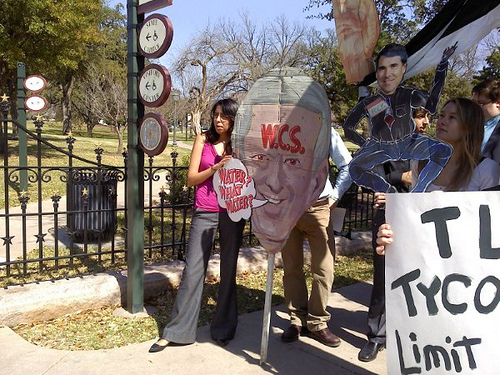
Supervillain Harold Simmons sitting on a pile of radioactive waste

Bond Supervillain and sometimes Grinch Harold Simmons, picture from D magazine

This morning when I woke up my precious 2 year old son, he asked if I could sing him “You’re a Mean One, Mr. Grinch“, and while I was singing and described the Grinch’s moldy, garlicky, spider-infested brain, heart, and soul, I couldn’t stop thinking of Dallas Billionaire Harold Simmons and the unelected bureacrats who decided the holidays were the perfect time to try to permit nuclear waste coming to Texas.  And while I wouldn’t normally touch them with a 39 1/2 foot pole, touch we must.

Whatever your plans for the holidays — putting up decorations, sending cards to friends and family, buying gifts and a much-needed vacation– I’m sure they did not include telling an obscure state commission you don’t want Texas to become the nation’s radioactive waste dump.  But more than any figgy pudding, that is what we must bring, and bring it right here!

Wait… you’re saying you weren’t planning to closely read and comment on a proposed rule that would put a big ole “for sale” sign on our state for anyone with unwanted radioactive waste?

Well that’s exactly what Michael Ford, the governor’s appointed (i.e. unelected) chairman of the Texas Low-Level Radioactive Waste Disposal Compact Commission (i.e. radioactive waste czar), is counting on.

At a meeting announced just hours after the November polls had closed and election winners and losers had been announced, the TLLRWDCC (I know, it’s a mouthful even abbreviated) voted 5-2 to repost a rule that would allow out-of-state radioactive waste generators – primarily nuclear power plants on the coasts and in the midwest – to send  their waste here.

Worse still, the TLLRWDCC managed to post the rule the day after Thanksgiving, ensuring that media and public attention would be minimal. The posting started a 30 day comment period during which the public can let the TLLRWDCC know how they feel about it. So let’s run the numbers and… oh, fabulous, comments are due the day after Christmas! Happy holidays, indeed!

Ford brought up this bad idea last summer, but polls showed a majority of Texans didn’t like the proposal.  Bill White made it an election issue, accusing Governor Perry of making the state a radioactive waste dump to benefit his donor.  So Perry’s Waste Czar pulled the proposal, waiting until day after the election to announce that the process would move forward once more.

But announcing a meeting the day after the election with just 10-days notice for people to travel to Midland (where the capitol press would be unlikely to follow), and then posting the rule itself such that the comment period would meet the literal definition of “the holidays” was only the beginning for Mr. Ford.

A commissioner named Bob Gregory who, like Ford, was appointed by Governor Perry asked that the comment period on this rule be extended to 90 days since a 30 day comment period would transpire during the holidays when most people are too busy to pay much attention to matters of civic engagement. Mr. Ford and 4 other members of the TLLRWDCC voted against Mr. Gregory’s very reasonable solution for this very obvious problem.

The bottom line is that Mr. Ford and several of the commissioners are afraid of public scrutiny. Last spring they received over 2,000 comments from Texans opposed to the rule. That was before the issue made the front pages of newspapers all across the state, so they have good reason to be afraid.

During the holidays many Americans take time to be with family, to exercise their generosity, and to reflect on all they have to be grateful for. Mr. Ford and 4 of the other commissioners have decided to cynically use this to keep the public out of the process on this enormously important matter.

And while you’re getting dumped on, someone will get a really nice Christmas gift this year.

This smacks of a political payback. Harold Simmons, whose company owns this dump, has spread his cash far and wide, giving Governor Perry over $1 million since 2000 (making him the governor’s 2nd largest individual donor) and funding campaigns for every member of the Texas Supreme Court among others. While Simmons gets to make billions off this waste, Texans will get the responsibility for managing it for 10,000 years and cleaning it up — Mr. Simmons’ license expires in just 15 years.

But there is hope. Send your comments to the Compact Commissioners telling them the only good radioactive waste importation rule is one that bans any waste from coming to this state unless there is a national emergency. Tell them lawmakers in Texas bargained for only Vermont and Texas waste, and that’s what the people of Texas expect. And tell them that Christmas isn’t a weapon to be wielded against the public.

The Grinch about to go down a chimney

The Grinch is likely to file a defamation suit against me for comparing him to Harold Simmons.

Please go to www.TexasNuclearSafety.org where you can learn more about this issue and submit comments to the commission, and I hope you’ll give ’em what-for because they certainly deserve it.

Keep Texas from becoming what they want it to: an appalling dump heap overflowing with the most disgraceful assortment of rubbish imaginable, mangled up in tangled up knots. So, Mr. Ford, Mr. Simmons– between the three of you, I think I’d take the seasick crocodile. And the three words that best describe you are as follows, and I quote: Stink. Stank! STUNK!

Read Full Post »

No Radioactive WasteNRC and EPA called upon to examine radioactive waste site and licensing process, risks of groundwater contamination and potential risks to the Ogallala Aquifer, which lies beneath eight states

AUSTIN – Environmental groups today asked the U.S. Nuclear Regulatory Commission (NRC) and the U.S. Environmental Protection Agency (EPA) to investigate the radioactive waste storage and disposal programs administered by the Texas Commission on Environmental Quality (TCEQ) for the West Texas radioactive waste site owned by Waste Control Specialists (WCS).  The groups say the TCEQ has failed to protect public health, safety and the environment by repeatedly and brazenly abusing its legal authority and disregarding warnings of its technical staff about the site’s hazards. Further, citizens have not had adequate opportunities to participate in the licensing processes.

The groups are calling on the NRC to consider terminating or suspending the TCEQ’s authority to regulate the storage and disposal of low-level radioactive waste and radioactive byproducts in Texas. The groups also are asking the EPA to review the potential impact on the water supply and take action if necessary.

Read the full release, the request to NRC and EPA,and supporting documents online at www.TexasNuclearSafety.org. The request was filed by Public Citizen and the Lone Star Chapter of the Sierra Club, along with State Representative Lon Burnam (Texas House District 90), and individuals from Andrews, Texas and Eunice, New Mexico, who live near the WCS facility in Andrews County. The matter is urgent because WCS has been pushing the Texas Low Level Radioactive Waste Disposal Compact Commission to let it import radioactive waste from at least 36 other states.

Some of the hottest radioactive waste that exists, including nuclear reactor containment vessels and poison curtains that absorb reactor radiation, could be buried in the proposed radioactive waste dump. There is not a single radionuclide that can’t go to the so-called ‘low-level’ site, and many of them remain hazardous for literally millions of years.

Radioactive waste dumps around the country have leaked. Cleaning up contaminated groundwater is difficult and expensive. Texas taxpayers could be on the hook for clean up costs if the site and groundwater become contaminated or if there are transportation accidents.

Go to www.TexasNuclearSafety.org to learn more.

Read Full Post »

Background: What the controversy is all about
On May 25, 2010, the US Environmental Protection Agency (EPA) barred the Texas Commission on Environmental Quality (TCEQ) from issuing a permit to a refinery in Corpus Christi. EPA said that the process used to justify that permit violated the Clean Air Act.  EPA’s Region 6 Administrator, Al Armendariz, also stated that the EPA would block future permits and force polluters to comply with EPA standards if the TCEQ did not change its rules. On June 14th, EPA announced it was taking over the process for two additional air-quality permits

At issue are two types of air permits used in Texas – one known as a “flex permit” and one known as a “plant-wide applicability limit.” In both cases, instead of issuing permits that limit pollution from each individual point-source (e.g. a smokestack), TCEQ limits pollution for entire facilities, allowing operators to emit more pollution from one stack if another stack was emitting less. Studies indicate that there would be greater emission reductions if limits were done on a stack-by-stack basis.

These permits make enforcement extremely difficult at vast petrochemical and refining facilities. They also fail to protect people from emission clouds that can occur as a result of letting one stack emit more than would be allowed under the Clean Air Act.

Suppressed reports add fuel to the fire
The flex permit controversy had been brewing for some time as EPA and TCEQ battled behind closed doors, secretly playing a game of chicken with air pollution regulations. Meanwhile, another controversy was broiling beneath the surface in Fort Worth.  Elected officials from the area felt they were getting the run-around from TCEQ when they asked whether natural gas drilling and processing on the Barnett Shale was putting residents’ health at risk.

On June 1st, TCEQ admitted they had failed to divulge (i.e. suppressed) reports showing elevated benzene levels in the area.  In a statement, Mark Vickery said TCEQ “missed an opportunity” to “bolster their confidence in the quality of the air.” In reality, TCEQ knowingly presented inaccurate air-quality information to leaders and decision makers for months. Soon after, TCEQ admitted that 3 additional air-quality reports had not been made public. (more…)

Read Full Post »

This month, the Texas Low Level Radioactive Waste Disposal Compact Commission will hear feedback on a proposed rule allowing the importation of so-called low-level radioactive waste into Texas from across the nation. Under the proposed rules Waste Control Specialists (WCS) would be allowed to import additional radioactive waste from other areas of the country and potentially the world into Andrews County, Texas.

Click here to take action! Tell the Compact Commission you do not want Texas to become the nation’s radioactive waste dumping ground!

An environmental analysis performed by the Texas Commission on Environmental Quality (TCEQ) found potential problems with the site, including possible pathways to underground aquifers. Three TCEQ staff members have resigned or taken early retirement as a result of the decision to grant the license. While TCEQ did approve the license, the Sierra Club has appealed that decision to the State District Court.

Take Action Now!

Even though the license granted by the TCEQ has been appealed, and the site has yet to be constructed, the eight-member Compact Commission is rushing ahead with this proposed rule at the behest of WCS and nuclear power plants, who are both desperate to find a place to send their waste. The Compact Commission does not even have a staff to review proposed importation agreements. A coalition of groups is opposing the rush to approve this rule. The groups are urging the Commission to deny the ability to import any waste other than Texas-Vermont compact waste or to put much stricter rules in place on how waste might be imported on a case-by-case basis. The present license only has enough capacity for waste from Texas and the other compact state Vermont.

Join us now to send a message to the Compact Commission!

In addition to e-mailed comments, the public may also make comments at two public hearings in Austin, TX on April 5 and Andrews, TX on April 6.

Austin Hearing – April 5, 2010, 1:00 PM at the Texas State Capitol Extension Auditorium, E1.004

Andrews Hearing – April 6, 2010, 6:00 PM at Andrews High School Little Theater, 1401 NW Avenue K.

###

By promoting cleaner energy, cleaner government, and cleaner air for all Texans, we hope to provide for a healthy place to live and prosper. We are Public Citizen Texas.

Read Full Post »

Older Posts »