Feeds:
Posts
Comments

Posts Tagged ‘water’

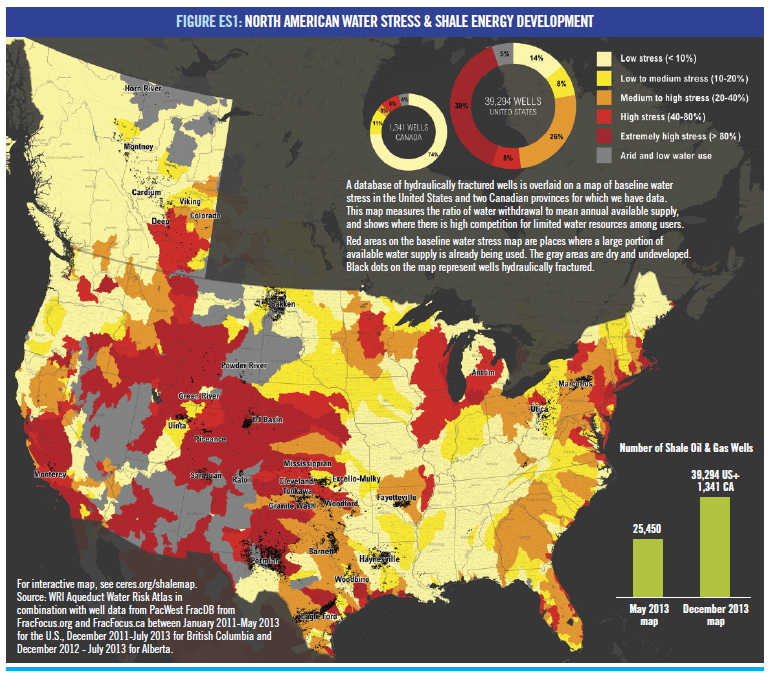
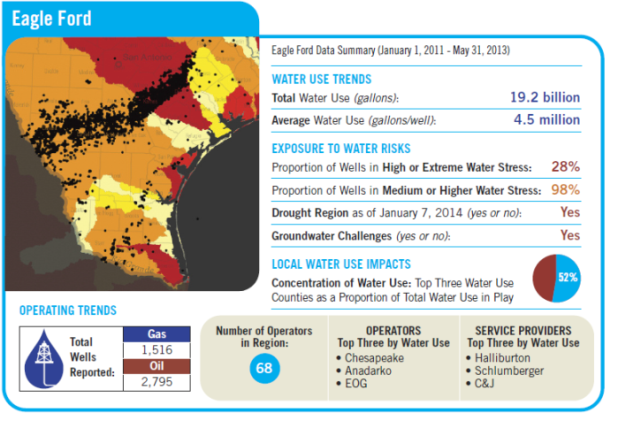
According to the Texas Energy Report, Senate Natural Resources Committee Chairman Troy Fraser, called the energy industry a bit too “thirsty” during a record one-year drought, and warned the oil and gas companies to ramp up the recycling of water consumed during hydraulic fracturing.

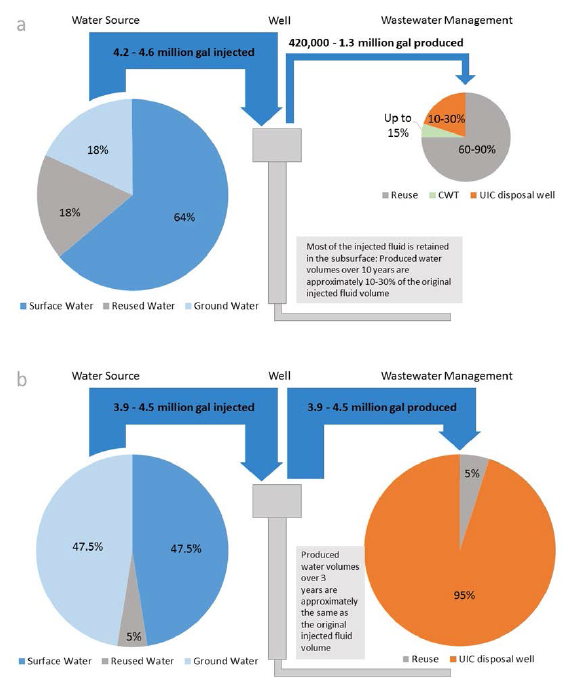
Currently much of the chemical-laced water and sand that Texas companies blast into shale formations to release oil and gas is later pumped back underground for disposal.

“It’s going to be an issue next session. I continue to tell the industry they’ve got to get aggressive about water reuse,” Fraser, a Republican from Horseshoe Bay in the Central Texas Highland Lakes region, said during a joint interim hearing on drought held by the Natural Resources and the Senate Agriculture and Rural Affairs Committees.

“In a drought situation, it’s starting to be a problem, a big problem in some areas,” Fraser added of the millions of gallons of water used in fracking. “I’ve been projecting for multiple months that this is coming and we’ve got a crisis out there.”

When asked about the water recovery program and how much water is being recovered from fracking, the industry representative responded that he did not have a specific number of how many companies recycle frack water but added that TXOGA has requested data from its members. He noted that while some companies do have significant recovery operations, others do not.

“Significant,”said Fraser. “That implies a lot.”  But the numbers from the industry were not there to back that implication up.

Fraser said he’d like to see more efficient water reclamation by cities, manufacturers and refiners as well, but he also took aim at the electric power industry.

“Long-term the power industry is going to hear me talking about figuring out a way to convert and get that technology,” he said. “We can’t continue to use the amount of water that we’ve used in the past. The way we are treating our water right now is not sustainable.”

John Fainter, president of the Association of Electric Companies of Texas, said everyone in the state needs to learn more and do more about conserving and saving and reusing water, but he added a threat of his own.  “There is a cost, and the public needs to be aware of that, just like the environmental requirements we’re facing,” he said.

Click here to watch the hearing.

Read Full Post »

The following are the Interim Charges focused on the current drought and wildfires as outlined by Lt Governor Dewhurst:

Business & Commerce Committee

  • Assess the impact of extreme drought conditions on electric generation capacity.
  • Identify those regions of Texas that will be most affected by a lack of capacity.
  • Analyze response plans and make recommendations to improve and expedite those plans.

Natural Resources Committee

  • Review water resources and conservation measures included in the State Water Plan.
  • Evaluate methods to enhance existing water resources and promote water conservation across the state at all times, not just in case of severe drought conditions.

Agriculture & Rural Affairs Committee

  • Review the impact of the drought on the Texas agricultural and ranching industry.
  • Develop methods and legislative recommendations to minimize the effects of drought and respond to the challenges for farmers and ranchers.

Economic Development Committee

  • Assess the economic impact of long-term drought on all sectors of the Texas economy.
  • Include additional analysis of economic consequences of wildland fires.
  • Develop a compendium of federal, state, and local funding and other assistance alternatives for reducing the long-term economic consequences of the drought.

Intergovernmental Relations Committee

  • Analyze ways to better coordinate existing federal, state and local housing resources to increase access to affordable housing following a disaster.
  • Review best practices for fulfilling emergency short-term housing needs and developing long-term housing opportunities using existing tools, such as land trusts, land banks and other available incentives.
  • Review housing and development codes, and guidelines for structures in areas prone to natural disasters, and make recommendations on how these structures can be “hardened” to avoid loss.
  • Make recommendations to educate and enable private landowners to use best practices in fire risk mitigation, fuel reduction and urban forest management to reduce exposure to wildland fires.

Subcommittee on Flooding & Evacuations

  • Investigate and evaluate communication options during evacuations and make recommendations for legislative action.

Transportation & Homeland Security Committee

  • Review state, local and federal emergency preparation and response efforts as they pertain to protecting lives, property and natural resources from wildland fire.
  • Consider ways to facilitate better communication, collaboration and response between all state agencies and stakeholders involved in wildfire prevention, mitigation and control.
  • Review training of emergency responders to ensure that they have the appropriate skills to respond to wildfire events.
  • Review best practices in urban forest management and fuel reduction policies, both regulatory as well as voluntary, to promote safe firefighting operations.

Read Full Post »

Solyndra was the pie in the face, but Keystone XL is the rake in the yard the White House needs to avoid.

Approval of controversial pipeline is bad for the environment, and bad politics, as it would offend not just environmentalists, but voters of all stripes across America’s heartland who would have the pipeline run through their backyards. It is another ethics landmine that would invite more attack from the WH’s political enemies about pay to play politics– this time because of copious amounts of Big Oil influence-peddling. 

We’ve previously talked about Solyndra. It’s not a problem with solar or of federal investment, but of questions about campaign finance and due diligence, problems which also exist in the much larger loan program for nuclear, especially when nuclear energy companies have been such big campaign backers of Obama’s.

In fact, worth reading is Brad Plummer’s Five Myths About Solyndra from the Washington Post, a great take from Climate Progress about the Solyndra timeline showing the  and this post from Blue Virginia showing there’s plenty of blame to go across the partisan aisle for this mess.

Money in politics will ALWAYS create these problems.  You can see here how a wireless company was trying to trade on their big dollar donations to get access to the White House.  This is why Obama must champion REAL campaign finance reform, specifically full disclosure of all independent expenditures and public financing options for people running for Congress.

But that is a tough legislative mountain to climb– and not one that it seems the White House has the intestinal fortitude for, given their willingness to always “compromise” (read: capitulate) to the Powers That Be. But those Powers That Be don’t Be without the steady stream of money they pour into campaign coffers, so its unlikely that Obama would rush to reform that system that has, so far at least, worked out better for him than his opponents.

So while it is unlikely Obama can avoid the ethical morass and swampland that is money for access and favors, one landmine he can avoid in approving the Keystone XL pipeline that would bring the world’s dirtiest oil from Canada to Texas.

Not only should we be seriously questioning the safety and integrity of our pipeline system after spills from as far afield as downtown Salt Lake City to Kalamazoo to Yellowstone National Park, but this graphic from the New York Times shows the large spills we’ve had all over the country just from existing pipelines

The other question is obviously one of addiction. If we are to take seriously the metaphor of an addiction to oil, then Keystone XL is like a new meth dealer moving in next to our heroin dealer. Climate scientist Jim Hansen has called the approval of the pipeline “game over” for the climate.

But besides a discussion of the merits, there is the question of why is this the rake in the yard Obama needs to avoid? It starts with the voters, specifically those who will be affected by this pipeline.

Today at 1:30 pm Texas time, East Texas landowners who made up the group Stop Tarsands Oil Pipelines, or STOP, held a press conference detailing their opposition to this proposed monstrosity. Among their chief complaints were that the State Department had failed to account for the current devastating Texas drought in their environmental impact study.   From STOP:

Strike 3: State Dept’s 3rd Pipeline Assessment Ignores Texas Drought

DOS puts Europe/China’s oil supply ahead of water for 12 million Texans and ag lands as wildfires burn

East Texas cattle rancher Don Williams has trimmed his herd in half, lost calves to drought, and now faces wildfires burning just 20 miles from his ranch.  Even before all of this, Williams was concerned about the impact the proposed Keystone XL tar sands pipeline would have on water supplies in the Carrizo Wilcox aquifer, which most East Texans rely on.
When he learned that the State Department, in their review of the proposed pipeline, had not even looked at what drought conditions meant for the pipeline’s safety, he was outraged.
“We need that aquifer, and that they could just ‘overlook’ what’s happened here in the last year shows we can’t trust what they’re telling us,” said Williams who also serves on the City Council in New Summerfield, a town of just over 1,000 people. “Tar sands oil isn’t like regular crude – they’ve got to pack it with heavy metals and chemicals just to thin it down enough to pump it. The first pipeline they built spilled at least a dozen times in just one year of operation.”
A report released today by an East Texas group called Stop Tarsands Oil Pipelines corroborates Williams’s story, demonstrating

Drought? What Drought?

that the historic Texas drought, which has been devastating communities and grabbing headlines all summer long, was overlooked by the US State Department in its third and purportedly final environmental impact statement (FEIS) on the controversial Keystone XL tar sands pipeline.

“Texas is burning, our firefighters have faced 300 consecutive days of wildfire,” said David Daniel, STOP’s Founder and President. “I’ve seen firsthand that a tar sands pipeline spill in Michigan is still contaminating water 14 months later, putting 40 miles of the Kalamazoo River off limits. If we had a similar spill in Texas under conditions like these where could we go for water for our homes, farms, and ranches?”
The report issued by STOP examines the implications for operating the proposed pipeline, which would push the denser and more toxic tar sands oil at higher pressures and temperatures than conventional oil pipelines, during droughts like the one currently scorching Texas. According to STOP, the impacts of a severe drought were ignored by the U.S. State Department in its review of the environmental impacts of the proposal.
STOP also documents that the Texas Commission on Environmental Quality has placed six TransCanada water withdrawal permit applications on hold due to drought.
“If State Department had bothered to talk to any Texans they would have realized that pumping 830,000 barrels a day of tar sands crude through the middle of Texas would be a grave mistake,” said Don Williams, East Texas Cattle rancher and City Councilman, New Summerfield. “We need all the water we have to keep our farms and ranches in business.”
To make matters worse, says David Daniel, the oil being delivered by this pipeline may not be intended for U.S. consumption. He points to a report by oil industry economist Philip K. Verleger, which concludes that the tar sands oil is much more likely to be exported to global markets for consumption in China and Europe.
“They’re selling this pipeline to the public as energy security, but the truth is that U.S. demand for oil has flat-lined whereas China’s demand keeps growing,” says Daniel. “Dr. Verleger is an oil industry economist who just happens to also be honest about what he sees, which is more than I can say for TransCanada after dealing with them the last couple years.”

You should visit their website at stoptarsands.org to listen to the rest of their stories. Their full study on the drought vs. the pipeline can be found here. 

Beyond that, with lobbyist ties to the White House, this makes approving the decision for the Keystone XL the biggest affirmation that pay-to-play politics and revolving door between industry and government are alive and well in Washington DC. TransCanada, the owner of the proposed pipeline, hired former Clinton campaign staffer Paul Elliot and several other Obama staffers to lobby the State Department and the White House. Is it any wonder why their analysis would overlook something so obvious as the Texas drought when they are being lobbied to get this out the door as quickly as possible?

It’s worth noting this is the third flawed FEIS that the State Department has produced. Three strikes and you’re out? Well, if there was any justice in this world, yes, as it would be obvious this is not due diligence, but pure politics and a Potemkin village of looking at impacts to local residents and their water supplies. It is a boneheaded mistake, and makes it look like the Obama administration is full of a bunch of rookies, making obvious mistakes like forgetting drought.

If Obama wants to avoid having his Presidency resemble The Three Stooges any more, he needs to clean the pie off his face from Solyndra, and don’t even go close to that rake. He can’t afford another similar self-inflicted wound, especially one that is not only so avoidable but also happens to be the right thing to do.

Now where are those three nincompoop chandelier hangers I hired?


Read Full Post »

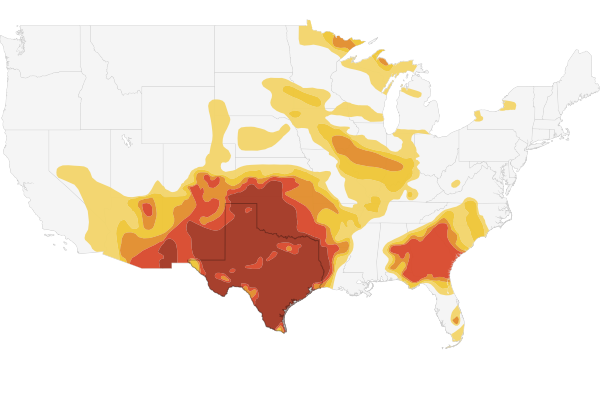
The worst Texas drought since the 1950s has a handful of cities facing a prospect they’ve never encountered before: running out of water.

Many lakes and reservoirs across the state are badly depleted after more than a month of 100-degree temperatures and less than 1 inch of rain. The worst-off communities are already trying to run pipes to distant water, drilling emergency wells bringing on systems that turn waste water into tap water and banning water use for virtually anything beyond drinking, bathing and keeping businesses working.

Worst-case scenarios have a few towns running out of water in a matter of months.  Although Texas cities have gone bone-dry before —Throckmorton in 2000 — the nearly 500 water systems statewide now under some mandatory restrictions appear unprecedented.

Prayer gatherings for rain have been held across the state, the most notable being called by Governor Rick Perry in July.  So far, these measures have not brought even the promise of rain for most of us.

In the town of Llano, near Austin, which went to Stage 5 water restrictions back around the 4th of July weekend, officials have made a contingency plan to roll trucks of bottled water into town if rain doesn’t start to replenish the water supply, and workers are drilling test wells into parched, rock-like soil. Water restrictions are in effect in unprecedented in places like Midland, where barely a half-inch of rain has fallen since October of 2010.

If La Nina conditions return this fall, which the Climate Prediction Center says is likely, Texas is unlikely to see any significant relief from this drought well into next year.

As I sit at my desk with the sun pouring through the window heating everything around me, knowing that just outside the front door it is still a soil scorching 103 degrees F, I think that it may be time to raise the specter of (duhn-duhn-duhhhhhhn) CLIMATE CHANGE.  Even if Governor Perry is traveling around the country telling everyone that scientists have cooked up the data on global warming for the cash, the numbers here in Texas seem to be refuting his claim and you can expect to see us blogging about it soon.

Read Full Post »

August 10 LCRA Board meeting canceled after White Stallion water contract pulled from agenda

Discussion and possible action by the LCRA Board of Directors on a contract to provide water to a proposed new coal plant in Matagorda County has been postponed indefinitely. This decision comes after the company proposing the plant substantially changed the terms of the contract on Monday, Aug 1st which prompted the cancellation of the special-called Aug. 10 meeting of the LCRA Board.

The new proposal by White Stallion asks for more time to pay the $55 million ($250,000 a year instead of $55 million upfront) and significantly reduces the amount of water reservation fees White Stallion would have to initially pay. The new proposal included other changes, some unprecedented for an LCRA water contract.

We say, good for the LCRA Board and thank you Senator Fraser for stepping in and asking the LCRA to call a moritorium on water contracts in light of this exceptional drought that blankets three quarters of the state.

Finally, thank you to the 2,200 Texas citizens who sent in cards and letters to the LCRA opposing this contract.  You made a difference.

Read Full Post »

At LCRA’s Board of Directors meeting on June 15, 2011, they discussed a contract to sell up to 25,400 acre-feet of water a year to White Stallion Energy Center for a power plant in Matagorda County.  The LCRA Boardroom was filled with citizens against the contract, and the board heard public comments with 30 signing up to speak, only 2 of whom spoke for the contract.  Matagorda County Judge, Nate McDonald, asked the LCRA board to table the item and take more time to determine the impact a water contract of this size would have on the area.  Board members then voted to defer a decision on the contract until its meeting scheduled for August 10.

Because of the size of the request, LCRA staff has developed a proposal that will address the water supply of the entire lower Colorado River basin.  Read the proposed draft water contract and fact sheet.

A meeting has been scheduled in Bay City, on July 28th, we have no additional details about that meeting at this point.

Read Full Post »

In their ongoing effort to accomplish a cold shutdown by January, Tokyo Electric Power Co (Tepco), the beleaguered operator of the crippled Fukushima Daiichi nuclear-power plant said it had resumed the use of recycled water to cool the reactor cores this weekend, a week after its first attempt was suspended due to leaks that developed within minutes of starting up the recycled water system.

Tepco has installed a tank to store 1,000 metric tons of decontaminated water to complete the recycling system, stabilizing the water source for cooling the Nos. 1-3 reactors, eliminating the need to use fresh water from an outside source to cool the reactors, and creating even more irradiated water, which then requires storage or disposal.

Establishment of a closed cooling system is essential to stabilizing the Daiichi reactors and getting the reactors to cold shutdown, which is defined as lowering the temperature of the fuel rods to below 100 degrees Celsius—water’s boiling point—and keeping it there.

If Tepco’s current efforts are successful, they hope to increase the flow of water and bring down the reactor-core temperatures, which currently hovers between 100 and 160 degrees Celsius.

Even if the recycling system works smoothly, Japan is still left with the problem of how to dispose of the radioactive sludge being created during the filtering process.  Japan, like Texas, has a disposal site for low-level radioactive waste, but there are no guidelines for disposing of the type of sludge now being created, which is expected to total 706 metric tons.

In the meantime, work at the complex is being hampered by the unseasonably hot weather.  There have been 17 reported cases of heatstroke at the plant in recent weeks.

And if that wasn’t enough

Tepco also faces other issues as senior members of Japan’s government developed secret plans to break up the nuclear plant operator, according to reports uncovered by Reuters.

The plan would bring nuclear operations of Tepco under government control, and force Tepco to sell its power distribution business.  Only the power-generation operations that use thermal and hydraulic power plants would remain as the company’s business cutting Tepco’s size to one third of its current operations.

I guess a really, really big mistake costs industry really, really big.

Read Full Post »

Lake Travis Levels Plummeted During 2009 Drought

Today the Lower Colorado River Authority (LCRA) Board of Directors delayed a vote on providing water to the “White Stallion” coal plant proposed for Matagorda County. Though White Stallion’s Chief Operation Officer, Randy Bird, was expecting and asking for approval of a contract today, the board chose to delay action until August 10. This makes sense considering that they were confronted with more than 30 people who signed up to speak against the coal plant, some driving from as far away as the Gulf Coast (some taking off work) in order to be there. This delay is a victory for those opposing the coal plant and a step in the right direction in convincing the LCRA that this project is not a beneficial or responsible use of water from the Colorado River Basin.

Key concerns included the general aspect of this project and the negative effects it would have on the people, environment (and watershed) of the region. There were also, as expected, many concerns regarding the current drought and many agreements that the last thing LCRA should consider is adding more, firm water commitments particularly when LCRA is already asking customers to conserve and scale back their water use. Concerns about how global warming would further worsen dry conditions in the region over the next 55 years (the length of the proposed contract) were also voiced by many of the speakers.

“Even though they haven’t denied it yet, we’re glad they’re taking their time to look into the serious implications of this coal plant request” said Lydia Avila with Sierra Club.  “We’re confident that when they look at the facts they will realize this is a bad deal for Texans and reject it.”

Only one or two people spoke in favor of granting the contract, one of whom was Owen Bludau, Executive Director of the Matagorda County Economic Development Corporation – one of the original entities that worked to bring the White Stallion proposal to Bay City. Those speaking against the contract included Matagorda County Judge Nate McDonald, Burnet County Judge Donna Klaeger, David Weinberg (Executive Director of the Texas League of Conservation Voters), Doctor Lauren Ross (who recently released this report on how White Stallion would affect water in the Colorado watershed), and many others including concerned residents throughout the LCRA region and landowners located right next to the proposed plant site.

Public Citizen applauds LCRA’s decision to table this vote. It shows that the LCRA takes the concerns of their stakeholders seriously. The next two months should prove to the LCRA that this coal plant is both unnecessary and a waste of our most precious and dwindling resource: our water.

Update and thank you!

Public Citizen wants to thank all of you who responded to our emails, blogs, tweets and phone calls and either called, mailed, or emailed comments in, and to those who showed up and packed the meeting room today.  This decision would probably have been very different if you had not made your concerns know to the board.  You are all awesome!

Read Full Post »

The 2009 record drought left the lower Colorado river basin stricken, but rains following the drought had made major inroads to recovery.  Now as Texas sees more than half the state in an “exceptional” drought with no end in sight, the board of the Lower Colorado River Authority (LCRA) could decide on Wednesday to sell at least 8.3 billion gallons of water a year to the proposed White Stallion coal-fired power plant near the Gulf coast in one of its first major water contracts since the last drought.

As I look out at the crisp brown vegetation baking in the easement outside my window, and the relentlessly hot air shimmering and dancing before me, I am concerned that there isn’t enough water right now for current stakeholders — cities, farmers, the environment and all the businesses that currently depend upon Lake Travis and Lake Buchanan for their existence.

Manufacturing and electric generation required 184,329 acre-feet of water in 2010 , according to estimates by the Lower Colorado Regional Water Planning Group, which provides statistics for the state water plan. By 2060, that number is expected to rise to 356,430.

Despite active opposition to the plant in Matagorda, the LCRA is likely to award the 40-year contract.  It has long held that it is OBLIGATED to sell water as long as it has water to sell and the use is a beneficial one.

John Dickerson, the LCRA board member who represents Matagorda, wants more time to review the contract saying, people in his district are against the plant and this is played out in a public outcry.  The LCRA board has received 2,260 letters and emails opposed to the project and only one letter in support.  In addition to local opposition to this plant, the State Office of Administrative Hearings (SOAH) recommended against granting the permit.  But true to their nature, the Texas Commission on Environmental Quality (TCEQ) granted the permit.  Sierra Club sued in district court and we are currently awaiting the final judgment that will remanded the permit application back to TCEQ to start all over again.

TAKE ACTION

It is important that Texans show up at the LCRA board meeting to speak out against this disastrous water contract.  This is no need to hurry this process and no need to tie up precious Central and South Texas water for an unwanted project.

When:              15 Jun, 9:00 AM

Where:             LCRA Headquarters
3700 Lake Travis Blvd.
Austin, TX 78703 (Map)

Host:               Josh Nelson

Status:             Public, open for RSVP, 10 Guests (Max 100)

To RSVP click here and sign up through CREDO Action

If you can’t attend the meeting, email or call and tell them that you oppose the Lower Colorado River Authority approving the White Stallion coal plant’s requested water contract.

Main Switch Board number is 1-800-776-5272, tell them you want to leave a comment on a board agenda item for Wednesday and they should direct you to the right person.

Or you can submit (their online form says question and they don’t seem to have an option to submit comments, but you can use this) by clicking here.   Be sure to reference the board member if you live in their service area county.

  • Timothy Timmerman, chair, Travis County
  • Rebecca A. Klein, vice chair , Bexar County
  • Kathleen Hartnett White,  secretary, Bastrop County
  • J. Scott Arbuckle, Wharton County
  • Steve K. Balas, Colorado County
  • Lori A. Berger, Fayette County
  • John C. Dickerson III, Matagorda County
  • John M. Franklin, Burnet County
  • Jett J. Johnson, Mills County
  • Sandra Wright Kibby, Comal County
  • Thomas Michael Martine, Blanco County
  • W.F. “Woody” McCasland, Llano County
  • Michael G. McHenry, San Saba County
  • Vernon E. “Buddy” Schrader, Llano County
  • Franklin Scott Spears, Jr., Travis County

Read Full Post »

 UPDATE:

Judge Sam Sparks of the US District Court for the Western District of Texas just dismissed the case to enjoin the Compact Commission meeting tomorrow, saying while he was concerned about the issue of citizen’s ability to participate fully, he did not have jurisdiction to enjoin the meeting, and threw the whole case out allowing the vote on the rule to go forward tomorrow.

So, the Compact Commission is still planning to meet in Andrews, Texas at 9 am tomorrow (Tuesday) morning at 9 AM, at the James Roberts Center located at 855 Hwy 176 East, Andrews, TX 79714 . . .  Please join us if you can!

UPDATE:

The Compact Commission is still planning to meet in Andrews, Texas at 9 am tomorrow (Tuesday) morning at 9 AM, at the James Roberts Center located at 855 Hwy 176 East, Andrews, TX 79714 . . .  Please join us if you can!


Legal Maneuvers Still Underway
The Commission could vote on the Import rule at this meeting. Passage would allow import of radioactive waste from all the states, and through a loophole, potentially the whole world. It would be disposed of through shallow burial at the Waste Control Specialists (WCS) site in Andrews County, Texas. The TCEQ does set license limits for the site, but the import rule sought by WCS and most members of the Compact Commission is a backhanded way to force license expansion.
Legal efforts by Public Citizen resulted in a Temporary Restraining Order for tomorrow’s meeting.  Now the AG is jumping in, although they should have nothing whatsoever to say about this, since they have made clear that they can’t represent the Commission, only individual members.
There is now a 3 pm hearing (today) with US District Judge Sam Sparks at the Federal Courthouse, 200 W. 8th Street in Austin.
Proceedings here could impact the Andrews meeting scheduled for tomorrow in Andrews, but we’re counting on the meeting still happening and heading out west after the hearing.

 UPDATE:

A hearing on the temporary restraining order (TRO) against the Texas Low-level Radioactive Waste Disposal Compact Commission’s (TLLRWDCC) hearing on their proposed rule to open Texas up to taking waste from states outside the current compact states of Texas and Vermont is scheduled for 3pm in Federal Court, Judge Sam Sparks presiding. The motion was filed by GNI Strategies.

No hearing has been set on the motion to dissolve TRO in state court.

ORIGINAL POST:


###

By promoting cleaner energy, cleaner government, and cleaner air for all Texans, we hope to provide for a healthy place to live and prosper. We are Public Citizen Texas.

Read Full Post »

Originally posted at jimhightower.com

Here in my home state of Texas, we’re suffering from withdrawal pains.

This is not caused by our addiction to alcohol or drugs – but to plain water. And to make our pain worse, it’s not the people of Texas who are hooked on a destructive water habit – it’s the boneheaded executives and greedheaded investors in coal-fired and nuclear-powered plants that generate electricity. (more…)

Read Full Post »


The No Coal Coalition brings their mascot, Pancho the Donkey, to the TCEQ hearing, but he is turned away. Photo by Susan Dancer

On Thursday, the TCEQ (Texas Commission of Environmental Quality) held a public meeting for the White Stallion Energy Center at the Bay City Civic Center to hear feedback on the plant’s application for a wastewater permit. (more…)

Read Full Post »

Read Full Post »

A few days ago, Larry King interviewed T. Boone Pickens and if you were watching it, you heard him condemn the spill and the US dependence on oil then he raved about natural gas and how safe it is to drill for it.

Pickens is not the first. Many have claimed that natural gas is better, safer, and cheaper. Simply, that is not the case. I have written about a couple of natural gas blow outs and pipe fractures in Texas this month alone but this documentary examines several other elements of natural gas impact than just rigs blowing up.

Yesterday, HBO aired a documentary that is both eye-opening and disturbing. It is called GasLand, in which Josh Fox, the director travels across the United States to explore the damage and contamination that has resulted from drilling for natural gas. In the documentary, Fox points out the different impacts of natural gas; on our drinking water, the air we breathe, and the nature that surrounds us. If the pictures of evaporating water mixed gas into the air to get rid of the waste (process done by gas-drilling facilities) won’t tell how bad natural gas is, then I am pretty sure watching people lighting their contaminated faucet water on fire will.

Fox collects water samples from homes with contaminated water and sends them to a lab for examination. I will leave it to you to watch his outrageous findings in the documentary.

In case you missed it, Josh Fox’s GasLand will be airing on HBO at the following (central) times:

Thursday, June 24: 12:00PM

Thursday, June 24: 11:30PM

Saturday, June 26: 11:00AM

Wednesday, June 30: 08:45AM

For more information, visit the HBO schedule page or the webpage for GasLand.

Read Full Post »

Exelon Nuclear plans to file a 6,000-plus-page document that would give it as many as 40 years to begin work on a power plant in Victoria.

Exelon has looked at building a plant in this area of Texas since 2007. It plans to file an early site permit application with the Nuclear Regulatory Commission on  March 25, 2010.  This will allow them to keep their options open as the permit, if approved by the NRC, would give Exelon three to 20 years to decide whether to build a plant in Victoria County. It can be extended for another 20 years, giving the company up to 40 years to begin construction from the time that the NRC approves the permit.

Once the early site permit application is submitted, it undergoes a three- to four-year review process by the NRC in which it will evaluate the project’s environmental impact and safety preparedness.

The NRC will conduct a public meeting April 15 at the Victoria Community Center to explain what the review process entails.

Water use figures prominently into the concerns of many. The Guadalupe River is the designated water source for the possible power plant, and Exelon has a water reservation agreement with the Guadalupe-Blanco River Authority (GBRA) that expires in 2013.

In the agreement with the GBRA, Exelon reserved 75,000 acre-feet of water every year.  The plant’s water use supercedes that of other water users, including the city of Victoria and farmers in the region.

We strongly urge the public to attend this meeting.

###

By promoting cleaner energy, cleaner government, and cleaner air for all Texans, we hope to provide for a healthy place to live and prosper. We are Public Citizen Texas.

Read Full Post »

Older Posts »

Follow

Get every new post delivered to your Inbox.

Join 3,136 other followers