Feeds:
Posts
Comments

Posts Tagged ‘wind energy’

Texas Capitol - north viewTwo bills have now been filed in the Texas House that would expand the state’s goals for renewable energy.  Representative Rafael Anchia‘s bill, HB 723, would establish goals for growing renewable energy installations other than large-scale wind through 2022.  Similarly, Representative Eddie Rodriquez‘s bill, HB 303, would establish a goal for solar installations and increase the existing goal (which was met 15 years ahead of schedule) for all renewable energy for 2020.

We applaud these efforts and the leadership that Rep. Anchia and Rep. Rodriquez are showing by filing these bills.  These proposals recognize that success is a good thing and something we want more of.  You wouldn’t think that would need saying, but when a state agency recommends tossing out a successful policy, I start to wonder.  Texas’s renewable energy goals have been extraordinarily successful.  Not only have the goals been met ahead of time, but they have spurred development of the wind industry in Texas, bringing economic benefits to rural parts of West Texas, as well as to manufacturing centers.  On top of that, wind energy is helping to keep electric bills lower.

A carpenter doesn’t throw away her hammer just because she finished building her first book shelf and Texas shouldn’t repeal it’s renewable energy policies, just because we’ve met some of our goals (remember, the non-wind goal was never enforced).  Wind energy does now makes a substantial contribution to meeting the state’s electrical needs – it contributed a record 26% this past Christmas day, but solar energy is still very underutilized (accounting for less than 1% of energy on the ERCOT grid, which serves 85% of the Texas population) and the geothermal energy industry is still getting off it’s feet.  As Rep. Anchia and Rep. Rodriquez’s bills show, this successful policy tool can be adjusted to keep moving Texas forward.

Read Full Post »

As we close in on the end of 2012 with a winter front keeping temperatures low, Texas achieved a new wind power integration record of 8.638 GW on Dec. 25 at 3:11 p.m according to the Texas grid operator, the Electric Reliability Council of Texas (ERCOT).

Electricity from wind accounted for 25.71% of power being generated and used at that point in time, as the peak demand was 39.847 GW.  Of the 8.638 GW being generated by Texas wind farms, over 84% came from wind farms in West Texas, and 16% came from sites on the Texas coast.

More details can be found in ERCOT’s wind integration report for Dec. 25.

Read Full Post »

Orbach: $1 billion for energy storage research could launch state’s next energy era

Watch for the University of Texas at Austin to soon make a $1 billion pitch to lawmakers aimed at unleashing the state’s vast potential to lead the nation and even the world in renewable energy production.

Ray Orbach, director of UT’s Texas Energy Institute, has compiled what he considers a compelling case for a large public investment in battery storage research meaningful enough to launch Texas into a new energy economy that taps the state’s enormous potential capacity for solar, wind and geothermal power generation.

“I really would like to have a crash program. My thought is it could be comparable to the cancer initiative,” he told Texas Energy Report. “I would like to see it in the billion-dollar range. My point is the potential is there. I just think it’s crazy not to sit down and optimize it for Texas.”

Orbach said a new study found that Texas has the potential to lead the nation in nearly every form of renewable energy. In concentrating solar alone – which allows for fluctuations that make it more economical – tapping just one percent of Texas’ total capacity could generate electricity equivalent to the entire needs of the ERCOT (Electric Reliability Council of Texas) power grid, he said.

“We have as much energy potential above ground as we do below ground,” Orbach said this week to an audience attending a symposium sponsored by the Texas Public Utility Commission called “Renewable Solutions for Energy Prosperity in Texas.”

Citing a just released July study called “U.S. Renewable Energy Technical Potentials: A GIS-Based Analysis,” Orbach laid out what’s in it for Texas if the state’s leading scientific minds solve the energy storage puzzle:

Urban utility-scale photovoltaics:  Texas has the highest estimated potential (13 percent of the U.S.)

Rural utility-scale photovoltaic: Texas has the highest estimated potential (14 percent of the U.S.

Rooftop photovoltaic’s: Texas has the second-highest estimated potential (9 percent of the U.S.)

Concentrating solar power: Texas has the highest estimated potential (20 percent of U.S.)

Onshore wind power: Texas has the highest estimated potential (17 percent of U.S.)

Offshore wind power: Hawaii has the highest estimated potential, while Texas has 6 percent of U.S.

Enhanced geothermal systems: Texas has the highest estimated potential (10 percent of U.S.)

“The opportunities are so enormous. I was stunned,” Orbach said of his reaction when he read the study that takes into account environmental and land-use constraints, and topographical limitations.

Because each of the renewable capacity calculations is based on the same total land, Orbach said Texas leaders need to determine how to best optimize the state’s renewable resources with decisions about which fuel mix to pursue and where. In an interview, he acknowledged that political and economic considerations would pose major challenges, but he suggested a planning commission appointed by the governor and legislators could help navigate those.

Think of the planning concept as akin to the Texas Railroad Commission’s early history in setting production limits to ensure that oil and gas resources would last longer with conservation measures such as adequate well spacing, he said.  And think of state’s commitment to building CREZ (Competitive Renewable Energy Zones) transmission lines to transport wind energy as a parallel to the research commitment needed to solve the problem of energy battery storage for wind and solar.

With its federal production tax credits, Orbach said wind has posed pricing issues for ERCOT’s wholesale competitive market. But he insisted he’s a free-market advocate who does not think wind or solar would need any subsidies to compete. As for kick-starting research to solve energy storage issues, he said Texans should think of that as an investment that would repay itself many times over.

“Our future will depend on our ability to store base load electricity from fluctuating sources. We are truly blessed with intellectual and energy sources. It’s time for a zoning, an optimization of how we use these wonderful resources for the benefit of citizens in this state,” Orbach said. “This is not just a Texas issue. The market for what we produce in Texas is global. You can think outside the boundaries of our state for these opportunities.”

In addition to the big picture, some of Texas’ energy opportunities have hardly been discussed, he said. The potential for enhanced geothermal energy alone, he said, is 384 gigawatts. That’s equivalent to five times the total ERCOT load.

Geothermal energy taps into underground heat, and fracturing underground rock is one way to release the heat. He points to natural gas wells hydraulically fractured in the Barnett Shale of North Texas and their future to be repurposed in 10 to 20 years for renewable energy production. The wells have already fractured rock at a depth of 8,000 to 10,000 feet where temperatures range from 200-300 degrees Fahrenheit, he noted.

“What happens when those wells are played out? Do we just cap them and walk away? They are a source of potential enhanced geothermal energy. We have the sources now that we’re using for liquids and gas and oil that in fact may well be available in the future for enhanced geothermal,” Orbach said.

Meanwhile, the price of solar panels is dropping sharply as China floods the market with panels at 80 cents a watt, he said. Consequently, solar installations in the first half of this year doubled to 1,254 megawatts over the 623 installed in the first six months of 2011. That’s the size of a nuclear reactor, he said, and this year it will amount to two.

“It’s a revolution,” he added. “It’s a sign for those of us interested in solar and wind and renewable energy that there’s an opportunity here for Texas to be mined.”

By Polly Ross Hughes

Copyright September 14, 2012, Harvey Kronberg, www.texasenergyreport.com, All rights are reserved.  Reposted by TexasVox.org with permission of the Texas Energy Report.

Read Full Post »

The booming wind energy industry in Texas didn’t just pop up over night — it was a result of years of research, advocacy, and policy work.  Ever wondered how it all happened?  Smitty, the director of Public Citizen’s Texas Office, has a story to tell — check it out!

Seeing as we are just at the beginning of the history of wind, it is a story that is constantly evolving.  Coastal wind projects have been developed in Texas recently (look for a post on this very topic soon!).  Just this week, the Abilene Reporter News ran an article about a local professor and director of the Wind Science and Engineering Research Center at Texas Tech that testified on a bill in Congress that would pump $200 million annually into research and development for wind power.  While wind is of course a viable industry in its current stages, further R&D will allow it to provide an even larger portion of our total electricity needs, operate more efficiently, and be an even cheaper and more reliable form of energy.

While you’re at it, check out this recent article from the Guardian about the “furious search for practical, affordable electricity storage” so that excess energy produced when the wind is blowing but no one’s lights are on can be socked away and used when we need it most.

Read Full Post »

stop nukeOral Hearing Set for June 10th-11th in Granbury, TX
Citizen opposition to more nuclear reactors in Texas continues. On June 10th-11th an oral hearing will be held before the Nuclear Regulatory Commission’s Atomic Safety and Licensing Board on Citizens’ petition to intervene in Comanche Peak Nuclear Power Plant Units 3 and 4.

“I have many grave concerns about building more nuclear reactors in Texas,” said Texas Representative Lon Burnam, District 90, Ft. Worth, one of the petitioners seeking to intervene in the proposed expansion of Comanche Peak. “The risks are simply too high. As the most expensive and most water intensive energy source, and with the unsolved problem of how to handle the radioactive waste, Texans deserve better.”

SEED Coalition, Public Citizen and the Ft. Worth-based True Cost of Nukes are also petitioners. Attorney, Robert V. Eye, will go before the designated Atomic Safety and Licensing Board Panel and argue the admissibility of the 19 contentions citizens filed with the Nuclear Regulatory Commission on April 6th. These contentions point out the inadequacies and the incompleteness of Luminant’s combined operating license application (COLA) to construct and operate Comanche Peak Units 3 and 4.

“Luminant has failed to comply with new federal regulations regarding aircraft impacts,” stated Mr. Eye. “These new regulations are very specific and require the applicant to plan for catastrophic fires and/or explosions that would cause the loss of major critical functional components in the plant. After 9-11, an aircraft attack on a nuclear power plant is a real and credible threat. Moreover, fire hazards represent about half of the risk of a nuclear reactor meltdown. Luminant’s noncompliance with these regulations puts citizens around Comanche Peak in a dangerous position, which is completely unacceptable.”

“Nuclear power is dangerous, expensive and obsolete,” says Karen Hadden, Executive Director of Sustainable Energy and Economic Development (SEED) Coalition. “Wind energy is booming and the cost of solar is coming down, while the costs of proposed nuclear plants is skyrocketing. Although they’re required to do so, Luminant failed to fully consider safer, more affordable alternatives to nuclear in their license application.” (more…)

Read Full Post »

With the announcement of the Texas Legislature Committee rosters, I thought that some light should be shed on the 2009 Legislative Recommendations as posted by the Alliance for a Clean Texas. You can read the full reports here, but here’s a quick-read version for  renewable energy and energy efficiency issues:

  • Diversify our Renewable Energy Mix. Its no surprise to most of us that Texas is in first place for renewable energy resources. Legislation has historically supported wind energy, but so much of our potential has not been tapped. Studies have shown that that our potential for solar is even greater than that of wind.
  • Incentives for Solar Roofs and other On-site Renewables. Instead of relying on power plants to supply our energy, wouldn’t it be great if we could have our power sources closer to home? On-site renewable technologies would be cheaper considering the spike in energy costs during high-demand season, and of course would help to improve air quality. Solar power is especially efficient, with new technologies that can be installed directly on the roofs of buildings. However, the current cost of a home or commericial system is still not cost-effective without government incentives. Solar power is estimated to reach parity with traditional electricity sources within the next five years.  By getting a jump on it ahead of time, early investment will allow Texas to benefit economically as demand increases.
  • Raise the Energy Efficiency Goal. Texas should aim to decrease both energy demand and energy usage. ACT recommends that the Legislature should raise the goal to 1.0 percent of peak demand and energy use by 2015 (equivalent to 50 percent load growth by 2015). By contributing only a small percentage of revenue, utility companies can invest in energy efficiency programs that will decrease peak demand of energy usage. In 2007, the legislature unanimously approved a 20% decrease in load growth by 2009, and a research study required by the legislation also supported our ability to cut load growth by 50% by 2015. (more…)

Read Full Post »

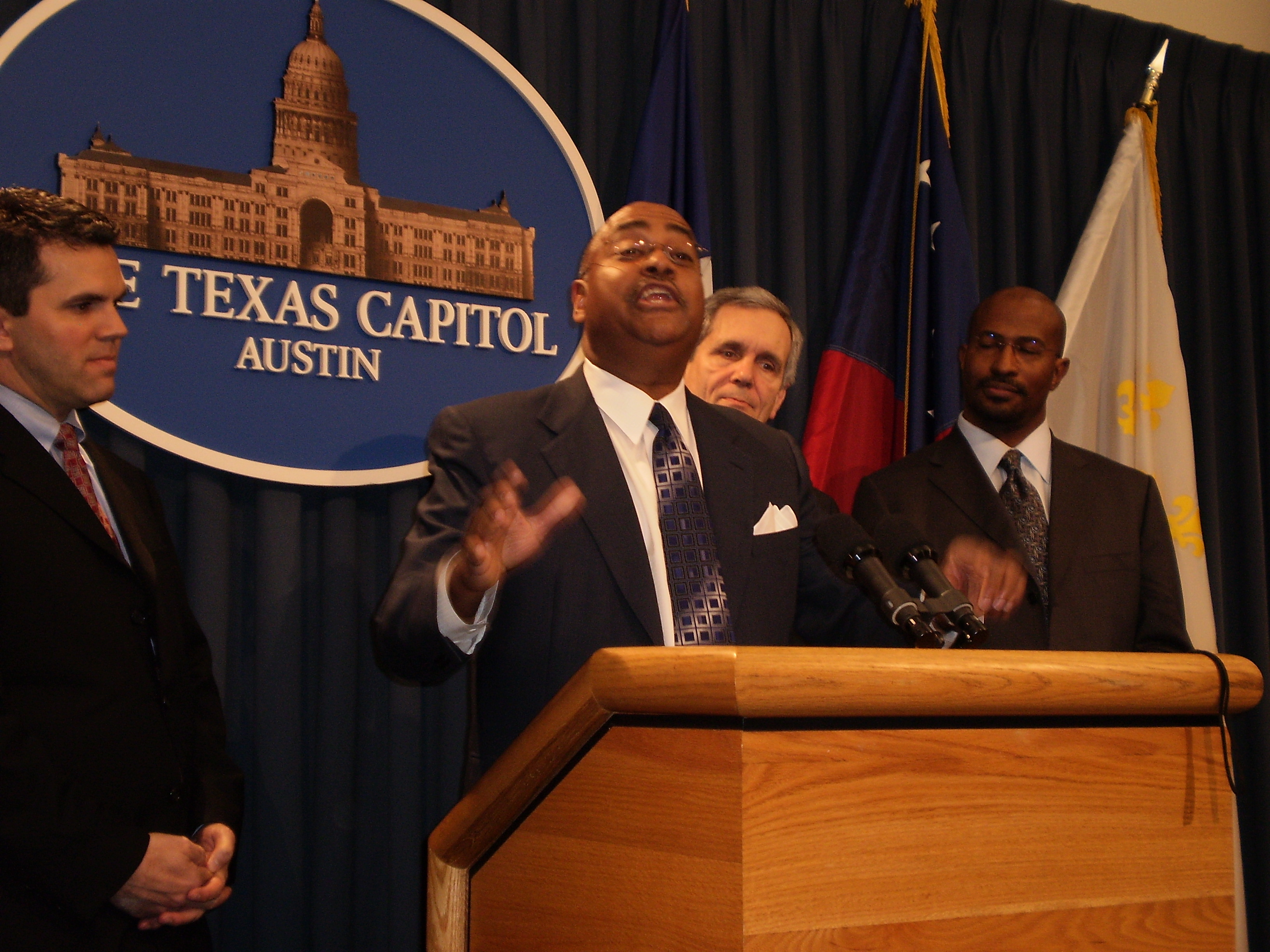
2_18_09-001Bright and early yesterday morning, US Representative Lloyd Doggett, State Senator Rodney Ellis, State Representative Mark Strama, and environmental and civil rights advocate Van Jones stood together to tout the Alliance for a Clean Texas’ Texas Energy Future: Clean Jobs, Green Power Conference.

Rodney Ellis opened up the press conference, stating that this year’s legislative session looks to be a very green session.  He also mentioned, as he has before, that the legislature is at a crucial moment in terms of climate change action. If the legislature doesn’t act this year, the federal government will likely pass and begin implementing comprehensive global warming legislation before the state legislature will have a chance to meet again.  If Texas is not prepared for this kind of drastic policy change, we may not have a chance to address these issues again until 2011.

Senator Ellis then gave the mic over to the group he termed the “Dapper Three” (swoon!).

Continue Reading and watch video of Van Jones after the jump! (more…)

Read Full Post »

Follow

Get every new post delivered to your Inbox.

Join 3,196 other followers