Feeds:
Posts
Comments

Posts Tagged ‘Carbon Dioxide’

It has been less than 24 hours since I received a copy of Austin Energy’s Generation Plan recommendation and there’s a lot here to like.  Before I get to the highlights, let me just say that those of you who spoke up, filled out the survey, played the sim game and demanded more renewable energy, energy efficiency, less dependence on coal, your voice was heard!

Here are the highlights:

Energy Efficiency: Goal increases from 700 megawatts to 800 megawatts by 2020, a new study on energy efficiency potential will be conducted and AE will target “baseload” efficiency more (previously they had really gone after peak reduction with an emphasis on load-shifting).

Renewable Energy: Goal increases from 30% to 35%. Doesn’t seem like a lot but it is. By 2020 Austin Energy will have 1001 megawatts of wind, 200 megawatts of solar (double what the previous goal was) and 162 megawatts of biomass.  They had originally thought to seek an additional 100 MW of biomass on top of what AE already has coming from Nagocdoches in 2012, but decided to scale that back to 50 MW. Not a bad idea considering the limited resource in Texas.

Gas: An additional 200 MW of combined cycle at Sand Hill. The expansion of the plant will provide balancing services to variable renewable resources.

Nuclear: Keep STP 1 & 2. Still saying no to 3 & 4 (woo-hoo!). If someone makes them an offer to contract for the power (we hope it never gets built), they’ll evaluate it.

Coal: The increase in energy efficiency and renewable energy should enable AE to reduce the capacity factor of their share of Fayette coal plant to around 60%, “setting the stage for eventual sale or other disposition of Austin’s share of the plant” (from the AE recommendation). At last night’s Electric Utility Commission meeting, Duncan said currently it’s at about 85-90%.

CO2 plan: Emissions would be 20% below 2005 levels by 2020 (Waxman, Markey, you got that?).

Water use: Water use intensity of the utility’s generation sources reduces by 20% from 724 gallons/kWh to 574 gallons/kWh. Most of that would come from running Fayette smaller.

Other notes: AE will heavily go after solar resources within the city. Duncan estimated that there is roughly 3,000-4,000 MW of solar potential in the city (both for electricity and solar water heating). AE also would work to develop energy storage like compressed air energy storage-aka CAES (case).

We have tons of questions and we’re still analyzing the plan. But our first impression is: this is a pretty good plan but it can be improved.  Roger Duncan and his staff deserve recognition. At a time when other utilities in Texas are actually still building new coal plants (CPS Energy, LCRA), Austin Energy recognizes the need to get out of coal. To hear this acknowledged by the utility publicly is very positive, but City Council needs to make this a commitment. The goal should be to see Fayette closed… sooner rather than later.

Obviously, this plan comes with a price tag. Once we get the chance to ask more questions and analyze the plan and possible variations of it we’ll do a more in depth post.

We look forward to a healthy debate on this plan over the next few months. To all you Austinites who want a clean and more sustainable utility, keep urging city council to go beyond coal!

-Matt

Read Full Post »

For any of you global warming denier trolls lurking out there, here you finally have it: ANOTHER final study that undeniably shows a link between manmade greenhouse gas emissions and the warming that has occurred.

Yes, yes, and the sky is blue as well.  AND the Earth revolves around the sun.  I know most of us don’t need more scientific evidence that putting pollution in the atmosphere fundamentally disrupts the climate, but what is most interesting about this study is it calculates a precise amount of warming per ton of CO2 or equivalent:

Until now, it has been difficult to estimate how much climate will warm in response to a given carbon dioxide emissions scenario because of the complex interactions between human emissions, carbon sinks, atmospheric concentrations and temperature change. Matthews and colleagues show that despite these uncertainties, each emission of carbon dioxide results in the same global temperature increase, regardless of when or over what period of time the emission occurs.

These findings mean that we can now say: if you emit that tonne of carbon dioxide, it will lead to 0.0000000000015 degrees of global temperature change.

If we want to restrict global warming to no more than 2 degrees, we must restrict total carbon emissions — from now until forever — to little more than half a trillion tonnes of carbon, or about as much again as we have emitted since the beginning of the industrial revolution.

The full article will eb published in the June 11 edition of Nature.

And if that wasn’t enough, this from the HuffPo about coal ash:

Aerial photo of the Kingston fly ash spill

Aerial photo of the Kingston fly ash spill

Just how bad has the coal ash situation gotten in the United States? So bad that the Department of Homeland Security has told Sen. Barbara Boxer (D-Calif.) that her committee can’t publicly disclose the location of coal ash dumps across the country.

The pollution is so toxic, so dangerous, that an enemy of the United States — or a storm or some other disrupting event — could easily cause them to spill out and lay waste to any area nearby.

There are 44 sites deemed by the Environmental Protection Agency to be high hazard, but Boxer said she isn’t allowed to talk about them other than to senators in the states affected. “There is a huge muzzle on me and my staff,” she said.

“Homeland Security and the Army Corps [of Engineers] have decided in the interests of national security they can’t make these sites known,” she said.

There are several hundred coal ash piles across the nation, she said, all of them unregulated.

“If these coal ash piles were to fail they’d pose a threat to the people nearby,” she said. While keeping it from the public, DHS is alerting first responders as to the location of the piles.

“I believe it is essential to let people know,” said Boxer, arguing that if people knew what was in their backyard they’d press public officials to clean it up and protect the area. “I think secrecy might lead to inaction…I am pressing on this.”

Especially in the wake of Kingston fly ash disaster, which was the worst environmental disaster ever in the US– worse even than the Exxon Valdez- this seems pretty simple to me: climate change is caused by greenhouse gases, coal is the major contributor to CO2 emissions, coal ash is so dangerous we can’t even know where the dumps are because of national security… so, let’s stop burning coal? That’s a solution so easy, it’s not surprising anyone in Washington (or for that matter, Austin) hasn’t proposed it.  Oh wait, we have.  It’s called a coal moratorium, and we should be doing it.  For more info, visit www.coalblock.org

Read Full Post »

For real, we gotta act now before it escalates.

Read Full Post »

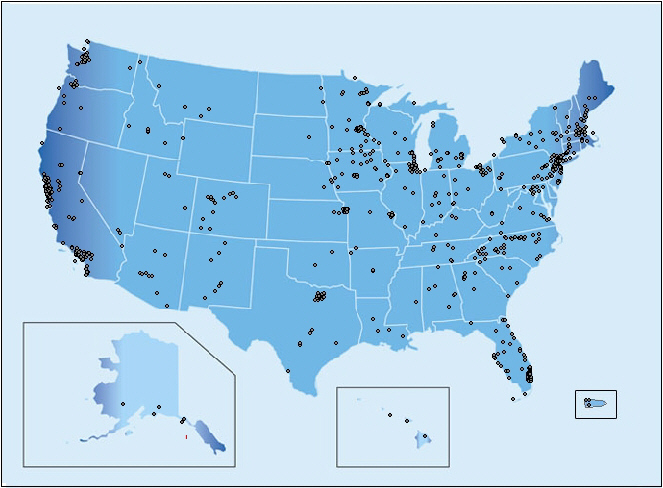
US_mapClimate change is clearly an important issue, and there is a lot that needs to be done about it at all levels of society. Fortunately there have been individuals and localities that have made great efforts to reduce their carbon footprint, and this should be applauded. I want to focus on a particular success in the area of local effort to reduce emissions and improve efficiency: The Mayor’s Climate Protection Agreement. This is an agreement between the mayors of several hundred participating cities, across the U.S to reduce their emissions to 7% below 1990 levels.

The agreement was started on February 16, 2005 by Seattle Mayor Greg Nickels and there are currently 944 participating cities in the United States that have pledged to reduce their emissions below 1990 levels. The agreement was officially endorsed by the Annual U.S Conference of Mayors in 2005, and the conference has actively encouraged Mayors to sign onto the agreement since. Mayors in participating towns and cities use practices such as vegetation restoration, anti-sprawl policies, emissions controls and efficiency improvement activities to improve their climate friendliness. (more…)

Read Full Post »

We’ve been disappointed by the process that the American Clean Energy and Security Act has gone through recently, so a few weeks ago I went to go see my Congressman during his “neighborhood office hours” (at the Randall’s at the corner of William Cannon and MoPac) and talk to him about climate change.  Then this morning  I opened up my email inbox to find a communique from Congressman Lloyd Doggett.

Needless to say, it made me happy, so I’m sharing it with all of you.  This should serve as an example– contact your leaders and tell them how you feel about issues like climate change.  They do listen!  (Or if they don’t– make them!)

I also think his ideas about the “Safe Markets Development” would be a major improvement to any climate bill.  Read on to find out that experts also think it’s a good idea!

Full text after the jump….

doggett banner

May 28, 2009

Mr. Andrew Wilson

5xxx Little Creek Trl

Austin, Texas 78744

Dear Andy:

Knowing of our shared interest in fighting global warming and creating a robust green jobs economy, I would like to update you about my work in Washington.

This is an exciting time for those of us who have long wanted to make renewable energy affordable. Never before has there been such a push from both politicians and concerned citizens like you to get something done.

We cannot allow the fossil fuel special interests to blacken our chances at achieving a strong, clean energy economy in the same way that they blacken our skies. It is critical that the climate legislation this Congress produces ensure both price stability and environmental integrity.  To this end, I have introduced the Safe Markets Development Act. I designed this act to

-Cap carbon pollution;

-Head off market manipulation;

-And incentivize renewable energy technology.

I have also introduced the Green Transit Act, which would require metropolitan planning organizations to consider greenhouse gas emissions in long-range transportation plans and transportation improvement programs. Transportation is an integral factor in the transition to a clean energy (more…)

Read Full Post »

While we at Public Citizen Texas are fighting the building of new coal power plants in Texas and the surrounding states, the focus has largely been on the CO2, sulfur and other pollutants emitted into the air by the burning of coal, not to mention its inefficiency as a fuel source. We often over look or neglect to think about the huge environmental destruction associated with getting coal out of the ground, as well as the history of health and safety risks associated with coal mining.
Historically these issues were brought up as some of the biggest objections to the use of coal as an energy source. One just needs to listen to John Prine’s “Paradise” or read any of the works by Wendell Berry on the topic (both document destruction caused by strip mining in Kentucky) to see how important the impact of coal mining was to environmentalists of past generations. This shift in focus has in no doubt been due the transfer of mining away from more populated regions to remote regions like the Powder River Basin, in Wyoming.

Traditionally coal mining has taken place underground and has been done by miners with shovels and picks (often exposing workers to dangerous and health compromising conditions). This is still the image of coal mining that resides in America’s popular consciousness. However this image is no longer accurate, as 67% of America’s coal is now extracted from the earth above ground. Surface mining techniques have become very popular for coal production since the development of steam shovels in the early twentieth century. Surface mining techniques revolve around removing the layers of Earth (overburden) above with large machines to expose the coal field to the surface where workers can easily extract it. This technique can be used to extract coal that is up to 200 ft deep within the Earth. (more…)

Read Full Post »

Check out the following letter to the editor from the Abilene Reporter News.  Turns out a local resident of Sweetwater recently had a revelation about the nature of coal and carbon sequestration.  Interesting theory…

Why are we digging up stuff God wants buried?

I believe that God has a purpose for coal, and it’s up to us to figure out what that purpose is. When I was posting to an Abilene Reporter-News thread on Monday, I believe he gave me the answer! God developed and implemented the Carbon Capture And Sequestration system on Earth! He captured the carbon dioxide, the mercury, the arsenic, the leadque and many of the other hazardous chemicals and bound them up in a matrix that we call coal! He bound up this matrix in such a way so that the materials he put into it would stay sequestered forever! He took that matrix and buried most of it, so it would be well below the life zone of Earth. Locked away forever.

He knew the planet would produce more carbon dioxide than the plants could ever recycle. He knew the mercury would contribute to autism in his children. He knew that arsenic caused death and that lead would cause nerve damage and learning disabilities. He knew if he buried it, it would make it more difficult for us to use it to screw up his creation! And here we are today, digging up what he has covered up, releasing the poisons he so lovingly protected us from, releasing them into death and destruction in his world! Releasing them into the life zones of his creation!

God invented the sequestration concept, why do we have to keep digging up his work and bringing the pollution back into our lives!

Jimmy Headstream

Sweetwater

Read Full Post »

Public Citizen disappointed by process as Big Money works to weaken, kill bill

Statement by Andy Wilson, Global Warming Program Director, Texas Office

This evening, the House Energy and Commerce Committee passed HR 2454, The American Clean Energy and Security Act (ACES or ACESA), sponsored by Henry Waxman (D-CA) and Ed Markey (D-MA), by a margin of 33 – 25.

We would like to thank Gene Green (D-Houston) and Charlie Gonzalez (D-San Antonio) for their support of this step towards clean energy and saving the climate from runaway global warming. It is unfortunate, however, that they chose to weaken the energy efficiency and renewable energy sections of the bill, as stronger mandates would mean more local jobs and more savings for Texans.

They also supported giving away billions of dollars worth of carbon credits to polluters for free, despite knowing that these giveaways hurt low income households the most.

Big money was the deciding factor in this process, with the energy industry donating a total of $3.1 million on all members of the Energy and Commerce Committee in the 2008 campaign cycle, with nearly $2.3 million of that going to committee Republicans, who presented nearly monolithic opposition to the bill and attempted to weaken it at every turn. Ranking member Joe Barton (R-TX) received $406,887 in campaign contributions from the energy industry, the largest amount of any member on the panel, and orchestrated the GOP opposition. Notable opposition to the bill came from Jim Matheson (D-UT), who received $103,097, Charlie Melancon (D-LA), who received $125,100, John Barrow (D-GA) who received $88,743, and Mike Ross (D-AR) who received $59,800. The first three of these received more money from the energy industry than any other Democrats on the panel, while Ross was the fifth largest recipient among Democrats.

The architects of the compromises which weakened the bill also received large contributions from the energy industry, including Rick Boucher (D-VA) who received $67,300 and was the architect of the plan to give coal-fired electric utilities nearly all of their pollution credits for free. A similar deal was struck with oil refineries, whose donations to Gene Green (D-TX) and Charlie Gonzalez (D-TX) along with other energy industries was equal to $84,500 and $51,250, respectively.

Unfortunately, the bill leaves the committee weaker than it came in. It has moved to a short term reduction of CO2 emissions of only 17%, even though the research by the Nobel Prize winning IPCC shows that target needs to be closer to 30%. This bill is also potentially a budget buster, as it has moved away from President Obama’s original position of auctioning all of the pollution credits to giving away credits worth billions in revenue to industry for free. By giving away 85% of all carbon credits to industry, the Congress has also limited their ability to help low-income consumers and invest in efficiency, renewable energy, and international programs to aid lesser developed countries. Furthermore, they have added unlimited loan guarantees to the nuclear industry, even though the Government Accountability Office (GAO) has stated that it is likely that more than 50 percent of all nuclear loans will fail. The loan guarantees would be used to

Even worse, by giving away too many credits to special interests, we will repeat the mistakes of the European carbon market, where too many credits were given away at the outset and actual carbon reductions did not occur. Utilities still passed on “compliance costs” to their customers and prices increased, which led to the EPA’s analysis of the Waxman-Markey draft that any giveaways to industries are “highly regressive.”

A well designed cap and invest program with strong efficiency and renewable energy standards would save the average Texas household $900 per year according to a study by the Union of Concerned Scientists. We fear that by weakening the bill, as the Energy and Commerce Committee has, this savings could evaporate.

Now that the committee process has ended, it is now the responsibility of every Texas Representative to strengthen HR 2454. The bill needs to move back to scientifically and economically based goals in order to protect consumers and create a green jobs future for every family in the country.

Read Full Post »

This afternoon Waxman and Markey finally formally introduced H.R. 2454, the American Clean Energy and Security Act of 2009. Up to now, they’ve just been circulating an unofficial ‘discussion draft’, but now that we’ve got some actual language (932 pages of it), we’ve got a better idea of the bill’s specifics.

And it looks like some of the specifics are significantly watered down from the original draft, largely thanks to Texas’ own Congressmen Charlie Gonzalez and Gene Green.  According to a CongressDaily article, “Waxman To Release Draft Text After Striking Late Deals,”

Eyeing the start of the bill’s markup Monday, House Energy and Commerce Chairman Henry Waxman struck a deal early this morning with Texas Reps. Gene Green and Charles Gonzalez that strips out a low-carbon fuels mandate and hands out credits to petroleum refiners amounting to 2 percent of all emissions under the bill’s cap-and trade-program from 2014-26. The deal might be enough to get Green, Gonzalez and perhaps other oil-patch Democrats on board. Green called the deal “a reasonable first step to protecting our energy infrastructure and keeping good-paying jobs here at home.”

The thrust of the bill, and how it differeniates from the drafts, is as follows:

  • 17% emissions cut from 2005 levels by 2020 (instead of 20%)
  • giving away 85% of allowances and auctioning just 15%

Unfortunately, this kind of means that no one has to really cut their emissions for 20 years.  Which is disappointing, to say the least. You can see how these allowances will allocated here.

The good news is that, though the bill is compromised… we’ve got a real carbon bill introduced! The bad news is… it isn’t nearly strong enough to create the economic revolution we need to really address the carbon crisis.  Now, the bill won’t go through markup until early next week, which could mean that there is a chance it could be strengthened… but it is more likely that in order to pass the whole House, it may be weakened even more.

Heavy news for a Friday, I know.  It can’t be all good news all the time.  We’ll keep you updated on the status of this bill through markup.

Have hope, my friends.  It ain’t over til the fat lady sings.

Read Full Post »

We’ve been putting a lot of effort into pressuring US Congressman Charlie Gonzalez to support a strong climate change bill, but according to an article in the Houston Chronicle this morning, Congressman Gene Green from Houston is another key swing vote on cap and trade:

A 17-year veteran of Washington politics known for his low-key style and behind-the-scenes approach to legislation, Rep. Gene Green has seen his popularity skyrocket in recent days — at least with lawmakers eager to write new climate change rules.

The celebrity status comes courtesy of Green’s role as one of a handful of moderate Democrats on the Energy and Commerce Committee. His support is crucial to advancing a sweeping energy and climate change bill.

Looks like Gene Green wants to vote for the bill, but won’t support it without some pretty significant concessions to industry.  Shocking.

The good news for Waxman, Markey and other proponents of the so-called cap-and-trade plan is that Green believes “the United States has to lead” in limiting greenhouse gas emissions.

The bad news? Green worries about the potential price tag for oil refiners along the Houston Ship Channel he represents.

“I’d like to vote for a bill,” Green said. “But I’m not going to vote for one unless I think it’s going to be good for the area I represent.”

Green has become the main lawmaker pushing for free allowances for refiners, as one of just four Democrats on the Energy and Commerce Committee representing states with big refining operations. The others are Rep. Charlie Melancon, D-La., Charlie Gonzalez, D-Texas, and Jim Matheson, D-Utah.

In order to support the bill, Green wants to give away 5% of pollution permits to refineries for free, and hand over 40% of allowances to utilities.  At the risk of sounding like a broken record, GIVING AWAY ALLOWANCES IS A TERRIBLE WAY TO WRITE THIS BILL.

As I wrote a few weeks ago in a blog post scolding Charlie Gonzalez on this same issue,

Charlie Gonzalez just doesn’t have his facts straight on this one. If you’re really concerned about consumers, giving away pollution credits for free is about the worst way you can write this bill. Giving away allowances would force customers to pay for industry and utilities’ right to pollute without even cutting carbon emissions. There is a right and a very wrong way to write a good climate change bill, and Charlie is supporting the wrong way.

EPA’s most recent analysis say that giving away pollution credits is “highly regressive”, meaning it hurts low-income families the most. At best, this is a bailout and a free ride for the polluters. At worst it will create windfall profits for huge energy companies at the expense of every lower and middle income family in Texas.

Whether Green can make this bill good for the area he represents depends on what he means by “area.”  If by “area”, Green is referring to his constituency, which is a majority-minority district made up of primarily low and middle income families, Green is going to have to think again.  Giving away pollution allowances to industry sells out working families.  It allows industry to jack up their prices without doing any real work to reduce their emissions and charge families extra for their “compliance costs”.

If this was just our opinion here at Public Citizen, you could dismiss it, but everybody agrees that giving away pollution credits for free hurts poor and working families.  Who?  Well, the Wall Street Journal, for one:

“There are a lot of things in the bill I need to have changed,” said Rep. Gene Green (D., Texas). Mr. Green, whose district is home to the largest petrochemical complex in the world, wants Mr. Waxman to give some pollution permits to oil refiners for free. “If that’s not in the bill, I can’t vote for it,” he said.

Refiners are lobbying to get for free 30% of the pollution permits, an amount that corresponds roughly to the share of U.S. greenhouse-gas emissions produced by transportation fuel. Without such allowances, the industry says, it will lose out to refineries in India and the Middle East that ship their product to the U.S. and don’t operate under carbon caps at home.

“The electric utilities want 40%, and if they’re getting 40%, the refiners say ‘Why shouldn’t we get 30%?”‘ Mr. Green said. Mr. Green said he has asked Mr. Waxman to give the refining industry a smaller share of the allowances — roughly 5%.

Economists say generally that consumer prices will rise regardless of whether permits are given away for free, and that giving them away for free will divert money from other purposes in the public interest, such as tax cuts for consumers.

As we mentioned before, the EPA’s analysis showed that giving away credits was “highly regressive.” When both our government’s environmental agency and our nation’s top conservative-dominated-hard-headed-economist-driven-Australian-tycoon-run newspaper agree on something, there’s a consensus, people.

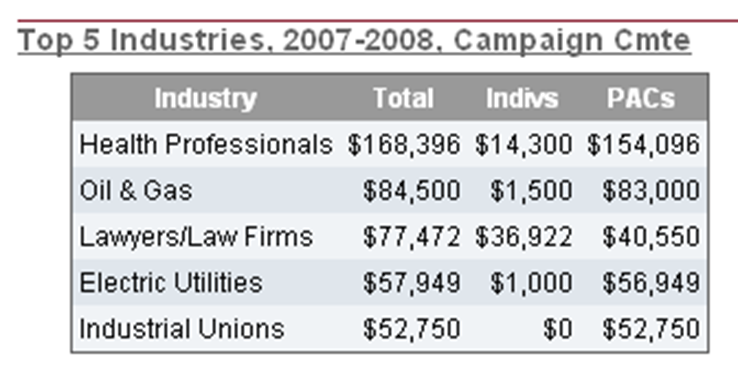
Ok– time to put on our tin foil hats for a moment– but one explanation these actions is that when Gene Green is talking about his “area”, he really means the five refineries and “more chemical plants than (he)  can count” inside his district.  Green received significant campaign contributions from both the Oil & Gas and Electric Utilities industries.  Check out the following chart from OpenSecrets.org:

genegreenchart

To put these numbers in perspective, Green spent a total of $860,643 on his last campaign.  Of that, $139, 949 came from the same folks Green is now trying to score free pollution credits.

If that weren’t enough, it looks like the refineries don’t even know their own business.  They claim that paying for carbon will hurt them and force refining to markets like China who aren’t regulating their environment.  Well, first, a new economic analysis shows that “Cap and Trade Won’t Push Heavy Industries Overseas”.  Second, on what planet does it make economic sense to pump oil out of Texas, ship it literally halfway around the world to China, refine it, and then ship it back?  You would need a PRETTY hefty price on carbon to make that economically feasible.  And lastly, China is beginning to implement export taxes on steel and other carbon intensive products, making it even more unlikely that refining would ever move there.

Bottom line: Green can’t have his cake and eat it too on this one.  He can either protect the families in his district by supporting a full auction of pollution credits that puts the revenue to work in renewable energy, energy efficiency programs, and rebates, or he can fill the pockets of polluters by demanding free carbon giveaways.

And, I do need to give Green some props– he is sponsoring the Fair Elections Now Act, which would create a public financing system for Congressional campaigns, freeing him forever from having to raise money from the fossil fuel industries or other special interests whose views may not coincide exactly with the greater good of the people of the 29th congressional district.  We can only hope for such a world– we know Gene Green has to raise money for his campaigns, he certainly can’t get it from the working class people of his district, and we know that when special interests give it is not out of the kindess of their hearts but because they want access and influence.

Read Full Post »

According to a Bloomberg article this morning, San Antonio Representative Charlie Gonzalez has joined

a group of Democrats on the House Energy and Commerce Committee (who) want to give utilities free permits for all their existing carbon emissions, according to people familiar with a plan sent to the committee’s chairman.

The article continues:

Representative Rick Boucher of Virginia sent the four-page list of recommendations to Henry Waxman, the committee’s chairman and the author of draft climate-change legislation that some of his fellow Democrats are seeking to temper, said the people, who declined to be identified before the plan is made public. Courtney Lamie, Boucher’s spokeswoman, didn’t respond to e-mail and phone messages.

Waxman’s measure would establish a cap-and-trade system of pollution credits designed to cut carbon dioxide 20 percent from 2005 levels by 2020. He needs to win the support of Boucher and the other Democrats pushing for changes in his plan because no Republicans are likely to vote for it, Representative Gene Green, a Texas Democrat, said yesterday.

“It’s all about the consumer,” said Representative Charles Gonzalez of Texas, whose San Antonio-area district has oil and gas operations. “It’s also the economic interests of a member’s district or region.”

Charlie Gonzalez just doesn’t have his facts straight on this one.  If you’re really concerned about consumers, giving away pollution credits for free is about the worst way you can write this bill.  Giving away allowances would force customers to pay for industry and utilities’ right to pollute without even cutting carbon emissions.  There is a right and a very wrong way to write a good climate change bill, and Charlie is supporting the wrong way.

EPA’s most recent analysis say that giving away pollution credits is “highly regressive”, meaning it hurts low-income families the most.  At best, this is a bailout and a free ride for the polluters.  At worst it will create windfall profits for huge energy companies at the expense of every lower and middle income family in Texas.  However, an auction fixes these problems.  EPA continues:

“Assuming that the bulk of the revenues from the program are returned to households, the cap-and-trade policy has a relatively modest impact on U.S. consumers. . . . Returning the revenues in this fashion could make the median household, and those living at lower ends of the income distribution, better off than they would be without the program

A good climate change bill will create billions of dollars of revenue by charging large polluters for the dangerous pollutants they’ve been emitting for decades.  This money could then be returned to taxpayers, particularly low-income households, to protect them from any price increases that energy industries may try to pass through to consumers.  Another portion of the money could also be used to pursue aggressive energy efficiency programs, so that citizens can save even more money by using less electricity.  Every dollar spent on energy efficiency will then also help reinvigorate local economy by putting people back to work doing energy audits and retrofitting inefficient homes.

Congressman Charlie Gonzalez needs to hear that what consumers really need is energy efficiency, renewable energy, lower electric bills and less pollution — not more industry giveaways.  So far, it looks like he’s only heard from the lobbyists for the big polluters.  We’ve heard that  Congressman Gonzalez will cast a deciding vote on whether Texans will be given the tools to forge a new, green economy, or left unprotected from the worst effects of extreme weather and high energy prices.

Congressman Charlie Gonzalez is the swing vote on this issue.  Please pick up the phone and call him.  The phone number for his DC office is (202) 225-3236 and his office in San Antonio is (210) 472-6195.  You can also email his office from his website

Read Full Post »

shockingNEWSFLASH!  Carbon Dioxide emissions may represent a threat to public health or welfare.

Shocking, I know.  But what is old news to the rest of us, released in the form of a proposed endangerment finding by the EPA, is actually a really big deal.  Environmentalists and concerned citizens alike have been waiting years for this announcement.  In 2007, as a result of the landmark Supreme Court case Massachusetts v. EPA, the court ordered the EPA administrator to determine if greenhouse gas emissions could “cause or contribute to air pollution which may reasonably be anticipated to endanger public health or welfare.”  The Bush Administration delayed reacting to this order, but Friday EPA Administrator Lisa Jackson signed a proposed endangerment finding which identified six global warming gasses that pose a threat to human health.

The finding will now enter a 60-day comment period, and have no immediate regulatory effect, but could give the EPA power to regulate CO2 under the Clean Air Act.

According to the EPA’s official statement,

Before taking any steps to reduce greenhouse gases under the Clean Air Act, EPA would conduct an appropriate process and consider stakeholder input. Notwithstanding this required regulatory process, both President Obama and Administrator Jackson have repeatedly indicated their preference for comprehensive legislation to address this issue and create the framework for a clean energy economy.

After years of global warming being the elephant in the room that the government would not address, the EPA’s proposed finding finally gives the agency the ability to take action on climate change — though as stated, everyone would rather Congress take care of business.  Hopefully, this finding will light a fire under cap-and-trade negotiations.

Its kind of like when my mother used threaten that she’d clean my room herself if I didn’t get cracking — which I knew meant she would just come in with a trash bag and clear everything out.  The EPA could straight up regulate carbon dioxide — but few people would really be happy with the result, most environmentalists included.  By creating new policy, Congress is simply better equipped to deal with our greenhouse gas emissions than the EPA.

So sorry Congress — no more reading the comics you found with the dust bunnies under the bed.  Go clean up, or Mom’s going to start vacuuming.

But don’t take my word for it.  Andy Wilson (Citizen Andy, if you will), Global Warming Program Director here at the Texas Office, wrote a statement on how this finding relates to the big picture, and Texas specifically.  Check it out!

Read Full Post »

And so it begins….

We knew as soon as there was a draft climate bill that it would be falsely attacked and derided disingenuously as “an energy tax.”  But we had no idea to what extent the truth-stretchers would go to make their rhetorical points.

Did I say stretch the truth?  I meant break, beat, spit upon and then toss it into a cesspool to be feasted upon by worms and vermin, for as little as truth means to these lying liars.

Wednesday, Keith Olbermann named John Boehner his “Worst Person in the World” for his exaggeration lie about the costs of tackling carbon.  Watch this video for yourself:

This is just the tip of the iceberg.  At least some people are willing to check their facts and talk about climate in a rational manner.  Look, a Press Release! (emphasis added is mine, not in original)

‘Energy Tax’ Rhetoric Ill Serves Debate on Climate Legislation

Republican members of Congress have taken to calling cap-and-trade legislation an “energy tax” or a “light switch tax” on American families and businesses.

Most recently, congressional Republicans misrepresented a Massachusetts Institute of Technology study analyzing cap-and-trade proposals. They distorted the study’s conclusions to exaggerate the costs of cap-and-trade legislation on individual households, by making faulty calculations based on erroneous assumptions and by ignoring a basic principle of economics – the time value of money.

Conservatives, of all people, should not ignore basic principles of economics. (more…)

Read Full Post »

Public Citizen will be testifying on nearly three dozen bills today during committee meetings in the House and Senate.  You can watch the action in the House or the Senate by going to the individual committees.  Be sure to tune in to our 10am Press Conference on a coal moratorium by clicking on the link to the Senate Press Room in the video feeds.  Links to the committees we’ll be testifying in all day today:

House Agriculture and Livestock 7:30 am

Senate Business and Commerce  8am  (where most of the solar bills will be heard)

Senate Natural Resources 1pm (including the coal moratorium)

House State Affairs 1pm

Also, if you’re looking for something to do today, come down and show your support for solar energy, the coal moratorium, or any of the other over 30 bills we’ll be testifying on.

For those of you interested in some light reading, I highly reccomend Forecast: The Global Conseqeunces of Climate Change by Stephen Faris.  As an international correspondant, he has seen how the conflict in Darfur began as a conflict over resources, and how the wildfires of Australia have decimated the countryside.  This is just a taste of things to come in a world of disrupted and rapidly changing climate.  The following excerpts are available:

Part 1: The Florida Keys are sinking

Part 1: Can insurance cover the costs of climate change?

Part 1: Who will be able to afford to live on the coast?

Part 2: Pathogens find new habitats

Part 2: Countries could backslide into poverty

Part 2: How disease relates to carbon dioxide

Part 3: Easier passage through the Arctic

Part 3: A scramble for control of the Arctic

Part 3: Opening the Arctic to damage

Also, for anyone who missed it, an article in today’s Washington Post about the EPA qietly delivering to Obama a finding that carbon dioxide is a dangerous pollutant,(like we needed the EPA to tell us that) opening the door for states to regulate emissions standards for cars, permitting of CO2 in power plants, etc.

Read Full Post »

picture-201Over the past several months, researchers at the Good Company have been compiling a report to measure our own University of Texas’ emissions.  Last week the results were announced…. We’ve got big feet.

Thereport showed that UT’s total carbon emissions were a 292,434 metric tons of carbon dioxide equivalent in 2006.  Emissions sources not required by the traditional registries are estimated to be an additional 238,237 metric tons.  The vast majority of these emissions were from natural gas consumption, which totaled 233,839 metric tons of CO2.

The release of this information is an important step to be accountable for our greenhouse gas emissions. Says Assistant Director of the Campus Environmental Center and Public Citizen’s own, Druscilla Tigner:

It was exciting!  This was a fantastic opportunity for the University of Texas to really stare its problems in the face, and pinpoint exactly what they need to do to reduce its impact on the environment.  It’s a concrete jumping point for the campus sustainability movement.

picture-151For me, one of the most interesting aspects of the report was a measure of the green house gasses emitted by a typical UT student to determine the per student carbon footprint.  The report offered two general categories of students. (more…)

Read Full Post »

« Newer Posts - Older Posts »

Follow

Get every new post delivered to your Inbox.

Join 3,169 other followers